Su Filindeu…World’s Rarest Pasta

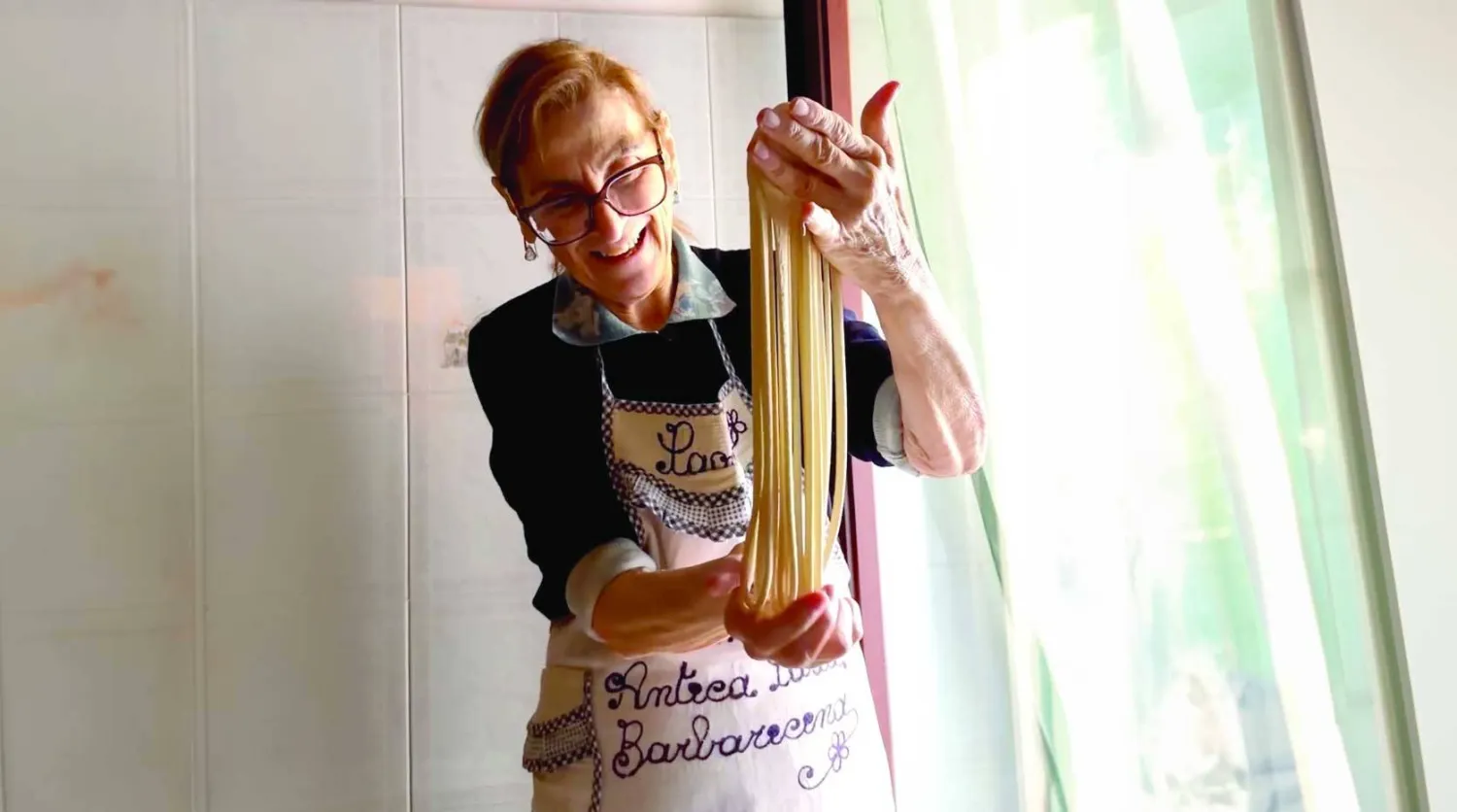
A woman wearing glasses and an embroidered apron pulls and stretches pasta dough into numerous thin strands (The New York Times)
TT

Su Filindeu…World’s Rarest Pasta

A woman wearing glasses and an embroidered apron pulls and stretches pasta dough into numerous thin strands (The New York Times)

Sardinia: Matt Goulding

In the mountains of Northern Sardinia, a 300-year-old pilgrimage comes with a serving of the world’s rarest pasta.

The name tells you all you need to know about the significance of Sardinia’s most elusive pasta: su filindeu, the threads of God. Of the more than 350 officially recognized shapes of pasta in Italy, this is considered the rarest.

Paola Abraini is one of only a handful of people who still know how to make su filindeu. “To lose this tradition would be like losing a piece of our identity,” she said.

Stretched by hand, a single ball of dough is converted into 256 gossamer strands that are stretched across a drying rack called a fundo in a triangular pattern, to evoke the Holy Trinity.
She holds up the circular board covered in a grid pattern with the pasta strands.

It’s a meticulous process that has proven difficult to pass down to younger generations. Every detail of su filindeu matters, including its relationship with its Mediterranean environs. “When it is dried in the sun it becomes light and golden,” said Abraini.

Twenty years ago, Abraini was among the last custodians of the vanishing foodway. But her tireless work as a teacher has helped bring it back from the brink of extinction.

For most of its centuries-long history, su filindeu was a tradition passed down through a single line of matriarchs from Nuoro, a town in the mountainous interior of the island. In fact, Abraini came to learn the intricate craft from her mother-in-law at 16.

Whereas most handmade pasta in Italy is rolled out with a wooden dowel called a mattarello, every pass of su filindeu dough halves the width and doubles the number of strands. Do that eight times and you end up with the requisite 256 threads.

Such finesse requires a not-so-secret ingredient: salt, which tightens the network of gluten in the flour, giving the dough the elasticity required to stretch so thin.

It’s not a recipe that can be read and recreated by enterprising cooks in kitchens abroad; the technique must be felt in the flesh, learned through repetition and error until the fingertips know the difference between just right and just wrong.

To master it requires mastering many variables, including the effect of hard water versus soft water, when to add the salt solution, how to adjust to the weather.

This level of dedication has made younger generations of local women reluctant to take up the practice.

Many have come to Nuoro to learn but few have succeeded at the intricate craftwork. Even the pasta barons of Barilla, the world’s largest pasta company, couldn’t crack the code for these noodles.

Su filindeu is closely bound to its home in the north of Sardinia, a sparsely populated tableau of verdant flora and sheer stone, hearty food and strong beliefs.

Much of the island’s history and culture have been defined by isolation, nowhere more so than Nuoro, which Grazia Deledda, the 1926 Nobel Prize-winning writer who grew up there, called “the most cultured and combative town on the island.”

At the heart of that culture is a biannual Catholic pilgrimage, which begins in the church of Rosario di Nuoro in May and October.

Some of the town’s oldest, and youngest, citizens make the trek.

At midnight on May 1, hundreds of pilgrims set out from Nuoro. Together they traverse over 20 miles of mountainous terrain to the church of San Francesco di Lula.

Some travel in groups of family and friends, telling stories and trading gossip deep into the night. Others prefer a solitary journey of reflection through the darkness.

Orange light peeks out from behind a mountain as the sun rises, a small forest in the foreground.

The first groups of pilgrims arrive at San Francesco di Lula shrine just as the sun rises above the limestone crest of the Monte Albo massif — a spiritual journey now illuminated.

Local lore has it that a bandit back in the 17th century was falsely accused of murder. After being exonerated, he built a church outside the village of Lula and dedicated it to Saint Francis of Assisi, defender of the poor and steward of nature.

The overnight journey evokes a wide range of emotions in Sardinia’s pilgrims — joy, hope, solemnity and catharsis.

The pilgrims endure the journey and the community responds with restorative hospitality: water and coffee, a footbath, and eventually, a bowl of pasta.

Ask five pilgrims why they make the journey, and you’ll get varied answers: For faith. For pride. For a loved one. For exercise. And, of course, for pasta.

One thing that most pilgrims agree on: this is as good as su filindeu gets. For centuries, it was served exclusively at San Francesco di Lula. But recently a few restaurants in Sardinia started to serve the pasta outside of the pilgrimage.

Context is everything, though. Eaten any other time, the dish doesn’t taste the way it does after an overnight mountain hike. It’s the effort that matters — both in the making of the pasta and the pilgrimage to eat it.

Sheep, many of which live in those same mountains, outnumber humans two to one on Sardinia. They play a central role in island culture and cuisine — including as the base for the su filindeu broth.

It takes a village to make the dish, but the division of kitchen labor at San Francesco di Lula is clear: men make the broth, and women cook (and bless) the pasta.

Soft cubes of sheep’s milk cheese are stirred into the broth just before serving. The final creation is more delicate than the sheep-on-sheep treatment would suggest — aromatic, gentle, almost sweet.

For three centuries, the pasta and the pilgrimage have been inexorably connected.
The power of the pilgrimage is found in the balance between solitude and community, sacrifice and hospitality, pain and pleasure.

Seated at the long communal tables, some of the pilgrims have consumed dozens of bowls of su filindeu over the course of decades. Others are just beginning their journey.

The New York Times


UK Endures Second Big Storm of the Weekend, with the North Bearing the Brunt This Time

People walk through heavy rain in Liverpool, Britain, 24 October 2026. (EPA)
TT

UK Endures Second Big Storm of the Weekend, with the North Bearing the Brunt This Time

People walk through heavy rain in Liverpool, Britain, 24 October 2026. (EPA)

The second of two storms to hit the UK this weekend brought widespread travel disruptions and power outages to Scotland, Northern Ireland and northern England on Sunday.

The Met Office, the UK's national forecaster, said Storm Boelo will bring a danger to life from flying debris and crashing waves and people should stay indoors as much as possible.

Gusts above 80 mph (128 kph) have already been recorded in Scotland, including on the island of Tiree in the Inner Hebrides. Energy company SSEN had reported a total of 93 unplanned power cuts in Scotland by 10 a.m.

An amber wind warning, the Met Office’s second most severe, is active across Scotland and the north of England until late Sunday. Flood warnings are also in place, while airports, ferries, railways and roads have seen disruptions.

Boelo, pronounced “Boo-Loh”, has followed hard on the heels of Storm Austen, which battered southern England on Friday. The National Grid, which distributes electricity around the UK, said power had been restored to more than 130,000 properties impacted by Austen by 7 p.m. on Saturday.

The Met Office began naming major storms in 2015 as a way to keep the public informed about severe weather. Storms are named in alphabetical order throughout the season, from September to August.


Ensnared Female Orangutan and Her Baby Rescued in Indonesia

A 20-year-old orangutan tries to escape as members of the BKSDA (Natural Resources Conservation Agency), the Borneo Orangutan Survival Foundation (BOSF) and the World Wide Fund for Nature (WWF) Indonesia evacuate it due to forest and land fire, in Hampangen Village, Katingan Regency, Central Kalimantan, on October 17, 2026. (AFP)
TT

Ensnared Female Orangutan and Her Baby Rescued in Indonesia

A 20-year-old orangutan tries to escape as members of the BKSDA (Natural Resources Conservation Agency), the Borneo Orangutan Survival Foundation (BOSF) and the World Wide Fund for Nature (WWF) Indonesia evacuate it due to forest and land fire, in Hampangen Village, Katingan Regency, Central Kalimantan, on October 17, 2026. (AFP)

Indonesian conservation workers rescued an orangutan ensnared in rope and her baby on the island of Borneo where the critically endangered animals are at risk from boar traps and wildfires, an official said Sunday.

The female orangutan named Gadis, about 25 years old, and her son Garis, 10 months, were found snared in a suspected trap early Friday near a village in Central Kalimantan province on the Indonesian part of Borneo.

"Gadis was found with the ropes tied to her upper right arm and lower left arms, and the wounds were bad because the ropes had torn deep into her flesh," local conservation official Muriansyah told AFP by telephone on Sunday.

"It looked like the ropes were set up as a wild boar snare trap," added Muriansyah, who like many Indonesians has one name.

Both were receiving treatment at the Orangutan Foundation International clinic near the village of Pangkalan Bun.

Wild boar hunting using rope snares is legal and common in parts of Indonesia as a pest control measure to protect crops, but illegal inside protected forests or national parks.

Officials have repeatedly cautioned that careless placement of snares near wildlife areas could instead trap endangered sun bears or orangutans.

Dozens of orangutans have also been rescued in recent weeks from rampant wildfires burning across Indonesia that have cloaked the Southeast Asian region in a toxic haze.

Two more were released in Ketapang, West Kalimantan on Saturday after being rescued from an oil palm plantation.

Orangutans are critically endangered and only about 120,000 remain in the wild in Borneo and Sumatra -- about half the number from a century ago, according to conservation group WWF.

Last month, the International Union for Conservation of Nature said fires were burning in habitats containing 52 percent of Borneo's orangutan population.


Cracking a Smile Regularly May be Good Not Just for Your Mood but for Your Health

FILE - A fan attends the performance by American singer Jon Batiste at the Rock in Rio music festival in Rio de Janeiro, Sept. 7, 2026. (AP Photo/Bruna Prado, File)
TT

Cracking a Smile Regularly May be Good Not Just for Your Mood but for Your Health

FILE - A fan attends the performance by American singer Jon Batiste at the Rock in Rio music festival in Rio de Janeiro, Sept. 7, 2026. (AP Photo/Bruna Prado, File)

Reminding yourself to smile often cannot only make more friendships but it can also make you feel better.

And rather than wait for a reason to smile, just making the physical change of literally turning that frown upside down could impact emotions, according to experts.

Research backs up the fact that smiling goes a long way.

Some older research has focused on this “facial feedback hypothesis,” according to Jeanne Tsai, a longtime psychology professor at Stanford University who runs the Culture and Emotion Lab. In one classic study in the late 1980s, researchers would have subjects put a pencil between their lips and adopt a smile or a frown while viewing a positive movie clip like a cartoon. Some subjects who smiled would feel the sensation of the smile more and be more amused.

“When we’ve done that demonstration in classes, it works,” Tsai said. “When you’re doing it in a room by yourself, you’re not doing it in a social interaction, maybe it’s making you remember, or it’s an effect of remembering some good thing that happened and that would put you in a better mood.”

At the Orange County Academy of Sciences and Arts in Southern California, the power of a smile is taken very seriously. An entire section on the charter school group’s website is dedicated to its philosophy that a smile can make a difference.

“Smiling creates a supportive classroom culture that makes students relaxed, active, and motivated,” according to the website. “It increases emotional well-being, lowers stress, and gives students confidence.”

How smiling can benefit health Dr. Judy Ho, a Los Angeles clinical and forensic neuropsychologist who also teaches at Pepperdine University, discusses smiling as a coping strategy with some patients suffering depression or anxiety.

“I'm not suggesting that that's the only way they can fix things,” Ho said. “It's just like another thing that you can add to your toolbox.”

Smiling can affect one's level of cortisol, a hormone the body releases partly to help regulate stress and mood, according to Ho. Smiling can affect brain chemicals that are associated with positive feelings including endorphins, dopamine and serotonin.

“People who smile during stressful tasks generally demonstrated lower heart rates during recovery than those maintaining neutral expressions,” Ho said. “Smiling also reduced aspects of the body's physiological stress response.”

The hope is if you smile enough, you will start feeling it emotionally.

“In some ways it's like a mediating effect,” she added.

The value of a smile varies culture to culture How smiling and even the openness of a smile are perceived are not universal. Tsai, the Stanford professor, has conducted research on how emotion in American culture puts value on trying to always feel positive and minimizing negativity and sadness. In East Asian cultures, emotion is more about balance.

“It’s like the positive and the negative emotions are braided together, and so you don’t want to feel too positive or too negative,” Tsai said. “You want more of a balance between the two.”

Her past studies also examined how European Americans and East Asians — including Taiwanese, South Koreans, Japanese and Hong Kong Chinese — look at a “neutral or a calm” smile versus a full-on grin. Subjects rated the differing facial expressions on warmth and trustworthiness. While some Americans saw the excited smiles as friendlier, some East Asians characterized those facial expressions as “emotionally unstable” or “unreliable."

“What kind of smile matters — whether it’s a calm, closed mouth smile more like the Dalai Lama or a big toothy excited smile like Julia Roberts,” Tsai said. “We’ve done some series of studies in Taiwan and other East Asian contexts. They don’t like the big, toothy, excited smile unless it’s really situationally appropriate.”

In Thailand — known as “The Land of Smiles” — smiling is embedded in the culture. There are nearly 30 Thai words for “smile.” Many teach-abroad programs where people can teach English as a foreign language in Thailand cite that smiling often with children and colleagues is key to showing respect, good manners and calmness.

At the OCASA charter schools, smiling is part of an effort to make children feel seen.

“I’ve always believed in wanting school to be a happy place for kids,” said RaNae Posey, principal of OCASA Capistrano Elementary School. “To actually help them form habits of looking at the bright side of things.”

Mandating smiles may lead to more frowns Women in recent years have smacked down the idea that they have to smile in the workplace while men do not. Smiling can feel like a Catch-22 for some women and sometimes for people of color who may be stereotyped as unapproachable or cold if they don’t smile enough.

Last year, retailer Target was ridiculed across social media for instituting a smiling policy. Workers had to smile and make eye contact if a customer was within 10 feet (3 meters) and personally greet them if they were within 4 feet (1.2 meters).

People do not like feeling like they have no “emotional autonomy,” according to Nicholas Coles, an assistant professor who runs the Social Science Collaboratory at the University of Florida in Gainesville.

“In those scenarios, what we find is that it’s more that you’re smiling your way to misery,” Coles said. “It’s only when it feels authentic and voluntary that I think it’ll have any real effect.”

With the holidays approaching, more people may have to muster smiles with family if sensitive topics like politics and religion come up. Those could be good times to see if smiling helps.

“If we were able to just smile and be like ’Look, this is somebody that historically cares about you and loves you,' maybe that would change the way that we respond to them even in a moment of tough conversation,” Ho said.