


For Sale on Facebook: Monkeys, Rhino Horn and Dead Pangolins

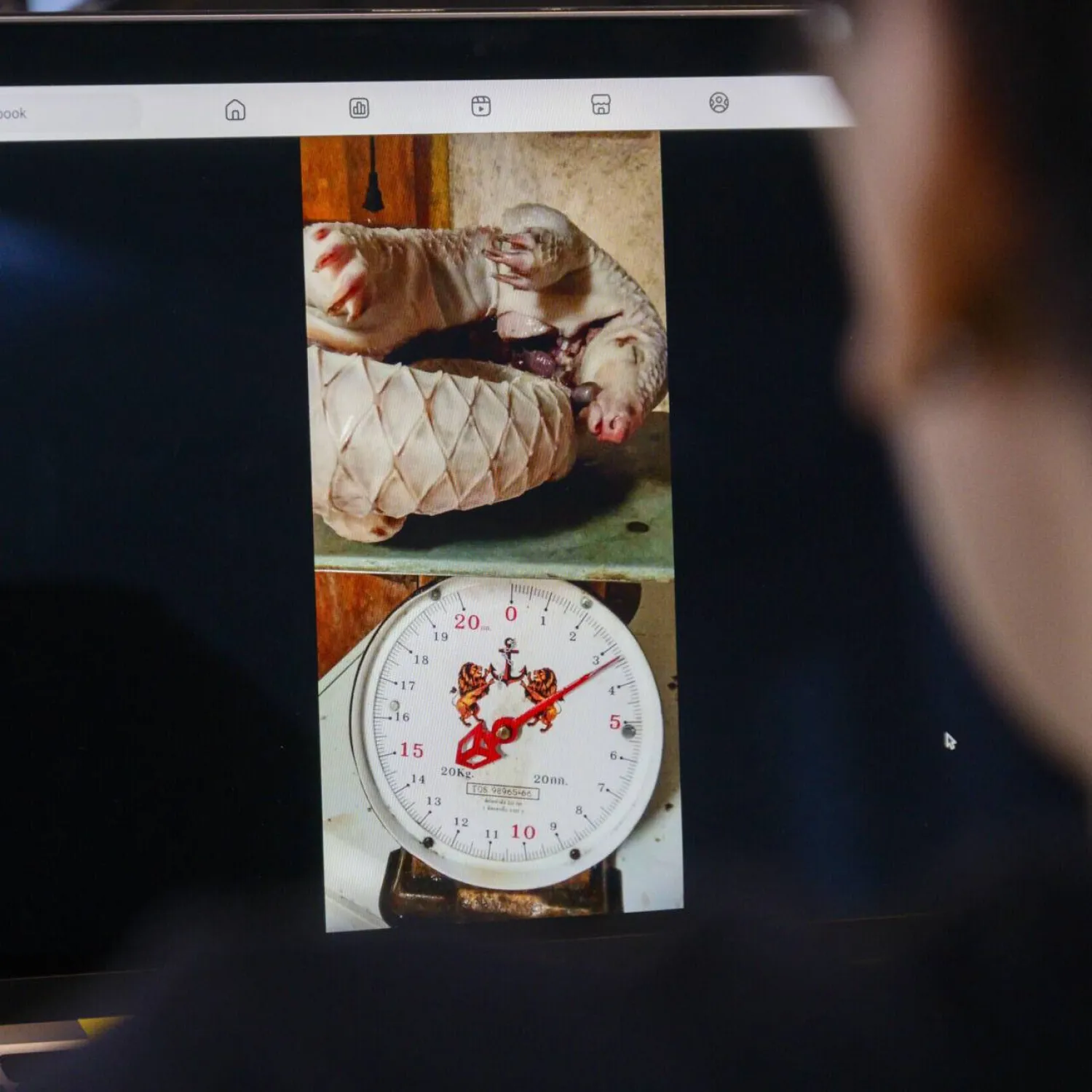
A Facebook post offering a dead pangolin curled up on a weighing scale for sale. STR / AFP
TT

For Sale on Facebook: Monkeys, Rhino Horn and Dead Pangolins

A Facebook post offering a dead pangolin curled up on a weighing scale for sale. STR / AFP

The ghostly white creature curled up on a weighing scale is almost unrecognizable in the Facebook post offering it for sale. Only closer inspection reveals it to be a dead pangolin.

The animal, one of the world's most endangered and trafficked mammals, has been stripped of its scales and is being advertised by a Thai account selling "seasonal wild delicacies".

The post is one of dozens reviewed by AFP that illustrate what conservationists call rampant illegal wildlife trafficking across social media platforms, particularly those belonging to Facebook parent company Meta.

A report by several NGOs released Monday accuses Meta of hosting the world's "largest single known illegal wildlife trade market" and effectively encouraging the trade by sharing advertising revenues with users and allowing them subscription models.

The report follows recent research by the Global Initiative Against Transnational Organized Crime (GI-TOC), which warned Facebook is now "the central public infrastructure through which online wildlife trafficking is being concentrated, discovered and scaled".

Meta declined to respond to questions from AFP, and pointed to policies that restrict the sale of endangered species on its platforms.

But conservationists say those policies have done little to prevent Meta's platforms being used for the illegal wildlife trade.

The GI-TOC research found over 20,000 adverts for more than 260,000 wildlife products on social media platforms between April 2024 and March 2026.

Nearly three-quarters were on Facebook, and many remained up even after being reported, said Russell Gray, a data scientist and ecologist who co-authored GI-TOC's April report.

"Even the unredacted accounts and groups we reported on publicly in the report are still live and active," he told AFP.

'Mindboggling'

Conservationists and wildlife experts said that was common.

"I have not once received a response or seen any action taken," said Tom Taylor, chief operating officer of Wildlife Friends Foundation Thailand.

"Accounts that are openly breaking the law should be closed, and investigations into the criminal activities behind them should be launched."

Conservationists argue Meta is not only failing to remove content that violates its policies, but may effectively be encouraging it by allowing popular accounts to monetize content through advertising revenue and subscription models.

"This content monetization that Facebook and Instagram push is actually incentivizing people to commit illegal acts," said Daniel Stiles, an independent wildlife trafficking investigator.

"The more interaction and engagement they get on their account, the more money they can make," added Stiles, who co-authored the report released Monday by NGOs including Freeland, Education for Nature Vietnam and International Wildlife Trust.

Meta does not make public which accounts are in its content monetization programs.

But those enrolled in its subscription program are publicly identifiable, and include an account apparently in Laos purporting to show poaching of wildlife including pangolins.

"How Meta can allow that is mindboggling," said Stiles.

'Lip service'

Animals and wildlife products are offered across Meta platforms, including Facebook, Instagram and WhatsApp, research shows.

But other platforms, including TikTok and Snapchat -- popular because of its disappearing post settings -- are also increasingly used by traffickers.

AFP reviewed examples offering everything from chimpanzees intended as pets to rhino horn for traditional medicine and pangolins for consumption.

Some of the content is oblique -- vendors often post images of animals or parts for sale without any price or explanation. Interested commenters are told to message them directly.

But much of the content is clear, including a public Facebook account offering dead pangolins, monitor lizards and other protected wildlife for consumption in Thailand.

The algorithmic nature of social media platforms means that users who engage with wildlife trafficking accounts are offered more.

After reviewing just a handful of public accounts advertising illegal wildlife trade, an AFP journalist's Facebook feed began routinely displaying posts selling wildlife and endangered animal parts.

Meta was among 11 tech firms that announced this month they would work to eliminate wildlife trafficking on their sites.

But the company has been a member of the Coalition to End Wildlife Trafficking Online since 2018, and the problem has continued to grow, said Steve Galster, founder of Freeland.

He warned the latest announcement risked being "more lip service".

"Until Meta is compelled to rid its platforms of illegal wildlife trade, and prove that it is not profiting from it, the online wildlife trade will only get worse."



UK Met Office: El Nino to be 'Biggest for Over a Century’

FILE PHOTO: The London skyline is seen with the financial district in the background, in London, Britain, March 25, 2026. REUTERS/Isabel Infantes./File Photo
TT

UK Met Office: El Nino to be 'Biggest for Over a Century’

FILE PHOTO: The London skyline is seen with the financial district in the background, in London, Britain, March 25, 2026. REUTERS/Isabel Infantes./File Photo

This year's El Nino weather pattern will be the biggest in over a century, warming sea surface temperatures to an "unheard-of" level, Britain's national weather agency predicted Friday.

The El Nino weather pattern is declared when sea temperatures in the tropical eastern Pacific rise 0.5C above the baseline average, triggering worldwide changes in winds, atmospheric pressure and rainfall patterns, and causing warmer global temperatures overall.

Adam Scaife, head of long-range forecasting at the Met Office, told the BBC that "We are expecting the biggest El Nino for over a century, peaking at something over three degrees -- that is unheard-of in modern climate records."

According to AFP, he called it "an unprecedented event", adding that "I have never seen an El Nino signal this intense in our forecasts."

The anomalous warmth, which is "up to nearly two degrees already,” will have particularly strong effects throughout the Tropics, Scaife said, "where we expect really severe droughts in places like South America, and the West Pacific.”

Temperatures in the region are currently running about 2.6C above a rolling 30-year average, according to the Climate Brink dashboard.

"These are not short-term weather forecasts. We're talking about really long-term, persistent conditions here. There are well-known impacts on other systems including food, food security," said Scaife, a physicist who specializes in climate modelling.

The weather pattern is also expected to cause "increased rainfall and storminess in the autumn here in the UK around November time,” Scaife said.


Europe’s Hottest Town Says Climate Change Is Reshaping Daily Life

A drone view of the Sicilian town of Floridia where five years ago a temperature of 48.8 degrees Celsius, the highest temperature officially registered in continental Europe, was recorded, Italy, August 19, 2026. (Reuters)
TT

Europe’s Hottest Town Says Climate Change Is Reshaping Daily Life

A drone view of the Sicilian town of Floridia where five years ago a temperature of 48.8 degrees Celsius, the highest temperature officially registered in continental Europe, was recorded, Italy, August 19, 2026. (Reuters)

Five years after Floridia registered Europe's highest-ever temperature, residents say extreme heat is no longer measured by records but by its impact on daily life, keeping people indoors, reducing social interaction and threatening livelihoods.

The August 2021 record of 48.8 degrees Celsius (119.8 degrees Fahrenheit) turned the Sicilian town into a symbol of Europe's warming climate as the continent emerged from COVID-19 restrictions.

Today, increasingly frequent and prolonged heatwaves are driving people indoors, leaving streets and piazzas deserted and prompting some residents to compare the extreme heat to a new form of lockdown.

The shift is visible across the town of 20,000 on the outskirts of Syracuse, the ancient Greek city on Sicily's southeastern coast. Piazza del Popolo, long Floridia's social hub and lined with cafes, palm trees and municipal buildings, is nearly empty for much of the day.

The ‌heat lingers well ‌into the evening, disrupting a cherished local tradition known as "pigghiari u frescu", when families pull ‌kitchen ⁠chairs outside their ⁠homes to catch the breeze and socialize.

"It's awful because many people end up shut indoors. In a way, we are all experiencing another kind of lockdown," Floridia's culture councilor Serena Spada told Reuters.

"Even people with small children find themselves in this situation. Children cannot go to the park or play outside because, until late afternoon, temperatures are genuinely hostile."

A WARNING THAT DID NOT GO AWAY

On August 11, 2021, Sicily's Agrometeorological Information Service (SIAS) measured a temperature of 48.8 C in Monasteri, a rural district about 5 km (3 miles) from Floridia's center. In 2024, the World Meteorological Organization certified it as the highest temperature ever recorded in continental Europe, a mark that still stands.

"As ⁠I walked, I began struggling to breathe and thought: 'I could die here in the street, ‌with no one around to help me'," said resident Ugo Tomasello.

Many residents assumed ‌the record would prove an isolated event. Instead, hot summers became the norm.

"It turned out to be a very sad warning ‌sign," Spada said.

While the temperature record drew international attention, climate scientists say individual extremes are less significant than the steady ‌rise in average temperatures.

Reuters Climate Monitor data showed Floridia reached 33.3 C (92 F) on August 12, 2026, 4.1 C (7.4 F) above the average for the 1961-1990 historic norm.

"It is really the increase in average temperatures that worries us," SIAS director Luigi Pasotti said.

"We are no longer talking about extreme temperature peaks lasting one or two days, as happened in 2021. We are talking about entire weeks, even months ‌during which temperatures remain consistently high."

Night-time temperatures are climbing too, leaving little respite from the daytime heat.

"This year in particular, we are recording exceptionally high numbers of tropical nights in ⁠some parts of Sicily, as ⁠well as super-tropical nights," Pasotti said.

FOR BEEKEEPERS SUMMER HAS BECOME A SEASON TO DREAD

Across Europe, climate change has been linked to increasingly frequent and intense weather extremes, from drought and wildfires to torrential rainfall.

Sicily has emerged as one of Europe's climate frontlines.

In January, Cyclone Harry produced a record 16.66-meter (55-foot) wave between Sicily and Malta. Wildfires have taken a growing toll with the island accounting for roughly 70% of southern Italy's burned area between January and July, according to a Legambiente analysis based on EFFIS-Copernicus data.

Agriculture, a pillar of the island's economy, is increasingly vulnerable to climate change.

In 2021, more than 3,000 beehives were lost in the area of Floridia and honey production plunged by 80%.

"The decline in bee populations and the number of beekeepers, together with the loss of pollinators due to climate change and the widespread use of pesticides, is leading to a reduction in biodiversity and lower quality and yields in agricultural production," agronomist Francesco Bellomi said.

For beekeepers in Floridia, summer has become a season of anxiety.

"There's much more concern about getting through the summer than there used to be," said beekeeper Francesco Pappalardo, 33, who began working with his father as a child.

"The heat can cause individual colonies to collapse and sometimes entire apiaries can be lost, as happened to me in previous years."


A Question Looms Over Harry’s Return to the UK. Can He Rebuild His Relationship with Prince William?

Britain's Prince William and Britain's Prince Harry walk beside each other after viewing the floral tributes for the late Queen Elizabeth II outside Windsor Castle, in Windsor, England on Sept. 10, 2022. (AP)
TT

A Question Looms Over Harry’s Return to the UK. Can He Rebuild His Relationship with Prince William?

Britain's Prince William and Britain's Prince Harry walk beside each other after viewing the floral tributes for the late Queen Elizabeth II outside Windsor Castle, in Windsor, England on Sept. 10, 2022. (AP)

The royal family’s long-running American soap opera is returning to Britain. The question is whether it will blossom into a happy reunion or descend into anger, division and chaos.

Prince Harry and his wife, Meghan, plan to return to the United Kingdom from California in a matter of weeks. They have already enrolled their children, Prince Archie, 7, and Princess Lilibet, 5, in British schools so they can start the autumn term with their classmates.

News of the surprise decision, which broke late Wednesday in stories published by the Telegraph and Sun newspapers, has sparked widespread discussion about where the couple will live, who will pay for their security and whether they will return to royal duties one day.

But perhaps the most difficult issue is whether Harry can repair his once-close relationship with Prince William, the heir to the throne, which was decimated by Harry’s very public complaints of mistreatment at the hands of Buckingham Palace staff, racism in the royal family and the failings of the monarchy. There are also concerns that Harry and Meghan could try to upstage William and his wife Catherine, when they once again share the British stage.

“That will be something for the palace to deal with ...” Craig Prescott, an expert on the UK constitution and the monarchy at Royal Holloway University of London, told The Associated Press. “They wouldn’t want Meghan and Harry’s presence in the UK here to overshadow the work of the monarchy, and there will have to be some discussion and allowance for that.”

Harry and Meghan wanted their children to grow up British

The couple are expected to live at a private, nonroyal residence outside of London and they won’t resume their royal duties, which they gave up when they moved to the exclusive Southern California community of Montecito six years ago, British media reported late Wednesday.

Their return to the UK comes as King Charles III, Harry’s 77-year-old father, continues to undergo treatment for an undisclosed form of cancer that was discovered in 2024. The prince said last year that he didn’t know “how much time my father has left,” and has expressed a desire for his children to have a chance to get to know their grandfather.

While Harry and Meghan’s decision is a surprise to many, royal historian Ed Owens said recent events created a pathway for the couple's return.

First, Harry spoke of his desire for reconciliation, then there was the apparently successful meeting between the king, his younger son and daughter-in-law and their children last month at Charles’ Highgrove estate in western England.

In addition, there is Harry’s stated desire for his children to grow up British and that the UK looks like a safer place to be right now, given the divisions in American society, said Owens, author of “After Elizabeth: Can the Monarchy Save Itself?”

Royal experts expect Charles to forgive Harry

Finally, Owens said he expects Charles to forgive Harry because as the supreme governor of the Church of England he has to demonstrate the teachings of Christianity, including the virtue of forgiveness.

William may find forgiving his brother more difficult, but someday he too will become head of the church, Owens said.

“It may be that privately William never fully forgives his younger brother for what he deems the betrayal of the family,” Owens told The AP.

“But publicly,” he will, “because for traditional moralists, traditional Christian values, they demand that there is this public act of forgiveness, that there’s reconciliation between the brothers.”

Charles was informed of Harry and Meghan’s plans on Sunday and the matter wasn’t discussed during their recent visit to the UK.

Relations have been strained in the House of Windsor

Relations between Harry and Meghan and the rest of the royal family have been strained since the couple gave up their royal duties and moved to California in 2020 to earn their own living. The couple later signed lucrative contracts with Netflix and Spotify.

The rift deepened after the couple gave a series of interviews and Harry published his explosive memoir “Spare,” in which he said they left Britain to escape the restrictions of royal life. The couple also criticized palace officials for being insensitive to Meghan’s mental health and alleged at least one member of the royal family had expressed racist views when she was pregnant with their first child. Meghan describes herself as biracial.

Oprah Winfrey asked Harry to summarize his reasons for leaving Britain in a 2021 interview that was broadcast around the world.

“Lack of support and lack of understanding,” he replied.

Strains are exacerbated by long-running battles with the newspapers

Those tensions were exacerbated by Harry’s long-running legal battle with Britain’s tabloid newspapers, which he alleges illegally hacked his phones and invaded his privacy when he was younger. The courtroom drama seemed to be nearing an end after Harry and other plaintiffs lost their lawsuit against the publisher of the Daily Mail last month.

That case left Harry facing a potential bill for millions of pounds after the court ruled the plaintiffs were liable for the publisher’s legal fees. Associated Newspapers has filed documents showing that its costs amounted to 34.5 million pounds ($47 million).

Harry has also been embroiled in a legal wrangle with the British government after a government committee refused to authorize police protection for him and his family when they are in the UK. The prince says they need armed police protection because they are at risk as members of the royal family, regardless of whether they are working royals.

The couple’s security arrangements are a “private matter” for Harry and Meghan to deal with, Prime Minister Andy Burnham said when asked about the issue on Thursday.

After Harry lost his court challenge of the committee’s decision in May 2025, the prince said he hoped to reconcile with his family while continuing to vent his anger at those in Britain he feels have mistreated him and his wife.

“I can’t see a world in which I would be bringing my wife and children back to the UK at this point,” he told the BBC at the time. “And the things that they’re going to miss is, well, everything. You know, I love my country. I always have done, despite what some people in that country have done.”

Although much of the media attention on Harry and Meghan has focused on family tensions and recriminations in recent years, Owens suggested that the story may now shift to the royal’s efforts to rebuild family harmony.

“I think time is a great healer. It creates space in a social media-saturated world,” he said. “People are always looking for the next thing to talk about and, arguably, that will be reconciliation between first of all father and son, and then potentially the two brothers.”