

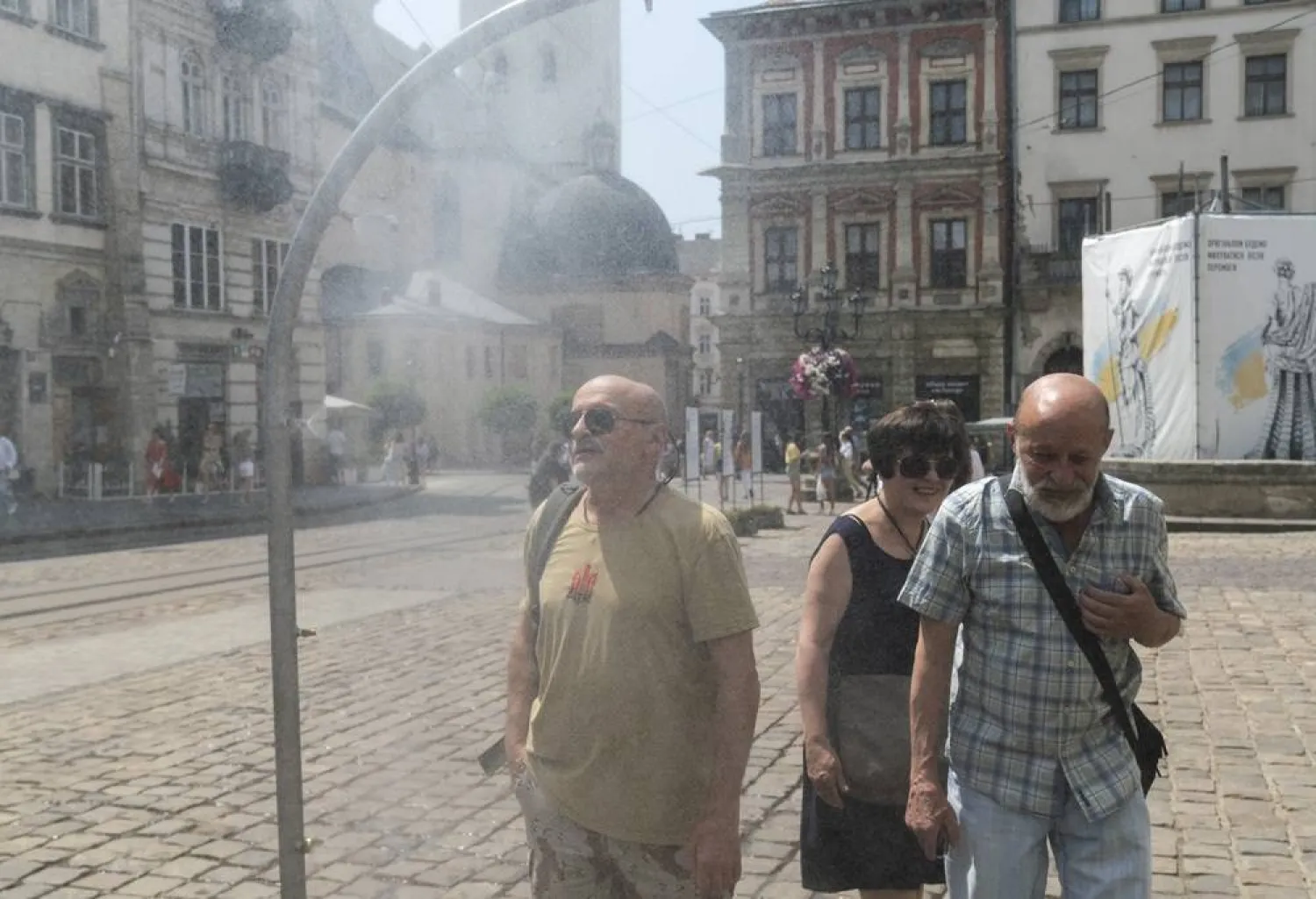

Europe’s Deadly Heatwave Scorches Eastern Flank, Takes Aim at Ukraine

People cool themselves with water sprayed from a special sprayer set up on a sidewalk during a hot day in Lviv, Western Ukraine, 29 June 2026. (EPA)
TT

Europe’s Deadly Heatwave Scorches Eastern Flank, Takes Aim at Ukraine

People cool themselves with water sprayed from a special sprayer set up on a sidewalk during a hot day in Lviv, Western Ukraine, 29 June 2026. (EPA)

The most severe heatwave ever recorded in Europe roasted central and eastern parts of the continent on Monday as Ukraine's war-ravaged power grid struggled to cope with the shock of scorching heat.

The heatwave first smothered western Europe last week, sending temperatures to record highs and straining hospitals, transport networks and power grids on a continent where infrastructure was not built to withstand punishing heat and where air conditioning is not widespread.

More than 1,300 excess deaths were recorded in Europe since June 21, according to the UN health agency, including several small children who died in locked cars and youths who drowned as they sought relief from the infernal temperatures in unsupervised swimming spots.

France reported at least 74 drowning deaths since June 18 and Poland said 17 drowned on Sunday alone.

"I'm doing the same thing as everyone -- trying to stay in the shade and drink a lot of water," Susanne, a Vienna resident, told AFP on a bank of a river near the Austrian capital.

"I just hope that the politicians will understand the situation and will begin to set a course in the right direction," she said.

On Monday, the Balkans braced for temperatures of up to 40C, with firefighters in Bosnia battling blazes sparked during the heat.

At least 130 million people in Europe were expected to swelter through temperatures of more than 35C, down from 190 million on Sunday according to an AFP analysis.

This heatwave is the most severe ever recorded in Europe, and would have been "virtually impossible" this early in the summer without climate change, the World Weather Attribution group of scientists said.

All-time temperature records have been broken in Germany, Poland and the Czech Republic, as well as for the month of June in the UK and in Switzerland.

- New shock for Ukraine -

Ukraine's energy network, already pummeled by Russian attacks over more than four years of war, was buckling under the high temperatures on Monday.

In the western Rivne region, authorities introduced emergency power outages to ease pressure on the grid as temperatures passed 36C as of 15:00 (1200 GMT), according to data from the state Hydrometeorological Centre.

The central Khmelnytsky region also announced temporary outages, and five other regions -- from Ivano-Frankivsk in the west to Zaporizhzhia on the front line in the south -- warned households and businesses to be prepared for blackouts on Tuesday.

The state weather service said the country would face "intense heat", with temperatures of 35C-38C expected, though this is some way off the national record of 42C recorded in August 2010.

"The heat is also a serious test for equipment that has been operating under wartime conditions for more than four years and has withstood numerous attacks," Sergii Kovalenko, CEO of the Yasno energy company said over the weekend.

He said that summer was the peak period for repairing the energy network, battered through the winter by repeat Russian attacks, meaning the grid was already "operating at the limit of its capabilities".

- Record temperatures -

Over the weekend, the heat scorched the Czech Republic, Germany and Poland, with the countries setting new temperature records of 41.9C, 41.7C and 40.5C, respectively.

The Berlin police used water cannons to help residents of the capital cool off for a second day running Sunday -- this time at the Olympia venue where singer Bruno Mars was performing.

With temperatures cooling in France, the national weather service said on Sunday evening it was already anticipating the possibility of another heatwave in July.

The scorching heat has sparked lively discussion in some countries about the merits of air-conditioning, which is used far less in Europe than in some parts of the world.

The EU on Monday refused to be drawn into the increasingly politicized debate, with a Brussels spokeswoman saying the bloc did not have "a particular view or position" on the matter.



Curtain Falls on the Romance of India's Single-screen Cinemas

Researchers estimate that India had around 14,000 single-screen halls in the 1980s. Only around 2,000 remain today. Idrees MOHAMMED / AFP
TT

Curtain Falls on the Romance of India's Single-screen Cinemas

Researchers estimate that India had around 14,000 single-screen halls in the 1980s. Only around 2,000 remain today. Idrees MOHAMMED / AFP

The demolition has begun at Bengaluru's Urvashi Cinema, once a 1,200-seat movie palace where generations of filmgoers cheered and whistled, another casualty of India's vanishing single-screen era.

"The theater came up in the 1970s... I was so happy when it opened," said Manjunath, watching as seats were ripped out and strewn outside.

Manjunath, who uses one name, recalled its glory days, when the shop he runs opposite was packed with customers buying snacks before and after shows.

"That was the rush... now I have a lot of free time," he said. "But what to do? There is barely any crowd."

The peeling facades, faded signs and cavernous auditoriums of such cinemas are remnants of a time when going to the movies was itself the main event.

"It is a completely different experience," said photographer Hemant Chaturvedi, 58, who has documented what remains during a seven-year odyssey, photographing 1,350 single-screen cinemas across 1,000 towns.

His photographs capture not only the movie houses but their ornate facades and decay -- a record of a cultural landscape disappearing as cinemas are demolished, converted into multiplexes or left to crumble.

- 'Ecosystem is fading' -

"People would be cheering, jumping on the seats, even throwing money at the screen," Chaturvedi said.

The old halls offered a collective, interactive experience, with fans applauding at the hero's entrance, clapping to romantic songs and shouting at dramatic twists.

"Now that old ecosystem is fading, and the charm is being lost," he said.

India's single-screen cinemas have been steadily squeezed by multiplexes, streaming, rising property costs and the expense of maintaining ageing buildings and equipment.

Researchers estimate that India had around 14,000 single-screen halls in the 1980s. Only around 2,000 remain today.

Many of the old halls could accommodate around 1,000 people, creating a communal atmosphere rarely found in today's multiplexes.

The decline has also changed the way Indians experience films. New halls offer air conditioning, reclining seats and food delivered to the seat.

"To me, the new cinemas have lost the charm," said Chaturvedi, a former Bollywood cinematographer who worked on hit movies during a three-decade career.

"The multiplexes are a generic, cold experience."

- 'Old times' -

Some of the old cinemas have been restored and renovated, and the single-screen experience still has its devotees.

In Bengaluru, Mukunda Cinemas still draws crowds -- even for early-morning shows before work.

Hundreds lined up before dawn for a recent 6:00 am screening of the latest release of film star Yash, who is hugely popular in India's Kannada-language cinema.

Santosh, a 47-year-old businessman who uses one name, queued with hundreds of others as crowds set off fireworks outside while waiting for the show.

"Only in the single screen theaters can they take the cinema to the next level, it increases the tradition of cinema," Santosh said, as cheers and whistles reverberated through the packed hall before the film began.

Veerain Reddy, the third generation of his family running the 50-year-old theater, said maintaining the establishment "was not an easy task".

Inflation, rising costs and "so much competition" have made business tough.

"But people who are really passionate are still trying to maintain these single-screen theaters, where people come to watch and celebrate cinema," he told AFP.

Another survivor in Mumbai -- formerly known as Bombay -- is the Regal Cinema, an Art Deco hall that opened in 1933.

"The rest of them feel very artificial, commercial, very blingy," said 23-year-old fan Vanshika. "But Bombay has little places which remind us of the old times."


GEA Chairman Announces October 21 Launch for Riyadh Season 2026

Turki Alalshikh, Chairman of Saudi Arabia’s General Entertainment Authority (Asharq Al-Awsat)
TT

GEA Chairman Announces October 21 Launch for Riyadh Season 2026

Turki Alalshikh, Chairman of Saudi Arabia’s General Entertainment Authority (Asharq Al-Awsat)

Chairman of the Board of Directors of the General Entertainment Authority (GEA) Turki Alalshikh announced that Riyadh Season 2026 will open on Wednesday, October 21, featuring a 10-week program of championships, concerts, performances, and entertainment experiences, the Saudi Press Agency reported on Saturday.

Alalshikh made the announcement in a promotional video previewing the season's sporting, entertainment, and arts events, which he said would reinforce Riyadh's standing as a destination for premier events and audiences from around the world.

The seventh edition's lineup includes world-class boxing and wrestling matches, UFC bouts, and the Six Kings Slam tennis tournament, alongside concerts, theatrical and comedy performances, and events designed for children and families.

Boulevard World returns as one of the season's principal zones, gathering global cultures and destinations in a single location, while Boulevard City opens with new content and Wonder Garden offers a range of rides and activities. Other zones and events include The Groves, the Farmers' Market, and the Ana Arabia exhibition at VIA Riyadh, with further programs spread across multiple locations in the capital.

The season runs under the theme "Big Time," drawing visitors from Saudi Arabia and abroad.


New Road Lanes Open in Makkah to Ease Congestion, Aid Pilgrims

The expansion includes an additional 1.5-kilometer stretch on the Third Ring Road connecting the Prince Mutib intersection to the Grand Mosque intersection via the Prince Sultan intersection - SPA
TT

New Road Lanes Open in Makkah to Ease Congestion, Aid Pilgrims

The expansion includes an additional 1.5-kilometer stretch on the Third Ring Road connecting the Prince Mutib intersection to the Grand Mosque intersection via the Prince Sultan intersection - SPA

The Royal Commission for Makkah City and Holy Sites has opened traffic on several newly developed lanes along the Third Ring Road and Prince Saud Al Faisal Road, reducing travel times by more than 90%.

The expansion includes an additional 1.5-kilometer stretch on the Third Ring Road connecting the Prince Mutib intersection to the Grand Mosque intersection via the Prince Sultan intersection, SPA reported.

Traffic flow was also inaugurated on the final section of Prince Saud Al Faisal Road, linking the Prince Mohammed bin Salman axis to Abdulqadir Koshak Street through the Prince Naif bin Abdulaziz intersection.

These openings are part of integrated infrastructure projects designed to ease traffic congestion, improve road safety, and streamline access for residents, visitors, and pilgrims during the Hajj and Umrah seasons.