


Lebanon-Israel Deal May Entrench Stalemate Rather Than End War, Analysts Say

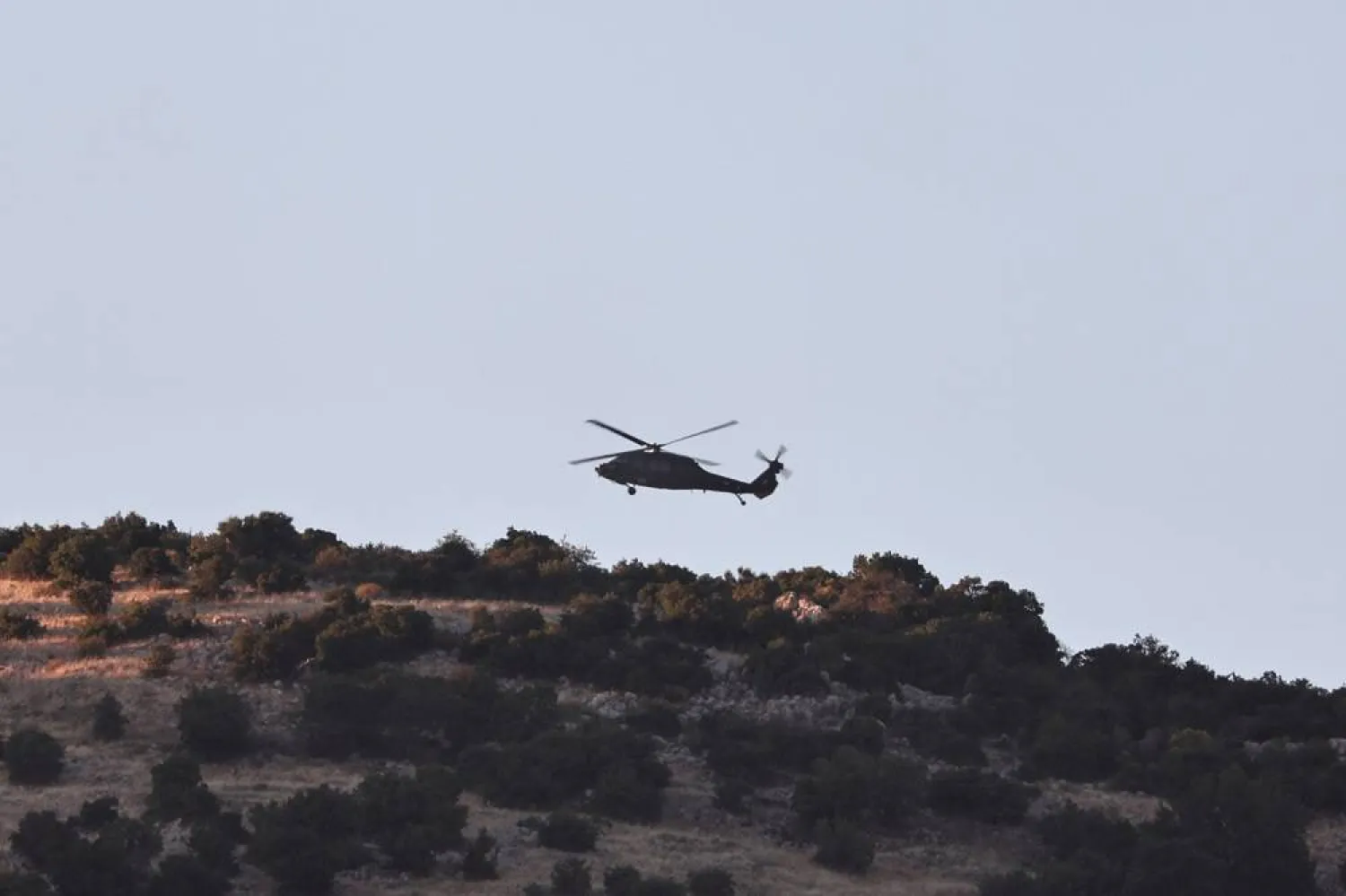
An Israeli helicopter flies on patrol near the Israel-Lebanon border, 23 June 2026, amid a ceasefire between Israel and Hezbollah. (EPA)
TT

Lebanon-Israel Deal May Entrench Stalemate Rather Than End War, Analysts Say

An Israeli helicopter flies on patrol near the Israel-Lebanon border, 23 June 2026, amid a ceasefire between Israel and Hezbollah. (EPA)

A security deal between Lebanon and Israel risks entrenching a stalemate rather than resolving Israel's underlying conflict with Hezbollah by tying Israel's pullout from southern Lebanon to the Iran-aligned group's disarmament, a condition regional analysts and politicians say is unattainable.

At its core is a bargain few see as workable: Hezbollah has flatly rejected disarmament, and no Lebanese government has the power to enforce it.

With Hezbollah unlikely to disarm, analysts say Israel has political cover to keep an open-ended military presence in southern Lebanon, which it invaded after Hezbollah fired at Israel on March 2 in solidarity with Tehran over the war in Iran.

The deal leaves the Lebanese state trapped between obligations it cannot meet and sovereignty it cannot fully reclaim, the analysts say.

The framework deal also collides with Lebanon’s political realities, asking a fragile sectarian state to confront the most powerful armed faction in the country despite a post–civil war system built on power-sharing rather than coercion.

"This is not an agreement, it is an imposed settlement," said a senior Lebanese politician who ‌declined to be ‌named, according to Reuters.

The Lebanese army, he said, was neither structured nor equipped to disarm Hezbollah, and expecting it ‌to do ⁠so ignored both the ⁠group’s entrenched military capacity and the fragile sectarian balance on which Lebanon's stability rests.

'BURDEN' PLACED ON LEBANON

Political analysts say the imbalance is built into the agreement’s design, with sweeping obligations placed on Lebanon but no reciprocal guarantee of Israeli withdrawal.

"This agreement has put all the burden on Lebanon," said Michael Young, a Beirut-based analyst, adding that it "creates a structure that allows the Israelis to remain (in southern Lebanon) indefinitely."

Fawaz Gerges, a Lebanese scholar at the London School of Economics and Political Science, said the deal was "born dead" and is structurally flawed, hinging on a condition that is impossible to meet in practice.

Gerges said Israel had already occupied a buffer zone in southern Lebanon about eight to 10 km (five to six miles) deep while tying any future withdrawal to Hezbollah’s ⁠disarmament.

The terms of the deal risk the buffer zone becoming long-term and giving it diplomatic legitimacy, he ‌said, describing it as a political "gift" to Israel.

The conflict in Lebanon has been a ‌central part of diplomacy towards ending the wider US-Iran war.

Gerges said Washington’s deliberate decoupling of the conflicts gave Israel greater freedom of action in Lebanon.

FEAR OF ‌CIVIL CONFLICT

The framework agreement signed in Washington affirms that Israel has no claim to Lebanese territory and makes Lebanese army authority in the ‌south contingent on the verified disarmament of non-state armed groups, including Hezbollah.

Israeli Prime Minister Benjamin Netanyahu portrays the deal as a historic achievement that could lead to broader peace, while Israeli troops remain deployed in a so-called security zone which Israel says is designed to protect its north from potential attack.

"We will continue to hold it (territory in the security zone) until Hezbollah and other terrorist organizations are disarmed, and until no further threat to Israel is posed from Lebanon," Netanyahu said on Saturday.

Three senior Israeli ‌officials said Israel has little faith in Lebanon's ability to disarm Hezbollah but sees the deal as a vital diplomatic step towards building peace with Lebanon in the long run.

About 4,000 people have been ⁠killed in Lebanon and a ⁠million displaced during Israel’s military campaign against Hezbollah.

Lebanese President Joseph Aoun welcomed the agreement as a first step towards restoring Lebanon's sovereignty, saying it should allow Lebanese people to return to fully liberated land.

Parliament Speaker and key Hezbollah ally Nabih Berri said it amounted to an "agreement of dictates, not one that preserves Lebanon's rights" and said it would not be implemented.

Hezbollah chief Naim Qassem declared the deal "null and void" and a "surrender" and said his group would keep fighting until Israel is forced to leave. Hezbollah lawmaker Hassan Fadlallah warned of "internal conflict" in Lebanon.

Any attempt to forcibly disarm Hezbollah would risk deepening sectarian tensions.

Young said the deal "won't lead us anywhere except to civil conflict, and maybe an insurrection by the Shiite community."

DEAL'S IMPLEMENTATION IN QUESTION

Danny Citrinowicz, a regional analyst and former Israeli military intelligence officer, said Hezbollah's dismantlement was "something that would never happen" and the deal in effect legitimized an open-ended Israeli military presence.

"Nothing will happen. Israel won't withdraw, and Hezbollah won't dismantle," he said.

Citrinowicz said no Israeli prime minister has the domestic political space to withdraw while Hezbollah is still armed and northern Israeli communities remain displaced.

A narrower pact focused on Hezbollah's pullout from south of the Litani River, an expanded Lebanese army deployment and an extension of state authority, would have stood a better chance of success, he said.

Pro-Hezbollah analyst Mohammed Obeid also said the deal was unlikely to be implemented, adding that its provisions were "like explosives", capable of detonating Lebanon's internal stability, as they hinge on state action to disarm Hezbollah.

Mazen Al-Sudairi Brings Financial Expertise as Saudi Market Expands Globally

Mazen bin Turki Al-Sudairi (Asharq Al-Awsat)
TT

Mazen Al-Sudairi Brings Financial Expertise as Saudi Market Expands Globally

Mazen bin Turki Al-Sudairi (Asharq Al-Awsat)

Mazen bin Turki Al-Sudairi will lead the board of Saudi Arabia’s Capital Market Authority after a royal order appointed him chairman with the rank of minister, as the kingdom’s capital market rapidly expands, deepens its offerings, strengthens ties with global markets and seeks to attract more foreign investment.

Al-Sudairi brings a career rooted in financial markets and investment before moving into government and policymaking, combining technical expertise in market analysis with institutional experience inside government.

His appointment comes as Saudi Arabia’s capital market enters a new phase of growth focused on greater depth and openness, a broader investor base and a stronger presence in global markets, alongside the economic and investment transformation under Saudi Vision 2030.

The royal order appointed Al-Sudairi chairman of the Capital Market Authority’s board with the rank of minister, succeeding Mohammed El-Kuwaiz. He takes charge of the market regulator as the financial sector assumes an increasingly important role in financing economic growth and attracting domestic and international capital.

Since 2024, Al-Sudairi has served as an adviser at the General Secretariat of the Council of Ministers at an excellent grade, adding a government dimension to his background in finance and investment. The role broadened his experience from analyzing markets and investments to working in an environment closely connected to policymaking and decision-making.

He holds a master’s degree in finance from HEC Paris in France and a bachelor’s degree in industrial engineering from King Saud University, an academic background combining financial knowledge with the analytical and quantitative training associated with engineering.

Al-Sudairi has extensive experience in financial services and capital markets. He served as head of research at Al Rajhi Capital, where he monitored company and sector performance and analyzed economic and financial developments and their impact on investor decisions.

He also headed sell-side research at Al-Istithmar Capital, adding experience in managing investment research and responding to market developments and investor needs during a period of rapid regulatory and investment change in the Saudi market.

Earlier, Al-Sudairi worked as an analyst covering the energy and petrochemicals sectors at Samba Capital, two of the most influential sectors in the Saudi economy and capital market. The role gave him direct experience analyzing companies and industries exposed to energy markets, global developments, commodity prices and economic cycles.

His career also took him outside Saudi Arabia, where he worked in equity research at Bank Degroof in Belgium. The experience added an international dimension to his background and gave him practical exposure to market and company analysis in a European financial environment.

Al-Sudairi is a recognized name in financial research and market analysis, having built experience across Saudi and international financial and investment institutions. His roles have been closely tied to assessing markets, analyzing companies and sectors, and evaluating investment opportunities.

His career spans financial and economic analysis, investment research and government work. After years of leading research functions at Saudi financial institutions and analyzing equities and sectors, his move into government added experience in institutional work and policymaking.

Al-Sudairi takes the helm of the Capital Market Authority’s board as the market becomes increasingly important as a channel for financing companies and projects, supporting private-sector growth, expanding savings and investment options, and connecting the Saudi economy more closely with global capital flows.


From War Amnesty to Prison Amnesty... What Has Changed in Lebanon in 35 Years?

A general view of parliament building in Beirut, Lebanon, March 24, 2026. (Reuters)
TT

From War Amnesty to Prison Amnesty... What Has Changed in Lebanon in 35 Years?

A general view of parliament building in Beirut, Lebanon, March 24, 2026. (Reuters)

The Lebanese parliament's landmark approval of an amnesty law on Wednesday, 35 years after the 1991 amnesty, has revived debate on the different circumstances that prompted Lebanon to resort to amnesty twice.

While the first was enacted to turn the page on the 1975-90 civil war and kick off a new political chapter in the country, the 2026 law came to address the conditions of detainees and convicts, prolonged detentions, and the prison crisis, amid political considerations that led to parliament to ratify it.

‘Public oblivion’

Former Minister of Social Affairs Rashid Derbas brought the discussion back to the philosophy of amnesty itself, telling Asharq Al-Awsat that "the general amnesty issued in 1991 came following the civil war, in hopes of closing a chapter and entering a new era."

He explained that "the philosophy of general amnesty is fundamentally based on establishing public oblivion, meaning closing a page of the past and opening a new one."

Commenting on the current amnesty law, Derbas wondered: "Is it reasonable for a person to remain all this long time without a trial? Is it reasonable for certain accusations and cases to drag on to this extent? It was necessary to address this issue,” but unfortunately, it fell victim to political wrangling for years.

Former Justice Minister Ibrahim Najjar drew a legal and political distinction between the two experiences, telling Asharq Al-Awsat that "there is a very big difference between the law of August 26, 1991, and the law of August 12, 2026."

He explained that "from a political standpoint, the 1991 general amnesty law aimed to turn the page on the war and conclude all prosecutions associated with it. This is evidenced by the fact that it broadly covered crimes committed before March 28, 1991, specifically war-related crimes of a political nature, with some specific exceptions."

Najjar added that "the 1991 law therefore had a political, reconciliatory character, meaning it aimed to restore the smooth functioning of coexistence, which was its primary political goal."

As for the new legislation, he placed it in a different framework, stating that "the 2026 law has specific political dimensions in Lebanon and Syria, in addition to being related to prison conditions and the high number of detainees and convicts."

Najjar stressed that "the law issued on Wednesday is not a general amnesty for crimes committed before a specific date, because it targets specific categories and cases. It is closer to a socio-penal law concerned with addressing the conditions of detainees and convicts through an exceptional reduction of certain sentences."

He pointed out that "the 2026 law excluded many crimes and felonies, including the killing of military personnel, crimes referred to the Judicial Council, premeditated murder, money laundering, financial crimes, and drug felonies."

"This Lebanese law has clear Syrian dimensions, and it has also benefited some Lebanese who had sought refuge in Israel," he added.

Lebanese lawmakers attend a parliamentary session to discuss a proposed general amnesty law, the abolition of the death penalty and the salaries of retired members of Lebanon's security forces in Beirut, Lebanon, 11 August 2026. (EPA)

Political settlement

Former MP and Minister Butros Harb interpreted the current law from an angle that combines politics and humanitarian considerations.

Speaking to Asharq Al-Awsat, Harb stated: "In part, the current amnesty is a political settlement more than a purely judicial move, even though it includes a humanitarian aspect that cannot be ignored."

At the same time, he stressed that addressing the conditions of prisoners should not lead to "overlooking the rights of the Lebanese Army and its victims, particularly in cases related to those who engaged in clashes with it."

He explained that "there is a humanitarian aspect that must be taken into account, because the Lebanese judiciary was influenced at certain stages and did not exercise its powers with the required speed, whether in terms of settling cases or issuing verdicts."

He noted that "there are individuals who spent long periods in prison that, in some cases, exceeded the sentence that could have been issued against them had they been tried within normal timeframes."

This "demands a humanitarian and legal solution to the problem," he remarked.

However, he noted that the amnesty file "has also unfortunately turned into a subject of sectarian debates, especially regarding the cases of Islamists who fought the army."

Harb criticized the double standards related to the army in the ongoing debate. "Some of those who today declare their concern for the army were, unfortunately, among the forces that helped inflict major losses on it, whether during the Lebanese civil war or in the clashes the country witnessed in later years."

The issue must not turn into fodder for political debates at the expense of the army or the rights of its victims, he urged.

‘Fundamentally different’

He said the 1991 and current amnesty are "fundamentally different."

He explained that the 1991 amnesty happened during "exceptional political circumstances that followed the Taif Agreement" and the end of the civil war.

"At that time, Lebanon was emerging from a long war, and it was necessary to turn the page on that chapter and enter a new era allowing the rebuilding of the state. Therefore, the amnesty was part of a broader national political settlement."

"Today, however, the problem is different even if it has a political aspect because it is primarily linked to a judicial and humanitarian failure that must be addressed," Harb stressed.

"The issue required a solution because it is unacceptable for individuals to remain in prison for years due to delayed trials or the failure to settle their cases," he said.


Gaza Cancer Patients Face Rising Death Rate Amid Israeli Curbs, Doctors Say

Palestinian cancer patient Elham Al-Sakafi, 38, speaks to a doctor after receiving nutritional intravenous fluids at Al-Shifa Hospital in Gaza City, August 6, 2026, according to medics. (Reuters)
TT

Gaza Cancer Patients Face Rising Death Rate Amid Israeli Curbs, Doctors Say

Palestinian cancer patient Elham Al-Sakafi, 38, speaks to a doctor after receiving nutritional intravenous fluids at Al-Shifa Hospital in Gaza City, August 6, 2026, according to medics. (Reuters)

Gaza cancer patients are dying at two to three times the pace they did before the start of the war in the territory, as Israel blocks many from travelling for treatment after destroying the only local specialized facility, Gaza doctors said.

Israel blew up Gaza's specialized cancer hospital last year after saying troops found a tunnel used by Hamas running beneath it. That means that an estimated 17,000 Gazans with cancer have no local option for chemotherapy or other advanced therapy.

Few Palestinians can afford to travel for treatment, and those who can face Israeli restrictions. The military imposes strict caps on daily crossings to Egypt, despite a 2025 Israel-Hamas ceasefire deal that requires free movement in and out.

Asked for comment, COGAT, the Israeli military agency that controls access to Gaza, said it coordinates medical evacuations with the World Health Organization. To depart, Gazans must have a ‌valid request from a ‌receiving country and pass "required security screening," COGAT said.

The WHO did not immediately respond to a ‌request ⁠for comment.

RACE AGAINST TIME

For ⁠Khuloud Abu Sahmoud, a Palestinian mother-of-two with advanced ovarian cancer, the wait for treatment abroad has become a race against time as her cancer spreads.

"Every day my disease progresses, and my condition is tragic. My fingernails have all fallen out – I have none left. I am just waiting to die."

Abu Sahmoud, 33, said she has been waiting to exit Gaza for treatment in Egypt or further afield since the ceasefire was struck last October. In that time, the cancer has spread to her lungs and bones, she says.

COGAT said around 5,800 Gazans needing medical treatment have exited to Egypt since Israel agreed in February to a limited reopening of the Rafah border crossing, largely shut during the ⁠war that began in 2023.

"Medical evacuations are in no sense restricted by the State of Israel ‌but are wholly dependent on the receiving country's request; without the official request, ‌COGAT cannot coordinate a patient's leave," COGAT said.

Palestinian health officials said 11,000 people, including patients, had gone through Rafah since it reopened, fewer than half ‌the number that had been expected under the ceasefire deal.

A further 20,000 patients, including 5,000 with cancer, are registered for treatment ‌abroad but not yet permitted to leave, the officials said.

TOXIC CHEMICAL EXPOSURE

The ceasefire ended major fighting but left Israeli forces in control of more than half of Gaza, since expanded to around two-thirds. Nearly all of Gaza's more than 2 million people live in a Hamas-controlled strip along the coast, mostly in makeshift tents or shelters in damaged buildings.

Before the war, local health services had made advances thanks to investment from abroad and persistence ‌from local doctors, a Reuters investigation found.

But most Gaza hospitals were destroyed or damaged in the war, and those that remain operational have been stripped of up to 70% of essential ⁠medical supplies, including those needed ⁠for cancer treatment and diagnostic services, doctors said.

Among those killed by Israel during the war were dozens of highly qualified specialists, including cancer experts operating in the Turkish-Palestinian Friendship Hospital, demolished in an Israeli controlled demolition in March 2025.

"We have been recording a significant number of deaths, ranging from three to five daily, because patients are not receiving the chemotherapy needed to save their lives," said Mohamed Abu Selmia, head of Gaza's biggest hospital, Al-Shifa.

Sobhi Skaik, a Palestinian surgeon who was head of the Turkish-Palestinian Friendship Hospital, said the death rate before the war was about one to two per day. Some pre-war statistics put the figure at around 1.7 per day, he said.

He said the rising deaths were due mostly to an absence of local treatment and to border restrictions. But he also said that cancer itself may be spreading at a faster rate due to the presence of toxic materials from Israeli explosives dropped on Gaza.

There were some 11,000 registered cancer patients in Gaza before the war started following the October 7, 2023, Hamas attacks on southern Israel, after which registrations largely stopped, Skaik said.

He estimated that another 6,000 Gazans had likely developed cancer since.

"Some people can be treated if diagnosed in early stages, but they are wandering around the tents sick, unaware, and with no help," Skaik said.
