


Rare Dinosaur Fossil from Antarctica is Found Tucked Away in a Drawer

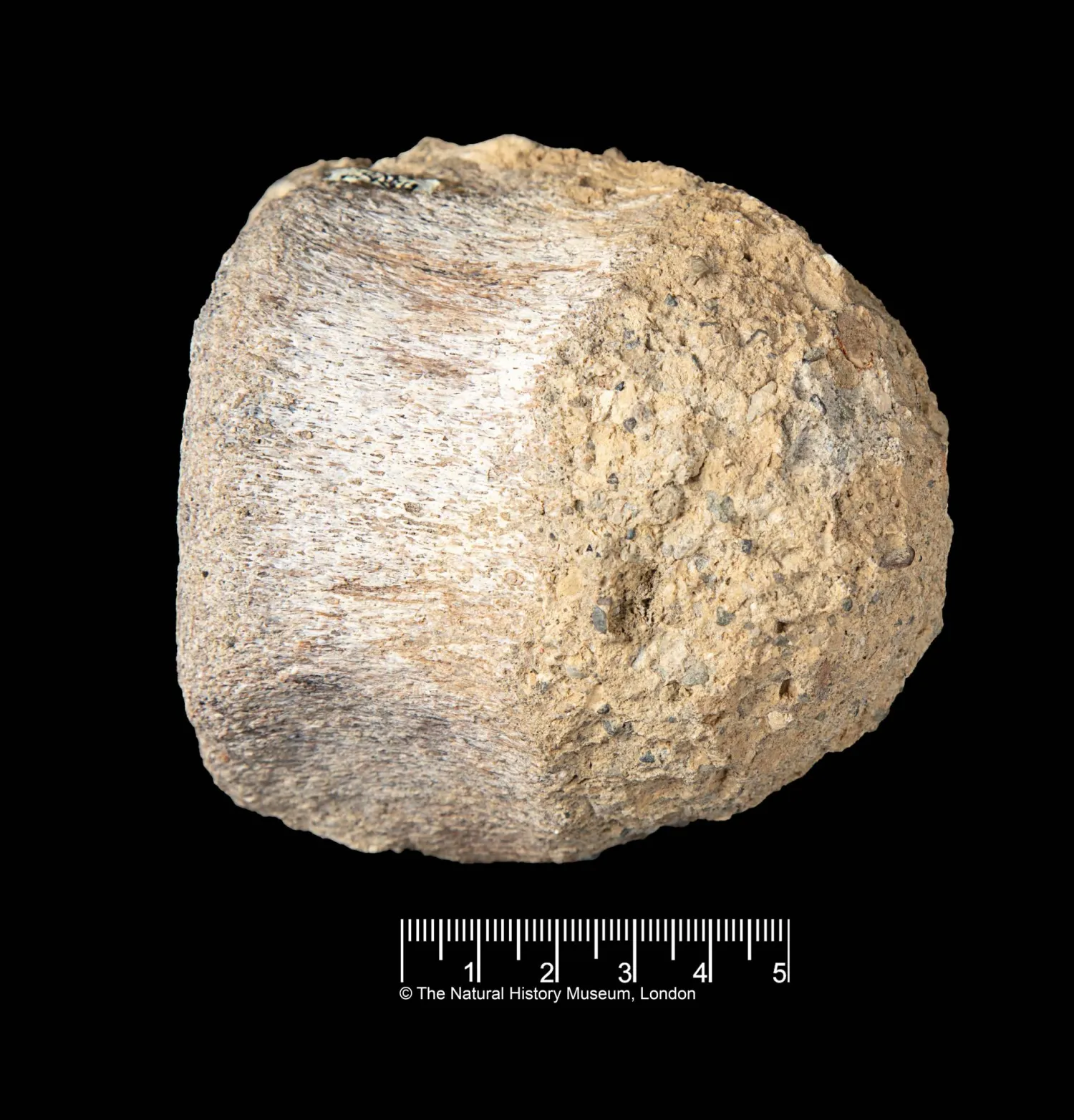
This image provided by the Natural History Museum shows a fossil found in Antarctica that belongs to a group of dinosaurs called titanosaurs. (Natural History Museum via AP)
TT

Rare Dinosaur Fossil from Antarctica is Found Tucked Away in a Drawer

This image provided by the Natural History Museum shows a fossil found in Antarctica that belongs to a group of dinosaurs called titanosaurs. (Natural History Museum via AP)

Scientists have stumbled on a rare dinosaur fossil from Antarctica, tucked away for decades in a drawer.

The bone comes from the tail of a long-necked, plant-eating dinosaur called a titanosaur. Scientists haven't yet identified the species it belongs to, The Associated Press reported.

It was discovered in 1985 during an expedition to Antarctica's James Ross Island and collected by geologist Mike Thomson. Working with the British Antarctic Survey, Thomson was mapping the area's rock layers and collected marine reptile fossils to help with future dating efforts. He recorded the find as a large reptile.

Decades later, paleontologist Mark Evans spotted the bone in the British Antarctic Survey's collections and wondered whether it might be a dinosaur.

He and other researchers analyzed the shape of the bone and compared it to other more complete dinosaur remains, confirming their discovery. The findings were published on Monday in the journal Acta Palaeontologica Polonica.

Dinosaur fossils are rare to find in Antarctica because of the unforgiving ice caps. But millions of years ago, when this dinosaur lived, the region was populated by lush forests — a “rather different and much more hospitable place than we think of today,” said study co-author Paul Barrett with the Natural History Museum in London.

At about 23 feet (7 meters) long, the dinosaur was small for its group and may have been young when it died. Scientists don't know how the creature met its end, but they think its body floated away from the coast and sank to the sea floor, becoming fossilized in marine rock.

Technology has come a long way since the dinosaur tail bone was first found, allowing researchers to peer inside bones and gain even more detailed information about ancient creatures. Thomson died in 2020 before the fossil was identified as belonging to a dinosaur.

“If he were still with us, he would be delighted to know what this was,” Evans, a study co-author, said.


GEA Chairman Unveils New Promotional Video for Riyadh Season 2026

The seventh edition of Riyadh Season kicks off on October 21. (SPA)
TT

GEA Chairman Unveils New Promotional Video for Riyadh Season 2026

The seventh edition of Riyadh Season kicks off on October 21. (SPA)

Chairman of the General Entertainment Authority (GEA) Turki Alalshikh unveiled a new promotional video for the seventh edition of Riyadh Season, creatively showcasing some of the experiences and events awaiting visitors from Saudi Arabia and around the world.

The video takes viewers on a journey through a number of Riyadh Season zones and events, featuring the atmosphere of Boulevard World alongside major international sporting events, including tennis and boxing, through visual storytelling that highlights the variety of experiences brought together in the Saudi capital.

The video focuses on the emotions that accompany the Riyadh Season visitor experience, capturing the excitement, enjoyment, and joy of the journey from the moment of arrival, through exploring its different zones, events, and experiences, to the lasting memories visitors take away with them.

The seventh edition of Riyadh Season, which kicks off on October 21, features a diverse lineup of entertainment and sporting events and experiences, including boxing, wrestling, UFC events, and the Six Kings Slam tennis tournament, alongside concerts, comedy shows, and experiences for children and families.

It also features a number of zones and destinations, including Boulevard World, Boulevard City, The Groves, Via Riyadh, Al Suwaidi Park, Wonder Garden, Dirah Winter, and Farm Market.


Food Giants in India Call for Reconsidering Red Color of Warning Labels

A man walks near a grocery shop in Bhubaneswar, Odisha, India, September 18, 2026. REUTERS/Priyanshu Singh
TT

Food Giants in India Call for Reconsidering Red Color of Warning Labels

A man walks near a grocery shop in Bhubaneswar, Odisha, India, September 18, 2026. REUTERS/Priyanshu Singh

India should reconsider the red color of its proposed food warning labels as it can confuse consumers who associate the color with non-vegetarian ingredient markings, food companies in India have told the Supreme Court.

India is in the midst of an unprecedented food safety crackdown, including nationwide raids against eateries, amid concern over poor hygiene and standards. The government's plan for front-of-pack red warning labels came after heated public debate on the lack of ⁠such measures.

The warning ⁠labels proposal has coincided with India's push to ban junk food sales to children in schools and within 50 meters (164 feet) of schools, measures that will take India close to stricter food regulation approaches adopted in Chile and Mexico.

In India, the food regulator has proposed a red hexagon warning label system to mark high salt, sugar or fat in packaged items, despite the more than $100 billion industry's multi-year campaign to ⁠oppose the labels.

In a court filing dated September 24, All India Food Processors Association, which represents dozens of Indian and foreign food giants, said the color and symbol used for the warnings "require careful consideration in the Indian context.”

"The average Indian consumer is habituated to associating the color red with the mandatory non-vegetarian identification mark," the industry group said in the filing, which was reviewed by Reuters.

The group said it had told the food regulator that "introducing another prominent red warning symbol may create confusion among consumers," the filing said.

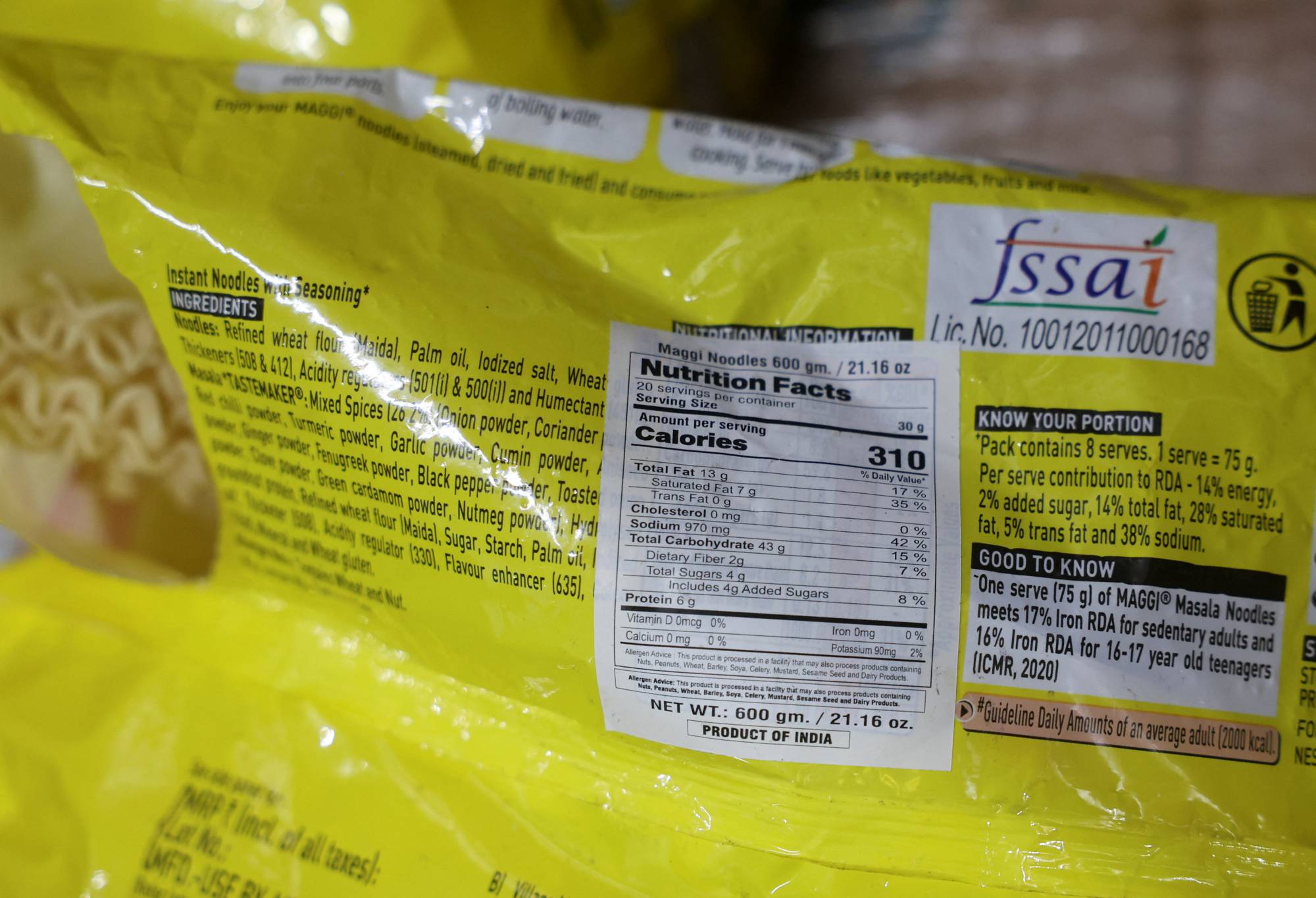
A modified label pasted over the original nutrition facts information on a packet of Maggi, during a raid by the Maharashtra Food and Drug Administration (FDA) at a warehouse in Turbhe, India, August 25, 2026. REUTERS/Francis Mascarenhas

India is a top growth market for global consumer giants like PepsiCo, Coca-Cola, Mondelez and Nestle, and also ⁠thousands of small Indian ⁠companies which sell traditional savories and sweets.

The lobby group told the Supreme Court it was not against front-of-pack warning labels, but the thresholds must be decided in a scientific manner. It said it objected to the "indiscriminate application of the thresholds presently proposed.”

India is proposing a red warning if added sugar is in excess of 3% of solid products by weight, and fat in excess of 4.2% - stricter than many foreign markets.

The industry also reiterated its concerns that warnings should be decided on consumption of a single serving of a product, and not 100 grams as currently proposed.

"Indian foods are eaten in widely varying quantities, including approximately 10g of pickle, 15-20g of spread of condiments, 30g of bread," the industry group said.

The Supreme Court is set to review the government's proposal on Monday.


Scientists Find New Clues to Reversal of Alzheimer's Brain Damage

Elderly women sit at a park in downtown Shanghai March 16, 2012. REUTERS/Carlos Barria/File Photo
TT

Scientists Find New Clues to Reversal of Alzheimer's Brain Damage

Elderly women sit at a park in downtown Shanghai March 16, 2012. REUTERS/Carlos Barria/File Photo

Scientists studying the strongest genetic risk factor for Alzheimer's disease say they have new clues to how it works and how its damaging effects on the brain could potentially be reversed.

Researchers have found a noninvasive way to identify and study cells in the body that contribute to age-related disorders ⁠such as cancer, tissue degeneration, and inflammatory diseases.

These so-called senescent cells have stopped dividing and growing but for some reason have not died, as would be expected of old cells. Instead, they undergo significant changes to their shape, metabolic processes, and gene activity, according to Reuters.

Earlier methods of studying these cells would destroy them, the researchers noted in a report of the study in Nature Aging.

Using an analytical technique known as Raman microscopy, which reveals the biochemical composition of cells without harming them, and analyzing individual cells’ ⁠genetic activity, the researchers were able to identify unique “barcodes” of senescent cells.

The study was done in mouse cells. The researchers are now working on adapting it for use with human tissue.

“You can imagine that one day we may develop an endoscope that can look inside your body and identify cellular senescence,” Jeon Woong Kang of MIT, one of the senior authors of the study, said in a statement.

Study leader Peter So of MIT noted that senescence “is ⁠not just a pathological condition.”

While it can also contribute to sagging skin and muscle weakness in aging individuals, cellular senescence plays critical beneficial roles in embryonic development and tissue regeneration, the researchers noted.

The research is part of a National Institutes of Health initiative called the Cellular Senescence Network.

“The idea behind the NIH Cellular Senescence Network is to take a very comprehensive approach to understand senescence and identify senescent cells, because it plays a role in so many normal physiological conditions and many pathological conditions,” So said.
