Lebanon’s Shiite Alliance United Against Israel Framework Deal, Divided Over Protests

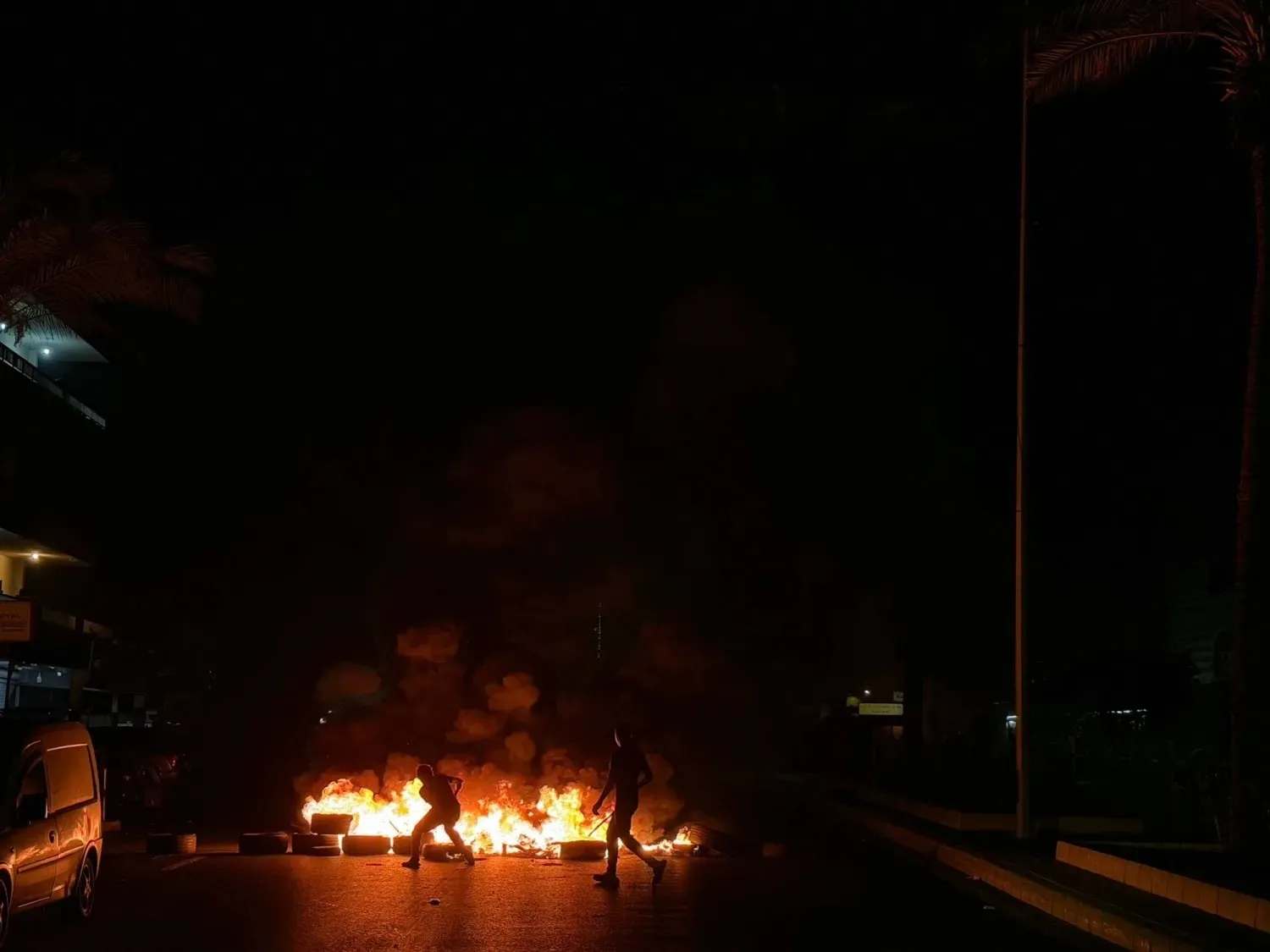
Hezbollah supporters block the old airport road in Beirut’s southern suburbs with burning tires on Saturday to protest the 2026 trilateral agreement signed by the United States, Israel, and Lebanon (AFP)
TT

Lebanon’s Shiite Alliance United Against Israel Framework Deal, Divided Over Protests

Hezbollah supporters block the old airport road in Beirut’s southern suburbs with burning tires on Saturday to protest the 2026 trilateral agreement signed by the United States, Israel, and Lebanon (AFP)

Calls by Hezbollah supporters to take to the streets in protest against the US-sponsored framework agreement between Lebanon and Israel has drawn only a few dozen demonstrators in downtown Beirut.

Also, dozens of motorcyclists blocked the airport road before the Lebanese army reopened it, underscoring the limited scale of the protests.

Observers attributed this to the absence of supporters from the Amal Movement, led by Parliament Speaker Nabih Berri, highlighting one of the main obstacles to any attempt to mobilize the street.

The Israel-Lebanon deal calls for Hezbollah to be disarmed before Israel will withdraw its troops from southern Lebanon. Israel agreed to withdraw initially from a couple of “pilot zones” where the Lebanese army would then deploy, but no details have been shared about how that will work in practice.

While Hezbollah and Amal - the two pillars of Lebanon’s Shiite alliance - remain united in rejecting the agreement, sources familiar with Amal’s position told Asharq Al-Awsat that the priority is to challenge it through constitutional institutions while keeping all options open as events unfold.

Opponents of the alliance, however, argue that there’s a growing discord between the two parties on how to navigate the next phase.

Unified rejection

Mohammad Khawaja, a member of the parliamentary Development and Liberation bloc, told Asharq Al-Awsat that the bloc categorically rejects the agreement, describing it as “a bad and completely unacceptable deal.”

Khawaja dismissed reports of differences between Amal and Hezbollah, insisting that “all talk of divisions within the Shiite duo is unfounded."

He added that the agreement was unacceptable in its current form and expressed hope that those behind it would reconsider it.

No decision on street protests

Sources within the Shiite duo told Asharq Al-Awsat that it is “premature” to offer assurances about whether street protests will or will not be held.

The sources said the current stage requires patience and that the alliance’s response will depend on political and constitutional developments surrounding the agreement. All options, they added, remain on the table.

That position broadly aligns with recent statements by Hezbollah officials, who have argued that the agreement “will not survive.”

At the same time, the party has sought to distance itself from recent street protests, saying they reflect public distrust of the authorities. While Hezbollah rejects both the agreement and the direct negotiations that produced it, it denies organizing or mobilizing the demonstrations.

Opponents of the Shiite alliance argue that differences are becoming increasingly apparent, particularly on how the agreement could reshape Lebanon’s domestic political landscape.

While both Hezbollah and Amal continue to emphasize their united rejection of the deal and favor constitutional and political channels for now, critics believe the coming months will reveal whether that cohesion endures or evolves into a more visible political divide.

Independent MP Ibrahim Mneimneh told Asharq Al-Awsat that Berri appears fully aware of the responsibility he bears and may seek to give state-building a genuine opportunity, while Hezbollah continues to rely on a highly polarizing political discourse.


Sudan’s Currency Tumbles to New Low as War Hammers Economy

People stand at a market in Omdurman, Sudan, September, 19, 2026. (Reuters)
TT

Sudan’s Currency Tumbles to New Low as War Hammers Economy

People stand at a market in Omdurman, Sudan, September, 19, 2026. (Reuters)

Sudan's currency ‌hit a new low of 10,000 Sudanese pounds to the dollar on Wednesday in parallel market trading, continuing a dramatic fall over recent months as wartime conditions take their toll on the economy.

The rapid 60% depreciation has heaped hardship on Sudanese still trying to regain their footing after devastating conflict and ‌forced displacement caused ‌by the war between ‌Sudanese ⁠armed forces and the ⁠paramilitary Rapid Support Forces, putting basic food items out of reach.

Sudan's official exchange rate remains stuck at 4,200 SDG to the dollar, a rate last seen on the parallel market ⁠in army-controlled areas in May.

A large ‌portion of ‌that fall has happened over the past month, ‌as the pound fell from a ‌previous low of 8,000, depreciating 20%. Prior to the start of the war in April 2023, the rate was about 600 ‌pounds to the dollar.

Currency traders cited import demands as a ⁠chief ⁠factor as the government increased the tightly controlled customs dollar, used to calculate duties, to more than 5,600 this week.

As the war continues Sudan has decreased production of key dollar earners while its chief export, gold, has increasingly been smuggled abroad. Meanwhile, the army-controlled government has said the war and reconstruction efforts require dollar-draining imports.


France Says to Hold Conference for Lebanese Forces after Israeli Elections

French President Emmanuel Macron gestures as he speaks to members of the media on the day of the 9th Annual One Planet Sovereign Wealth Funds (OPSWF) Summit, in Lusail, Qatar, 21 October 2026.  EPA/BENOIT TESSIER
French President Emmanuel Macron gestures as he speaks to members of the media on the day of the 9th Annual One Planet Sovereign Wealth Funds (OPSWF) Summit, in Lusail, Qatar, 21 October 2026. EPA/BENOIT TESSIER
TT

France Says to Hold Conference for Lebanese Forces after Israeli Elections

French President Emmanuel Macron gestures as he speaks to members of the media on the day of the 9th Annual One Planet Sovereign Wealth Funds (OPSWF) Summit, in Lusail, Qatar, 21 October 2026.  EPA/BENOIT TESSIER
French President Emmanuel Macron gestures as he speaks to members of the media on the day of the 9th Annual One Planet Sovereign Wealth Funds (OPSWF) Summit, in Lusail, Qatar, 21 October 2026. EPA/BENOIT TESSIER

French President Emmanuel Macron said on Wednesday that this country will organise a conference to support the Lebanese armed forces after the Israeli elections this month, as truce talks between the two sides stall.

"We will also coordinate to carry out this work of support for the Lebanese armed forces and a conference will be set up in the coming weeks by France... I think it is useless to do it before the Israeli elections, but we will organise such a conference because it is unavoidable," he told reporters in Qatar.

Israel goes to the polls on October 27.

Lebanese authorities last year committed to disarming Hezbollah after months of cross-border hostilities culminated in a 2024 war between the group and Israel.

But Hezbollah drew Lebanon into the Middle East war this year by attacking Israel, which responded with heavy strikes and a ground invasion.

In June, Lebanese and Israeli authorities signed a framework agreement which involves the disarmament of Hezbollah, a gradual Israeli withdrawal from territories it occupies, and the deployment of the Lebanese army to the area.

Hezbollah has rejected surrendering its weapons and the direct negotiations with Israel.


Syria: Israeli Forces Shell Quneitra Countryside

An Israeli military vehicle is seen near the border between the Israeli-occupied Golan Heights and Syria, May 4, 2025. REUTERS/Shir Torem/File Photo
TT

Syria: Israeli Forces Shell Quneitra Countryside

An Israeli military vehicle is seen near the border between the Israeli-occupied Golan Heights and Syria, May 4, 2025. REUTERS/Shir Torem/File Photo

Israeli forces fired several artillery shells on Wednesday at the area around eastern Tell al-Ahmar in the southern Quneitra countryside in southern Syria.

The Syrian Arab News Agency (SANA) said that “occupation forces fired two projectiles that landed on agricultural land around eastern Tell al-Ahmar, causing no injuries".

Israel continues to violate the 1974 Disengagement Agreement through repeated incursions into southern Syria, raids on and arrests of civilians, land bulldozing and shelling, among other attacks, the agency said.

Syria has repeatedly called for Israeli forces to withdraw from its territory, stressing that all measures taken by Israel are null and void and have no legal effect under international law. Damascus has also urged the international community to fulfil its responsibilities and compel Israel to withdraw fully from southern Syria.