


UK Economy Grows as Expected before Iran War Impact

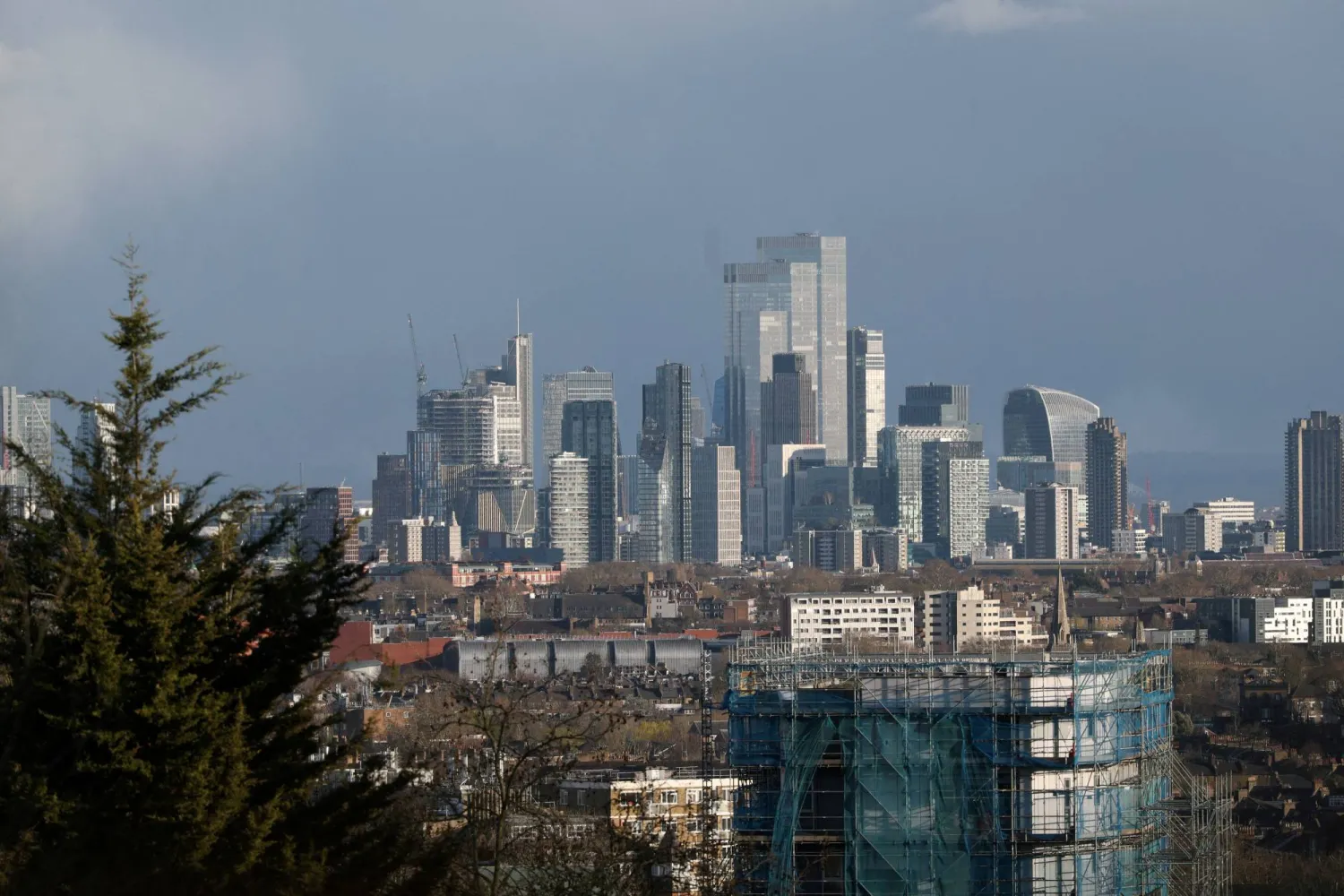
FILE PHOTO: The London skyline is seen with the financial district in the background, in London, Britain, March 25, 2026. REUTERS/Isabel Infantes/File Photo
TT

UK Economy Grows as Expected before Iran War Impact

FILE PHOTO: The London skyline is seen with the financial district in the background, in London, Britain, March 25, 2026. REUTERS/Isabel Infantes/File Photo

Britain's economy grew robustly in the first quarter of 2026, official data confirmed on Tuesday, but households were squeezed even before the worst effects of the US-Iran conflict started to feed through.

Economic output grew by 0.6% in the first three months of the year, unchanged from an initial estimate by the Office for National Statistics.

"Services were the main driver of growth in the latest quarter, with strengths in computer programming, wholesale and advertising only offset by falls in rental companies and recruitment agencies," ⁠Liz McKeown, director ⁠of economic statistics at the ONS, said.

It marked the third year running of conspicuously strong growth in the first quarter — and some economists have raised concerns with the statistics office's seasonal adjustment processes.

According to Reuters, the ONS reiterated on Tuesday that a review had found no statistically significant seasonality, although it was monitoring it closely.

Business surveys and economic growth data for April suggest Britain's likely next prime minister to replace ⁠Keir Starmer, Andy Burnham, will face a tougher inheritance.

"Alongside softer household spending, tighter financial conditions and economic uncertainty will weigh on investment," said Matt Swannell, chief economic adviser to the EY ITEM Club, a consultancy.

"Even though the government will soon be under new leadership, fiscal policy is likely to remain tight in the near term."

The ONS revised growth in the final three months of 2025 down to 0.1%.

Output in 2025 as a whole was also slightly lower than previously thought at 1.3%, compared with a previous estimate of 1.4%.

Sterling showed little reaction to the data.

Real household disposable income per head, a measure of living standards that the Labour government aims to ⁠raise by the end ⁠of the parliamentary term, contracted by 0.8% in the first quarter, after a 1.2% rise at the end of 2025.

Households put less money aside in the first quarter with the savings ratio decreasing by 0.7 percentage points to 8.9%, driven by a fall in the contribution of non-pension saving.

The squeeze on households looks set to continue as the Bank of England held interest rates at 3.75% in June and investors are pricing in the first quarter-point increase by February 2027.

Britain's budget watchdog in March forecast the economy to expand 1.1%, although the projections were made before the Iran war started.

Compared with a year earlier, GDP was 0.9% higher, the ONS said, revised down from a previous estimate of 1.1%, while output on a per capita basis was 0.7% higher than the year before.



Iraq's SOMO Offers Big Discounts for Term Basrah Oil in July

FILE PHOTO: A gas flare burns in the distance at the Rumaila oil field, amid nationwide output cuts following the closure of the Strait of Hormuz, in Basra, Iraq, March 4, 2026. REUTERS/Essam Al-Sudani/File Photo
TT

Iraq's SOMO Offers Big Discounts for Term Basrah Oil in July

FILE PHOTO: A gas flare burns in the distance at the Rumaila oil field, amid nationwide output cuts following the closure of the Strait of Hormuz, in Basra, Iraq, March 4, 2026. REUTERS/Essam Al-Sudani/File Photo

Iraq's SOMO has offered wide discounts to its official selling prices to encourage term buyers to lift Basrah crude from its terminal inside the Middle East Gulf in July, according to trade sources and a document reviewed by Reuters.

The discounts for Basrah Medium crude ranged from $14 to $16 a barrel while those for Basrah Heavy crude were between $16.80 and $18.80 a barrel, depending on the loading period. Discounts are wider for cargoes ⁠loading between July 1 ⁠and 5 and they become narrower for cargoes loading July 6-10 and July 11-31.

Buyers are requested to submit their nominations for quantity within a day from receiving the letter, Reuters quoted SOMO as saying.

The discounts are meant as compensation for buyers who have to pay high chartering ⁠costs for ships to enter the Strait of Hormuz to fetch the oil, a trade source said.

The daily time charter rate for a Very Large Crude Carrier to load 2 million barrels of crude from the Middle East to China has climbed to about $300,000 from about $220,000 on February 27, before the US and Israel launched strikes on Iran, but has dropped from a peak of about $600,000 in March, LSEG data shows.

The wide discounts for ⁠Basrah ⁠crude may entice buyers, but the question remains if the Strait of Hormuz is passable, two other people said.

Last week, SOMO issued a tender to sell July-loading crude but it failed to attract buying interest as traders had difficulties in booking tankers to enter the Gulf, another source said.

Other Middle East producers are pushing ahead with oil loadings, but shipping in the strait has slowed following fresh ship attacks and renewed strikes between the US and Iran in recent days.


IMF Reaches Staff-level Deal with Egypt that Could Unlock $1.6 Billion

FILE PHOTO: A general view of buildings and the Great Pyramids in Cairo, Egypt, March 25, 2026. REUTERS/Mohamed Abd El Ghany/File Photo
TT

IMF Reaches Staff-level Deal with Egypt that Could Unlock $1.6 Billion

FILE PHOTO: A general view of buildings and the Great Pyramids in Cairo, Egypt, March 25, 2026. REUTERS/Mohamed Abd El Ghany/File Photo

The International Monetary Fund said on Monday it had reached a staff-level agreement with Egypt on reviews of two financing arrangements, potentially unlocking about $1.6 billion pending approval by the fund's executive board.

The agreement would make available about $1.5 billion under Egypt's Extended Fund Facility and about $136 million under the Resilience and Sustainability Facility, bringing total disbursements under the arrangements to about $7.2 billion, Reuters quoted the IMF as saying.

The IMF said the impact of the war in the Middle East on Egypt's economy had remained "relatively contained,” helped by "timely and decisive" policy measures including fuel and electricity price adjustments, curbs on government energy consumption and spending reprioritization.

The IMF said real GDP growth reached 5% in the third quarter, bringing growth for the first three ⁠quarters of the fiscal year to 5.2%, while headline urban inflation remained elevated at 14.6% in May and was projected to rise to 15.8% by the end of the fiscal year.

It said Egypt should maintain tight monetary policy to contain renewed inflationary pressures and keep exchange rate flexibility as the "first line of defense" against external shocks, including spillovers from heightened geopolitical tensions.

The fund said Egypt's fiscal performance was strong, with primary balance and tax revenue targets exceeded by end-March, and projected the primary surplus to rise to 5% of GDP ⁠in the 2026/27 ⁠fiscal year from 4.8% in 2025/26.

The IMF said swift implementation of Egypt's State Ownership Policy, including faster divestment of state assets, would be critical to supporting private sector-led growth. Earlier in June, Egypt's cabinet said it had granted four state-owned companies preliminary listings as part of its privatization program.

Egypt agreed to a $3 billion loan with the IMF in December 2022. The program was expanded to $8 billion in March 2024, when the country was grappling with high inflation and foreign currency shortages.

Egypt's foreign reserves rose to $53.134 billion in May from $48.526 billion in May 2025, according to central bank data.


Saudi Arabia Introduces New Irrigation Code to Save 2 Billion Cubic Meters of Water Annually

Part of the meetings of Saudi Water Week
TT

Saudi Arabia Introduces New Irrigation Code to Save 2 Billion Cubic Meters of Water Annually

Part of the meetings of Saudi Water Week

Saudi Arabia is expanding the use of treated wastewater as a strategic resource to support industrial and urban growth, with industrial consumption projected to exceed 100 million cubic meters annually by 2030.

The push comes alongside the launch of a new national irrigation code designed to save about 2 billion cubic meters of water each year.

CEO of the Saudi Irrigation Organization (SIO) Mohammed bin Zaid Abu Haid told Asharq Al-Awsat that water has become a cornerstone of the Kingdom’s development agenda.

He said rapid economic growth and the rollout of megaprojects across Saudi Arabia are driving demand for treated water as a key component of project infrastructure.

The corporation manages and operates dams while overseeing the transport, distribution, and reuse of treated water for urban, industrial, and agricultural purposes, a sector that is expanding rapidly, he said.

Treated water use in industry has risen by about 50 percent over the past two years, increasing from roughly 20 million cubic meters to 30 million cubic meters by the end of 2025. Abu Haid expects consumption to surpass 100 million cubic meters by 2030.

Urban demand has also grown sharply. Consumption for parks, green spaces, and projects under the Saudi Green Initiative climbed from about 65,000 cubic meters to nearly 13 million cubic meters, with forecasts pointing to 150 million cubic meters annually by 2030.

Abu Haid identified the Saudi Green Initiative as one of the main drivers of demand for treated water, alongside development projects, nature reserves, and expanding urban applications.

He also announced the imminent launch of the Irrigation Practices Code, developed by the corporation in partnership with the Food and Agriculture Organization of the United Nations. The code is expected to raise irrigation efficiency in the Kingdom from about 55 percent to more than 70 percent.

Once fully implemented, the code is projected to save around 2 billion cubic meters of water annually. Field trials have shown higher farm productivity, increased farmer incomes, and more efficient water use.

The code also aims to reduce water consumption in grain cultivation from 9,750 cubic meters per hectare to about 6,500 cubic meters per hectare. Abu Haid said the project is in its final stages and will be officially launched during the World Water Forum.