


Oil Edges Higher as Breakdown in Iran-US Talks Raises Supply Concerns

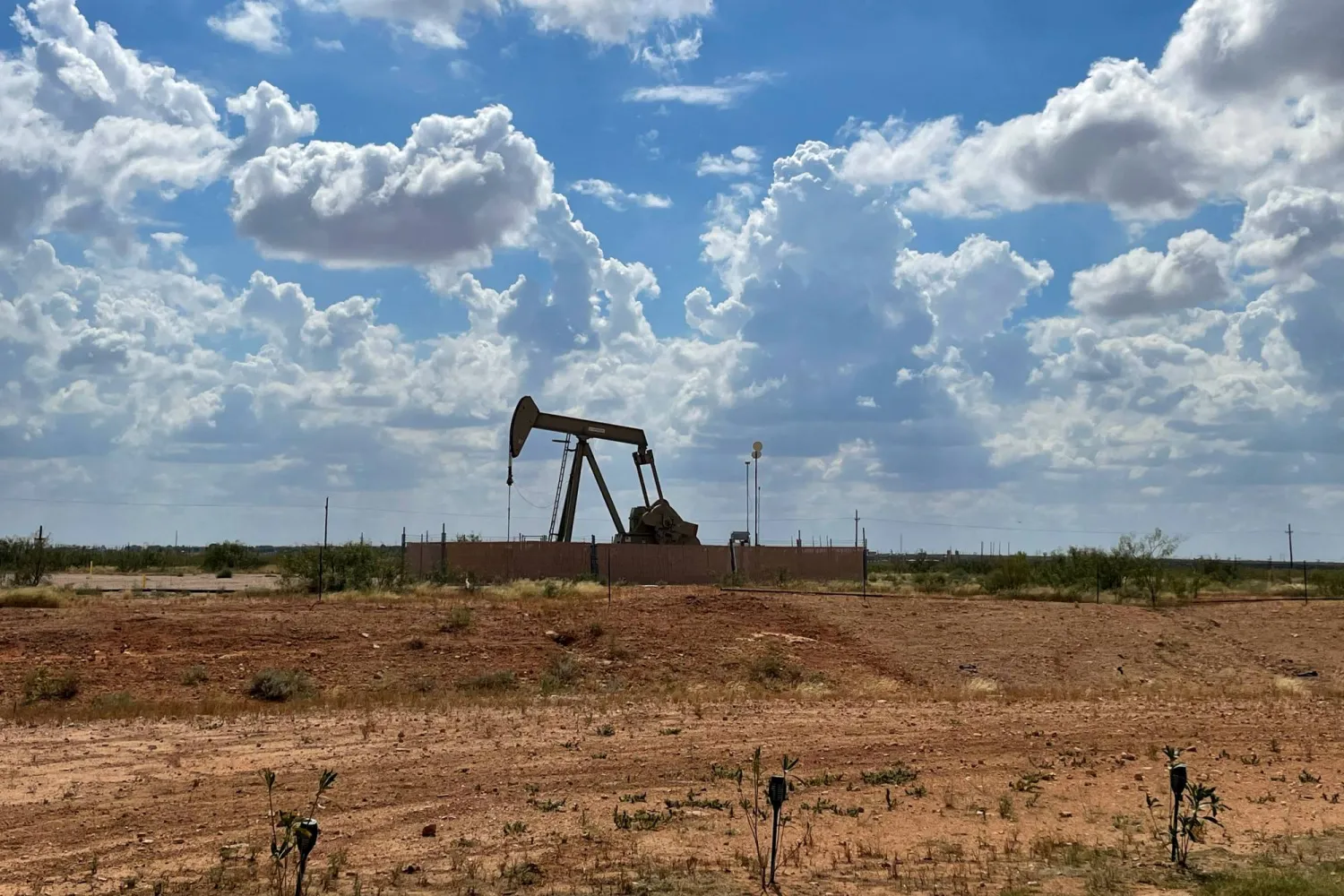
FILE PHOTO: A pumpjack, used to help lift oil from a well, in the Permian basin near Midland, Texas, US, October 8, 2025. REUTERS/Arathy Somasekhar/File Photo
TT

Oil Edges Higher as Breakdown in Iran-US Talks Raises Supply Concerns

FILE PHOTO: A pumpjack, used to help lift oil from a well, in the Permian basin near Midland, Texas, US, October 8, 2025. REUTERS/Arathy Somasekhar/File Photo

Oil prices ticked higher on Wednesday on concerns a breakdown in talks between Iran and the US for a final agreement to end their war may extend supply disruptions in the key Middle East producing region.

Brent futures rose 14 cents, or 0.19%, to $73.09 a barrel at 0644 GMT, while US West Texas Intermediate (WTI) crude was up 11 cents, or 0.16%, to $69.61 a barrel, Reuters said.

"Hormuz continues to reopen but it's patchy, unpredictable, and not fully transparent,” said Vandana Hari, founder ‌of oil market analysis ‌provider Vanda Insights.

"Unless there is a fresh understanding ‌between ⁠Washington and Tehran, the ⁠market may wait and watch for sustained peace and quiet before crude resumes bearish momentum."

US President Donald Trump's son-in-law Jared Kushner and envoy Steve Witkoff arrived in Doha for what the White House described as "high level" talks on Tuesday, but Iran and host Qatar said they would meet with mediators, rather than the Iranians themselves.

Qatar said Prime Minister Sheikh Mohammed bin Abdulrahman al-Thani was among those to meet with ⁠Witkoff and Kushner. Brent fell by around $45 a barrel in ‌the second quarter of this year, its largest ‌quarterly loss since the global financial crisis in 2008. US crude futures meanwhile fell by ‌around $31, their largest quarterly loss since 2020, when the COVID-19 pandemic crushed global oil ‌demand.

The declines followed progress toward ending the Middle East conflict, after sharp gains in March triggered by the outbreak in hostilities.

Analysts have cut their 2026 oil price forecasts for the first time since the Iran war began, after five straight monthly increases, as the ‌reopening of the Strait of Hormuz eased concerns over prolonged supply disruptions, a Reuters poll showed on Tuesday.

US Vice President ⁠JD Vance said ⁠Iran would be prevented from charging tolls through the strait, telling The Michael Knowles Show, "This is not going to end in a place where the Iranians are collecting tolls on ships going through the Strait of Hormuz."

Tanker traffic through the critical waterway has started to recover, with Vance claiming that oil flows through the strait had been restored to pre-war levels.

Meanwhile, US crude oil inventories fell again last week while gasoline stocks also declined, market sources said, citing data from the American Petroleum Institute released on Tuesday.

Crude stocks fell by 6.1 million barrels in the week ended June 26, the sources said on condition of anonymity.

Official US oil stock data from the Energy Information Administration will be released at 10:30 a.m. EDT (1430 GMT) on Wednesday.



Gold Falls as Higher Treasury Yields, Fed Rate Hike Bets Weigh

Gold bracelets and necklaces displayed for sale in a gold shop at Istanbul's Grand Bazaar (AFP)
TT

Gold Falls as Higher Treasury Yields, Fed Rate Hike Bets Weigh

Gold bracelets and necklaces displayed for sale in a gold shop at Istanbul's Grand Bazaar (AFP)

Gold fell for a third consecutive session on Wednesday, as rising US Treasury yields and growing bets that the Federal Reserve will raise interest rates pressured the non-yielding metal.

Spot gold was down 0.8% at $3,974.75 per ounce as of 0849 GMT, after touching its lowest level since last November at $3,942.99 in the previous session. US gold futures for August delivery lost 1.3% to $3,987.70/oz.

The yellow metal ‌on Tuesday recorded ‌its first quarterly loss since January 2024, Reuters reported.

A selloff ‌in ⁠US Treasuries on ⁠Tuesday pushed the benchmark 10-year yield up as much as 9 basis points before it backed off the highs. By Wednesday, yields were rising again, up 4 bps at 4.465%, outpacing increases in euro zone bond yields.

A stronger US dollar makes bullion less affordable for overseas buyers.

"The weakness is a bit driven by comments from ⁠Fed's Hammack, suggesting a rate hike might be ‌needed and market participants pricing in ‌a bit more rate hikes for this year," said UBS analyst Giovanni Staunovo. Federal ‌Reserve Bank of Cleveland President Beth Hammack said on Tuesday ‌she may advocate for higher rates if inflation pressures don’t moderate. According to CME FedWatch tool, traders see a nearly 67% chance of a rate hike by September.

Expectations for more hikes are not helping investment demand, and ‌ETF holdings have seen renewed outflows in recent days, said Staunovo, noting that price volatility is ⁠expected around economic ⁠data releases this week.

June ADP employment data, due at 1215 GMT, and Thursday's nonfarm payrolls report could give further clues on the Fed's policy path.

Markets will also closely watch the European Central Bank's annual Sintra conference on Wednesday, where Fed Chair Kevin Warsh and ECB President Christine Lagarde are due to speak. On the geopolitical front, concerns persisted over the prospects for US-Iran diplomacy after Tehran said it would not meet senior US envoys who travelled to the region following the recent outbreak of hostilities.

Spot silver fell 1.4% to $57.75 per ounce.

Platinum slipped 0.6% to $1,542.70, after hitting its lowest point since November. Palladium slid 1.4% to $1,187.01.


Turkish Manufacturing Contracts, Hit by Iran War Disruption, PMI Shows

 A full moon rises over the Galata Tower in Istanbul, Türkiye, June 29, 2026. (Reuters)
A full moon rises over the Galata Tower in Istanbul, Türkiye, June 29, 2026. (Reuters)
TT

Turkish Manufacturing Contracts, Hit by Iran War Disruption, PMI Shows

 A full moon rises over the Galata Tower in Istanbul, Türkiye, June 29, 2026. (Reuters)
A full moon rises over the Galata Tower in Istanbul, Türkiye, June 29, 2026. (Reuters)

Türkiye's manufacturing ‌sector contracted in June as the war in the Middle East disrupted demand and supply, a business survey showed on Wednesday.

The Istanbul Chamber of Industry's Türkiye Manufacturing Purchasing Managers' Index, compiled by S&P Global, fell to 47.1 in June from 49.8 in May. The 50-mark separates growth from contraction.

Output returned to decline after rising slightly in May, with firms ‌citing market uncertainty ‌linked to the conflict ‌in ⁠the Middle East, softer ⁠new orders and higher prices.

Demand weakened further, with total new orders posting a solid decline and new export business also falling again after expanding in May.

Companies also cut purchasing activity, while employment continued to be scaled ⁠back. Suppliers' delivery times lengthened again, although ‌the deterioration was ‌the least marked since February.

There were some signs ‌of easing price pressures. Input cost inflation slowed ‌for a second straight month to its weakest since November, while output price inflation eased to its lowest level so far this year.

The June ‌survey reversed some of May's improvement and extended the sector's downturn to ⁠27 ⁠consecutive months. Firms also reduced stocks of purchases and finished goods amid muted demand conditions, the panel showed.

"The Turkish manufacturing sector took a step back in June, posting a renewed softening of production amid muted new orders. Anecdotal evidence from the survey indicated that the war in the Middle East continued to be the principal cause of the challenges facing firms," said Andrew Harker, economics director at S&P Global Market Intelligence.


Oman Air Targets Tourists on New Singapore Route, Eyes North Asia Expansion

A Boeing 737 MAX 8 operated by Oman Air, on the tarmac at Muscat International Airport, amid the US-Israeli conflict with Iran, in Muscat, Oman, March 13, 2026. (Reuters)
TT

Oman Air Targets Tourists on New Singapore Route, Eyes North Asia Expansion

A Boeing 737 MAX 8 operated by Oman Air, on the tarmac at Muscat International Airport, amid the US-Israeli conflict with Iran, in Muscat, Oman, March 13, 2026. (Reuters)

Oman ‌Air is looking to capitalize on the Gulf state's appeal as a largely untapped tourism destination as it launches flights from Muscat to Singapore on Thursday and considers an expansion to North Asia over the next year, its CEO said.

The new nonstop Singapore service is underpinned by a lower cost base and the airline's year-old membership in the oneworld alliance to aid with connections, as serving the city-state with a stopover in Kuala Lumpur failed nine years ‌ago, Oman ‌Air CEO Con Korfiatis said in an ‌interview.

"Singapore ⁠is one of the ⁠major global hubs...and Singaporeans are among the most avid travelers in the world," he said. "Oman has moved from being a transit point...to now also being a tourist destination, and that has created a different market opportunity."

Korfiatis said the airline was targeting load factors, or the percentage of seats ⁠filled, in the mid-to-high 70% range in year ‌one for the Singapore route, ‌and first-month bookings were tracking above that level.

The eight-hour flight ‌will be one of the world's longest on a Boeing ‌737 MAX narrow-body and will run four days a week.

The launch comes as the government-owned airline has been executing a transformation plan since early 2024, cutting routes, renegotiating contracts, boosting fleet utilization ‌and reducing headcount.

The airline is also eyeing a return to North Asia for the first ⁠time in ⁠years, with Korfiatis expecting to announce at least one new nonstop destination in the region within 12 months.

He declined to name specific cities but described China, Japan and South Korea as markets of strong interest, citing their travelers' appetite for nature-based and off-the-beaten-track destinations.

Oman's airspace remained open throughout recent Middle East disruptions, giving the airline a brief advantage as passengers rerouted during the early weeks of the Iran war, Korfiatis said.

Load factors had still dipped by around 8 to 10 percentage points at the height of the disruption but had since mostly recovered, he added.