


Russia Bombards Kyiv in Major Strike, at Least 13 People Killed

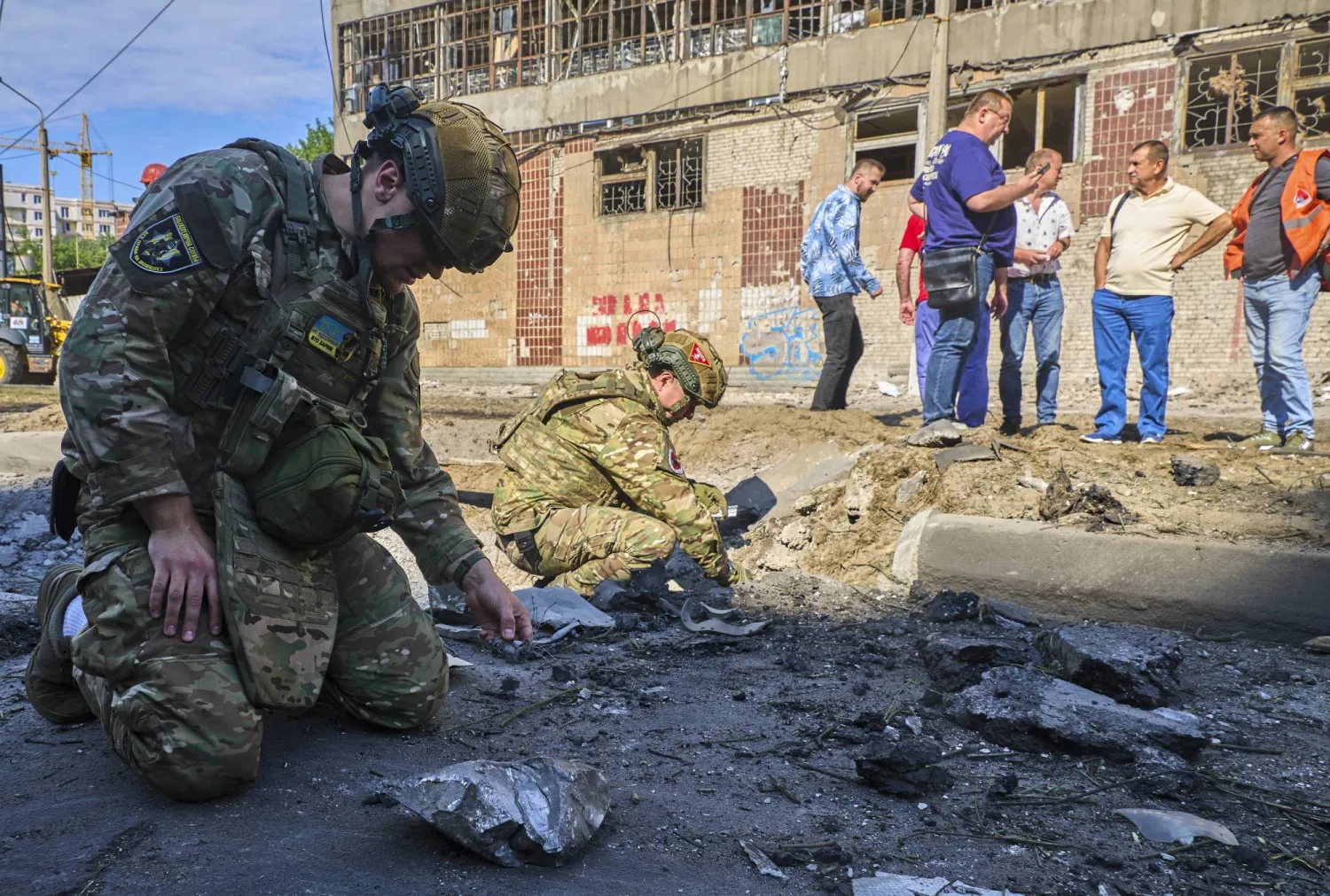
Ukrainian experts work at the site of a Russian glide bomb strike in Kharkiv, northeastern Ukraine, 29 June 2026, amid the Russian invasion. EPA/SERGEY KOZLOV
TT

Russia Bombards Kyiv in Major Strike, at Least 13 People Killed

Ukrainian experts work at the site of a Russian glide bomb strike in Kharkiv, northeastern Ukraine, 29 June 2026, amid the Russian invasion. EPA/SERGEY KOZLOV

Russia launched hundreds of drones and dozens of missiles at Ukraine's capital Kyiv in the early hours on Thursday, blasting apart residential buildings, killing at least 13 people and wounding scores, Reuters reported.

Multiple explosions shook buildings and reverberated across the capital throughout the night as thousands of residents rushed to bomb shelters and underground metro stations. It was the second-deadliest Russian attack on Kyiv so far this year. "This night, Russia once again carried out a cynical, large-scale attack on Ukraine," Prime Minister Yulia Svyrydenko said on the Telegram app. "The enemy launched dozens of ballistic missiles. Kyiv was hit the hardest."

"As of now, 13 people are known to have been killed."

President Volodymyr Zelenskiy had cut short a visit to Dublin on Wednesday night and warned Ukrainians about the upcoming strike.

Russia launched 74 missiles and 496 drones during the attack, the Ukrainian air force said. Air defense units downed most of those but 25 ballistic missiles ‌and 12 drones struck ‌33 locations.

The Russian Defense Ministry, in a Telegram post, said its "massive attack" using long-range, high-precision air-, ‌land-, sea-launched ⁠weapons and drones ⁠hit military and energy facilities, as well as airports in Kyiv and other locations.

The ministry said it was a retaliation for Ukrainian attacks on Russian civil infrastructure. Russia downed 327 drones overnight, the ministry said.

For its part, the Ukrainian General Staff said it had hit an oil refinery in the town of Kstovo in Russia's Nizhny Novgorod region overnight. Russia's Nizhny Novgorod Governor Gleb Nikitin said one person was killed and four people wounded in a drone strike that damaged an industrial facility.

DAY OF MOURNING ANNOUNCED IN KYIV

Ukrainian Foreign Minister Andrii Sybiha reiterated Kyiv's urgent plea for Ukraine's allies to supply more air defenses, saying that the capital had "suffered a night of horror".

Kyiv Mayor Vitali Klitschko announced a day of mourning in Kyiv for Friday. He ⁠said that damage was recorded across the entire city of about 3 million people, with some ‌buildings smashed.

Emergency services were working through the rubble of what used to be a nine-storey building ‌on the left bank of the Dnipro River that bisects the city as the sun rose and fires flared up around it. City officials said that about 90 ‌people, including children, paramedics and drivers at an ambulance station, were wounded and that some people were still trapped inside damaged residential buildings.

"Our ‌house is on fire. The attack is still going on. Oleg was pulling our neighbor out of the burning house, while I was phoning all the emergency services during the explosions," Iryna Plekhova, a Kyiv resident, said on Facebook, posting a picture of a half-destroyed apartment building with no windows.

"We do not have an apartment anymore."

Pictures posted online showed a blaze at the top of a building on the central Shevchenko Boulevard, while elsewhere in the city, windows blew ‌out and cars were destroyed.

People crowded into underground stations carrying children, belongings, tents and pets as air raid alerts blared across the city.

Ukraine's neighbor Poland, a NATO and European Union member, briefly scrambled fighter ⁠jets as a preventive measure. Finland ⁠also briefly issued a temporary aviation restriction zone in the eastern Gulf of Finland before lifting it later, its defense forces said on X.

MORE PRESSURE ON RUSSIA NEEDED

After years in which Ukraine bore the brunt of relentless long-range attacks from Russia, Kyiv has intensified its own strikes deeper into Russian territory in recent months, mainly hitting energy targets. That has triggered a fuel crisis in Russia, forcing the world's third-biggest oil producer to import gasoline from as far away as India.

Russia has responded with a stepped-up air campaign against Ukrainian cities, last month hitting a thousand-year-old Kyiv cathedral foundational to the Orthodox faith in both countries.

Kaja Kallas, the EU's foreign policy chief, said only sustained military support for Ukraine and increased pressure on Moscow could help stop Russian attacks.

"Today, I will propose to sanction more entities supporting Russia’s military-industrial complex in response to the strikes," she said in a post on X. "The more Moscow attacks civilians, the more sanctions must be imposed."

Zelenskiy has proposed talks with Russian President Vladimir Putin to end the more than four-year-old war, which the Kremlin leader has rejected.

Russia has killed thousands of Ukrainian civilians in strikes on Kyiv and other Ukrainian cities since it launched its full-scale invasion of Ukraine in February 2022.

Moscow denies intentionally attacking civilians but says attacks on what it describes as civil infrastructure are legitimate because they hurt Ukraine's ability to wage war. Kyiv has also launched attacks on Russia and Russian-occupied Ukraine on a far smaller scale.



North Korea Says US-led Arms Buildup Justifies Expanding Nuclear Force

North Korea's Vice Defense Minister Kim Kang Il looks on before a plenary session at the Beijing Xiangshan Forum in Beijing, China September 17, 2026. REUTERS/Florence Lo
TT

North Korea Says US-led Arms Buildup Justifies Expanding Nuclear Force

North Korea's Vice Defense Minister Kim Kang Il looks on before a plenary session at the Beijing Xiangshan Forum in Beijing, China September 17, 2026. REUTERS/Florence Lo

North Korea's vice defense minister said on Thursday that a growing US-led military buildup and what he called an expanding nuclear alliance among Washington, Seoul and Tokyo justified Pyongyang's efforts to strengthen and expand its nuclear forces.

Speaking at the Beijing Xiangshan Forum, China's flagship international security conference, Vice Defense Minister Kim Kang Il said North Korea's status as a nuclear weapons state was irreversible and pledged to continue expanding its nuclear arsenal.

"The ceaseless nuclear arms buildup of the enemy states fully justifies the building of a solid nuclear shield of the DPRK," Kim said, using the acronym for North Korea's formal name, the Democratic People's Republic of Korea.

"As ⁠the enemy states' ⁠nuclear threat reaches the extreme level ... the DPRK will firmly defend the peace and stability in the Korean Peninsula and the region by ceaselessly expanding and strengthening its self-defensive nuclear deterrent."

According to Reuters, Kim blamed tensions on the Korean Peninsula on what he called Washington's "invariable" hostile policy toward North Korea and accused the United States of turning trilateral cooperation with South Korea and Japan into a nuclear alliance.

He said North Korea's constitutional status as a nuclear weapons state was "the line of no retreat" and urged ⁠other countries to abandon what he called the "daydream" of denuclearization.

Kim's appearance at the Xiangshan Forum marked a rare high-profile showing by North Korea at an international security gathering in recent years and came as Pyongyang seeks closer ties with Beijing amid tensions with Washington and its allies.

Asked about the possibility of a meeting between US President Donald Trump and North Korean leader Kim Jong Un, Kim said he was not in a position to discuss whether such a summit could take place.

His remarks followed a statement on Thursday morning from Kim Yo Jong, the powerful sister of leader Kim Jong Un, rejecting renewed international calls for North Korea's denuclearization following discussions at the annual meeting of the International Atomic Energy Agency.

In a statement carried by state media KCNA, ⁠she said North Korea's ⁠status as a nuclear weapons state was "absolute" and could not be reversed, dismissing repeated denuclearization demands as annual "noise" and insisting Pyongyang's nuclear position had been permanently established "physically and legally.”

Her comments echoed a separate statement issued on Wednesday by a North Korean defense ministry spokesman, who accused the United States and South Korea of escalating military confrontation through joint weapons-of-mass-destruction response planning and exercises.

The spokesman said recent US-South Korean WMD response discussions amounted to an "open declaration of confrontation" and warned such actions could require Pyongyang to invoke provisions of its nuclear force policy law.

The statements appeared to form part of a broader messaging campaign by Pyongyang on its nuclear policy, according to Lim Eul-chul, a professor at Kyungnam University's Institute for Far Eastern Studies in Seoul.

The comments were aimed at cementing North Korea's claim that its nuclear status had reached an "irreversible stage,” while creating justification for future military and nuclear activities in response to what it portrays as growing US and South Korean pressure, Lim said.


WHO Eyes ‘Encouraging’ Signs in DR Congo Fight Against Ebola

A member of the civil protection team's dignified and safe burial service prepares to swab the body of a child suspected of having died from Ebola at the Butembo Unit Hospital morgue, in Butembo, North Kivu province, Democratic Republic of Congo, September 13, 2026. (Reuters)
TT

WHO Eyes ‘Encouraging’ Signs in DR Congo Fight Against Ebola

A member of the civil protection team's dignified and safe burial service prepares to swab the body of a child suspected of having died from Ebola at the Butembo Unit Hospital morgue, in Butembo, North Kivu province, Democratic Republic of Congo, September 13, 2026. (Reuters)

The Ebola epidemic in the Democratic Republic of Congo is still spreading but appears to be showing "encouraging" signs of improvement, the head of the World Health Organization said on Wednesday.

"We are starting to see encouraging signs that we're gaining ground," Tedros Adhanom Ghebreyesus told a news conference in Geneva.

Since the DRC declared its 17th Ebola outbreak in mid-May, more than 3,500 deaths have been recorded from over 7,200 cases to date across seven northern and eastern provinces plagued by widespread insecurity and a litany of armed groups.

Ebola, which is transmitted through contact with bodily fluids and can cause severe internal and external bleeding and organ failure, has killed more than 15,000 people in Africa over the last 50 years.

Tedros said that transmission was declining in the worst-affected areas of Ituri province, the epicenter of the outbreak, while South Kivu has not reported any new cases since May.

"Trials of treatments and post-exposure prophylaxis are picking up speed, due to increased community engagement," he added.

"Vaccine trials should begin in the coming weeks," Tedros said, while warning against complacency. "Make no mistake: the epidemic continues to grow and continues to kill," he said.

"We still have many, many months ahead of us," added Maria Van Kerkhove, director of epidemic and pandemic management at the UN health agency.

- Right response -

In North Kivu, the number of cases was rising "fast", Tedros said, with weekly cases almost doubling from about 100 to more than 200.

"The area is so vast that it is hard to speak of a single epidemic. It is many outbreaks, in many places. We must get the response right in every one of them," he added.

The remoteness of the province, high population mobility and attacks on humanitarian workers were further complicating efforts to fight the epidemic, he explained.

The Africa Centers for Disease Control and Prevention (CDC) and the WHO issued a funding appeal in June for $518 million to support the epidemic response until November.

Both organizations and the Congolese government earlier this month launched a new bid for $1.3 billion for the next six months, on top of the $1.1 billion requested by the UN in August for humanitarian assistance, WHO health emergencies chief Chikwe Ihekweazu said.

There is currently no approved vaccine or treatment against the Bundibugyo strain responsible for the current outbreak.

Some 70,000 doses of the Ervebo vaccine, which has been approved against the Zaire strain of Ebola, have been sent to the DRC to assess its effects on tackling the spread of Bundibugyo.

More than 3,000 health workers and frontline staff have already been vaccinated in Kisangani, said Meg Doherty, director of science for health at the UN health agency.

An observational study led by the Doctors Without Borders (MSF) charity will start on Saturday to evaluate the vaccine's effectiveness in reducing illness and death, she added.

Clinical trials of two vaccines in development against Bundibugyo will take place in the country on a date to be fixed.


Netanyahu’s Party Seeks to Impede Israeli Expat Voting

Israeli Prime Minister Benjamin Netanyahu greets supporters after delivering a statement to members of the press, in Jerusalem, September 8, 2026. (Reuters)
TT

Netanyahu’s Party Seeks to Impede Israeli Expat Voting

Israeli Prime Minister Benjamin Netanyahu greets supporters after delivering a statement to members of the press, in Jerusalem, September 8, 2026. (Reuters)

Prime Minister Benjamin Netanyahu's party on Wednesday petitioned the electoral commission to block initiatives aimed at helping Israelis who live abroad return to vote in upcoming close-fought elections.

Israel's electoral law does not allow citizens residing outside the country to vote abroad, except for diplomats and emissaries sent by certain organizations. The Central Bureau of Statistics estimates there are 600,000 Israelis living abroad.

Government opponents have been working for several weeks to encourage voters to come home to cast their ballots, hoping to strengthen the anti-Netanyahu camp in elections scheduled for October 27.

Initiatives include offering discounted plane tickets, assisting expatriates with the administrative procedures required to vote and organizing their transport from the airport.

Attorney Ilan Bombach, representing Netanyahu's right-wing Likud party, filed an appeal on Wednesday with the chairman of the Central Elections Committee demanding an end to these practices.

The petition specifically targets the US-based AID Coalition, an organization which says it is aimed at "strengthening and preserving the democratic foundations of the State of Israel" and is behind the "Fly&Vote" scheme.

The petition also targets the opposition Democrats party.

In his appeal, seen by AFP, Bombach likens these methods to an "electoral bribe" and argues that they violate the law on party financing.

Likud maintains that even if the passengers themselves pay for their plane tickets, the "Fly&Vote" scheme grants illicit benefits, such as discounted fares negotiated with airlines through group bookings.

The AID Coalition, which says it is an apolitical organization, has not immediately responded.

On its website, the organization describes the upcoming elections as "critical for the future of the country".

It says the law stipulating that Israelis must be physically in Israel to vote "impacts hundreds of thousands of dedicated Israelis who serve in the reserves... pay taxes, and never-endingly support Israel".

Michal Dagon from the AID Coalition recently told left-leaning daily Haaretz that the organization aimed to help bring between 50,000 and 70,000 voters from abroad to cast their ballots.

More than 30,000 Israelis have already registered, organizers said.

According to polls, the elections are expected to be tightly contested between the bloc led by Netanyahu and that of his main rival, centrist Gadi Eisenkot.