


Bomb Blast at Damascus Cafe Kills Nine

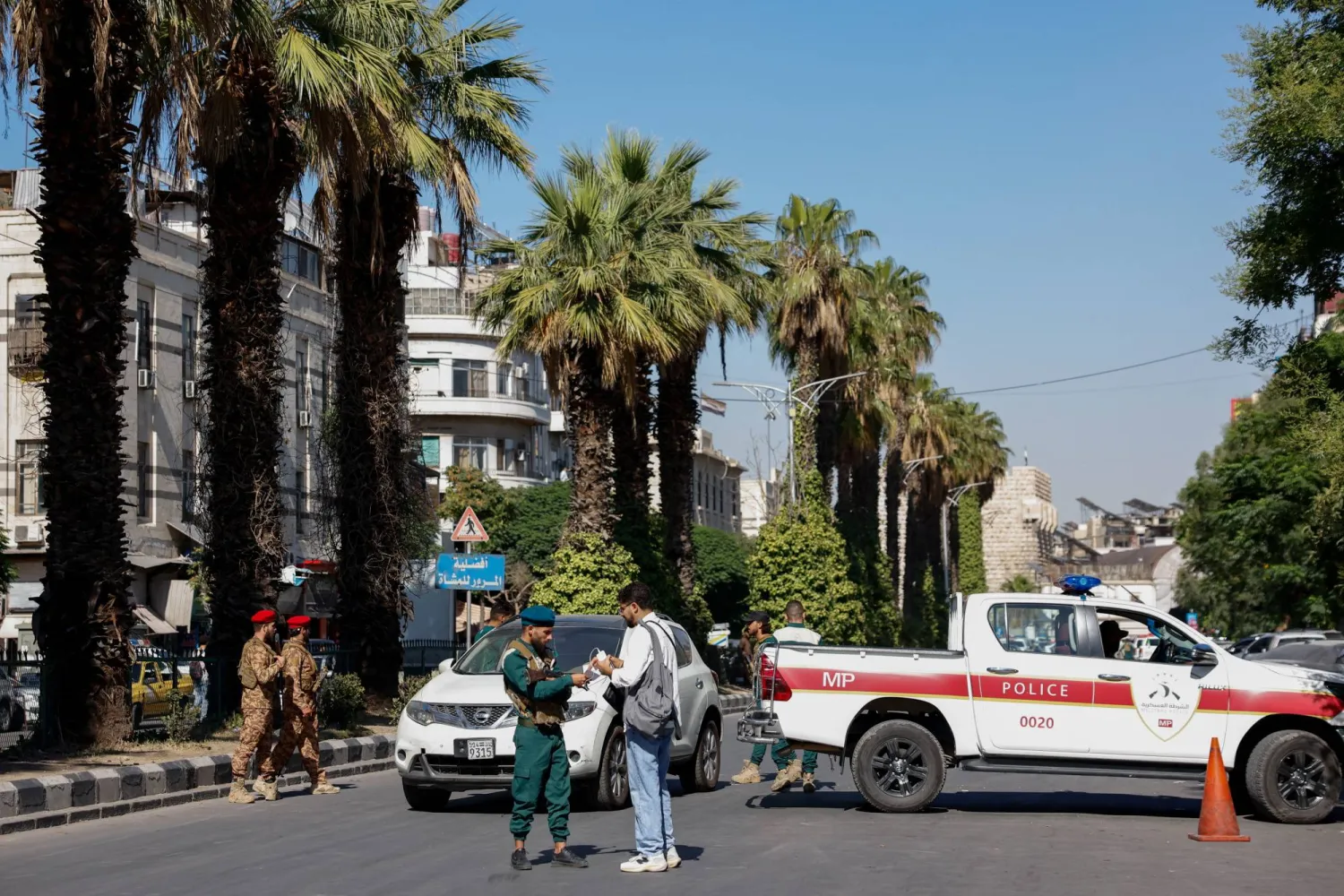
A police vehicle near the site of what Syrian state media reported was a blast at a cafe in central Damascus, Syria, July 2, 2026. REUTERS/Yamaam Al Shaar
TT

Bomb Blast at Damascus Cafe Kills Nine

A police vehicle near the site of what Syrian state media reported was a blast at a cafe in central Damascus, Syria, July 2, 2026. REUTERS/Yamaam Al Shaar

A bomb blast rocked a cafe in Syria's capital Damascus on Thursday, killing nine people and wounding 20, authorities said, in the latest challenge for the country's leaders as they seek stability after more than a decade of war. 

The bombing -- the deadliest since a suicide attack on a church last year -- was not immediately claimed, said AFP. 

It took place near the capital's Palace of Justice, a key government building, sparking scenes of panic in the busy area. 

An AFP correspondent saw ambulances weaving through traffic with their sirens blaring as they headed to the site, and security forces cordoned off the area of the blast. 

"The explosion that occurred in a cafe near the Palace of Justice in Damascus resulted from an explosive device planted in the location," state television said. 

The "improvised explosive device" contained metal fragments, which caused "severe injuries and significant damage", the interior ministry wrote on Telegram. 

Investigators are reviewing surveillance footage, speaking to witnesses and collecting forensic evidence from the scene, the ministry said. 

Nour Khayyat, 40, who owns a shop selling batteries for solar panels near the site, told AFP that "at about 3:00 pm (1200 GMT), I heard a powerful blast and the storefront shook". 

"People rushed to the cafe and called ambulances," he added. 

Mohammed al-Dahabi, the owner of a glasses shop next to the cafe, was trembling as he described the explosion, telling AFP: "I felt strong pressure, and the whole place shook". 

"I ran to the place and saw people lying on the floor with blood pooled around them everywhere," he added, saying the scenes recalled the bombings Damascus experienced during Syria's nearly 14-year civil war. 

- 'Malicious parties' - 

Arriving at the scene, Damascus governor Maher Eldibi said authorities had launched an investigation. 

"Those responsible for this bloodshed will be punished," he said. 

"Each time the country sees a period of stability, malicious parties try to destabilize it." 

The UN's deputy special envoy for Syria, Claudio Cordone, said on X that the perpetrators "should be brought to justice". 

Türkiye, which has close ties with Syria's authorities, also condemned the attack and vowed to "maintain its solidarity with Syria throughout this process", according to a foreign ministry statement. 

Several Arab countries also condemned the attack, including Iraq, Jordan, Qatar and Egypt. 

The Arab League and the six-member Gulf Cooperation Council slammed the "terrorist bombing". 

Since the toppling of longtime ruler Bashar al-Assad in December 2024, Syria's new authorities led by President Ahmed al-Sharaa have sought to exercise full control, restore security and reunify the country. 

Damascus has been the site of multiple attacks and incidents since the new authorities took over. 

The deadliest came in June 2025, when an attack on a Damascus church killed 25 people. 

The suicide attack was later claimed by an extremist group, while the authorities blamed it on the ISIS group. 

More recently, there have been other incidents, including the killing in May of a soldier in a car bombing in Damascus's Old City.



Israeli Strike in Gaza Kills Three Including Child

Children react as people take cover from a reported drone strike while they were queuing to receive meals from a charity kitchen in the Jabalia camp for Palestinian refugees in the northern Gaza Strip on October 24, 2026. (AFP)
TT

Israeli Strike in Gaza Kills Three Including Child

Children react as people take cover from a reported drone strike while they were queuing to receive meals from a charity kitchen in the Jabalia camp for Palestinian refugees in the northern Gaza Strip on October 24, 2026. (AFP)

Three Palestinians, including a young girl, were killed Monday in an Israeli airstrike on a camp for displaced people in the southern Gaza Strip, medical sources and first responders said.

Civil defense spokesman Mahmoud Bassal said a total of 11 people had been killed and 50 wounded by Israeli fire and airstrikes in Gaza over the past 24 hours.

"We transported three martyrs, including a child, following an Israeli airstrike targeting a camp for displaced people in the Al-Mawasi area, west of Khan Younis," Bassal told AFP.

Nasser Hospital in the southern Gaza city of Khan Younis confirmed the three deaths.

"Their bodies were torn apart by direct hits from shrapnel from the Israeli missile," the hospital said, adding that several wounded people, including a child and a woman, had also come in for treatment.

The hospital identified the deceased as Hossam al-Zamli, Tamer Abu Sneima, and Jouri al-Soufi, a young girl. The Gaza education ministry gave her age as seven.

Israel's military told AFP it was looking into reports of the strike.

A security source in Gaza told AFP that "several tanks and military vehicles, accompanied by a military bulldozer, advanced on Monday morning into the area west of the Yellow Line in the eastern part of Deir al-Balah", in central Gaza.

After a US-brokered ceasefire took hold in Gaza in October 2025, the so-called Yellow Line was established to divide the areas under Israeli control -- more than 60 percent of the territory -- from those under Hamas control.

The military advance Monday coincided with "heavy gunfire by the occupation forces towards the eastern and northern areas" of Deir al-Balah, home to hundreds of displaced families, the source added.

Since the ceasefire began last year, more than 1,500 people have been killed in Gaza, according to the territory's health ministry.

The war began on October 7, 2023, following an unprecedented attack by Hamas on southern Israel that killed 1,221 people, according to an AFP tally based on official Israeli figures.

Israel responded with a massive military campaign that has destroyed much of Gaza and killed more than 74,500 people, according to the territory's health ministry, which operates under Hamas and whose figures are considered accurate by the United Nations.


Mass Outages in Sudan After RSF Drones Hit Five Power Stations

 People walk through a vegetable market in El Obeid, as drought and heat linked to El Nino threaten harvests, livestock, and water supplies in Sudan's war-affected Kordofan region, El Obeid, North Kordofan, Sudan, September 13, 2026. (Reuters)
People walk through a vegetable market in El Obeid, as drought and heat linked to El Nino threaten harvests, livestock, and water supplies in Sudan's war-affected Kordofan region, El Obeid, North Kordofan, Sudan, September 13, 2026. (Reuters)
TT

Mass Outages in Sudan After RSF Drones Hit Five Power Stations

 People walk through a vegetable market in El Obeid, as drought and heat linked to El Nino threaten harvests, livestock, and water supplies in Sudan's war-affected Kordofan region, El Obeid, North Kordofan, Sudan, September 13, 2026. (Reuters)
People walk through a vegetable market in El Obeid, as drought and heat linked to El Nino threaten harvests, livestock, and water supplies in Sudan's war-affected Kordofan region, El Obeid, North Kordofan, Sudan, September 13, 2026. (Reuters)

Sudan's paramilitary Rapid Support Forces launched a coordinated drone attack Monday against five power stations, causing mass power outages across the country's east, a government official told AFP.

The drones hit two power stations each in the states of Al-Jazira and Gedaref, and one in White Nile state, "resulting in power outages across large parts of these three states", the official said on condition of anonymity.

All three states are controlled by the Sudanese army, which has since April 2023 been at war with its former ally, the RSF.

The United Nations has repeatedly warned that regular attacks on power stations threaten health and services for millions of people, already facing the world's largest hunger crisis.

An AFP correspondent in Al-Jazira state reported the electricity had been out since 2 am (0000 GMT).

Babiker Youssef, a resident of Al-Fao in Gedaref, said the power there had also been out since the same time.

"My son is diabetic, his insulin has to be stored in the fridge," he told AFP over the phone, scared he would not be able to replace the medication if it spoils.

"We have no idea when the power will come back," he added.

Electricity has been cut for days at a time after past paramilitary drone strikes on power stations and hydroelectric dams, compounding the suffering of nearly 20 million people facing extreme hunger.

- 'Losing our stock' -

Sudan's war is currently being fought primarily via drones, with both sides launching sophisticated attacks from across the country, killing dozens of civilians at a time.

In the first three weeks of October alone, drone strikes killed over 300 people and injured hundreds more, according to a UN tally.

Africa's third-largest country, home to an estimated 50 million people, has been ravaged by the war, which aid workers estimate has killed more than 200,000 people.

The majority of Sudan's hospitals have been forced shut, at least eight million children are out of school and swathes of the country cannot access basic services.

"The electricity had just started to improve three months ago, the power station the militia had destroyed was just repaired and we had hope our irrigation pumps would finally start running again," a 54-year-old farmer, Abdelhafez Daafallah, told AFP over the phone from Al-Jazira's Al-Junaid town.

"We hoped we would be able to finally get back to farming, but now the station has been hit," he said, frustrated after nearly four years unable to till his land.

Farmers in Al-Jazira have struggled to rehabilitate and re-plant their land since the army recaptured the state from the RSF last year.

Further east, in Gedaref, grocer Ibrahim Mohammed, 37, said he was "already facing power cuts for hours before the strike".

"Now I have chicken in the fridge, we either lose our entire stock, or will be forced to sell it off at any price, which is still a loss."

Sudan is also grappling with unprecedented inflation and a currency in freefall, having lost over 25 percent of its value in recent weeks.


Syrian Official: 25% of Displaced People Have Left Northern Camps

A convoy carrying 108 displaced families from the Al-Rasm al-Jadid and Al-Rasm al-Qadim camps in Manbij, north of Aleppo (Syrian Civil Defense). 
TT

Syrian Official: 25% of Displaced People Have Left Northern Camps

A convoy carrying 108 displaced families from the Al-Rasm al-Jadid and Al-Rasm al-Qadim camps in Manbij, north of Aleppo (Syrian Civil Defense). 

Around 25% of displaced Syrians living in camps in northern Syria have returned to their home areas since the launch of the “Syria Without Camps” initiative in May, Deputy Minister of Emergency and Disaster Management Ahmed Ekzayez told Asharq Al-Awsat.

Ekzayez explained that the initiative goes beyond closing displacement camps, focusing instead on restoring conditions in areas of origin to enable safe, voluntary, and dignified returns.

This includes rehabilitating hospitals, clinics, schools, water and sanitation networks, communications and roads, alongside creating employment opportunities for returnees.

Hundreds of Families Return Home

The Syrian Civil Defense reported that approximately 233 families left displacement camps in northern Idlib on Sunday for their home areas in Rural Damascus, Latakia, Homs, Deir Ezzor, Hama and the southern and eastern Idlib countryside.

The returns were organized under the auspices of Idlib governorate, in cooperation with social affairs and emergency management authorities, the UN refugee agency (UNHCR), the Muzn Organization and the Syrian Arab Red Crescent. A UN delegation attended the aid distribution.

Most returning families originated from southern Idlib and northern Hama, according to the official SANA news agency.

Meanwhile, the Al-Rasm al-Jadid and Al-Rasm al-Qadim camps in Manbij, eastern Aleppo province, were officially closed after approximately 108 displaced families returned to their home areas in Aleppo and Idlib.

Aleppo’s Directorate of Social Affairs and Labor confirmed the closures following the departure of the final convoy on Sunday.

The Civil Defense Directorate reported that additional voluntary return convoys departed camps in the Idlib and Aleppo countryside under the supervision of the national committee overseeing the “Syria Without Camps” initiative.

Emergency and Disaster Management Ministry teams helped secure the convoys and provide healthcare services.

The operations form part of efforts to implement Decree No. 59, which provides for rehabilitating damaged areas and creating suitable conditions for displaced residents to return.

Plan to Close Camps by 2027

The Syrian government launched its “Syria Without Camps” initiative on May 9, 2026, aiming to resolve internal displacement and dismantle camps by September 2027.

More than 200 camps were closed over the past year, but approximately 140,000 families, representing more than 700,000 people, remained in camps as of September 2026.

Speaking Friday at a UN side event on reconstruction and sustainable solutions to internal displacement following widespread destruction caused by conflict and disasters, Syria’s Permanent Representative to the United Nations, Ibrahim Olabi, appealed for international assistance.

He emphasized the need to rebuild affected communities, restore essential services and create livelihoods to support sustainable returns.

Olabi maintained that the government had addressed the root causes of internal displacement but warned that ensuring lasting returns would require substantial resources.

He also cautioned that the actions of Israeli forces in southern Syria were generating a new wave of displacement.

Sharp Decline in Northern Camps

Before the fall of the Assad government, northern Syria had more than 1,500 displacement camps and shelters, including 1,146 camps in Idlib alone.

Over nearly two years, the number of camps in the north fell to approximately 1,025, comprising 634 in Idlib and 391 in Aleppo.

The number of displaced families living in northern camps also declined from 261,000 to around 140,000, including approximately 82,000 in Idlib and 55,000 in Aleppo.

Across Syria, however, some 1,247 camps and shelters remain, underscoring the scale of the challenge facing authorities as they seek to end prolonged displacement.