



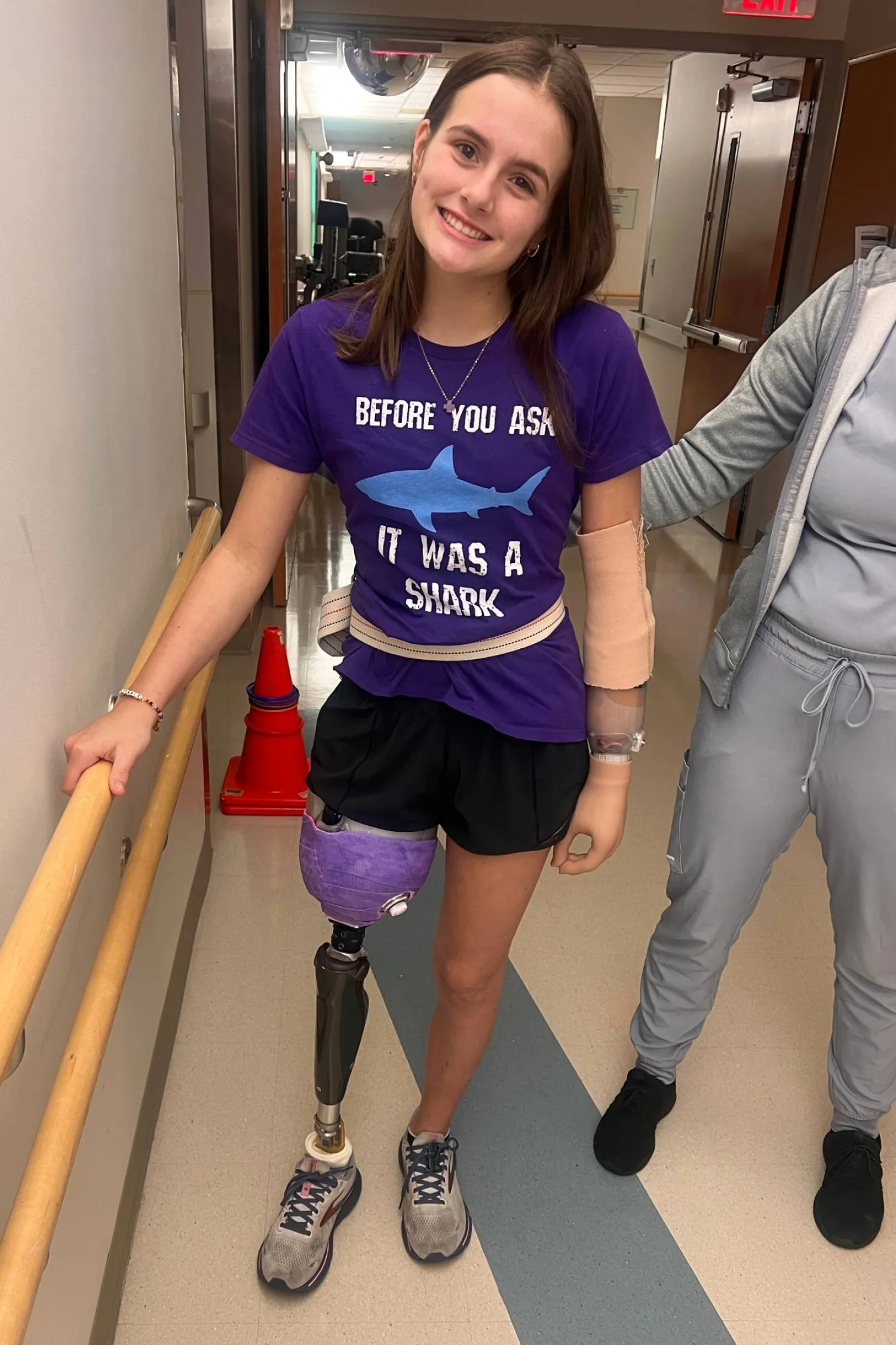

Lulu Gribbin was 15 when she survived a shark attack off the coast of Florida. She lost her left hand, part of her right leg and almost her life.
What she didn’t know when she entered the water on that day in 2024 was that another woman had been bitten by a shark 90 minutes earlier and just 3 miles (4.8 kilometers) down the beach. Had she known about the earlier attack, there is no way she would have been swimming, she said.
Gribbin’s story has inspired new federal legislation to authorize emergency alerts to mobile phones to warn beachgoers when a shark has bitten someone in the area.
President Donald Trump last week signed “Lulu’s Law,” which requires the Federal Communications Commission to allow the emergency messages. The legislation, which Gribbin advocated for, authorizes the warnings by classifying a shark attack as an event for which an emergency alert can be issued. It is up to states to implement the warnings.
Gribbin’s home state of Alabama approved such a warning system last year.
“It’s really just common-sense legislation. It says that whenever there has been a shark attack in a certain area where you are near, it will send an alert to your phone, exactly like how an Amber Alert system works when a child is abducted,” The Associated Press quoted her as saying.
Gribbin said she hopes the alert system will help prevent attacks like hers. “I definitely see this law working in the future and I'm really excited to hopefully save lives,” she said.
A fight to survive Gribbin was one of three people bitten by a shark on June 7, 2024, off the Florida Panhandle.
She was on a mother-daughter trip to the Florida Panhandle. Gribbin said she and her friend had been diving for sand dollars.
“All of the sudden my best friend yelled, ‘Shark!’ and so we all started swimming for our lives,” Gribbin recalled. She said she remembered that sharks are attracted to frantic splashing and yelled for everyone to be calm. Gribbin, who was closest to the shark, was bitten.
“The shark bit off my hand first, and I raised my arm out of the water, and there was just flesh and bone there,” Gribbin said. The shark then latched onto her leg. A man punched the shark off her and strangers on the beach rushed to help. She was flown by helicopter to a nearby hospital.
Doctors were able to save the teen's life but had to amputate part of her right leg.
Choosing positivity throughout her recovery In the hospital, Gribbin made a deliberate decision to choose joy and to never give up.
Gribbin was fitted with prosthetic limbs, quickly regained her ability to walk, returned to sports and got her driver’s license. She has gone back in the water and learned to surf, meeting Bethany Hamilton, a professional surfer who lost her arm in a shark attack.
US Sen. Katie Britt, the Alabama Republican who sponsored the legislation, said the legislation happened because of the teen's “courage, perseverance, and advocacy to protect future beachgoers.”
“Because of her strength, lives will be changed. We should all be inspired by her,” Britt said.


