

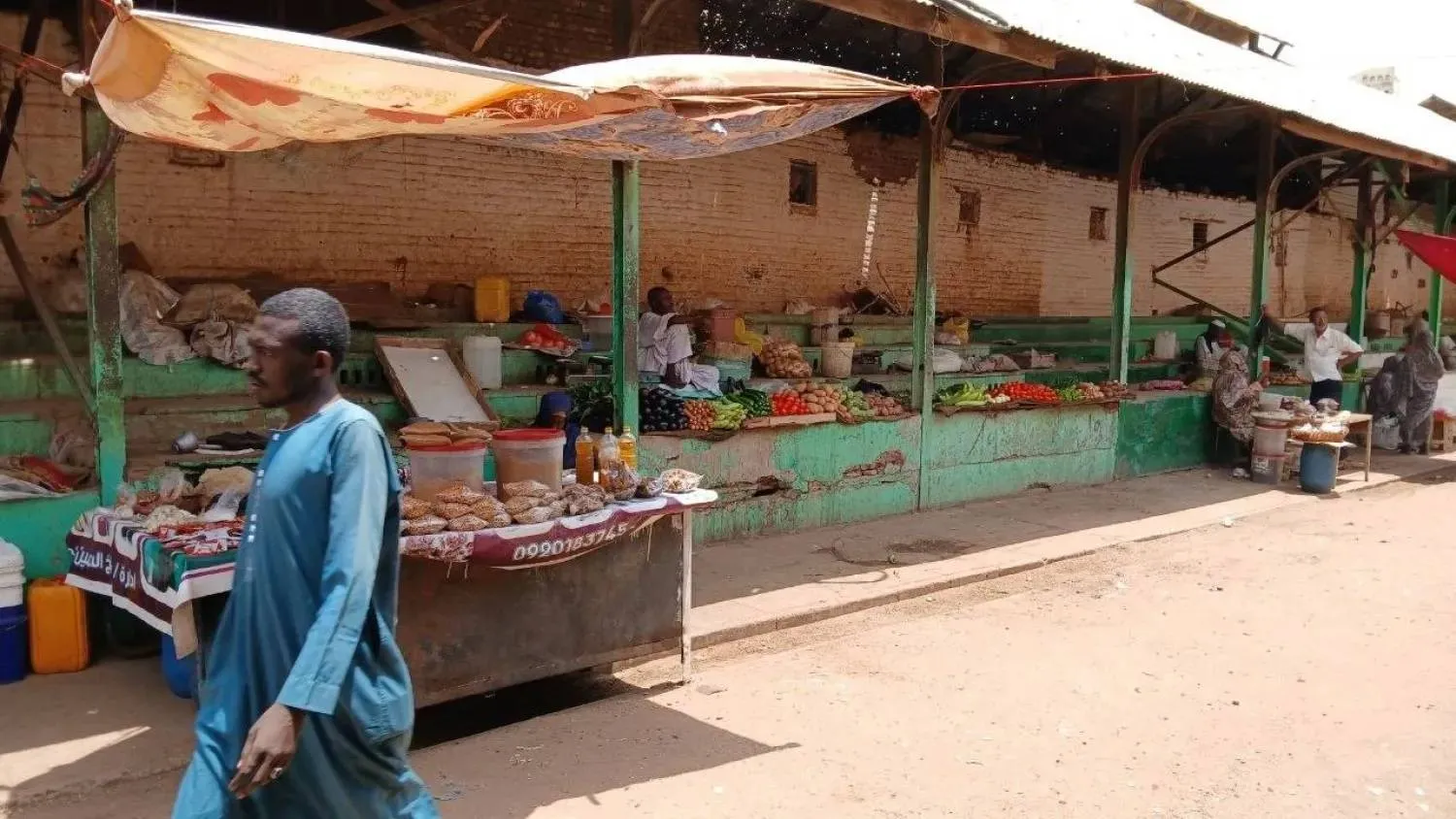

Sudanese Endure Hardship Under the Weight of War

A near-empty market in Khartoum (Asharq Al-Awsat)
TT

Sudanese Endure Hardship Under the Weight of War

A near-empty market in Khartoum (Asharq Al-Awsat)

For many Sudanese, the question is no longer when the war will end, but how they can make it through another day as prices soar and their ability to secure even the most basic necessities continues to erode.

Each morning brings higher prices for essential goods, shrinking incomes and fewer job opportunities, leaving thousands of families to make painful choices between food, medicine and education.

In the markets, buying and selling reflect more than just an economic crisis. They tell the story of a war whose impact has reached people's tables, turning daily life into a quiet struggle for survival.

The rapid rise in the exchange rate has weighed heavily on markets. Some traders have suspended sales temporarily while they reprice their goods to keep up with constant changes.

At the same time, a deepening liquidity crisis has added pressure on citizens, making it harder to meet basic needs amid the country’s current economic strain.

The US dollar has passed 5,000 Sudanese pounds on the parallel market, up from about 4,200 pounds a few weeks ago, a rise of nearly 20%, according to market dealers. The jump reflects sharp volatility in the currency market as economic pressure persists and monetary stability weakens.

Purchasing power declines

Trader Mohammed al-Rifai said markets were clearly stagnating as purchasing power fell and prices kept rising due to inflation and a stronger dollar.

He told Asharq Al-Awsat that “weaker daily earnings for traders, along with the fees and taxes imposed on them, have made continuing business activity more difficult and less worthwhile.”

Trader Abu Aqla Fadlallah described the economic situation as extremely difficult, saying prices of basic goods had reached unprecedented levels and daily needs had become a heavy burden on families.

He told Asharq Al-Awsat that “my income is no longer enough to cover my family’s needs and my children’s education.”

He said he sometimes spends an entire day in the market without making a single sale, adding that the country needs effective economic policies that draw on its vast resources and ease citizens’ suffering.

Vegetable seller al-Tijani Mahmoud said weak purchasing power had hit sales directly. The cost of bringing vegetables to market has risen sharply, he said, alongside rent and operating expenses.

Speaking to Asharq Al-Awsat, he said some traders are forced to sell at a loss to clear their goods, calling for steps to address market imbalances.

Unregulated practices

Economic expert Haitham Mohamed Fathi said higher prices for raw materials used in production, driven by the rise in local exchange rates and higher global fuel costs, had directly pushed up the prices of finished goods.

Fathi told Asharq Al-Awsat that the shutdown of many factories because of the war and the damage they sustained had reduced supply just as demand increased. The result, he said, was higher prices in retail markets and the spread of the informal market.

“Higher global shipping costs, longer transport times, rising internal transport expenses, and the multiplicity of fees and levies between states are all additional factors that have doubled the cost of goods,” he said.

He said some unregulated commercial practices, including excessive price increases aimed at maximizing profits, had further deepened consumers’ suffering.

The economic expert warned that continued disruption in the energy, transport and trade sectors could undermine food security and increase the risk of shortages or unstable supplies of some goods.

He said the agricultural sector could also be affected if production costs continue to rise without sufficient support for farming.

Government measures

To contain the economic crisis, the Sudanese government has stepped up meetings in recent days at the sovereign and ministerial levels to discuss the fallout from the rising exchange rate and the country’s worsening liquidity crisis.

The Sovereign Council said the state was working on a package of measures to stabilize the foreign exchange market, limit the impact of the pound’s decline on living conditions and address market imbalances.

The Sovereign Council held a meeting, chaired by Sovereign Council chief Abdel Fattah al-Burhan, to discuss measures to stabilize the currency market and ease economic pressure, as the pound has recorded a slight improvement in recent days.

In a statement, the council said the meeting discussed several priority national issues, led by economic, security and service-related files, amid the current conditions facing the country.

Daily challenges

Citizen Sumaya Hassan said food prices had risen beyond what she could afford, leaving her in a daily struggle to provide for her children’s basic needs. She told Asharq Al-Awsat that the continuing war and lack of job opportunities had made living conditions harsher and weighed heavily on thousands of families.

Citizen Fatima Hussein said the wave of price hikes had directly affected her family’s life, with basic goods now beyond the means of most citizens.

Speaking to Asharq Al-Awsat, she said she had reached Omdurman after a long displacement journey and was still struggling to secure daily necessities. She called for urgent steps to curb rising prices.

Citizen Maysoun Abbas said she was shocked by the sharp rise in the prices of spices and foodstuffs, which she estimated were now about 70% higher than before the war. She said families had been forced to give up many basic needs just to manage living expenses, amid the anxiety and instability imposed by the war.

In Sudan, the war is no longer measured only by the number of victims or the scale of destruction. It is also measured by what it has done to families’ tables and livelihoods. As citizens and traders struggle to adapt to an extremely harsh economic reality, the gap between income and the cost of living is widening.

The need for urgent policies to restore market stability and protect the most vulnerable is growing.

Without a real response to the roots of the economic crisis, high prices will remain another face of the war, and the suffering of millions of Sudanese will continue even after the guns fall silent.



The Ukrainian Social Media Channels Tracking Russian Missiles

Ukrainians use Telegram channels to track incoming Russian missiles and drones. Tetiana DZHAFAROVA / AFP
TT

The Ukrainian Social Media Channels Tracking Russian Missiles

Ukrainians use Telegram channels to track incoming Russian missiles and drones. Tetiana DZHAFAROVA / AFP

The chances of a missile attack on Kyiv that night were around 50 percent, according to the administrator of a social media channel monitoring Russian air raids.

His channel, Aeris Rimor -- roughly derived from the Latin for Searcher of the Skies -- is one of dozens sending real-time messages about incoming drones and missiles.

Ukrainians consult them to track potential Russian attacks, like people check weather applications for storms but with less certainty, shorter warning, and deadly stakes.

During one recent overnight attack, AFP journalists were granted rare access to shadow "Esko", the channel's administrator, on condition that his identity and some details of the operation remained undisclosed.

The 19-year-old, sporting a budding beard, usually operates from home, filling lulls by watching the TV show Criminal Minds or honing his drone-flying skills on a simulator.

Twenty-six minutes after midnight, the air raid alert rang, soon followed by a red dot glitching across the map on a screen in front of him.

"Oh, a missile on Kyiv," he said.

Switching to Telegram, he sent a message to 150,000 followers: "KYIV TARGET!"

"It's going to hit Kyiv in about a minute," he said.

He then sent out the names of the districts being targeted, quietly lamenting a few typos.

Seconds later, explosions echoed over the capital.

The red dot disappeared from the map, only for another to pop up shorty after.

"You have to literally stay on duty and stare at the screen the whole time, because you can easily miss it," said Esko, who did not appear to struggle, even late into the night.

Esko was looking at a live map used by Ukraine's air defense units.

Red icons -- depicting Russian drones -- were dotted across the map and disappeared as they were downed by Ukraine's air force.

- Bedtime dilemma -

The channels are tolerated by authorities but operate in a legal grey area as they use information from air force contacts.

Esko would not reveal publicly how he accessed the map.

In its nightly attacks, Moscow increasingly fires ballistic missiles, flying up to thousands of kilometers (miles) per hour and reaching Kyiv within three minutes of an air raid warning.

This poses a haunting dilemma for those in the capital.

Either go to a shelter -- the metro or a basement -- in advance, accepting a disrupted and uncomfortable night of half-sleep.

Or stay home and face the risk of a hit, particularly dangerous for those in high-rise buildings in heavily targeted districts.

Sometimes authorities warn hours before a likely attack.

Telegram channels -- sifting through intelligence data -- close the information gap, putting out daily forecasts on the probability of different types of attacks.

Esko said people often reach out asking for advice.

"You can only say: something might happen... but decide for yourselves."

On a recent night in Kyiv when there were mixed signals about a Russian strike, Kateryna Reshetnyk had gone down to the subway.

She based her decision on "a parallel analysis of several channels that have been posting truthful information for a long time."

She had set up folding chair next to the turnstiles with her mother and grandmother -- their beds for the next hours.

"But no one knows for sure what will happen or not. You just rely on your intuition and survival instinct," the 34-year-old said.

- 'Tension rising' -

Hundreds of others, armed with mats, tents and pillows, had done the same.

Dogs snored next to their owners, who were glued to their phones, screens lighting up weary faces.

"We track what's happening and where, because our relatives, friends and colleagues are all over Kyiv and the region, so at least we understand what is happening and where," Reshetnyk said.

The night passed without a major strike.

Ukraine's air force grudgingly tolerates the monitoring channels.

"We can't ban them. They exist, they inform the public, for some people that's convenient," spokesman Yuri Ignat told AFP.

But he warned those running them not to post "excess information ... that the enemy can use against us."

With people making potentially life-or-death decisions based on his posts, Esko said he felt the weight of responsibility.

Much of his life now is spent at the screen, tracking hundreds of drones on only a few hours sleep.

But he prefers busy nights, rather than uneasy periods of calm when Russia is stockpiling for future attacks.

"You keep waiting, waiting, waiting, and then you start posting warnings because the tension is rising. And still, nothing happens. You post again, and nothing happens..."

"And then they hit."


US Pulls Last Aircraft Carrier in Asia as Trump Focuses on Iran and the Western Hemisphere

This handout picture released by the US Navy on May 8, 2019 shows the Nimitz-class aircraft carrier USS Abraham Lincoln (CVN 72) while conducting a replenishment-at-sea with the fast combat support ship USNS Arctic (T-AOE 9), while MH-60S Sea Hawk helicopters assigned to the "Nightdippers" of Helicopter Maritime Strike Squadron (HSM) 5, transfer stores between the ships. (Jason WAITE / Navy Office of Information / AFP)
TT

US Pulls Last Aircraft Carrier in Asia as Trump Focuses on Iran and the Western Hemisphere

This handout picture released by the US Navy on May 8, 2019 shows the Nimitz-class aircraft carrier USS Abraham Lincoln (CVN 72) while conducting a replenishment-at-sea with the fast combat support ship USNS Arctic (T-AOE 9), while MH-60S Sea Hawk helicopters assigned to the "Nightdippers" of Helicopter Maritime Strike Squadron (HSM) 5, transfer stores between the ships. (Jason WAITE / Navy Office of Information / AFP)

President Donald Trump's war against Iran is stretching the limits of US aircraft carriers and leaving the western Pacific without one of the key American warships as China shows more signs of aggression.

The USS George Washington is departing the Pacific and expected to replace the USS Abraham Lincoln in the Middle East amid growing concerns about mental health and supply issues aboard the long-deployed carrier. The Lincoln has had its time at sea extended from its original May return date to support operations against Iran.

The lack of a US carrier in the Pacific may be short-lived if the Navy deploys another in the next couple of months. But it shows how the open-ended operations with Iran are running some American sailors ragged, analysts say, while the Trump administration further retreats from the Asia-Pacific region and focuses on the Western Hemisphere.

“The administration says that the Pacific is supposed to be the most important behind the Western Hemisphere,” said Greg Poling, director of the Southeast Asia Program at the Center for Strategic and International Studies. Instead, the US is "doing the exact opposite" of its previously expressed goal of pulling out of the Middle East.

American allies in the Pacific are unsettled over the unpredictability of the Republican administration, Poling said, while Beijing “is quite happy with US distraction, with the frustration of US allies and partners."

China may take advantage of US carrier's absence

Beijing sees the US military presence in the region as a threat to China’s rise and an obstacle to its ambition to seize Taiwan, the self-governing island it claims as its own. But the United States has argued that the Pacific region is too important economically to lose.

No one expects China to invade Taiwan because an American aircraft carrier has left the region. But the carrier's absence gives the Chinese another opportunity to show its strength, said Bryan Clark, a former Navy submariner who is a defense analyst at the Hudson Institute.

“They’re using this as part of the narrative to demonstrate to the Philippines, to Japan, to Indonesia and others that the US is not the big dog in the western Pacific anymore,” Clark said. “They would just prefer that countries in the region decide that China is the bigger power and the US is not able to guarantee their security anymore.”

China conducted naval exercises this week with Indonesia and recently has shown signs of aggression toward Japan and the Philippines, two key US allies that also have territorial disputes with Beijing.

China carried out military drills this month near the Scarborough Shoal in the South China Sea. Both China and the Philippines have claims over the shoal. Last month, a Chinese guided-missile destroyer conducted a live-fire exercise off Japan’s southernmost island of Okinotori.

Adm. Frank Bradley, head of the US Special Operations Command, has been trying to reassure regional allies of Washington’s commitment. He was in Manila on Thursday, telling his Filipino counterparts that US special operations forces are ready to step up joint exercises to strengthen the countries' alliance. He also is expected to travel to Japan.

“We have the ability to project force, the United States, anywhere on the globe,” Bradley told The Associated Press. “And when the threat in the region of the Middle East has been attended to, we will redeploy and reorient and be able to project that force wherever else it might be required.”

“I also feel very confident in the Armed Forces of the Philippines’ ability to protect their sovereignty here and for us to remain close with them,” he said.

Evan Sankey, a policy analyst at the Cato Institute who focuses on US policy toward China, said aircraft carriers provide psychological assurance to US allies. The absence of carriers in the region, he said, “adds to the general sense that the US is distracted by events in the Middle East.”

Trump has relied on aircraft carriers for military actions

Trump has relied heavily on aircraft carriers to support military operations during his second term. For example, the USS Gerald R. Ford returned home in mid-May after an 11-month deployment, the longest since the Vietnam War, during which it supported the US fight against Iran and the capture of Venezuela's then-leader, Nicolás Maduro.

The Ford had experienced a fire in a laundry space that forced the carrier to turn around and return to the Mediterranean Sea for repairs and left hundreds of sailors without places to sleep. Meanwhile, the Lincoln has spent a record uninterrupted time at sea of more than 240 days. Democratic lawmakers have been calling for investigations and greater visibility into conditions aboard the ship.

Warships and their crews can only handle so much, said Robert Farley, who teaches national security and diplomacy at the University of Kentucky and often writes about aircraft carriers.

“People don’t get enough rest. It's psychologically exhausting. And R&R is part of keeping the crew healthy,” Farley said. “Sometimes it’s framed as, ‘These people haven’t had a vacation.’ But we are dealing with well-known limits on the capacity of a crew to operate at top efficiency over time. And that just declines."

Clark, of the Hudson Institute, said the squeeze on the nation's aircraft carriers stems from the lack of preparation and planning for the Iran war.

“If we were going to mobilize to do this kind of conflict, and we anticipated it might go this long, we might have done some changes to the carrier schedule to make sure more would be available,” Clark said.

Clark said the Navy has 11 aircraft carriers and typically deploys two or three at a time. But it could soon deploy four if the USS Theodore Roosevelt leaves San Diego for the Middle East, allowing the Washington to return to Pacific.

But the massive warships will need maintenance, likely causing a bottleneck at the nation's only two carrier shipyards.

“We’ll end up with a maintenance debt that needs to be paid for the next few years,” Clark said. “We’ll probably have less carrier presence than we’ve had in the previous years because carriers will be lined up to get into the shipyard.”

There are questions about the use of aircraft carriers in modern warfare

Michael Swaine, a senior research fellow in the Quincy Institute’s East Asia Program, questions the future need for aircraft carriers as warfare rapidly changes.

Carriers can be more easily targeted with drones and missiles, particularly by an adversary such as China, Swaine said, while smaller ships and submarines can be as effective in striking targets as the fighter jets that launch off a carrier.

Top Navy officials have indicated a desire to move away from a heavy reliance on carriers. Adm. Daryl Caudle, chief of naval operations, told The Associated Press in February that he wants to convince commanders to use smaller, newer ships and other assets instead of consistently turning to huge aircraft carriers.


Palestinians Besieged in West Bank Village Fear Israeli Settlers will Seize Their Homes

CCTV footage shows, as witnesses say, Jewish settlers throwing rocks on the road in Qusra, in the Israeli-occupied West Bank, August 12, 2026 in this screengrab taken from a handout video- REUTERS
TT

Palestinians Besieged in West Bank Village Fear Israeli Settlers will Seize Their Homes

CCTV footage shows, as witnesses say, Jewish settlers throwing rocks on the road in Qusra, in the Israeli-occupied West Bank, August 12, 2026 in this screengrab taken from a handout video- REUTERS

From inside his home in the West Bank town of Qusra, Qusai Abu Rida watched on Friday as Israeli settlers moved from where they had erected a tent in front of his house to the valley below, rather than returning to the nearby outpost where they live.

Even as the army took positions around him and the homes of two other families that settlers had blockaded for most of this week, the settlers remained close enough that Abu Rida feared they would again return after the army left and try to take over the home owned by his Palestinian American brother in Ohio.

“I just don’t know when this will end,” he said.

The standoff in Qusra entered a new stage Friday as activists marched toward the besieged homes to try and replenish the families' food and water supply. But Abu Rida said he was growing tired of the pattern, with Israeli forces removing the settlers, only for them to return and reestablish their positions after the troops withdrew.

“It’s like a kids’ game, like cat and mouse,” Ziv Stahl, the executive director of the Israeli rights group Yesh Din, said. “It’s clearly not a matter of capability but a matter of will.”

The siege of the homes is the latest episode in a wave of settler violence convulsing the occupied West Bank, which Israel seized in the 1967 Mideast war and which would make up the main part of a future Palestinian state. Israel's military said the village — roughly 10 miles (16 kilometers) from the Palestinian city of Nablus — was a closed military zone.

They did not answer questions about the presence of the settlers. Both Israel’s military and Israel’s police both referred questions arrests in Qusra to the other.

The West Bank has become more dangerous for Palestinians as Israel, under Prime Minister Benjamin Netanyahu, has approved more than 100 new settlements. Extremist settlers routinely enter Palestinian towns, clashing with villagers, burning homes, mosques and cars.

Netanyahu is courting blocs of ultranationalist voters ahead of what’s expected to be a difficult reelection campaign in October. He and members of his cabinet have largely dismissed concerns about settler violence as overblown and attributed it to fringe groups of a few hundred youths. Yet rights groups and Palestinians say the government's policies have made it more difficult to restrain settlers, who are rarely punished for attacks.

The standoff in Qusra began on Sunday when dozens of settlers arrived and blocked the doors to the three houses, preventing occupants from leaving, according to the families inside.

Israeli troops intervened multiple times and arrived in large numbers Thursday.

Abu Rida and his teenage son were temporarily moved by the army on Thursday but allowed to return hours later. He told his brother in Ohio that he planned on staying to defend the home.

For many, the scene unfolding in Qusra — now in its sixth day — reflected broader failures by Israeli authorities to curb the violence in the West Bank.

Itamar Weil, an Israeli human rights activist from the group Bnei Avraham, said the army had threatened to use tear gas against the activists and forced them to leave, even as settlers remained in the valley below Qusra.

“The army used to prevent settlers from carrying out this kind of violence,” he said. “Now, with a government that fully supports them, they’re not doing their job. They should be protecting both sides from violence, but instead they’re removing activists while barely doing anything about the settlers.”

Palestinian officials have reported 1,476 attacks by Israeli settlers in 2026, including several earlier instances in which settlers staged takeovers of Palestinian homes on the outskirts of other West Bank towns.

A total of 87 Palestinians have been killed by Israeli settlers and soldiers in the West Bank this year, according to the Palestinian Authority’s Health Ministry. Israel says some were involved in terrorism, which it defines broadly to include militancy and rock-throwing. Three Israelis were killed by Palestinians, including two in a July clash during which four Palestinians were also killed.

Katz strips army of enforcement power against settlers Before calm was restored in Qusra, Israeli Defense Minister Israel Katz announced on Friday that he would transfer all enforcement powers against Israeli civilians in the West Bank from the army to Israel’s police.

“The (Israeli military’s) role is to fight Palestinian terrorism, focus on protecting the borders and settlements against threats, deal with the borders and the territory itself and security threats to the settlements and the State of Israel, and not chase after boys on the hills,” Katz said in a statement.

Historically, the army has been able to arrest Palestinians and bring those accused of crimes before military courts. But when it comes to Israeli civilians, in most circumstances it can only use temporary detention for those suspected of crimes, leaving arrests, investigations and prosecutions to police and civilian courts.

Katz’s move comes after he ended the use of administrative detention against Israeli civilians in November 2024. The military had used the policy as a tool to contain settler violence, allowing it to detain suspects without charge and remove them from the West Bank.

Much like with that move, rights groups said transferring all powers to the police was unlikely to restore order or ensure Palestinian safety.

Some 2.8 million Palestinians live under Israeli military rule in the West Bank alongside more than 560,000 Israeli civilians who live in settlements that the international community largely considers illegal and an obstacle to peace.

Though the Palestinian Authority exercises limited autonomy and policing power in the territory’s largest cities, agreements that date back to the 1990s give Israel security control over large swaths of the territory, including agricultural areas and communities such as Qusra.

Stahl, Yesh Din's executive director, said Katz's announcement wouldn't change or help stem the violence because police will still require army escorts to operate in Palestinian areas.

“Unless (Katz) means he’s going to apply Israeli law and have the police control the West Bank, the military is still the main body in charge,” she said.