
'Not a Museum': Slovak UNESCO Village Strains under Tourism

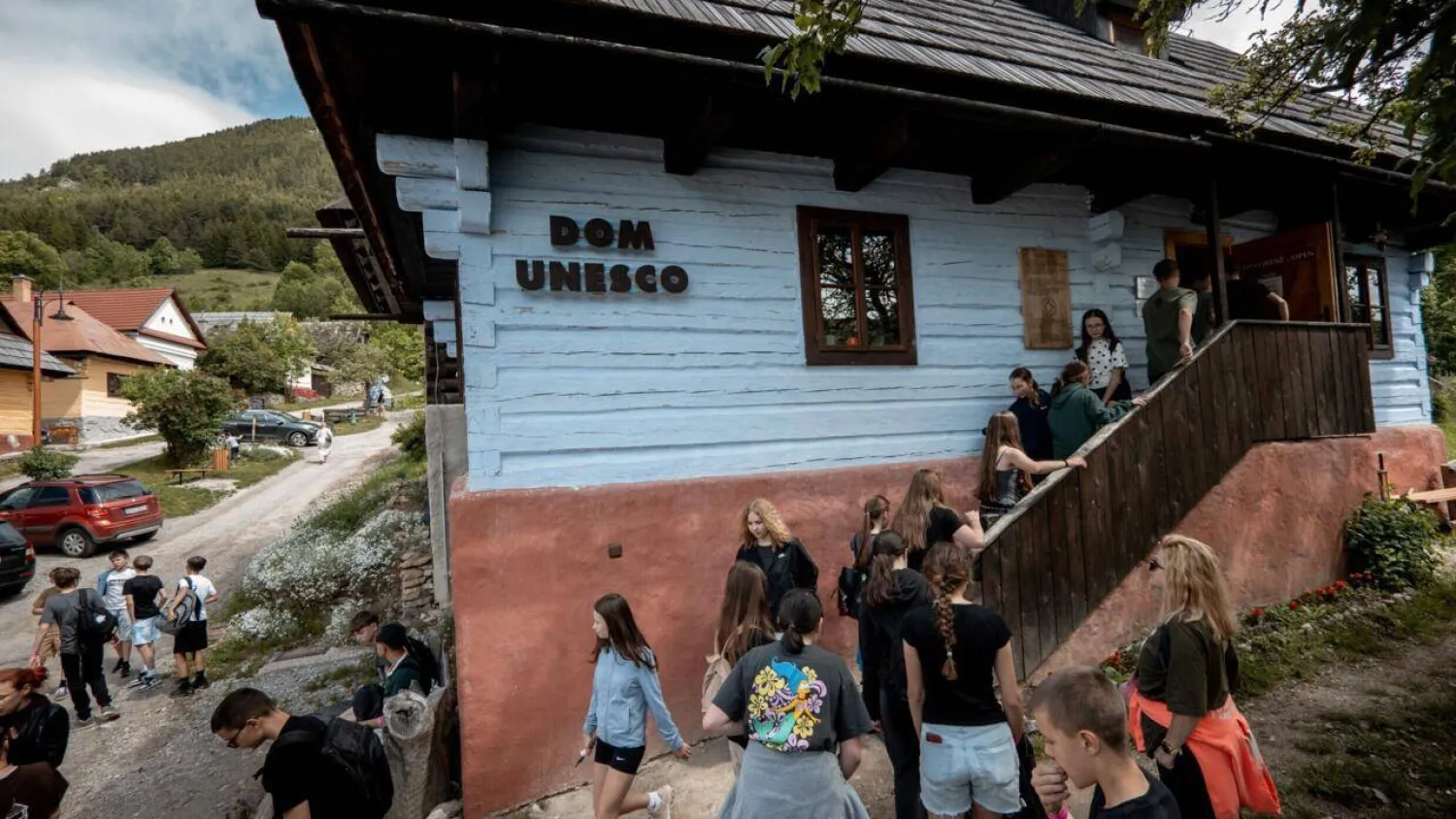
Vlkolinec attracts around 100,000 tourists a year. Joe KLAMAR / AFP
TT

'Not a Museum': Slovak UNESCO Village Strains under Tourism

Vlkolinec attracts around 100,000 tourists a year. Joe KLAMAR / AFP

"Private property. No entry", "No photography" read the signs on a gate set up in front of a traditional log house in Vlkolinec, a UNESCO-listed Slovak village visited by tens of thousands of tourists a year.

"Are we in a zoo or something?" 68-year-old pensioner Anton Sabucha protested to AFP, nodding to the signs outside his house.

Tourists are "going wherever they want, taking pictures and peering around" every day, he complained.

He said he and other villagers felt like extras on a film set and he wanted Vlkolinec's UNESCO World Heritage status removed.

Sabucha, the oldest resident, is one of just 17 people who live year-round in the village, struggling to preserve its authenticity and its inhabitants' privacy in the face of the tourism boom.

Vlkolinec, which comprises some 45 wooden houses, attracts around 100,000 tourists a year according to official estimates.

They wander among the houses -- painted mostly in shades of white, yellow or brown -- and go biking or hiking in the surrounding hills of central Slovakia.

- Doctor Zhivago -

UNESCO recognized Vlkolinec in 1993. Two other sites with traditional log houses also have heritage status in neighboring Hungary and Czech Republic.

Besides stopping at the church, belltower and the granary, tourists can visit the UNESCO center, which hosts small exhibitions on nature and history and showcases films shot in the village, including the 1965 classic "Doctor Zhivago".

For the tourists' benefit, Vlkolinec puts on traditional craft demonstrations, from sewing folk costumes and gingerbread decorating to mowing and haymaking.

It also stages harvest festivals and reenactments of traditional weddings.

But Sabucha said several of these customs were never genuinely even part of Vlkolinec's past and others were no longer practiced.

"They're showing them something that's no longer here," he grumbled.

While most residents are not lobbying for the UNESCO label to go, however, they do want their grievances addressed, according to Jan Ondrik, chairman of the Vlkolinec civic association.

"Locals feel the municipality is doing more for the tourists than for residents," he told AFP.

Vloklinec doesn't have adequate access roads, parking areas or public toilets needed to cater for the crowds that descend on it.

So some visitors may actually "relieve themselves in someone's garden", said Ondrik, who occasionally finds a tourist wandering into his own house.

- Living village -

Miroslav Parobek, 62, head of the cultural and tourism department of Ruzomberok city, which administers the site, rebuffed complaints that the village has lost the qualities for which it gained UNESCO status.

"This is not an open-air museum. It is a living village," he insisted.

He said there were no plans to seek a UNESCO delisting and Ruzomberok was trying to address residents' complaints.

Villagers get an annual 400-euro ($450) "animation contribution" to compensate for the disruption engendered by tourism, he added.

Vlkolinec's population has shrunk by more than 300 people over the past 150 years.

But two families have chosen to move to the village in the last decade, despite the excess tourism.

"It didn't matter. We were captivated by the countryside, the silence, the mountains," said 42-year-old billing specialist Lucia Hudecova.

- 'Too many' -

Ruzomberok is currently seeking international funds to repair and restore the church and other buildings, and to upgrade facilities such as adding more public toilets.

The money could also be used to set up a park-and-ride facility outside of the village.

Two coachloads of visitors arrived while AFP was visiting the village -- one of primary school children, the other of Polish tourists.

Peter Gries, whose green house is across the street from Sabucha's, said he also favored having Vlkolinec removed from UNESCO.

The 63-year-old retiree said life in the village was now like dwelling in "a sewer".

Even some tourists agree the overcrowding is unpleasant.

"I find it difficult because there are too many (tourists)", said Kristina Ziahlhofstetter, a 52-year-old from Germany, picturing people constantly wandering around her own home and garden.


Chile-led Team Maps Antarctic Plant Genome in Step Towards Climate-resilient Crops

FILE PHOTO: A frozen section of the Ross Sea at the Scott Base in Antarctica on November 12, 2016. REUTERS/Mark Ralston/Pool/File Photo
TT

Chile-led Team Maps Antarctic Plant Genome in Step Towards Climate-resilient Crops

FILE PHOTO: A frozen section of the Ross Sea at the Scott Base in Antarctica on November 12, 2016. REUTERS/Mark Ralston/Pool/File Photo

A team led by Chilean researchers has produced the most complete genetic map yet of one of only two flowering plants that grow naturally in Antarctica, potentially helping the development of crops resistant to extreme weather.

Colobanthus quitensis has long attracted scientific interest because it can survive the freezing temperatures, lack of water and high levels of ultraviolet radiation in Antarctica, one of the planet's coldest and driest environments.

As record heat and extensive drought have increased the urgency of ⁠debate in many ⁠parts of the world over how to adapt agriculture, the scientists said they are now equipped to start assessing whether the plant's traits could be transferred to agricultural crops through gene-editing techniques.

The study, published in Oxford University Press journal "Genome Biology and Evolution," ⁠assembled all 40 chromosome-scale scaffolds that make up the plant's genetic blueprint under a project known as Polarix.

"We were able to sequence and assemble the entire genome," said Eduardo Castro, an associate researcher at Chile's Cape Horn International Center and lead author of the study alongside Claudio Meneses of Chile's Pontifical Catholic University.

"The idea is not to create transgenic plants. The idea is to edit the genome of a plant with ⁠nutritional ⁠value," Reuters quoted Castro as saying.

Identifying individual genes is easier once a genome has been mapped, but it can still take time. When that has been done, Castro said that scientists could need between five and 10 years to develop commercial applications.

A team in California supported the Chilean scientists, who said their work built on previous efforts by the Korea Polar Research Institute. That work produced only a partial version of the genome and was not published.


Stubborn Vulture Reportedly Plucked from Plane's Wing before Greece Flight

A vulture flies over the Iraty mountains, southwestern France on July 2, 2026. (Photo by Gaizka IROZ / AFP)
TT

Stubborn Vulture Reportedly Plucked from Plane's Wing before Greece Flight

A vulture flies over the Iraty mountains, southwestern France on July 2, 2026. (Photo by Gaizka IROZ / AFP)

A vulture who refused to budge had to be removed from the wing of a flight awaiting takeoff on the Greek island of Crete, in order to avoid potential damage to the plane, a local newspaper reported Monday.

The Patris daily said the incident occurred late Sunday at the island's Iraklio airport, when the fire service was called in to remove the large scavenger.

It pictured the bird tucked inside a jacket held by a firefighter. The report did not specify where the flight was headed.

Birds are routinely sucked into aircraft engines, occasionally causing serious accidents.

Last week, the US National Transportation Safety Board said bird remains had been found in the engine of a Ryanair plane that saw a blade break off on July 10, shattering a cabin window and partially sucking a passenger outside.

Four suspected bird strikes to the plane's engine had been reported by flight crews in the 12 months preceding the accident, but no damage was found in subsequent maintenance, the report said.


Indian Marble Waste Dump Becomes Unlikely Tourist Attraction

Tourists visit the marble-waste dumping yard in Rajasthan's Kishangarh city on August 16, 2026. (AFP)
TT

Indian Marble Waste Dump Becomes Unlikely Tourist Attraction

Tourists visit the marble-waste dumping yard in Rajasthan's Kishangarh city on August 16, 2026. (AFP)

A sprawling expanse of white marble waste in India is drawing tourists, filmmakers and social media enthusiasts to a landscape that looks more like a snow-covered valley than a dumping ground.

The site in Kishangarh, a major marble-processing hub in the northwestern state of Rajasthan, is blanketed in white slurry and discarded stone generated when marble and granite blocks are cut and polished.

Spread across 82 acres (33 hectares), it receives more than 5,500 tons of slurry every day from over 1,200 processing units, making it one of Asia's largest such disposal sites.

But the industrial wasteland has evolved into an unlikely attraction.

Couples pose among the chalk-white mounds for pre-wedding photographs, while filmmakers and music-video crews use the terrain as a backdrop.

Visitors ride horses across the undulating landscape, drawn by its unusual appearance.

Social media has fueled the site's popularity, with visitors comparing its gleaming surface to snowy alpine scenery.

After rainfall, water collects in depressions between the waste piles, forming vivid blue pools that accentuate the illusion of a mountain vista.

Authorities have repeatedly warned about the environmental impacts of marble waste disposal in the region, citing risks ranging from airborne dust to groundwater contamination.

Studies have detected elevated levels of salinity, hardness and some heavy metals in water from the surrounding area.

India's top environmental court ordered a series of corrective measures in January, including guidelines aimed at promoting the reuse of slurry instead of uncontrolled dumping.

"There is no engineered liner system, no decanting wells, no dust suppression mechanisms, no monitoring of air or groundwater, and no protective green belt," the tribunal said in its order.

But those dangers have not yet deterred crowds of visitors from soaking in the striking, otherworldly scenery.