
Steam Railway That Travels Through the Swiss Alps Celebrates Its 100th Anniversary

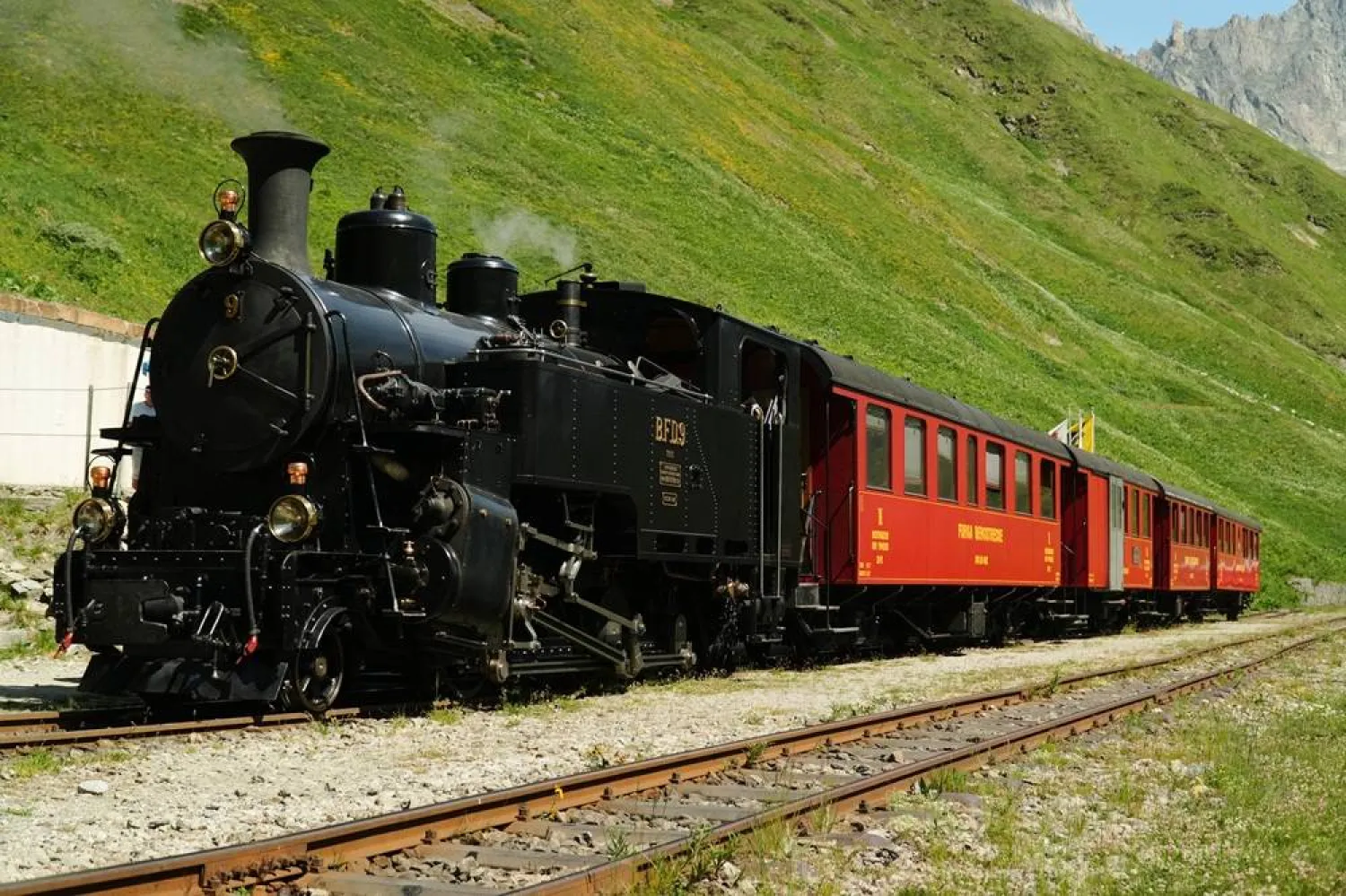
 One of DFB's historic steam trains travels from Realp to Oberwald during a stop at the Furka station, Switzerland, Friday, June 26, 2026. (AP)
One of DFB's historic steam trains travels from Realp to Oberwald during a stop at the Furka station, Switzerland, Friday, June 26, 2026. (AP)
TT

Steam Railway That Travels Through the Swiss Alps Celebrates Its 100th Anniversary

 One of DFB's historic steam trains travels from Realp to Oberwald during a stop at the Furka station, Switzerland, Friday, June 26, 2026. (AP)
One of DFB's historic steam trains travels from Realp to Oberwald during a stop at the Furka station, Switzerland, Friday, June 26, 2026. (AP)

Train enthusiasts will celebrate the 100th anniversary of a historic Swiss railway this weekend as vintage steam locomotives ferry tourists through the stunning Alpine scenery as part of the celebration.

The Furka Pass, at an altitude of 2,431 meters (7,976 feet), is among Switzerland's highest Alpine passes and famous for its hairpin curves featured in the 1964 James Bond “Goldfinger” movie.

But long before 007 actor Sean Connery filmed a harrowing car chase scene there, a steam train first traversed the steep and winding route in a continuous journey on July 3, 1926, kicking off a vital rail link between the regions of Uri and Valais in central Switzerland for decades.

In the early 1980s, a tunnel at the base of the Alps diverted rail traffic and prompted the closure of the historic mountain route until volunteers stepped in. Hundreds of them, nicknamed the railway's “pioneers,” have spent hours to restore, maintain and operate the historic tracks and trains so they run the same as a century ago.

The first section of the line reopened as a heritage railway in 1992, and the 18-kilometer (11-mile) track was ready for travel in 2010. The steam trains now operate exclusively as a tourist attraction in the summers between the stations of Realp and Oberwald, where visitors can hop aboard vintage carriages and marvel at the scenery of rivers, Alpine meadows and lush green pastures where patches of snow still linger.

Tourists last month enjoyed their trips through the German-speaking region aboard the “dampflokomotive.” Passenger Stephan Willareth called his journey “wonderful,” while Kurt Guldemann, a former employee of the Swiss railways, heralded the history of the machines.

Bernhard Lang, one of the many enthusiasts who volunteer to drive the vintage steam trains, said it can take years to master the skill.

“It’s something like a living machine, so you have to get kind of the feeling for it," he said. “To feel how it behaves, how it moves, how it smells, how it sounds.”

Jacob Kallert, a 21-year-old German transport engineering student and the youngest train manager, said it's important to listen to the locomotives.

“You hear every sound, you hear if everything is right," he said. “You can pretty much feel how it was then and how it is now.”

Volunteer Sergio Rovelli said anyone who has dedicated their time to the project gets hooked.

"We say, in German, that everyone who works here has the ‘Furka Virus, the Furka disease,’" he joked. “Once you come here, you like it, and you stay.”

A one-way ticket starts at 46 Swiss francs ($56.82) for a journey that lasts just under 2 1/2 hours. The anniversary celebration began Friday and continues through the weekend.


Chile-led Team Maps Antarctic Plant Genome in Step Towards Climate-resilient Crops

FILE PHOTO: A frozen section of the Ross Sea at the Scott Base in Antarctica on November 12, 2016. REUTERS/Mark Ralston/Pool/File Photo
TT

Chile-led Team Maps Antarctic Plant Genome in Step Towards Climate-resilient Crops

FILE PHOTO: A frozen section of the Ross Sea at the Scott Base in Antarctica on November 12, 2016. REUTERS/Mark Ralston/Pool/File Photo

A team led by Chilean researchers has produced the most complete genetic map yet of one of only two flowering plants that grow naturally in Antarctica, potentially helping the development of crops resistant to extreme weather.

Colobanthus quitensis has long attracted scientific interest because it can survive the freezing temperatures, lack of water and high levels of ultraviolet radiation in Antarctica, one of the planet's coldest and driest environments.

As record heat and extensive drought have increased the urgency of ⁠debate in many ⁠parts of the world over how to adapt agriculture, the scientists said they are now equipped to start assessing whether the plant's traits could be transferred to agricultural crops through gene-editing techniques.

The study, published in Oxford University Press journal "Genome Biology and Evolution," ⁠assembled all 40 chromosome-scale scaffolds that make up the plant's genetic blueprint under a project known as Polarix.

"We were able to sequence and assemble the entire genome," said Eduardo Castro, an associate researcher at Chile's Cape Horn International Center and lead author of the study alongside Claudio Meneses of Chile's Pontifical Catholic University.

"The idea is not to create transgenic plants. The idea is to edit the genome of a plant with ⁠nutritional ⁠value," Reuters quoted Castro as saying.

Identifying individual genes is easier once a genome has been mapped, but it can still take time. When that has been done, Castro said that scientists could need between five and 10 years to develop commercial applications.

A team in California supported the Chilean scientists, who said their work built on previous efforts by the Korea Polar Research Institute. That work produced only a partial version of the genome and was not published.


Stubborn Vulture Reportedly Plucked from Plane's Wing before Greece Flight

A vulture flies over the Iraty mountains, southwestern France on July 2, 2026. (Photo by Gaizka IROZ / AFP)
TT

Stubborn Vulture Reportedly Plucked from Plane's Wing before Greece Flight

A vulture flies over the Iraty mountains, southwestern France on July 2, 2026. (Photo by Gaizka IROZ / AFP)

A vulture who refused to budge had to be removed from the wing of a flight awaiting takeoff on the Greek island of Crete, in order to avoid potential damage to the plane, a local newspaper reported Monday.

The Patris daily said the incident occurred late Sunday at the island's Iraklio airport, when the fire service was called in to remove the large scavenger.

It pictured the bird tucked inside a jacket held by a firefighter. The report did not specify where the flight was headed.

Birds are routinely sucked into aircraft engines, occasionally causing serious accidents.

Last week, the US National Transportation Safety Board said bird remains had been found in the engine of a Ryanair plane that saw a blade break off on July 10, shattering a cabin window and partially sucking a passenger outside.

Four suspected bird strikes to the plane's engine had been reported by flight crews in the 12 months preceding the accident, but no damage was found in subsequent maintenance, the report said.


Indian Marble Waste Dump Becomes Unlikely Tourist Attraction

Tourists visit the marble-waste dumping yard in Rajasthan's Kishangarh city on August 16, 2026. (AFP)
TT

Indian Marble Waste Dump Becomes Unlikely Tourist Attraction

Tourists visit the marble-waste dumping yard in Rajasthan's Kishangarh city on August 16, 2026. (AFP)

A sprawling expanse of white marble waste in India is drawing tourists, filmmakers and social media enthusiasts to a landscape that looks more like a snow-covered valley than a dumping ground.

The site in Kishangarh, a major marble-processing hub in the northwestern state of Rajasthan, is blanketed in white slurry and discarded stone generated when marble and granite blocks are cut and polished.

Spread across 82 acres (33 hectares), it receives more than 5,500 tons of slurry every day from over 1,200 processing units, making it one of Asia's largest such disposal sites.

But the industrial wasteland has evolved into an unlikely attraction.

Couples pose among the chalk-white mounds for pre-wedding photographs, while filmmakers and music-video crews use the terrain as a backdrop.

Visitors ride horses across the undulating landscape, drawn by its unusual appearance.

Social media has fueled the site's popularity, with visitors comparing its gleaming surface to snowy alpine scenery.

After rainfall, water collects in depressions between the waste piles, forming vivid blue pools that accentuate the illusion of a mountain vista.

Authorities have repeatedly warned about the environmental impacts of marble waste disposal in the region, citing risks ranging from airborne dust to groundwater contamination.

Studies have detected elevated levels of salinity, hardness and some heavy metals in water from the surrounding area.

India's top environmental court ordered a series of corrective measures in January, including guidelines aimed at promoting the reuse of slurry instead of uncontrolled dumping.

"There is no engineered liner system, no decanting wells, no dust suppression mechanisms, no monitoring of air or groundwater, and no protective green belt," the tribunal said in its order.

But those dangers have not yet deterred crowds of visitors from soaking in the striking, otherworldly scenery.