


Iran’s Slain Leader Khamenei Laid in State in Tehran for Week of Mass Funeral Events

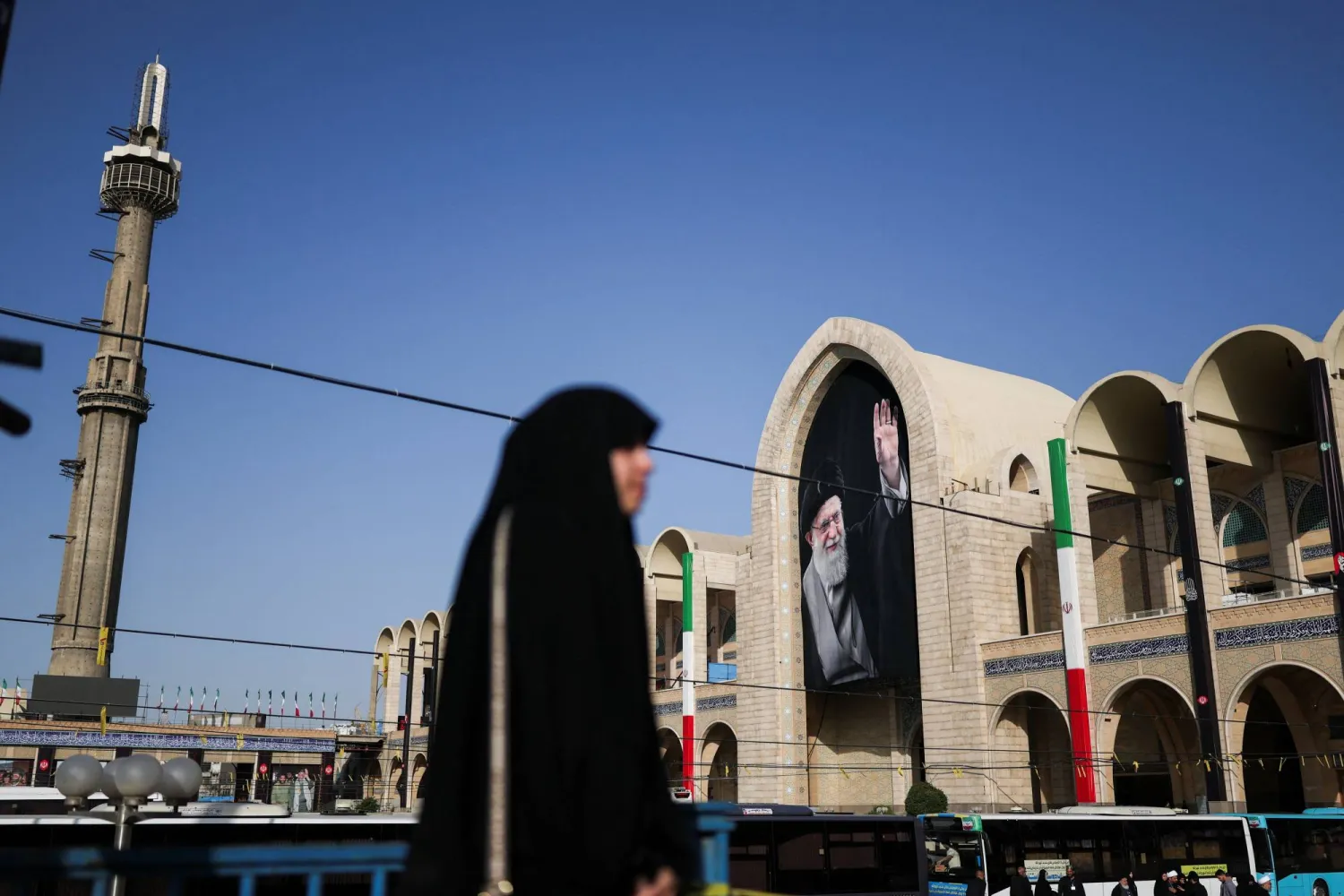
A woman walks at the Imam Khomeini Grand Mosalla on the day International delegates participate in a farewell ceremony for Iran's late Supreme Leader Ali Khamenei, who was killed on February 28 during Israeli and US airstrikes on Iran, in Tehran, Iran July 3, 2026. (Reuters)
TT

Iran’s Slain Leader Khamenei Laid in State in Tehran for Week of Mass Funeral Events

A woman walks at the Imam Khomeini Grand Mosalla on the day International delegates participate in a farewell ceremony for Iran's late Supreme Leader Ali Khamenei, who was killed on February 28 during Israeli and US airstrikes on Iran, in Tehran, Iran July 3, 2026. (Reuters)

The body of Iran's slain Supreme Leader Ali Khamenei was lying in state in a vast hall in Tehran on Friday as clerics, officials, foreign dignitaries and other mourners paid their respects after his 37-year rule.

Iran is staging a week of mass funeral processions for Khamenei — killed in February by US and Israeli airstrikes at the start of a four-month war — in a show of public devotion to the country's theocratic state and revolutionary fire.

Khamenei's body was expected to be taken to Qom, Najaf and Karbala, the great Shiite centers of Iran and Iraq, before being laid to rest on Thursday in Mashhad, home to the country's holiest shrine.

His coffin was unveiled late on Thursday to a throng of sobbing supporters, swaying and beating their heads in time to a sung lament as flowers were thrown from the bier into the crowd. On Friday the coffin — and those of family members killed with him — was laid in state in the great prayer hall built to honor his predecessor, Khomeini.

The funeral comes at a critical moment for Iran, where the clerical rulers backed by the Iranian Revolutionary Guard Corps are riding high from surviving what they saw as ‌an existential war against their ‌greatest and most powerful foes.

But nearly five decades after the 1979 revolution, and for all the official proclamations of ‌national ⁠unity in the ⁠run-up to Khamenei's funeral, the country has rarely been so internally fractured.

Support for the clerical leadership is paper thin, analysts say, and the new Supreme Leader, Khamenei's son Mojtaba Khamenei, has not been seen in public since being wounded in the strike that killed his father.

Years of crippling sanctions have paralyzed the economy as accelerating bouts of mass nationwide protests have been put down by security forces with increasing force, culminating in the killing of thousands of demonstrators in January.

Those deep problems have been brushed aside this week, with the authorities mounting a display of state power and mass support, mobilizing what they hope will be millions of mourners to take part in the funeral.

Tehran streets were tightly controlled, with military and police vehicles lining the major roads and police and members of the black-shirted volunteer Basij paramilitary force patrolling on motorbikes. Iran warned the United States and Israel against any attacks during ⁠the funeral.

After the coffins arrived on Friday, borne high across the upraised hands of a waiting crowd, they were laid ‌in the prayer hall on a white, stepped, dais before a high, intricately tiled, arched recess, flanked by ‌national and black mourning flags.

Delegations, including from Lebanon, Iraq and Yemen, home to the strongest proxies in Iran's network of regional power, followed each other into ‌the hall to stand before the coffins.

Representatives from Russia and China were expected to attend. Iraqi President Abdul Latif Rashid, Armenian Prime Minister Nikol Pashinyan and Pakistani Interior Minister Syed Mohsin Naqvi arrived in Tehran for the funeral.

Families of Hezbollah leader Hassan Nasrallah and senior commander Imad Mughniyeh, close Lebanese allies of Iran killed in Israeli strikes, attended the ceremony.

In central Tehran overnight, a crowd stood sobbing and chanting, led by a Basij member, as others handed out posters of the late Khamenei.

"God willing, only by avenging his blood, demanding justice for it, and ensuring that our leader's blood is not left unavenged, can this sorrow of the people be somewhat alleviated," said Mobina Razaaghi, an 18-year-old student from Isfahan, attending the funeral events with classmates.

Killed alongside Khamenei, and displayed in coffins next to his, were his daughter, son-in-law and baby granddaughter, as well as the wife of his son Mojtaba.

Burials are meant to be conducted within a day of death in Islam, but because of the risks of holding a big funeral during the war it was postponed until after last month's interim truce deal was agreed.

Hotels are offering 50% discounts, schools, mosques and sports halls have been prepared to house mourners, and bus and rail networks are being diverted to serve the main events.

After what authorities are billing as a massive procession in central Tehran on Monday, the remains will be taken to the seminary city of Qom for ceremonies on Tuesday.

Ceremonies will then be held in Iraq's shrine cities of Najaf and Karbala on Wednesday with prominent attendees from Iran's regional network of proxies.

He will be buried on Thursday, after another procession, in Mashhad.


Poland Says Fire at Starlink Station is Act of 'Sabotage'

FILE PHOTO: An evening launch of a SpaceX Falcon 9 rocket carrying 22 Starlink satellites to low-Earth orbit is seen over the Pacific Ocean from Encinitas, California, US, April 1, 2024.  REUTERS/Mike Blake/File Photo
FILE PHOTO: An evening launch of a SpaceX Falcon 9 rocket carrying 22 Starlink satellites to low-Earth orbit is seen over the Pacific Ocean from Encinitas, California, US, April 1, 2024. REUTERS/Mike Blake/File Photo
TT

Poland Says Fire at Starlink Station is Act of 'Sabotage'

FILE PHOTO: An evening launch of a SpaceX Falcon 9 rocket carrying 22 Starlink satellites to low-Earth orbit is seen over the Pacific Ocean from Encinitas, California, US, April 1, 2024.  REUTERS/Mike Blake/File Photo
FILE PHOTO: An evening launch of a SpaceX Falcon 9 rocket carrying 22 Starlink satellites to low-Earth orbit is seen over the Pacific Ocean from Encinitas, California, US, April 1, 2024. REUTERS/Mike Blake/File Photo

A fire broke out at a Starlink satellite communications station in central Poland overnight, the digital affairs minister said on Thursday, calling the blaze an act of "sabotage."

"This act of sabotage was deliberately designed to disable the station ... disrupting internet access for various institutions, including the Ukrainian army," Krzysztof Gawkowski told Polish public broadcaster TVP Info, adding that the fire broke out late on Wednesday and that the station was still operational.

"There is much to suggest that we are dealing with an element of the next phase of hybrid warfare," he added, according to AFP.

The station, owned by state-owned telecommunications company Exatel, is used, among other things, to transmit internet traffic through Poland, including to Ukraine, according to the minister.

It is also used by SpaceX systems that provide connectivity via Starlink terminals.

Gawkowski said that the investigation was ongoing into the causes of the blaze, "many indications suggest that it fits into this new Russian doctrine of attack.”

Poland, a NATO and EU member state along the alliance's eastern flank, has accused Russia of "sabotage" on several occasions since Moscow's full-scale invasion of Ukraine in 2022.

Poland has become the main hub for transporting Western military and humanitarian support to Kyiv.

Earlier this month, Prime Minister Donald Tusk warned that Russia's plans in the war against Ukraine include "hybrid" drone and missile strikes against Kyiv's allies.


Pakistan Says It Launched Air Strikes on Afghanistan over Drone Attacks

FILE PHOTO: Afghan Taliban fighters patrol near the Afghanistan-Pakistan border in Spin Boldak, Kandahar Province, following exchanges of fire between Pakistani and Afghan forces in Afghanistan, October 15, 2025. REUTERS/Stringer/File Photo
TT

Pakistan Says It Launched Air Strikes on Afghanistan over Drone Attacks

FILE PHOTO: Afghan Taliban fighters patrol near the Afghanistan-Pakistan border in Spin Boldak, Kandahar Province, following exchanges of fire between Pakistani and Afghan forces in Afghanistan, October 15, 2025. REUTERS/Stringer/File Photo

Pakistan conducted airstrikes on 10 locations in Afghanistan that it said were being used to launch and store drones, some of which had been used against Pakistan a day earlier, Information Minister Attaullah Tarar said on Thursday.

The strikes come as tensions escalate between the allies-turned-foes, ‌who have long ‌been at odds over attacks by extremist militants, ⁠which also triggered ⁠their worst fighting in years in February.

Islamabad accuses Kabul of harboring militants who stage cross-border attacks, but Afghanistan's Taliban government denies harboring anti-Pakistani insurgents and says militancy is Pakistan's internal problem.

Pakistan's air defense systems detected drones launched from Afghan territory on Wednesday, which were tracked and neutralized before they could reach any of their ⁠intended targets, Tarar said in a post on X.

Pakistan ‌then conducted the "precision aerial and ‌drone strikes" on 10 locations, which were "limited to identified military objectives" linked ‌to the attempted attacks, he said.

"Any further provocative act ‌by Afghan Taliban will be responded with firm and resolute response," the minister said.

The Pakistani airstrikes were conducted in several areas of the southeastern Khost province, Mustaghfir Gurbaz, spokesperson for the Khost governor, said.

There were ‌no casualties, he said.

An attack on a police facility in northwestern Pakistan last week, which ⁠killed at ⁠least 24 people, has reignited fighting between the countries after nearly three months of relative calm.

Pakistan's government earlier this week also said it had launched airstrikes in the Afghanistan-Pakistan border region, killing 28 militants, while Afghan Taliban officials accused Islamabad of killing three civilians in overnight strikes on Afghan territory.

The worst single incident, however, occurred in March, when more than 400 people were killed in a Pakistani airstrike on Kabul, which the Afghan Taliban said hit a drug rehabilitation center.

Islamabad denied the charge, saying it "precisely targeted military installations and terrorist support infrastructure".


US Judge Orders White House to Restore Access to News Outlets Trump Banned

23 September 2026, US, Washington: US President Donald Trump arrives back at the White House aboard Marine One after travelling to Joint Base Andrews to welcome Chinese President Xi Jinping. Photo: Matt Kaminsky/ZUMA Press Wire/dpa
TT

US Judge Orders White House to Restore Access to News Outlets Trump Banned

23 September 2026, US, Washington: US President Donald Trump arrives back at the White House aboard Marine One after travelling to Joint Base Andrews to welcome Chinese President Xi Jinping. Photo: Matt Kaminsky/ZUMA Press Wire/dpa

A federal judge early Thursday temporarily blocked President Donald Trump’s move to ban three news outlets from the White House grounds and said CNN, MS NOW and Politico must have their access restored.

It's the latest development in an escalating showdown between President Donald Trump and media outlets whose coverage he dislikes. Trump announced he was banning the outlets Sept. 18, assailing what he called “fake news.” More recently, the president has said negative coverage was dangerous for the country.

The outlets argued they were singled out because of the content of their coverage — in other words, viewpoint discrimination — and called the ban a “blatant violation” of the First Amendment.

In an order posted shortly after midnight, US District Judge Timothy Kelly said the media outlets had met the legal thresholds needed to obtain a temporary restraining order, which include likelihoods of succeeding on the merits of the case and of suffering irreparable harm without an order.

“This is a high bar, but Plaintiffs have met it,” he wrote, according to The Associated Press.

US District Judge Timothy Kelly — who Trump nominated in 2017 and who ordered a CNN journalist’s access restored in a similar case in 2018 — heard arguments Wednesday and ended the hearing without ruling.

On Thursday, he issued a temporary restraining order that will be in effect for 14 days. Such orders are typically designed to preserve the status quo pending a closer review of the case by the court.

During the hearing, Kelly questioned whether the administration had met its legal responsibilities and provided CNN, MS NOW and Politico with adequate due process before banning them.

The rulings in two prior cases over press access, including one that went to the US Supreme Court, made it clear that journalists were entitled to an opportunity to be heard before they have their press passes revoked.

Justice Department attorney Michael Velchik argued that the rulings in the earlier cases were wrong.

The judge noted that his decision would be guided by prior rulings in comparable First Amendment cases, even if the government disagrees with them.
