

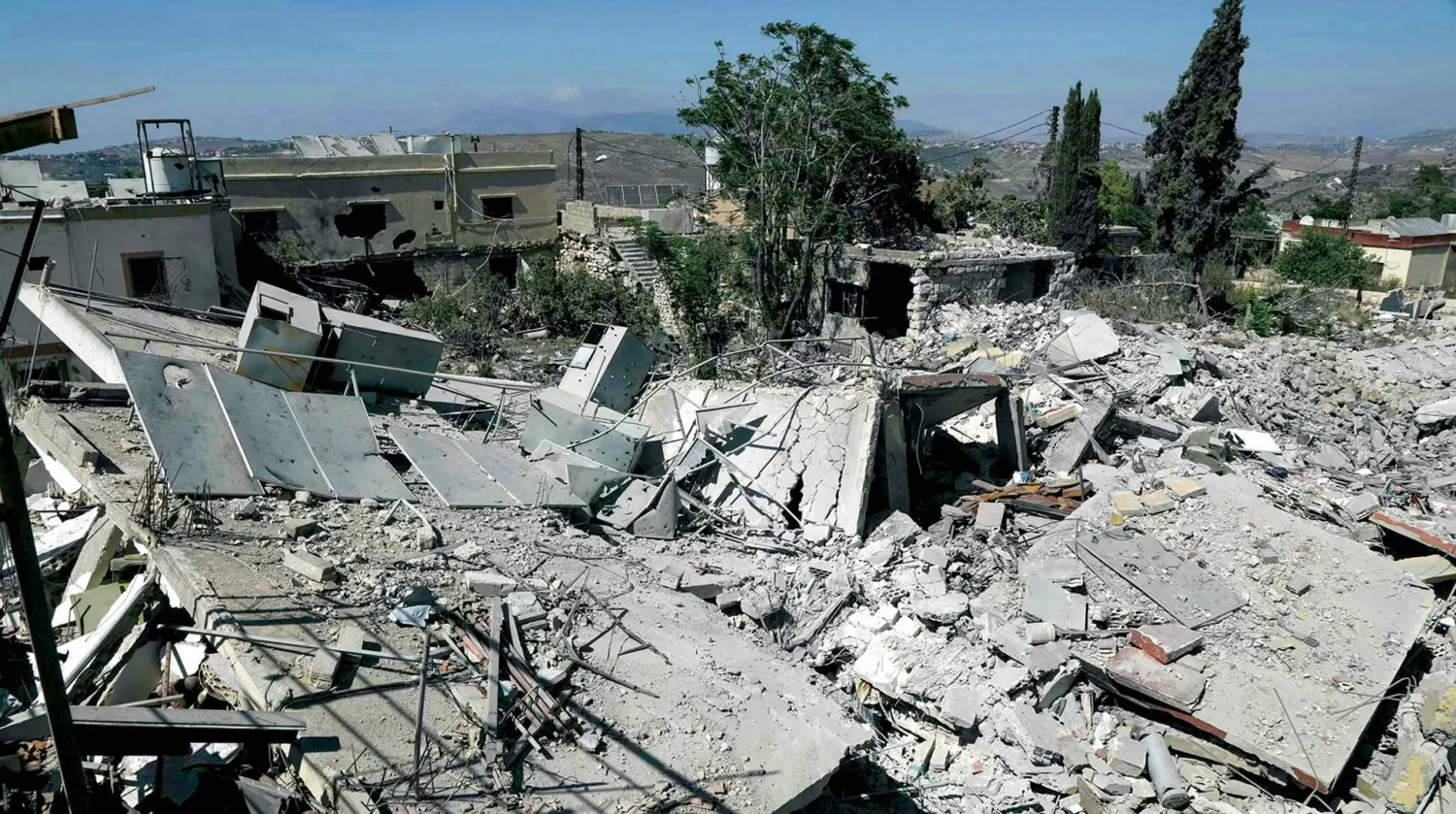

Demolitions in South Lebanon as Israel Redraws Border Strip

This picture shows the destruction in the southern Lebanese village of Froun on June 30, 2026. (Photo by Kawnat HAJU / AFP)
TT

Demolitions in South Lebanon as Israel Redraws Border Strip

This picture shows the destruction in the southern Lebanese village of Froun on June 30, 2026. (Photo by Kawnat HAJU / AFP)

Israel has revived its policy of wide-scale demolitions in southern Lebanon, with the Israeli army blowing up sites on Thursday and Friday in the towns of Hadatha, Beit Yahoun, Kounine, al-Tiri and Kfar Tibnit.

The operations coincided with air strikes, artillery fire, heavy warplane and drone flights, and attacks around Arnoun-al-Shaqif, Nabatieh al-Fawqa and Yater.

An Israeli drone also struck a vehicle in Siddiqin, in Tyre district, in two consecutive attacks, wounding two people. Israeli drones dropped stun grenades in Safad al-Battikh and al-Mansouri, with no casualties reported.

The Israeli army said it killed a Hezbollah member in the Ali al-Taher heights, saying he was detected as he emerged from an underground facility and was hit in an air strike.

It also said the Givati Brigade had ended its mission in southern Lebanon after eight months of operations, saying it had destroyed hundreds of Hezbollah infrastructure sites.

As the escalation unfolded, Israeli military spokesperson Ella Waweya said the air force struck about 10 sites it described as Hezbollah infrastructure in Bint Jbeil, Beit Yahoun, Kounine and Baraachit.

She said forces from the 91st Division also targeted a truck overnight near the security zone, saying it was carrying weapons for Hezbollah and that secondary explosions after the strike pointed to ammunition inside.

The operations come as Lebanon awaits the implementation of the first phase of the “framework agreement,” which is meant to open the way for gradual Israeli withdrawals.

But no practical steps have been taken, while Israel’s military presence, bulldozing and demolition work continue, raising questions over whether the operations are preparing for withdrawal or redrawing the security reality in the south.

Facts on the ground suggest the campaign goes beyond targeting Hezbollah sites or tunnels. It points to a re-engineering of the border area by removing anything that could be used militarily and turning border villages into devastated zones where life would be difficult to restore.

Removing anything that can be used militarily

Retired Brig. Gen. Saeed Qozah told Asharq Al-Awsat that the large-scale demolitions carried out by the Israeli army in Hadatha, Beit Yahoun, al-Tiri and around Kounine did not appear to be isolated operations.

“Rather, they fall within a military plan aimed at clearing the areas Israel now controls of any military infrastructure that could pose a future threat, especially tunnels, ammunition depots and facilities that could be reused,” he said.

Qozah said the towns fall within what Israel now regards as a security zone. The Israeli army, he said, is combing through them “inch by inch,” so that if it is forced to withdraw at any stage, it does not leave behind tunnels, weapons depots or facilities that armed groups could later use.

“The Israelis have announced in recent days that they discovered tunnels in several areas. They had also previously blown up a large tunnel in Majdal Zoun, causing a powerful tremor.

So it is natural that they continue to blow up any tunnel or military facility they find inside the areas they control, because their goal is to remove anything that could pose a future threat to them,” he said.

He told Asharq Al-Awsat that the Israeli army seizes the equipment and weapons it finds, while destroying facilities, tunnels and depots to prevent them from being used again. The pace of demolitions, he added, is “likely to continue as long as surveying and military engineering operations last inside these areas.”

Qozah said developments in the battlefield, together with the installation of military gates and repeated Israeli statements about not withdrawing from the areas it has occupied, show that Israel is moving to entrench a new security belt in southern Lebanon.

“The installation of gates, the continued demolition operations and the insistence of Israeli officials, foremost among them Benjamin Netanyahu and Israel Katz, on remaining in what they call the security zone are all signs that Israel is working to create a security belt that closely resembles the belt that existed between 1982 and 2000,” he said.

The main difference between the previous security belt and what is happening today is that villages inside this zone have suffered sweeping destruction, making it easier for the Israeli army to impose control and reducing the chances of resistance operations against its positions, he added.

From removing tunnels to preventing life from returning

Retired Brig. Gen. Bassam Yassin told Asharq Al-Awsat that the Israeli army’s return to wide-scale demolitions in southern Lebanese towns, especially Hadatha, Beit Yahoun, Kounine and al-Tiri, “does not fall only within the framework of targeting Hezbollah’s military infrastructure, but reflects Israel’s move into a new phase of cementing facts on the ground in the areas it controls.”

Yassin said Israel is working to turn the strip it occupies into a buffer zone stripped of the basic conditions for life.

“The goal is not only to remove military sites or facilities, but to prevent any sign of life from remaining inside this area, because rebuilding it will take many years, making the return of residents more difficult,” he said.

He added that the widespread destruction also serves a direct military purpose: securing full freedom of movement for Israeli forces inside the occupied area.

Removing buildings and urban infrastructure exposes the terrain to the Israeli army and limits any future ability to use it for military operations or fortified positions, ensuring Israeli forces retain freedom of maneuver.



UN Says Only 3% of Gaza Cropland Accessible and Undamaged

Salvage workers shovel the scrapped rubble of a building that was destroyed during Israel's war against Hamas in Gaza, to use the recycled remains in the future, in Gaza City on August 16, 2026. (Photo by Omar AL-QATTAA / AFP)
TT

UN Says Only 3% of Gaza Cropland Accessible and Undamaged

Salvage workers shovel the scrapped rubble of a building that was destroyed during Israel's war against Hamas in Gaza, to use the recycled remains in the future, in Gaza City on August 16, 2026. (Photo by Omar AL-QATTAA / AFP)

Just three percent of the cropland in Gaza remains accessible and undamaged, the UN's Food and Agriculture Organization warned Tuesday, citing an analysis of satellite images.

The report found that since October 2025, when a fragile ceasefire between Israel and Hamas took hold, the area of accessible and undamaged cropland had fallen to 448 hectares from 601 hectares, a reduction of 25.5 percent, said AFP.

Another 3,643 hectares of cropland are accessible but too damaged to be farmed without rehabilitation, the FAO said.

"Without urgent action to restore safe access and provide farmers with the support they need, opportunities to restore local food production will continue to diminish," said Rein Paulsen, director of the agency's Office of Emergencies and Resilience.

Restrictions on the import of agricultural goods are also hampering recovery, with livestock farmers struggling to obtain animal feed and veterinary supplies.

Greenhouse availability has also declined, dropping 17.3 percent since October 2025 to 224 hectares that are accessible and undamaged.

The FAO said the reduced access could be explained mainly by the westward expansion of the so-called "Yellow Line" that separates the ceasefire zone from the area controlled by the Israeli military.

The Palestinian militant group Hamas launched an attack on Israel on October 7, 2023, that resulted in the deaths of 1,221 people, according to an AFP tally based on official Israeli figures.

Militants also took 251 hostages to Gaza.

Israel's retaliatory military campaign in Gaza has killed more than 73,000 people, according to the territory's health ministry, which operates under Hamas authority and whose figures are considered reliable by the United Nations.

A ceasefire took hold in October 2025 but progress on permanently ending the war has stalled, and Israeli forces currently control nearly 70 percent of the territory.

Before October 2023 agriculture accounted for about 10 percent of Gaza's economy and supported the livelihoods of more than 560,000 people, according to the FAO.


Syria Says 3 Dead in Hydrogen Tank Blast at Coastal Power Plant

The Banias power plant. (Tartus Governorate on Facebook)
TT

Syria Says 3 Dead in Hydrogen Tank Blast at Coastal Power Plant

The Banias power plant. (Tartus Governorate on Facebook)

A hydrogen tank explosion at a power plant in western Syria killed three people on Tuesday, an electricity company official said.

Alaa Sawda, head of the Syrian Electricity Company's media department told the official SANA news agency that "the explosion at the Banias thermal power plant was caused by maintenance work on the hydrogen tank, and occurred during the replacement of the tank's float valve, resulting in the death of three workers".

"The station continues its operations and was not affected by the explosion," he added.

SANA had initially reported "an explosion in the thermal power plant in Banias" with the cause under investigation.

It cited a regional health official as saying the blast resulted in three deaths.

Banias's thermal plant, located in the western Tartus province, is one of the most important electrical facilities in Syria.

Syria's dilapidated electricity sector suffered heavy blows during the country's civil war with heavy damage to its infrastructure, leading to power cuts that can last up to 20 hours a day.

Since the ousting of longtime ruler Bashar al-Assad in 2024, the new Syrian authorities have repeatedly vowed to increase electricity production.


Hamas Says It Is Committed to Gaza Deal After Kushner’s Israel Visit

 Palestinians walk amid the ruins of buildings destroyed by Israeli airstrikes during the war with Hamas, in Gaza City, Monday, Aug. 17, 2026. (AP)
Palestinians walk amid the ruins of buildings destroyed by Israeli airstrikes during the war with Hamas, in Gaza City, Monday, Aug. 17, 2026. (AP)
TT

Hamas Says It Is Committed to Gaza Deal After Kushner’s Israel Visit

 Palestinians walk amid the ruins of buildings destroyed by Israeli airstrikes during the war with Hamas, in Gaza City, Monday, Aug. 17, 2026. (AP)
Palestinians walk amid the ruins of buildings destroyed by Israeli airstrikes during the war with Hamas, in Gaza City, Monday, Aug. 17, 2026. (AP)

Hamas said on Tuesday it remained committed to the US-backed Gaza peace deal after White House envoy Jared Kushner spoke to Israel about steps towards the group's disarmament.

"Hamas is committed to this agreed-upon process. It is clear that, so far, the Israeli side has not given the mediators clear approval of the roadmap," Hamas spokesman Hazem Qassem told AFP.

"There are timelines and procedural steps that need to be worked out in detail, but there must first be Israeli approval of the roadmap," he said.

Kushner, President Donald Trump's son-in-law, held a rare meeting with Hamas on Sunday in Egypt before meeting the following day in Jerusalem with Israeli Prime Minister Benjamin Netanyahu, who has publicly rejected the latest phase of the deal.

Kushner, in a Fox News interview after the talks, said that Hamas's disarmament could begin in about 30 days and that reconstruction of Gaza would not begin until that happens.

Kushner also said that the United States is "not going to restrict Israel's right to defend itself if there are any imminent threats" in Gaza.

Netanyahu has demanded that Hamas fully disarm. In his talks with Kushner, the two sides agreed that a US general would oversee the surrender of weapons, according to an Israeli official.

Trump's Board of Peace implementing the deal has also told Netanyahu that Israel does not need to start withdrawing from Gaza until full disarmament, walking back an earlier call for Israel to start a phased pullout.

Israel has kept up airstrikes in Gaza despite the peace push.

The Israeli military said Tuesday that a strike two days earlier had killed a commander of the Islamic Jihad group who was responsible for abducting an Israeli during the October 7, 2023, attack that triggered the war.

Israeli operations have killed at least 1,265 Palestinians since a ceasefire came into effect on October 10, according to figures from Gaza's health ministry, which operates under Hamas authority and whose figures are considered reliable by the United Nations.

The Israeli army has reported five deaths in its ranks from Gaza operations over the same period.