Australia Welcomes Draft UNESCO Decision to Keep Great Barrier Reef Off Danger List

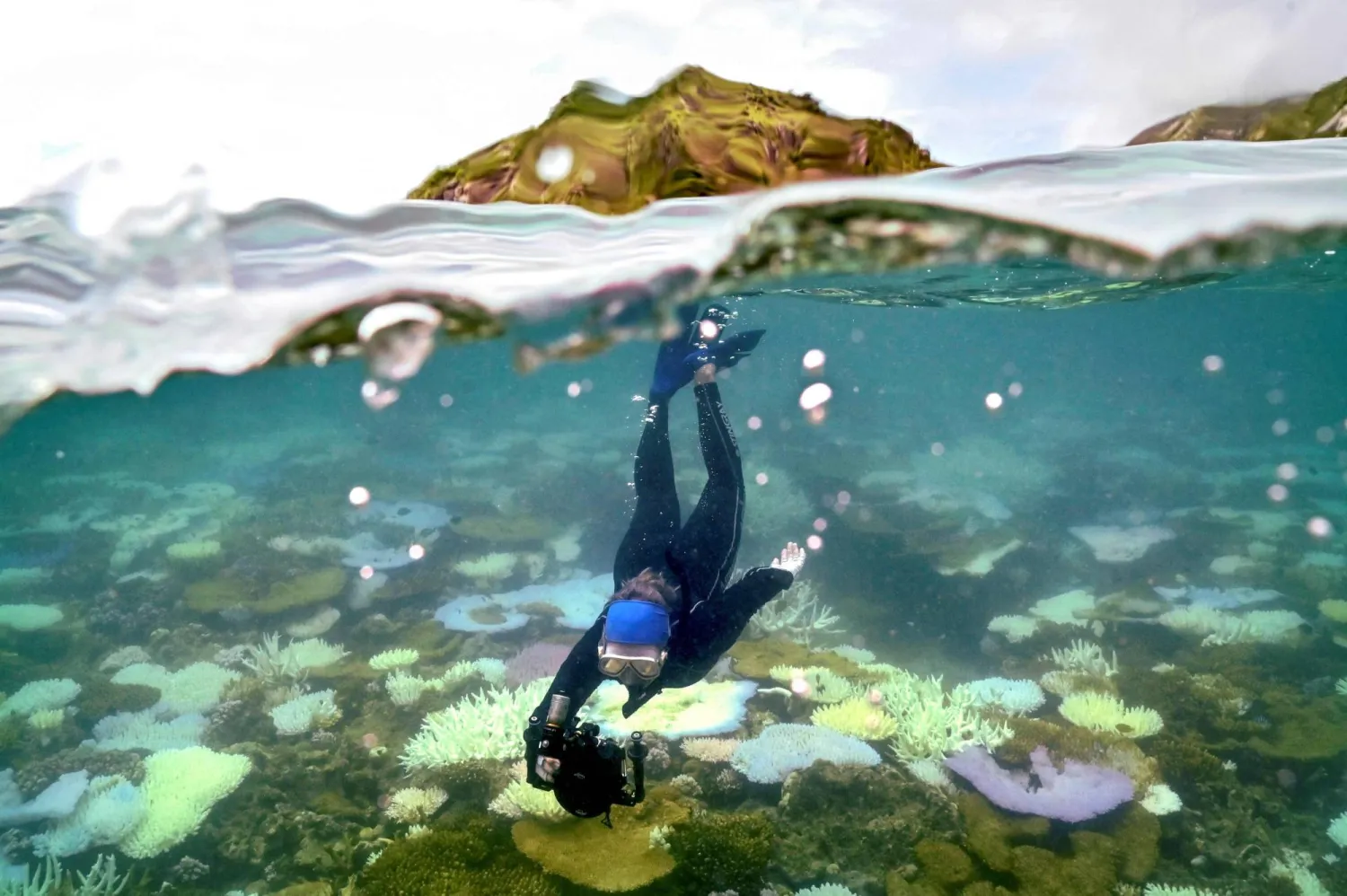
(FILES) In this underwater photo taken on April 5, 2024, marine biologist Anne Hoggett snorkels to inspect and record bleached and dead coral around Lizard Island on the Great Barrier Reef, located 270 kilometres (167 miles) north of the city of Cairns. (Photo by DAVID GRAY / AFP)
TT

Australia Welcomes Draft UNESCO Decision to Keep Great Barrier Reef Off Danger List

(FILES) In this underwater photo taken on April 5, 2024, marine biologist Anne Hoggett snorkels to inspect and record bleached and dead coral around Lizard Island on the Great Barrier Reef, located 270 kilometres (167 miles) north of the city of Cairns. (Photo by DAVID GRAY / AFP)

Australia welcomed a draft UNESCO decision not to list the Great Barrier Reef as an endangered site, its assistant tourism minister said on Saturday, despite ongoing struggles of the world's biggest coral reef ecosystem with coral bleaching.

The reef, which has suffered several mass coral bleaching events in recent years, is not currently on the United Nations Educational, Scientific and Cultural Organization (UNESCO) list of world heritage sites that are in danger, although UN scientists have previously ⁠recommended that it ⁠should be added.

Australia's government has lobbied for years to keep the reef - which contributes more than A$9.0 billion ($6.25 billion) to the economy annually - off the list, as it could damage tourism at the site, which receives more than ⁠2 million visitors each year.

Assistant Tourism Minister Nita Green said the decision overnight by the UNESCO World Heritage Centre "recognizes Australia's continued efforts to protect and manage this important icon,” Reuters reported.

"Australia welcomes UNESCO's decision to not list the reef as endangered, and recognize all of the work that's been going into protecting the reef," Green said in televised remarks from the capital Canberra.

The reef, home to 400 ⁠types ⁠of coral and 1,500 species of fish, stretches for some 2,400 km (1,500 miles) off the coast of the northern state of Queensland.

Since 2016, it has experienced five summers of mass coral bleaching, when large sections of the reef turn white due to heat stress, putting them at greater risk of death. Climate change is a primary driver of rising sea temperatures which cause coral bleaching, according to the Queensland government.


India Stirs Up Its Gastronomy with French Cooking Schools

The boom in French cooking schools in India reflects a growing demand for high-end hospitality workers in the world's most populous country. Arun SANKAR / AFP
TT

India Stirs Up Its Gastronomy with French Cooking Schools

The boom in French cooking schools in India reflects a growing demand for high-end hospitality workers in the world's most populous country. Arun SANKAR / AFP

Fiercely proud of its culinary traditions, India is increasingly open to foreign influences, with French cooking schools attracting students eager to make their mark on the country's growing fine-dining sector.

"Ten or 15 years ago, there were far fewer young people dreaming of becoming chefs," said Aabhas Jain, director of bakery and pastry training at Ecole Ducasse, a French culinary school also operating in India.

"But with the rise of social media... today's students have greater ambitions in this profession," added Jain, 36, who is also part of the Indian School of Hospitality (ISH) in Gurugram, just outside New Delhi.

In the world's most populous country, the need for high-end hospitality workers is immense, fueled by economic growth and the rise of a middle class that travels more and increasingly eats at plush establishments.

"There are plenty of job opportunities," said Saurav Chhabra, head of French hotel school Vatel's Indian campus, which has been based in Gurugram since 2015 in partnership with Sushant University.

"Employers' expectations are very high, particularly in five-star hotel chains."

- 'Braising, blanching' -

Culinary and pastry courses, once relatively rare in India, have proliferated over the past decade, with foreign private schools helping drive its high-end hospitality sector.

Such is the enthusiasm that France is considering opening vocational schools, notably in Puducherry, the former French colonial port in India's southeast.

Ecole Ducasse has more than 600 students, most from affluent backgrounds.

Indian chefs who have worked at prestigious restaurants, including overseas, teach their respective specialties: Indian, European, Mediterranean and Asian cuisine, as well as bakery and pastry-making.

Siddhant Marwah, a final-year student, joined the school to acquire "French techniques that represent the quintessence of culinary expertise."

As he puts the finishing touches to a gratin dauphinois -- a dish of sliced potatoes baked in cream -- he explains that French and Indian cuisines share techniques such as "braising, blanching, and slow cooking in stews."

While France boasts its beef bourguignon, India is not to be outdone with goat nihari, a meat dish cooked for hours in a spicy broth.

Drawn by the opportunities for travel and meeting people that a career as a chef offers, Marwah already dreams of opening his own restaurant in India.

Nearby, Amitabh Sukhwal has just enrolled at Vatel, whose tuition fees are considerably lower than those at Ecole Ducasse.

The school has around 120 students, many from modest backgrounds.

Sukhwal, 18, who calls himself a "lover of the French language", plans to go to France in four years to pursue a master's degree, gain experience abroad and then draw on it to open his own hotel in India.

He learned French through interactions with guests at the small hotel run by his parents in Chittorgarh, Rajasthan and is now honing his skills at his new school, where French-language classes are compulsory.

- 'In vogue' -

A majority of the students interviewed by AFP at the two schools plan to remain in India.

After working for many years in India's luxury hotels, chef Shikha Gupta, who teaches bakery and pastry-making at Vatel, is pleased to see her classes have "as many men as women."

"Over the past 10 to 12 years, attitudes have changed and many women have chosen to enter the culinary profession," said Ecole Ducasse's Aabhas Jain.

"We now see near parity, or even a ratio of 60 percent women to 40 percent men."

Anusha Nagia, who joined Ecole Ducasse in 2024, hopes to open a restaurant in India and one day earn a Michelin star, perhaps by betting on fusion cuisine, which is "very much in vogue."

While chicken chasseur is one of her favorite French dishes, she fondly recalls a galantine -- a French preparation of stuffed meat -- in which she and her classmates incorporated the spicy flavors of chicken tikka.


No More Taking Out the Trash at Your Airbnb

A general view of apartment and office buildings in Hanoi, Vietnam, 21 October 2026. EPA/LUONG THAI LINH
TT

No More Taking Out the Trash at Your Airbnb

A general view of apartment and office buildings in Hanoi, Vietnam, 21 October 2026. EPA/LUONG THAI LINH

The days of having to take out the trash or wash the dishes before leaving an Airbnb are numbered as the short-term rental platform is tightening rules on what conditions hosts may impose on guests.

"Our rules regarding accommodations allow travelers to receive guidelines from hosts; however, our community has let us know that they can be confusing, restrictive, and difficult to manage," Airbnb said Thursday to AFP.

New rules published this week that will apply to reservations made from November 20 will seek to reduce that confusion.

In particular the new rules will generally prohibit hosts from asking guests "to complete tasks that require significant effort or time, or would typically be performed by a cleaner, including stripping the bed, taking trash offsite, or washing and putting away dishes."

Hosts can still ask guests to put dirty dishes in the sink or separate trash and recyclables.

Hosts will also no longer be able to impose fines or penalties on guests, who instead must seek compensation for any damage from insurance provided through Airbnb.


Champion-chip: Best Fries Contest Heats Up Belgium

Fries are a national passion in Belgium. Nicolas TUCAT / AFP
TT

Champion-chip: Best Fries Contest Heats Up Belgium

Fries are a national passion in Belgium. Nicolas TUCAT / AFP

Thick or thin, greasy or crispy, with samurai sauce or a more traditional mayo dip? A TV show has been on a quest to find the best fries in potato-mad Belgium.

For four years running "La meilleure friterie" (the best chip shop), a lighthearted culinary competition aired by broadcaster RTL-TVI, has been seeking out perfection among fry peddlers in the country's French-speaking region.

Watching it is a "sacred Thursday night ritual", said David Antoine, the host.

Crowning a winner among a dozen contestants is no picnic.

"There's sometimes friction among the judges, but we always find that famous Belgian compromise" over a portion of fries, Antoine told AFP in a joking reference to the country's penchant for lengthy political negotiations.

Fried potatoes are a national dish and symbol of pride in Belgium, home to about 4,600 diners specializing in the dish known as "friteries" in French or "frituren" in Flemish.

That number "has remained stable for many years," said Bernard Lefevre of the National Chip Shop Union, an industry group, noting the "market is doing well".

Each has its own flair.

To Lefevre, a good chip is preferably cut from a Belgian potato of the Bintje variety and double fried in beef fat. And size is paramount.

"Anything under nine millimeters is too thin and anything over fourteen is too thick," he explained.

- Hand-peeled 'gold' -

At Hill's Burger, a diner in Brussels, chef Massimo Sefa has gone for a "size twelve" -- that is "a two-millimeter crust and ten millimeters of creamy flesh", he said.

The 23-year-old smiled nervously when the TV show's judges entered his joint and the cameras started rolling.

But the stress is worth it, he explained. The broadcast will shine a spotlight on his friterie and a win would likely send sales skyrocketing.

Sefa opened up shop with his two younger brothers, Lorenzo and Marco. For them chips are a family matter: their grandfather ran about 10 chip shops in Brussels.

"Wow, delicious, crispy, and peeled by hand," Fabienne De Corte, one of the judges, raved upon tasting the goods.

"Fries in Belgium are our gold," added her husband Patrick De Corte, who is also on the judging panel.

"Every little detail makes a difference."

The show has a devout following, including some who tag along for filming sometimes dressed as fry cones and chanting "We've got the fries, we've got the potatoes!".

It has also had its share of controversies, particularly on the hot topic of sauces.

A technical glitch caused trouble during public voting in the first season and some grumbled the winner had bamboozled jurors with dazzling sauces, while the fries were not to everyone's taste.

Still the show has established itself in the French-speaking Belgian media landscape at a time where fries are sometimes changing along with Belgian society.

"There are halal, vegetarian, and vegan fry shops -- that's perfectly normal; society is evolving. We're not a museum of bygone folklore," Lefevre insists.