


Heavy Rains Leave 5 Dead in China’s North While Tropical Storm Maysak Hits the South and Vietnam

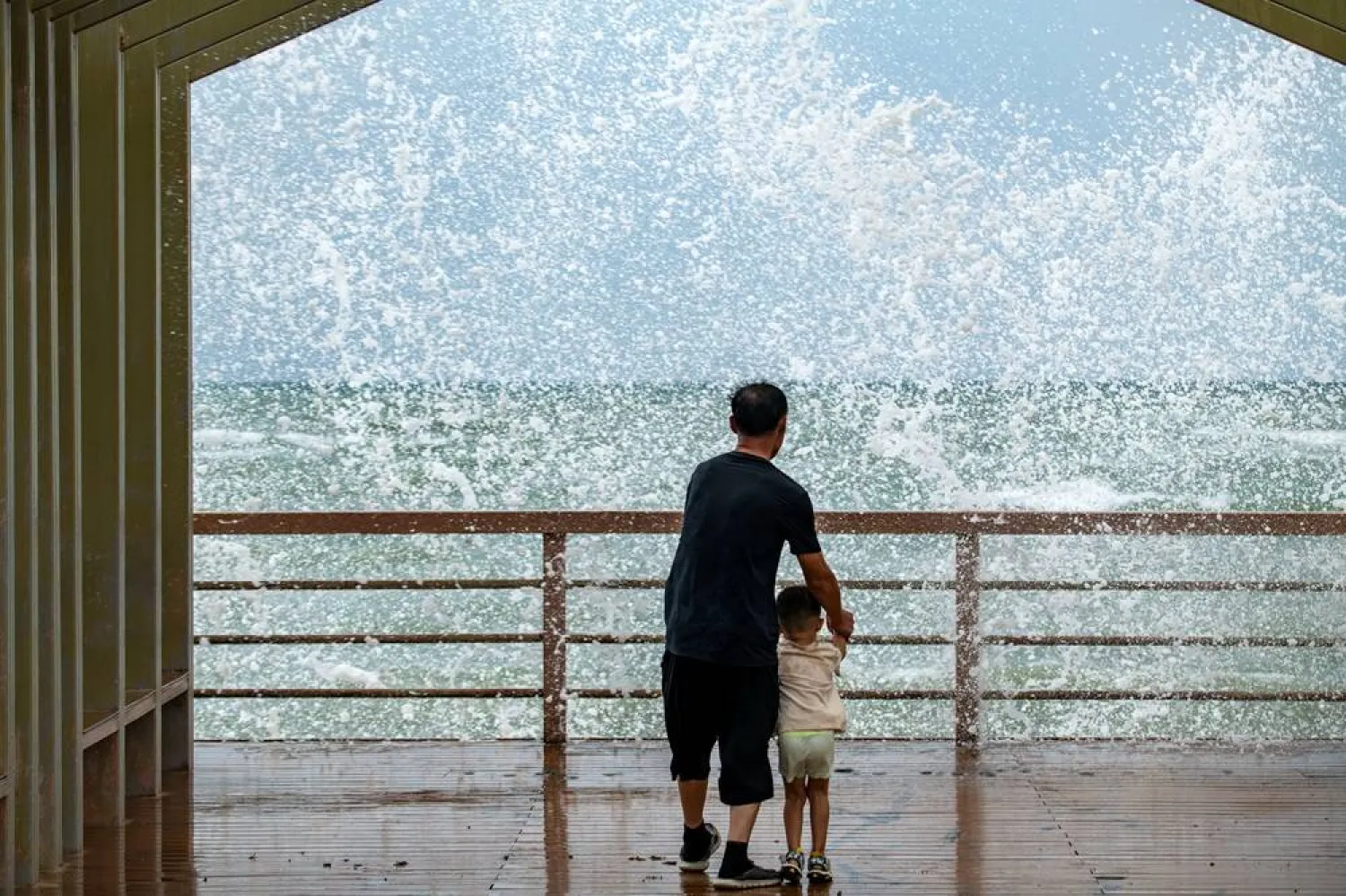
People watch waves crashing against the shore as Tropical Storm Maysak approaches in Boao, Qionghai, Hainan province, China, July 3, 2026. (cnsphoto via Reuters)
TT

Heavy Rains Leave 5 Dead in China’s North While Tropical Storm Maysak Hits the South and Vietnam

People watch waves crashing against the shore as Tropical Storm Maysak approaches in Boao, Qionghai, Hainan province, China, July 3, 2026. (cnsphoto via Reuters)

Heavy rains have left five people dead in northern China while a tropical storm toppled trees and submerged cars in the nation's south, state media reported Sunday.

Two villagers died in a mountain flash flood Saturday evening in the eastern part of China's Inner Mongolia region, the official Xinhua News Agency said. One drowned while herding cattle and the other fell into water while driving a cattle herd away, the report said.

Three other people died the same day in neighboring Liaoning province's Fushun city, about 390 kilometers (240 miles) to the southeast, Xinhua said. It did not provide details on how they died.

A heavy rainstorm battered Fushun for several hours early Saturday with rainfall of up to 32.9 centimeters (13 inches) in one area, according to state media reports. Video posted online showed streets turned into lakes. About 3,600 residents were relocated to safer areas.

In southern China, Tropical Storm Maysak headed north into the Guangxi region on Sunday after making landfall the previous night with winds of 101 kilometers (63 miles) per hour in neighboring Vietnam's Quang Ninh province. It weakened from severe tropical storm to tropical storm strength as it moved inland.

Rivers overflowed in Guangxi's Fangchenggang city, submerging cars up to their roofs, footage on state broadcaster CCTV showed. Rescuers used inflatable boats to reach trapped people. Residents described it as the most severe flooding in two decades, according to a China News Service report.

In Vietnam, the storm knocked down trees and ripped metal roofs off buildings in the town of Mong Cai on Saturday evening, Vietnamese state media said. Crews used chainsaws and heavy machinery to clear debris and reopen roads after the winds subsided.

Maysak also uprooted trees in Dongxing, a city that borders Vietnam. The tropical storm dumped rain on China's Hainan island last week before crossing water and making landfall again in Vietnam.



Eisenkot Ally Says Israel Need Not Strike Iran Now Over Chemical Weapons

 Leader of Yisrael Beiteinu (Israel Our Home) party Avigdor Liberman attends a faction meeting at the Israeli parliament in Jerusalem, November 16, 2026. (Reuters)
Leader of Yisrael Beiteinu (Israel Our Home) party Avigdor Liberman attends a faction meeting at the Israeli parliament in Jerusalem, November 16, 2026. (Reuters)
TT

Eisenkot Ally Says Israel Need Not Strike Iran Now Over Chemical Weapons

 Leader of Yisrael Beiteinu (Israel Our Home) party Avigdor Liberman attends a faction meeting at the Israeli parliament in Jerusalem, November 16, 2026. (Reuters)
Leader of Yisrael Beiteinu (Israel Our Home) party Avigdor Liberman attends a faction meeting at the Israeli parliament in Jerusalem, November 16, 2026. (Reuters)

A key ally of Israeli prime ministerial hopeful Gadi Eisenkot said Wednesday there was no need to attack Iran immediately and questioned the caretaker government's intentions after the defense minister alleged Tehran is building chemical weapons.

Avigdor Liberman, who on Tuesday sealed a deal to enter a coalition with Eisenkot, said caretaker Prime Minister Benjamin Netanyahu and Defense Minister Israel Katz had a "lust for power" that had driven them "out of their minds".

"The statements about chemical weapons in Iran's hands are serious, but from an intelligence and operational standpoint, there is no justification for an independent Israeli attack in the immediate term," Liberman wrote on X.

Liberman, a former close aide to Netanyahu who shares his hawkish views but has become his outspoken critic, predicted that Eisenkot, a former general leading a broad alliance from right to left, would form a government soon.

"A government with a clear Jewish majority could be presented by the end of next week," Liberman, who opposes relying on lawmakers from Israel's Arab minority, told public broadcaster Kan.

Netanyahu, Israel's longest serving prime minister who has been in and out of power for three decades, has ordered two major bombing campaigns on Iran over the last year and a half in coordination with US President Donald Trump.

Netanyahu has been threatening to return to war since the weeks leading up to Israel's October 27 election, in which his right-wing bloc lost seats but neither side won a clear majority.

But Trump, who suffered a major defeat in midterm elections earlier this month, is not believed to have signed off on resuming the war.

Israel in recent weeks has been ramping up the allegations of Iran developing chemical weapons, with the chief of the Mossad intelligence service reportedly raising the issue on a visit to Washington.

Katz said Tuesday said that Israel "must not allow" Iran's clerical state to progress on chemical weapons.

"Iran is in the process of developing chemical weapons but has not yet reached the capability to attack Israel with them," he said.

Iran has dismissed the allegations as propaganda, with foreign minister Abbas Araghchi last week calling talk of Iran planning to use chemical weapons "rubbish".

Supreme leader Ali Khamenei publicly opposed developing chemical weapons. He was killed in February last year in an Israeli strike.


Iran Says It Is Prepared to Withstand US Blockade, Seeks to Curb Price Rises

 A man shops at a local market in Tehran, Iran, August 23, 2026. Majid Asgaripour/WANA (West Asia News Agency) via Reuters
A man shops at a local market in Tehran, Iran, August 23, 2026. Majid Asgaripour/WANA (West Asia News Agency) via Reuters
TT

Iran Says It Is Prepared to Withstand US Blockade, Seeks to Curb Price Rises

 A man shops at a local market in Tehran, Iran, August 23, 2026. Majid Asgaripour/WANA (West Asia News Agency) via Reuters
A man shops at a local market in Tehran, Iran, August 23, 2026. Majid Asgaripour/WANA (West Asia News Agency) via Reuters

Iran's first vice president said on Wednesday Tehran was not concerned about a US naval blockade as there had been a significant increase in cargo through other borders, and that the government was seeking to rein in price rises.

Tehran is facing one of its worst inflation surges in decades, driven by the nearly ‌nine-month-old Iran ‌war, with a particularly sharp ‌rise ⁠in food prices.

The ⁠US reimposed its naval blockade on Iranian ports in July, and earlier this month announced Task Force Iron Gate to restrict the movement of weapons and sanctioned materials across Iran's land borders and ⁠the Caspian Sea.

“The increase in ‌the unloading ‌and clearance of goods through non-southern borders sends the ‌message that we are not concerned ‌about the enemy's naval blockade," Mohammad Reza Aref said.

Strategic goods reserves were strong and supplies plentiful, he added, without giving any figures.

Aref said ‌the government was seeking to prevent increases in basic goods prices ⁠for ⁠at least three months.

In a separate meeting, President Masoud Pezeshkian said the government was seeking to direct more budget resources and energy savings towards improving living standards in poorer communities.

Consumer prices in Iran in October were 88.7% higher than a year earlier, while annual average inflation accelerated to 76.8%, according to the Statistical Centre of Iran. Food and beverage prices rose 112.6% year-on-year.


Israel’s Eisenkot Clinches First Coalition Agreement in Bid to Form Government

 Former military chief Gadi Eisenkot, leader of the Yashar party arrives to speak at the Knesset, Israel's parliament in Jerusalem, November 23, 2026. (Reuters)
Former military chief Gadi Eisenkot, leader of the Yashar party arrives to speak at the Knesset, Israel's parliament in Jerusalem, November 23, 2026. (Reuters)
TT

Israel’s Eisenkot Clinches First Coalition Agreement in Bid to Form Government

 Former military chief Gadi Eisenkot, leader of the Yashar party arrives to speak at the Knesset, Israel's parliament in Jerusalem, November 23, 2026. (Reuters)
Former military chief Gadi Eisenkot, leader of the Yashar party arrives to speak at the Knesset, Israel's parliament in Jerusalem, November 23, 2026. (Reuters)

Israel's Yashar ‌party, led by former military chief Gadi Eisenkot, said on Tuesday it agreed to sign a coalition pact with a right-wing opposition party as it seeks to form a government following last month's election.

Yashar said that Eisenkot had met with Avigdor Lieberman, head of the Israel Our Home party, earlier on Tuesday and they agreed on a deal afterward, the first such alliance since the election.

Israel's parliament was sworn in on November 10 without a new government, after the election on October 27 stripped Prime Minister Benjamin Netanyahu ‌of his majority ‌but left others with no clear path to ‌power.

President ⁠Isaac Herzog has ⁠tasked Eisenkot with forming a government, while Netanyahu remains caretaker prime minister.

Netanyahu's right-wing Likud's alliance with far-right and ultra-Orthodox parties outperformed election expectations but still lost its majority. It now holds 53 of the Knesset's 120 seats.

Eisenkot's center-right Yashar party and patchwork coalition partners, including Lieberman, hold just 48 seats. But they have potential allies in ⁠the parties representing Israel's Arab minority, which hold ‌19 seats and are aligned ‌with Eisenkot in their vehement opposition to Netanyahu.

The agreement between Eisenkot, whose party ‌won 21 parliament seats, and Lieberman, whose party won seven, ‌was something of a surprise, since Lieberman had been vocal about his opposition to forming a government with support from Arab parties, as well as to a unity government with Netanyahu.

Lieberman has also said his main ‌goal is to oust Netanyahu from power.

Eisenkot has until December 6 to form a government under ⁠a 28-day mandate, ⁠but he could ask for a 14-day extension. If he fails, Netanyahu would get a shot. If no one is able to form a government, another election will be held next year.

Talks are also ongoing between Eisenkot, some of his "change bloc" partners and Likud on forming a unity government.

The left-wing Democrats party, which won eight parliament seats, separately said it was suspending talks with Eisenkot because of progress in his talks with Netanyahu's Likud on a possible unity government and "given with the deadlock in negotiations to form a 'change government.'

Yair Golan, head of the Democrats, has said he prefers a government without Netanyahu but with Arab parties.