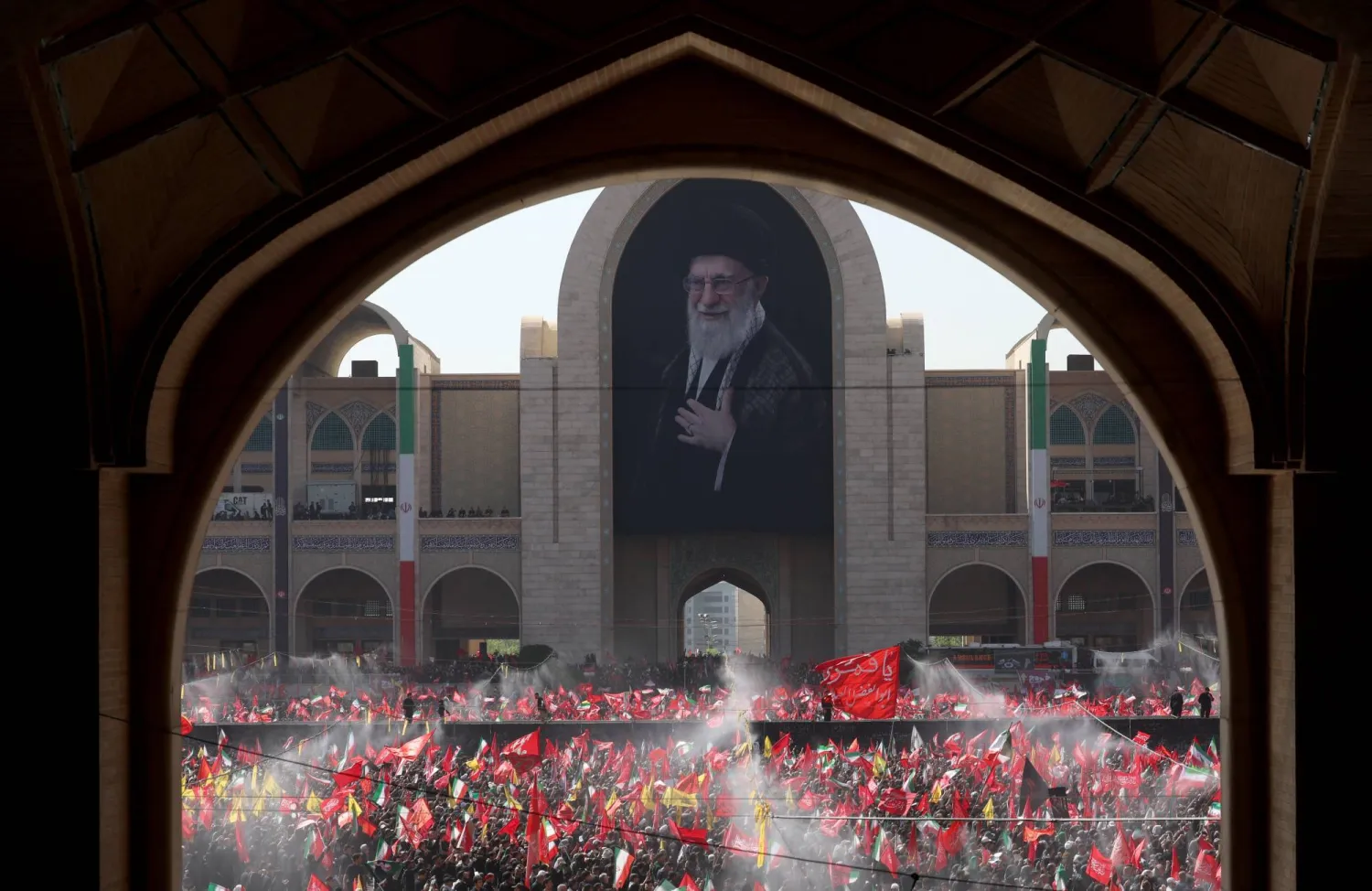

Iran Begins a Procession Through Tehran for Supreme Leader Ali Khamenei's Funeral

Iranians take part in a mass prayer for late Iranian supreme leader Ali Khamenei during a farewell ceremony ahead of his funeral at the grand Mosallah mosque in Tehran, Iran, 05 July 2026. EPA/ABEDIN TAHERKENAREH
TT

Iran Begins a Procession Through Tehran for Supreme Leader Ali Khamenei's Funeral

Iranians take part in a mass prayer for late Iranian supreme leader Ali Khamenei during a farewell ceremony ahead of his funeral at the grand Mosallah mosque in Tehran, Iran, 05 July 2026. EPA/ABEDIN TAHERKENAREH

Iran began a procession Monday through its capital, Tehran, for the funeral of the late Supreme Leader Ali Khamenei.

Khamenei's flag-draped coffin, and those of his family killed Feb. 28 in an airstrike at the start of the war launched by Israel and the United States, sat on board a truck. Authorities decorated the truck's side to resemble the ornamental grating that surrounds the shrine of an imam, The Associated Press said.

The coffins will be taken through the streets of Tehran on their way to Mehrabad International Airport over a 12-hour journey, said Revolutionary Guard Gen. Hasan Hasanzsdeh, who is overseeing the procession.

Iran's theocracy plans to see large crowds attend the ceremony across the city to show popular support for the government. Already, thousands have gathered at squares in Tehran, waving flags and banners in Khamenei's honor.

Authorities have shut down streets, airspace and daily life for the mourning, which began Saturday and will end Thursday as the 86-year-old Khamenei is buried at the Imam Reza shrine in Mashhad, his birthplace.

The US is meanwhile pressing ahead with negotiations with Iran aimed at fully reopening the Strait of Hormuz, rolling back its disputed nuclear program and reaching a permanent end to the war. Talks appear to be on hold until after the burial.

As the funeral has gone on, however, there's increasingly been threats from mourners to avenge Khamenei's death. Mourners and the signs they carry have called for the killing of both US President Donald Trump and Israeli Prime Minister Benjamin Netanyahu. Such signs were seen again Monday along the procession's route.

US federal authorities have been tracking Iranian threats against Trump and other administration officials for years, stemming from Trump's ordering the 2020 killing of Gen. Qassem Soleimani, who had led the elite Quds Force. Iran has repeatedly denied plotting to kill Trump, though hard-line propaganda footage long has suggested Trump was in Tehran’s crosshairs.

Trump meanwhile promised to destroy Iran’s civilization during the war, among other threats.

“Today that we are here for the funeral for our leader, it’s a very tough day," mourner Fatima Hassan said Monday morning. "We are not here to say goodbye to him, we are here for revenge. And we will take revenge.”


As Venezuela Quake Deaths Pass 3,000, Attention Turns to Mourning, Burials

At La Esperanza cemetery in La Guaira, gravediggers buried more than 150 bodies still unidentified since the earthquakes. Miguel MEDINA / AFP
TT

As Venezuela Quake Deaths Pass 3,000, Attention Turns to Mourning, Burials

At La Esperanza cemetery in La Guaira, gravediggers buried more than 150 bodies still unidentified since the earthquakes. Miguel MEDINA / AFP

Deaths from Venezuela's devastating twin earthquakes rose to at least 3,342 on Sunday as officials began to bury dozens of bodies left unidentified 11 days after the disaster.

The June 24 double shocks, one of Latin America's worst quake disasters, toppled scores of buildings in the La Guaira coastal area north of Caracas and left thousands of people missing, AFP said.

As international rescue teams packed up and ended attempts to find survivors, attention shifted to mourning those lost and burying the remains that families have recovered from the ruins.

In a secluded area of La Esperanza cemetery in La Guaira, gravediggers buried more than 150 bodies still unidentified since the earthquakes, AFP journalists saw.

A line of simple white crosses with small bouquets at their foot marked a long row of individual graves. Each one had the same date of death: June 24, 2026.

Two excavators were working to dig more graves in the light brown earth.

"We are first and foremost overcome with grief," said local resident Eli Zavala, who was helping with the burials.

"We started here on July 25th, the very next day, to do all the work...so that all those people could have dignified burials."

According to updated official figures on Sunday, at least 3,342 people died and another 16,700 were injured.

With nearly 200 buildings totally collapsed, most of them in La Guaira, more than 17,000 people have been left homeless and are sleeping in shelters and temporary camps.

The government has not given any figure for those still missing, but the UN estimates that as many as 50,000 people may still be unaccounted for after the shocks.

Many families are still trying to search for relatives in the rubble.

"I've lost track of the days. You lose your mind, but I'm not leaving here because I know he's there," said Zuly, looking for her son in Catia la Mar district.

She now sleeps in a plaza near where he worked.

"I found his motorcycle; I found his helmet. He's there, God willing, alive. If not, at least I can find him, see him...I'm not leaving here without my son."

'No social unrest'

Even before the quakes, Venezuela had been struggling with economic crisis and political upheaval that left infrastructure and health services depleted.

The UN estimates the quakes caused $6.7 billion in damage - equivalent to six percent of Venezuela's GDP.

The damaged international airport serving Caracas is still closed to commercial flights.

Soon after the quakes, many Venezuelans complained they were left alone to dig for families in the ruins and criticized the government's response until international teams arrived.

Interim President Delcy Rodriguez has defended the government reaction, saying thousands of public officials and rescue teams were dispatched.

On Sunday, she dismissed concerns about upheaval over the quakes.

"There will be no social unrest here, what we have here is deep social solidarity," Rodriguez said during a military ceremony marking the country's independence day.

Across Caracas and La Guaira, many were focused instead on Sunday services in churches to remember those lost and still missing.

On the campus of Venezuela Central University in Caracas, dozens of people gathered around a large Venezuela flag surrounded by candles for a vigil.

"I've met with couples who have lost both their children, or two of their three. It's very painful," Father Rafael Troconis told AFP in La Guaira.

"You try to offer support as much as you can. You want to be close to those who are suffering. You notice a lot of sadness and despair."


China’s Nanning on Top Alert as Typhoon Maysak Triggers Reservoir Breach

Floodwater flows down the side of a ramp at a construction site, amid heavy rain brought by Typhoon Maysak, in Guigang, Guangxi Zhuang Autonomous Region, China, in this still image obtained from social media video. (Social Media/via Reuters)
TT

China’s Nanning on Top Alert as Typhoon Maysak Triggers Reservoir Breach

Floodwater flows down the side of a ramp at a construction site, amid heavy rain brought by Typhoon Maysak, in Guigang, Guangxi Zhuang Autonomous Region, China, in this still image obtained from social media video. (Social Media/via Reuters)

Nanning, capital of China's southwestern Guangxi region, raised its flood control response to the highest level as rivers and reservoirs swelled with the passage of Typhoon Maysak, Chinese state media said on Monday.

Authorities in ‌Nanning, a ‌city of nearly 9 ‌million ⁠people, raised the flood ⁠control emergency response level to I from III due to "extremely heavy rain", China Central Television (CCTV) reported.

So far, one breach has been reported at a medium-sized ⁠reservoir in Nanning's Hengzhou, and ‌people in ‌the area were being evacuated, state-run ‌Xinhua news agency reported, citing ‌local authorities.

Maysak made landfall in the southern island province of Hainan on Friday, the first tropical cyclone to ‌reach the Chinese mainland this year.

The storm made its ⁠second ⁠landfall on Sunday in Vietnam, which shares a border with Guangxi.

Maysak is expected to weaken further as it moves inland, but remnants of the storm and seasonal southwestern rains will continue to bring heavy rainfall to Guangxi, Guizhou, Hunan, and other areas, according to Chinese meteorologists.


Thousands Flee Raging Wildfires in Southern Europe

A firefighting helicopter battles a wildfire near Calonge, Spain, July 3, 2026. REUTERS/Bruna Casas
TT

Thousands Flee Raging Wildfires in Southern Europe

A firefighting helicopter battles a wildfire near Calonge, Spain, July 3, 2026. REUTERS/Bruna Casas

Wildfires raged across southern Europe on Monday, forcing thousands of people to evacuate their homes and prompting officials to ban spectators from a stage of the storied Tour de France cycling race.

Hundreds of firefighters are battling blazes that have devastated more than 19,000 hectares (42,000 acres) of land -- an area more than twice the size of Manhattan -- across Portugal, Spain, France and Greece.

And temperatures are on the rise again, predicted to reach 40C in parts of a region still suffering the aftermath of a recent record-breaking heatwave.

In southwestern France near the city of Perpignan, 700 hundred firefighters backed by special aircraft battled to control a "gigantic" blaze spreading in a hard-to-reach remote area, with more than 10,000 local residents evacuated.

Fanned by wind, intense heat and exceptionally dry air, the fire has nearly tripled in size since early Sunday, devouring 4,600 hectares and leaving a firefighter and a resident injured, local authorities said.

"The fire came within 300 meters of the houses. We were taken aback by how fast it spread, it was staggering -- bordering on panic," said Patrice, a 53-year-old resident of the village of Trevillach, who did not wish to give his surname.

"We started seeing smoke around 10:30 pm, then it kept coming closer and closer. Someone from the town hall knocked on our door around 1:00 am to tell us to leave," said Charlotte Pignol, 30, who was among the first to be evacuated from her home early on Sunday.

The blazes come shortly after a heatwave in June, one of Europe's worst, during which thousands of excess deaths were registered and which would have been "virtually impossible" without climate change, the World Weather Attribution group of scientists said.

With the mercury set to rise again in the coming days, authorities expressed alarm that the annual summer wildfire season had started a month early.

"Climate change is here, we are living the consequences and it is only the start of July," said French fire service Colonel Eric Belgioino as he appealed to people near the Pyrenees inferno to take precautions to avoid starting fires.

"The season is going to be long for the soldiers fighting fires. You have to help us," he pleaded.

- Tour de France -

In France, officials announced that Monday's third stage of the Tour de France cycling race through the Pyrenees would take place without spectators who normally line the routes of the storied competition.

The stage, which on Monday will see cyclists ride from Spain into France, "will be limited to the passage of the riders only and the vehicles essential to organizing the race" on French territory, the regional prefect Pierre Regnault de la Mothe told reporters.

"The public is asked not to go near the route or to the finish area," he said.

"In other words, and I regret having to say this, it will be, in France at least, a stage of the Tour de France without spectators."

- Poisonous cloud -

In Greece, flames set off by a forest fire tore through two factories in Thessaloniki in the north of the country over the weekend, forcing authorities to evacuate the surrounding area and to warn households to keep their windows closed.

In Spain, a fire near the northeastern Costa Brava coast burned more than 2,200 hectares in two days and firefighters said their efforts would be "complicated" by rising temperatures and the many "smoking hotspots" within the fire's perimeter.

In Portugal, emergency services said they had controlled "80 percent" of a wildfire that has devastated some 13,000 hectares of forest and scrub land in the north of the country.

Elsewhere, major fires also destroyed hundreds of hectares of forest, vineyards and scrub land on the Croatian island of Hvar and at Tale in Albania, authorities said.

Regions across Portugal, Spain and southern France have stepped up heat alerts for the coming days.

On Monday the latest heatwave was expected to move north, with forecasters saying it could last until next weekend.