Alarm Phone: 12 Migrants Missing Since Leaving Algerian Coast a Week Ago

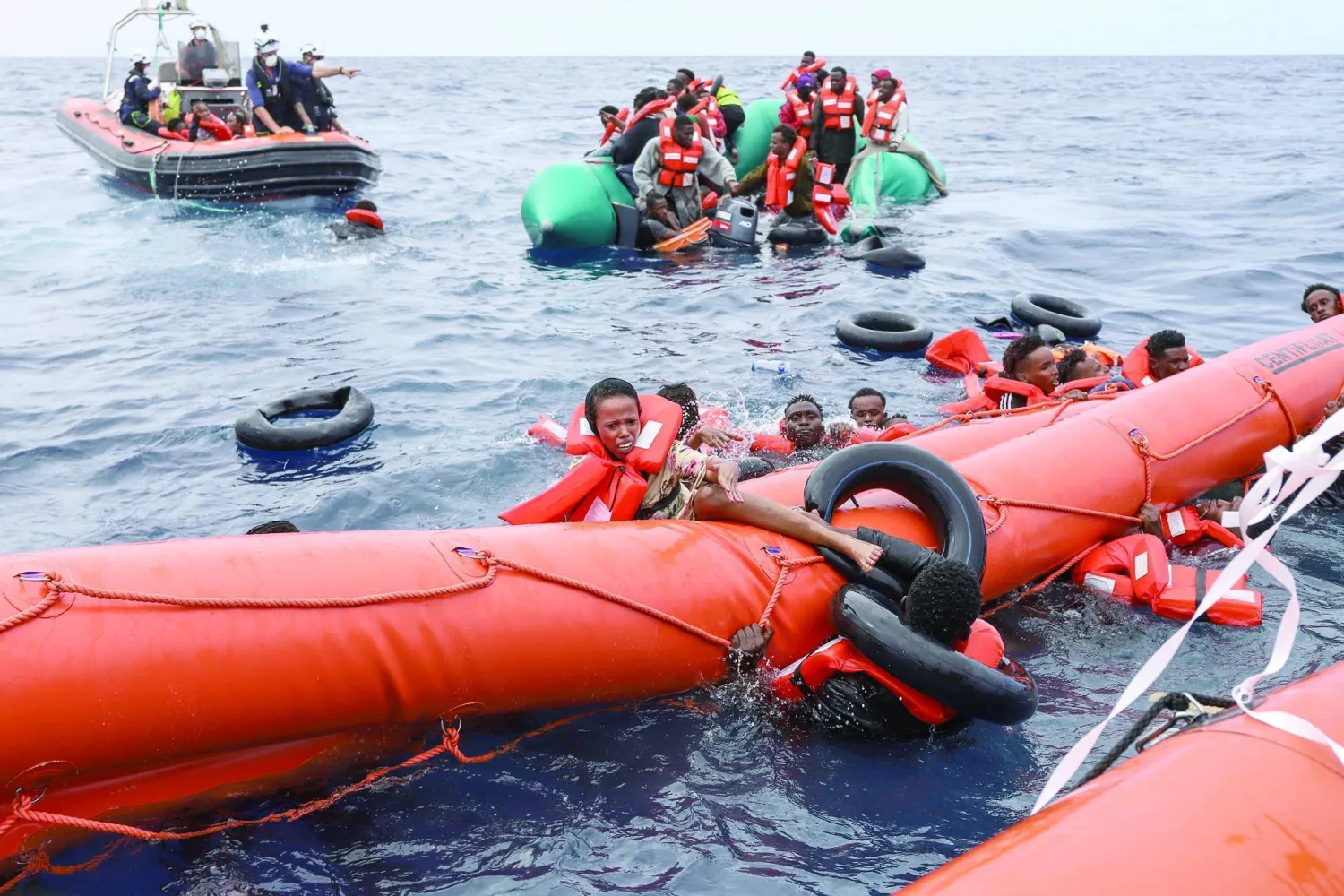
Migrants rescued after their boat, which departed from the coast of Libya towards Europe, sank (AP file photo)
TT

Alarm Phone: 12 Migrants Missing Since Leaving Algerian Coast a Week Ago

Migrants rescued after their boat, which departed from the coast of Libya towards Europe, sank (AP file photo)

Twelve migrants are missing since last week in the western Mediterranean, according to Alarm Phone, a Tunisian platform specialized in tracking migrants in distress at sea.

“A boat with 12 people missing in western Mediterranean.

The group left Tipaza, in Algeria on June 29. We have had no news of them since their departure. We hope they will be found and brought to safety!” Alarm Phone wrote on its X account.

Relatives of one of the 12 migrants had notified the platform about the boat missing and said they lost contact with the migrants since their departure a week ago.

Spain’s Maritime Safety and Rescue Society, Salvamento Maritimo, announced it had not intercepted the boat or the migrants.

Using the Mediterranean route to reach Europe is considered the deadliest for migrants, according to the International Organization for Migration (IOM).

As the summer months offer more stable weather conditions, more migrant boats venture out to reach European shores.

According to data from the IOM’s Missing Migrants Project, over 1,410 people are feared dead or missing in the Mediterranean shipwrecks this year, including 225 migrants using the Western Mediterranean route.

Last week, Pope Leo XIV visited Italy's Lampedusa island, a major port of call for migrants risking the perilous crossing from Africa, in a stark message to US and EU leaders.

Leo's visit also comes just two weeks after the European Union's approval of new migrant rules allowing much broader detention powers and the creation of deportation centers outside the bloc.

Lampedusa sits 145 kilometers off the coast of Tunisia, and is famous for showing compassion to thousands of migrants -- and taking in their dead.


Implementation of Deal on Pilot Zones in Southern Lebanon Runs into Israeli, Hezbollah Resistance

An Israeli soldier works on a tank on the Israeli side of the Israel-Lebanon border (Reuters)
TT

Implementation of Deal on Pilot Zones in Southern Lebanon Runs into Israeli, Hezbollah Resistance

An Israeli soldier works on a tank on the Israeli side of the Israel-Lebanon border (Reuters)

Lebanon is awaiting the launch of the first phase of Israel’s withdrawal from two pilot areas in the south, although no date has yet been set. The move remains uncertain amid Israeli military violations and threats, while Hezbollah continues to denounce the US-brokered framework agreement as “nonexistent” and refuses to cooperate in its implementation.

Speaking Sunday from Beaufort Castle overlooking southern Lebanon, Israeli Chief of Staff Lt. Gen. Eyal Zamir issued fresh warnings.

He described the Beaufort area as “packed with terrorist infrastructure,” saying Hezbollah, “with Iranian funding and direction,” had spent decades building underground tunnels and military networks there to threaten Israeli communities in the north.

Zamir stressed that the Lebanese army “must fulfill its commitments under the historic agreement” by clearing the area of Hezbollah operatives.

He added that the Israeli military would continue acting “decisively” against threats from Lebanese territory and was prepared to launch a rapid offensive if the ceasefire were violated.

He also claimed Hezbollah had been significantly weakened by Israeli military operations and was now relying on Iran for support.

Israeli Pressure, Hezbollah Rejection

Against this backdrop, Lebanese officials say implementation of the pilot-zone provision is being hindered by resistance from both Israel and Hezbollah.

Ministerial sources told Asharq Al-Awsat that contacts are underway to establish a US-chaired trilateral committee comprising the United States, Lebanon, and Israel to oversee the deployment of the Lebanese army in two pilot zones covering the towns of Froun and Ghandouriyeh in Bint Jbeil district, and Zawtar al-Gharbiyeh in Nabatieh district.

The committee would supervise the pilot phase, with Washington expected to pressure Israel to proceed. However, the sources said Hezbollah’s refusal to cooperate further complicates implementation.

US Mediation

The sources said Washington is holding talks with both Iran and Israel in an effort to devise a mechanism for a simultaneous Israeli withdrawal and Hezbollah redeployment. Israel insists that its withdrawal be linked to Hezbollah’s evacuation of the areas, while Hezbollah maintains that no such steps will be taken before Israel pulls out.

They added that contacts had slowed in recent days because of Iran’s near-total absence from diplomatic exchanges, as Tehran has been preoccupied with funeral ceremonies following the death of Supreme Leader Ali Khamenei.

Despite the lull, Israel’s public broadcaster Kan reported Sunday that preparations for the next withdrawal phase were advancing under direct US coordination.

The plan calls for a joint mechanism to oversee the ceasefire and transfer security responsibility to the Lebanese army.

The pilot phase is part of the US-brokered framework agreement, which envisions two experimental security zones under the exclusive control of the Lebanese army, alongside reconstruction efforts and the return of displaced residents, under the supervision of a US-led trilateral military coordination group.

Continuing Violations

Israeli forces continued military operations in southern Lebanon. Artillery shelled the towns of Braachit and Deir Siryan, while an Israeli drone dropped two stun grenades over Hadatha in Bint Jbeil district.

An Israeli helicopter also carried out aerial sweeps over Majdal Zoun, while fighter jets flew over Beirut’s southern suburbs, Sidon, and surrounding areas. Israeli forces also continued demolishing homes and neighborhoods in several southern villages, most recently in Talloussah in Marjayoun district.

Meanwhile, the Lebanese army said its engineering units had dismantled four unexploded Israeli munitions in Meifadoun, Braachit, Kfardounine, and Shaqra, moving them to secure locations while urging residents to report suspicious objects.

Politically, Hezbollah escalated its criticism of the framework agreement. Hezbollah MP Hassan Fadlallah argued that the deal “has no provision that serves Lebanon,” claiming it seeks to achieve through diplomacy what Israel failed to impose by force: entrenching the occupation, creating a buffer zone, shielding Israel from international legal accountability, and ultimately eliminating the “resistance.”

Fadlallah also asserted that the agreement lacks constitutional, legal, and national legitimacy, declaring that Hezbollah would not allow its implementation.

He insisted that southern Lebanon’s villages “are not a testing ground” and that the group would continue to uphold what it described as its right to defend Lebanon.


More Than 300 Children Killed in Sudan War in 6 Months, Mostly in Drone Strikes, UNICEF Says

A woman and a child, displaced from North Darfur's capital, al-Fashiar or other conflict-affected areas walk in the newly established el-Afadh camp in al-Dabbah, in Sudan's Northern State, Sudan, Thursday, Nov. 13, 2025. (AP)
TT

More Than 300 Children Killed in Sudan War in 6 Months, Mostly in Drone Strikes, UNICEF Says

A woman and a child, displaced from North Darfur's capital, al-Fashiar or other conflict-affected areas walk in the newly established el-Afadh camp in al-Dabbah, in Sudan's Northern State, Sudan, Thursday, Nov. 13, 2025. (AP)

More than 300 children have been killed in the last six months in the war in Sudan, mostly from drone strikes, the UN children's agency said Monday.

Sudan has been mired in a war between the Sudanese military and the paramilitary Rapid Support Forces since April 2023.

The war is now concentrated in the Kordofan, Darfur and Blue Niles states, with drone warfare causing 60% of casualties, according to UNICEF.

The UN, US UK and others have expressed alarm about potential atrocities as the RSF and the military fight for control of the strategic city of el-Obeid, in North Kordofan.

The conflict has killed at least 59,000 people, displaced some 13 million and pushed many parts of Sudan into famine. More than 30 million people are in need of humanitarian assistance.

Drone strikes and shelling have targeted civilian infrastructure including schools, markets, fuel and water stations putting over 500,000 people at risk. Civilians have faced almost siege-like conditions for over a year.

“Children are being caught in a relentless cycle of violence, displacement and deprivation,” said Sheldon Yett, UNICEF Representative for Sudan.

The UN called on parties “to protect civilians and civilian infrastructure, allow and facilitate safe, rapid and unimpeded humanitarian access, and take all possible measures to protect children from harm.”


Baghdad Rejects Iranian ‘Protection’ for Suspects Placed on Corruption Lists

A circulating image shows Iraqi vehicles at an entrance to the Green Zone at dawn on June 28, 2026
TT

Baghdad Rejects Iranian ‘Protection’ for Suspects Placed on Corruption Lists

A circulating image shows Iraqi vehicles at an entrance to the Green Zone at dawn on June 28, 2026

The Iraqi government has rejected Iranian requests to exempt individuals facing judicial arrest warrants as part of corruption investigations and has urged Tehran to use official diplomatic channels to arrange visits by Iranian officials who have “customarily held secret meetings” in Baghdad, according to two informed sources on Sunday.

The developments followed what was described as a “secret” visit by Esmail Qaani, commander of the Quds Force, shortly after an official visit by Iranian Foreign Minister Abbas Araghchi, who met Iraqi Prime Minister Ali al-Zaidi on June 28.

One source said Qaani arrived in Baghdad a few days after Araghchi’s visit without any public announcement. It is believed to have been his first trip to Iraq since al-Zaidi took office on May 14.

As Iranian influence in Baghdad has expanded over the years, reports of undeclared visits by senior officials from the Iranian Revolutionary Guard Corps (IRGC) have become frequent, although many were never officially confirmed and some could not be independently verified.

During the recent US-Iran war, Qaani acknowledged that he had traveled to Baghdad in late April to express his “thanks and appreciation to the Iraqi people and officials.”

Iranian Requests

According to the two sources, the Iranian officials sought changes to Iraq’s plan to bring all weapons under state control after the government set Sept. 30 as the deadline for eliminating arms outside state authority. Tehran also requested that Baghdad narrow the list of arrest warrants that could target political and government figures with close ties to the IRGC.

One source said Iraqi authorities rejected any changes to their plans on weapons control and anti-corruption measures and informed Tehran of their decision. Baghdad also insisted that Iran adhere to formal diplomatic procedures and rejected “bypassing official channels through secret meetings,” in an apparent reference to Qaani.

Unannounced visits by Iranian officials, particularly commanders of the Quds Force, have long been politically sensitive in Iraq and across the region. The Iraqi government did not respond to requests for comment.

For years, Baghdad has struggled to establish the state’s monopoly over arms. Iran-backed armed factions argue that they have earned a role in shaping political decisions because of their campaign against ISIS.

The United States has pressed Iraq to diminish its ties with Iran, and some observers believe al-Zaidi’s government is gradually emerging as a promising opportunity to reshape the balance of power as part of a broader regional realignment.

In an interview with Asharq Al-Awsat, al-Zaidi pledged to place all weapons under state control, declaring that “there will be no weapons except those of the state.”

Doubts and International Commitments

A former lawmaker from a Shiite alliance told Asharq Al-Awsat that the recent developments do not necessarily signal a fundamental shift in Baghdad’s relationship with Tehran.

Speaking on condition of anonymity, he warned that Iran and its Iraqi allies could respond to growing US pressure by adopting a lower profile while preserving their influence through indirect channels.

He said it remains too early to conclude that Iranian influence is receding, noting that the extent to which Tehran-aligned factions comply with government policies will become clearer in the coming months.

A senior political adviser in Baghdad told Asharq Al-Awsat that the government informed Tehran it could not approve of requests that would violate Iraq’s international commitments on combating money laundering and controlling weapons that threaten regional security.

Baghdad has recently entered into commitments with the US and European countries to implement economic and security reforms, including tighter measures against money laundering and illegal weapons.

The adviser added that Iraq remains committed to maintaining its strategic partnership with neighboring Iran on the basis of mutual respect and shared interests.