


As Venezuela Quake Deaths Pass 3,000, Attention Turns to Mourning, Burials

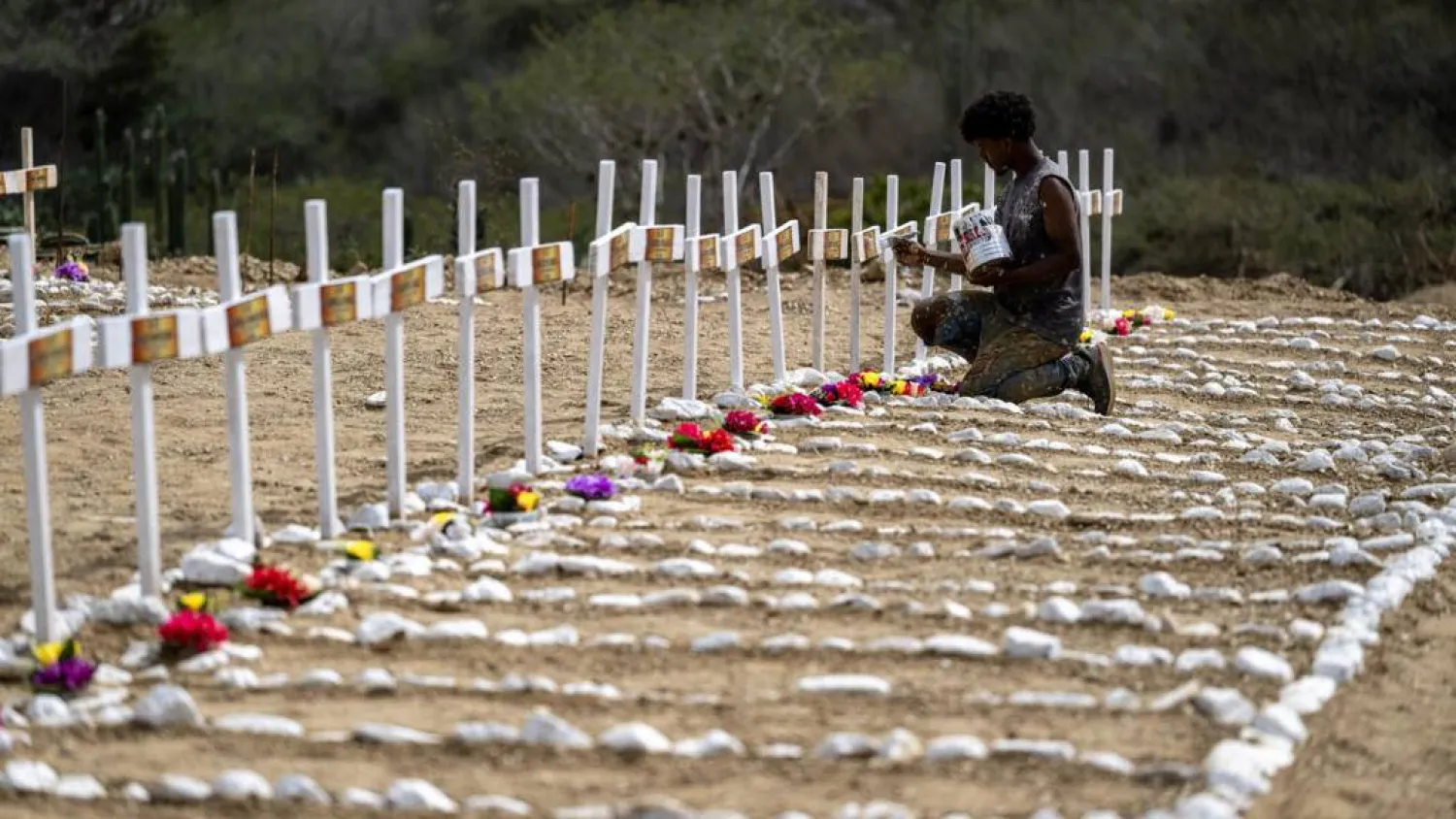
At La Esperanza cemetery in La Guaira, gravediggers buried more than 150 bodies still unidentified since the earthquakes. Miguel MEDINA / AFP
TT

As Venezuela Quake Deaths Pass 3,000, Attention Turns to Mourning, Burials

At La Esperanza cemetery in La Guaira, gravediggers buried more than 150 bodies still unidentified since the earthquakes. Miguel MEDINA / AFP

Deaths from Venezuela's devastating twin earthquakes rose to at least 3,342 on Sunday as officials began to bury dozens of bodies left unidentified 11 days after the disaster.

The June 24 double shocks, one of Latin America's worst quake disasters, toppled scores of buildings in the La Guaira coastal area north of Caracas and left thousands of people missing, AFP said.

As international rescue teams packed up and ended attempts to find survivors, attention shifted to mourning those lost and burying the remains that families have recovered from the ruins.

In a secluded area of La Esperanza cemetery in La Guaira, gravediggers buried more than 150 bodies still unidentified since the earthquakes, AFP journalists saw.

A line of simple white crosses with small bouquets at their foot marked a long row of individual graves. Each one had the same date of death: June 24, 2026.

Two excavators were working to dig more graves in the light brown earth.

"We are first and foremost overcome with grief," said local resident Eli Zavala, who was helping with the burials.

"We started here on July 25th, the very next day, to do all the work...so that all those people could have dignified burials."

According to updated official figures on Sunday, at least 3,342 people died and another 16,700 were injured.

With nearly 200 buildings totally collapsed, most of them in La Guaira, more than 17,000 people have been left homeless and are sleeping in shelters and temporary camps.

The government has not given any figure for those still missing, but the UN estimates that as many as 50,000 people may still be unaccounted for after the shocks.

Many families are still trying to search for relatives in the rubble.

"I've lost track of the days. You lose your mind, but I'm not leaving here because I know he's there," said Zuly, looking for her son in Catia la Mar district.

She now sleeps in a plaza near where he worked.

"I found his motorcycle; I found his helmet. He's there, God willing, alive. If not, at least I can find him, see him...I'm not leaving here without my son."

'No social unrest'

Even before the quakes, Venezuela had been struggling with economic crisis and political upheaval that left infrastructure and health services depleted.

The UN estimates the quakes caused $6.7 billion in damage - equivalent to six percent of Venezuela's GDP.

The damaged international airport serving Caracas is still closed to commercial flights.

Soon after the quakes, many Venezuelans complained they were left alone to dig for families in the ruins and criticized the government's response until international teams arrived.

Interim President Delcy Rodriguez has defended the government reaction, saying thousands of public officials and rescue teams were dispatched.

On Sunday, she dismissed concerns about upheaval over the quakes.

"There will be no social unrest here, what we have here is deep social solidarity," Rodriguez said during a military ceremony marking the country's independence day.

Across Caracas and La Guaira, many were focused instead on Sunday services in churches to remember those lost and still missing.

On the campus of Venezuela Central University in Caracas, dozens of people gathered around a large Venezuela flag surrounded by candles for a vigil.

"I've met with couples who have lost both their children, or two of their three. It's very painful," Father Rafael Troconis told AFP in La Guaira.

"You try to offer support as much as you can. You want to be close to those who are suffering. You notice a lot of sadness and despair."



Seoul Detects North Korean Missile Launches after Trump Says to Meet Kim

People watch a news broadcast with file footage of a North Korean missile test, at a train station in Seoul. Jung Yeon-je / AFP
TT

Seoul Detects North Korean Missile Launches after Trump Says to Meet Kim

People watch a news broadcast with file footage of a North Korean missile test, at a train station in Seoul. Jung Yeon-je / AFP

North Korea has fired several short-range ballistic missiles, Seoul's military said on Thursday, hours after US President Donald Trump said he would meet Pyongyang's Kim Jong Un this year.

The latest launches from the nuclear-armed North come as South Korea and the United States hold a shorter edition of their annual Ulchi Freedom Shield military exercises, following an order from Trump to scale them back.

Pyongyang has long condemned US-South Korea joint exercises as rehearsals for invasion, often staging missile launches around the drills.

Trump, seeking to revive the bond he claims to have forged with Kim in his first term, told reporters at the White House on Wednesday he plans to meet the North Korean leader later this year.

The US president also said it was important to "get along" with Kim, adding that Pyongyang now had 57 "very powerful" nuclear weapons. Seoul says there are around 80-120.

Hours after Trump's remarks, an official from Seoul's Joint Chiefs of Staff told AFP that the North fired "around 10 short-range ballistic missiles" from the Pyongyang area.

Japan earlier said a suspected "ballistic missile launched by North Korea a short while ago has already fallen", according to an X post from the prime minister's office.

Trump's sudden focus on Kim and his scaling back of joint US-South Korean military drills have alarmed Asian allies, while sparking speculation that he was seeking a foreign policy win as the Iran war stalls.

Kim Yo Jong, the powerful sister of the North Korean leader, said on Wednesday that her brother had "good memories and feelings" about Trump and that the relationship between the two leaders remains "excellent".

She said, however, that she was unaware of any current communication between the two leaders.

Her statement came hours after Seoul announced the Ulchi Freedom Shield exercises would end on Friday -- about a week earlier than planned -- "at the suggestion of the US side".

The Pentagon said the reduced drills would cause "no degradation to US training objectives".

The exercises are designed to prepare for a possible attack by North Korea.

The United States stations about 28,500 troops in South Korea to bolster the country's defenses, a legacy of the 1950-53 Korean War that ended with an armistice rather than a peace treaty.

South Korea's Defense Minister Ahn Gyu-back said Seoul remained opposed to officially recognizing the North as a nuclear-weapon state.

Asked whether Washington had "given up" on North Korea's denuclearization, Ahn said he did not believe so.

President Lee Jae Myung - who has long pushed for stronger homegrown defenses to reduce South Korea's reliance on the United States -- said on Wednesday he would "do his utmost" to support Trump's peacemaking efforts with the North.


Japan Train Hits Station Workers, 4 Killed

A man takes photographs of a Japanese government sign reading "Day of the Return of the Northern Territories, Day of Peace. The Northern Territories are an inherent part of Japan's territory." (Photo by Yuichi YAMAZAKI / AFP)
TT

Japan Train Hits Station Workers, 4 Killed

A man takes photographs of a Japanese government sign reading "Day of the Return of the Northern Territories, Day of Peace. The Northern Territories are an inherent part of Japan's territory." (Photo by Yuichi YAMAZAKI / AFP)

A train hit and killed four workers in Japan on Thursday, authorities said, a rare incident in a country renowned for its normally excellent rail safety record.

Local media reported that the four workers were removing weeds from the train tracks at Shin-Kanuma Station in Kanuma city north of Tokyo when the express train struck them.

"The four were confirmed dead," a fire department official told AFP.

Another official said that when emergency services arrived, three workers were trapped under the train, while one was on the platform.

The workers, all men, were in their 50s and 60s, Jiji Press reported. None of the roughly 50 passengers on the train suffered injuries.

The six-car train was the Spacia X express on the Tobu Nikko Line, connecting Greater Tokyo with popular tourist destination Nikko in the Tochigi region, media reports said.

The Tokyo-bound train was approaching its stop at Shin-Kanuma when the accident occurred, broadcaster NHK said, citing the operator.

"We heard this loud rumbling noise. Then the train came to an emergency stop with such sudden braking that it was impossible to stand," a 40-year-old man who was on the train told NHK.

"There was an announcement saying 'we will stop to identify where the noise came from', and then we were left unable to get off for a while," the man was quoted as saying.

Local media reported that the workers were part of a seven-person crew removing weeds from around the train tracks.

Japanese railways have one of the best safety records in the world.

Fatal accidents from malfunctioning trains are extremely rare in Japan due to high levels of maintenance and training, and use of advanced technology.

Japan's deadliest accident this century was in April 2005 when a rush-hour commuter train derailed and smashed into an apartment building in Amagasaki, in the country's west, killing 107 people and injured more than 500 others.

An accident involving a derailed cargo train and two passenger trains killed 161 people in 1963.

There has never been a passenger fatality from a derailment or a collision on Japan's network of "shinkansen" bullet trains since they entered service in 1964.


Iran Slams Trump's Economic Pressure Plan as a 'Diversion from America's Own Crisis'

FILED - 16 March 2018, Austria, Vienna: FILE PHOTO - Abbas Araghchi, Deputy Foreign Minister of Iran, gives an interview in Vienna. Photo: Farshid-Motahari Bina/dpa
TT

Iran Slams Trump's Economic Pressure Plan as a 'Diversion from America's Own Crisis'

FILED - 16 March 2018, Austria, Vienna: FILE PHOTO - Abbas Araghchi, Deputy Foreign Minister of Iran, gives an interview in Vienna. Photo: Farshid-Motahari Bina/dpa

Iran's Foreign Minister Abbas Araghchi on Thursday dismissed US President Donald Trump's economic punishment plan for Tehran as a continuation of "failed policies", which he said would bring Washington "further defeat".

"The so-called 'Economic D-Day' is a diversion from America's own crisis: unprecedented debt & surging interest costs. Doubling down on failed policies will only bring further defeat -- and enmity of Iranians," Araghchi said in a post on X.

"US economic terrorism threatens global economy and sovereignty worldwide."

In a post on his Truth Social, Trump said he was announcing "the MOST CRUSHING ECONOMIC OPERATION EVER TAKEN AGAINST ANY COUNTRY! This will be Economic Warfare and Isolation on an unprecedented scale."

"ANY country that allows its financial institutions, businesses, airports, or government entities to provide any type of lifeline to Iran will itself face TREMENDOUS Economic Consequences," he said.

War broke out between Iran and the United States on February 28 with US-Israeli attacks which triggered Iranian retaliation across the region.

An April 8 ceasefire put an end to the intense bombardment but sporadic clashes continued in and around the Strait of Hormuz, a vital energy conduit which Iran has blockaded and has since become flashpoint in the conflict.

Reopening the strait has become a US priority but Iran insists the waterway will remain closed until Washington lifts its naval blockade on Iranian ports, removes oil sanctions, and unfreezes Iran's assets abroad.

Trump has long pursued a "maximum pressure" policy of economic sanctions on Iran and reinstated those measures after he took office in January 2025, mirroring his approach during his first term.

Iran has dismissed the sanctions program as a failure, insisting that such measures and threats will not force it to change course.