Ebola Outbreak in Congo Still in ‘Expansion Phase’, WHO Says

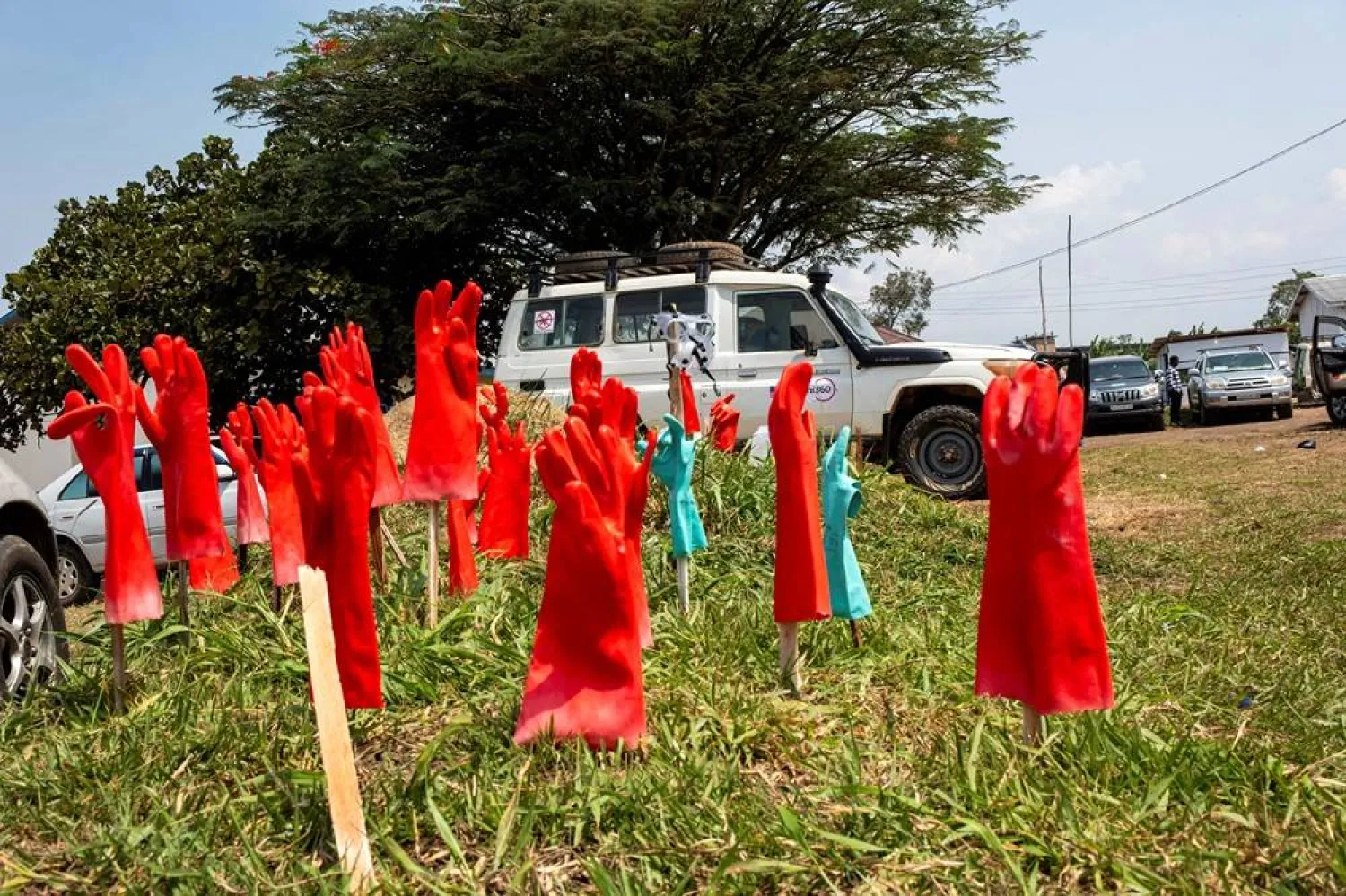
Rubber gloves are laid out on the ground outside the Rwampara General Hospital as healthcare workers involved in the Ebola response stage a go-slow over unpaid salaries, while authorities seek to contain a new outbreak of the Bundibugyo strain of Ebola in Rwampara, Ituri province, Democratic Republic of Congo, July 6, 2026. (Reuters)
TT

Ebola Outbreak in Congo Still in ‘Expansion Phase’, WHO Says

Rubber gloves are laid out on the ground outside the Rwampara General Hospital as healthcare workers involved in the Ebola response stage a go-slow over unpaid salaries, while authorities seek to contain a new outbreak of the Bundibugyo strain of Ebola in Rwampara, Ituri province, Democratic Republic of Congo, July 6, 2026. (Reuters)

The Ebola outbreak in Congo has not yet stabilized and is still expanding, with transmission fueled by population movement, a World Health Official said on Tuesday.

The Democratic Republic of Congo has confirmed 1,561 cases, including 506 deaths, in the worst-ever outbreak ‌of the ‌rare Bundibugyo species of ‌Ebola ⁠for which there ⁠is no proven treatment or cure.

"It is still in the expansion phase unfortunately. We would like to say it is stabilizing but frankly we cannot ⁠say it yet," Dr Anne ‌Ancia, WHO ‌representative in the country, told reporters by ‌video link from Bunia, at ‌the epicenter of the epidemic.

She said that major challenges remained, such as the near-saturation of some Ebola ‌treatment centers with occupancy levels around 90%.

Another difficulty is ⁠that ⁠workers falling ill in the mining town of Mongbwalu are not seeking treatment locally, but instead travelling and spreading the disease to new regions, she said.

"Population movements, persistent insecurity and the fragility of the health system continue to complicate efforts to bring the outbreak under control," she said.


Reports: US Agriculture Department, FBI Breached by Hackers

BEVERLY HILLS, CALIFORNIA - OCTOBER 27: A member of the FBI stands outside a home in Beverly Hills, California. Justin Sullivan/Getty Images/AFP
TT

Reports: US Agriculture Department, FBI Breached by Hackers

BEVERLY HILLS, CALIFORNIA - OCTOBER 27: A member of the FBI stands outside a home in Beverly Hills, California. Justin Sullivan/Getty Images/AFP

The US Agriculture Department and the FBI were breached by hackers in cyberattacks, US media reported on Friday, as concerns deepened over the recent spate of tech outages at key American institutions.

The incidents were first reported by NBC News and CNN respectively, and it remained unclear whether they were related and who was responsible.

Major outages in recent weeks have disrupted travel, communications and e-commerce for countless users across the United States, even affecting a top-secret network at the National Security Agency.

US President Donald Trump has sought to calm the public and urged people to "relax", while officials said the various outages were not linked to criminal activity.

The US Department of Agriculture (USDA) told employees that a system used to facilitate payments to farmers was targeted in a cyberattack, NBC reported on Friday, citing two former USDA officials.

The hackers may use the payments system as a backdoor to access more sensitive material, the former officials told NBC.

The USDA deals with "a bunch of scary biologic issues" and "if an adversary or a competitor were to have access to that same information... they could use our own research against us," a former official was quoted as saying.

According to AFP, CNN said separately on Friday that the FBI was hacked for the second time since September.

The federal agency was investigating an intrusion of the National Crime Information Center (NCIC) by apparent hackers, CNN reported citing two people briefed on the probe.

The NCIC has a nationwide criminal information database linking federal, state and local law enforcement and is used to share information on warrants and background checks.

"Every day, officers across the country rely on NCIC to identify wanted fugitives, check for outstanding warrants, and access information that can directly impact officer and public safety," a former FBI official told CNN.

The former official expressed concerns that hackers "could compromise the accuracy of the information that officers rely on."

AFP has contacted the FBI and USDA for comment.

The newly uncovered breaches at the FBI and USDA were described as hacks, which are different from outages like the ones that afflicted Microsoft Outlook and the Federal Aviation Administration.

In September, a hacking group known as ShinyHunters targeted sensitive employee personal data from an FBI jobs website.

The White House fired cybersecurity chief Sean Cairncross this week as criticism mounted over the string of major outages.


Countries Open Path Towards 'Killer Robots' Pact

The European headquarters of the United Nations (UN) in Geneva, Switzerland, November 17, 2026. REUTERS/Denis Balibouse
TT

Countries Open Path Towards 'Killer Robots' Pact

The European headquarters of the United Nations (UN) in Geneva, Switzerland, November 17, 2026. REUTERS/Denis Balibouse

Countries opened a path Saturday towards finding an international agreement on regulating lethal autonomous weapons systems -- though campaigners seeking to stop so-called killer robots were disappointed by the "weakened" outcome.

After five grueling days of talks at the United Nations, which dragged on into overtime, states agreed on building some form of pact over the next two years.

However, with warfare being radically transformed by artificial intelligence, non-governmental organizations wanted far swifter, legally binding rules on handing power over human life and death to autonomous machines.

With full consensus required for any decision, talks at the UN's Review Conference of the Convention on Conventional Weapons in Geneva finally concluded at nearly 4:45 am (0345 GMT) on Saturday.

The 128 countries party to the convention "agreed to launch the elaboration of an international instrument on lethal autonomous weapons systems, which should be conducted over the next two years", conference president Julien Thoni told reporters afterwards.

While a majority of states want a legally binding agreement, countries that have the technology, including the United States and Russia, are reluctant to have their hands tied.

- Two-year timeline -

The process ahead should flesh out "which weapons can be forbidden according to international humanitarian law, and which is not forbidden but can be regulated", Thoni told AFP.

The Swiss diplomat said the parties would work on the instrument, and then decide on whether it should be a treaty, along with the extent to which its provisions should be binding.

He stressed that having the world's major military powers agreeing to work towards an instrument on lethal autonomous weapons systems (LAWS) was a big step forward.

Brazilian ambassador Frederico Meyer described a balancing act as "some countries have the power, some countries have the majority".

Before midnight, during a break in talks, delegates spent a long period huddled tightly around Russia's representative.
Later, a group of 15 delegates broke out for hushed talks on a staircase.

Diplomats inside could be seen pointing at amended text on the screens and refuelling on packets of crisps.

- 'Watered down' -

Campaign groups said the outcome fell well short of expectations.

Once activated, LAWS are capable of selecting and attacking targets without any human intervention.

According to Stop Killer Robots, a global coalition of more than 300 organisations, such systems have already been tested or deployed, including during the war in Ukraine.

"States adopted a watered-down mandate that fails to chart a clear path towards a legally binding instrument," said the group.

"Over 95 states expressed their support for a treaty. In the final hours, a small number of states weakened the mandate introducing uncertainty about the legal status of the final document."

- Diplomacy lagging behind technology -

Verity Coyle, the deputy director for arms at Human Rights Watch, said the outcome "does not provide the urgent action needed to agree new rules -- but the technology is racing ahead", she said.

Rain Liivoja, a director of the Asia-Pacific Institute for Law and Security, said the decision was one "nobody wanted but everyone could grudgingly live with", adding that consensus merely "makes everyone equally unhappy".

"It remains possible -- likely, even -- that there will be no treaty by the end of 2028," he added.

UN disarmament chief Izumi Nakamitsu said getting an instrument completed in two years was a "very compressed timeframe" which would require "a lot of negotiations".

She said countries should start thinking as soon as Monday about how to get as strong an instrument as possible to ban and regulate LAWS.

"The consequences of not having a strong instrument are very clear," she told reporters.

She said a group of governmental experts from the countries would make recommendations on the legal nature and specific form of the instrument, including whether it should be a binding protocol.

"The path to, or possibility to, have a legally binding instrument is still open," she insisted.



Tanker Catches Fire After Projectile Strike Near Strait of Hormuz, UKMTO Says

Vessels at the Strait of Hormuz, as seen from Musandam, Oman, November 17, 2026. (Reuters)
TT

Tanker Catches Fire After Projectile Strike Near Strait of Hormuz, UKMTO Says

Vessels at the Strait of Hormuz, as seen from Musandam, Oman, November 17, 2026. (Reuters)

A tanker caught fire after being struck by an unknown projectile while sailing outbound through the Strait of Hormuz, the United Kingdom Maritime Trade Operations (UKMTO) agency said on Friday.

The British navy-affiliated agency ‌UKMTO said ‌that the incident occurred ‌8 ⁠nautical miles north ⁠of the Omani town of Khasab, adding that no casualties or environmental impact were reported.

Iran's Revolutionary Guards said shortly afterwards that ⁠an oil tanker had caught ‌fire ‌after hitting a mine while ‌attempting to transit the Strait ‌of Hormuz near Khasab, Iranian state media reported.

Khasab lies on Oman's Musandam Peninsula at the ‌entrance to the Strait of Hormuz, a strategic waterway ⁠that ⁠carried nearly one-fifth of global crude oil supplies before the US-Israeli conflict with Iran.

Shipping through the Strait of Hormuz has been disrupted since Iran moved to close the waterway following the eruption of the conflict on February 28.