


US Support for Israel Slips as Democrats Grow More Critical, Poll Finds

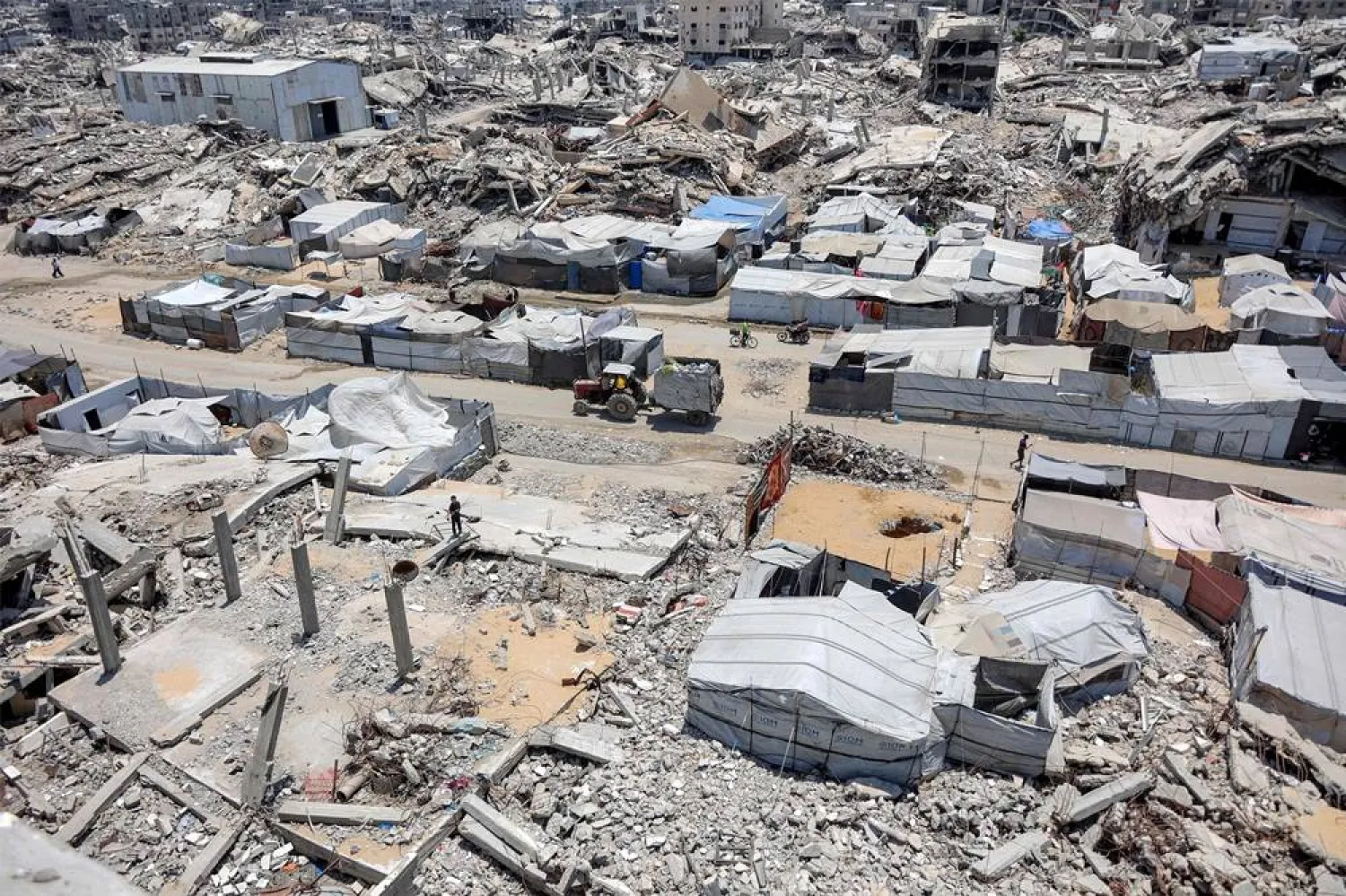
Tents and shelters are pictured next to rubble of collapsed buildings at a camp for people displaced by war in the Sheikh Radwan neighborhood of Gaza City on July 6, 2026. (AFP)
TT

US Support for Israel Slips as Democrats Grow More Critical, Poll Finds

Tents and shelters are pictured next to rubble of collapsed buildings at a camp for people displaced by war in the Sheikh Radwan neighborhood of Gaza City on July 6, 2026. (AFP)

After decades of reliable bipartisan backing for Israel, a new AP-NORC poll reveals a dramatic erosion of support for the longtime US ally, with rising opposition from Democrats and signs of division among Republicans.

The survey by The Associated Press-NORC Center for Public Affairs Research arrives at a moment when a once-consensus foreign policy issue is increasingly polarizing Americans along partisan and generational lines, driven by criticism for Israel's conduct nearly three years after the outbreak of its latest war with Hamas in Gaza.

About one-third of US adults, including roughly half of Democrats, believe that Israel has committed genocide against Palestinians during the war in Gaza, an accusation that’s been leveled by some human rights organizations and vehemently denied by Israel and the US government. About 2 in 10 Americans say Israel has not and the rest, about half, don’t know enough to say.

A similar share, 30%, of Jewish adults say Israel has committed genocide, although about half, 49%, say it has not.

Harold Kalmus, a 69-year-old Democrat from Arden, Delaware who describes himself as Jewish by birth, said he remembers being proud of Israel when he was younger. Not anymore.

“I realize that there is a threat from Hamas. And I realize they’re in a very difficult situation, but what they have done is just an unspeakable horror,” he said of Israel’s military action against the Palestinians. “They’re trying to wipe out a civilization as far as I’m concerned.”

The findings show sharply eroded views of Israel in the US, nearly three years after Hamas' attack on Oct. 7, 2023, which left 1,200 people dead in Israel, mainly civilians, while 251 hostages were taken back to Gaza.

More than 73,000 Palestinians have died in Gaza according to the Hamas-run Gaza Health Ministry, which doesn’t distinguish between civilian and militant deaths, including more than 1,000 killed since the beginning of the latest ceasefire.

American sympathies had been shifting toward the Palestinians and away from the Israelis since around 2020, according to other polling, but has nose-dived since the latest war in Gaza began.

Many Americans, about 4 in 10, don't know enough to say whether Israel’s immediate military response to Hamas’ attack or its ongoing military operations were justified. Among those who did have an opinion in each case, most say the initial retaliation was justified, but a majority think its current actions are not.

About three-quarters of Jewish adults said Israel's initial response was justified, but only about 4 in 10 believe that about its ongoing operations.

Only about one-third of US adults view Israel as an “extremely” or “very" important issue to them personally. But it's been a searing topic in American politics as the relationship between the two countries remains tense, just four months before high-stakes midterm elections determine the balance of power in Congress for President Donald Trump’s final two years in office.

Vice President JD Vance recently criticized Israeli leaders who have expressed frustration with Trump, while vocal critics of Israel recently defeated establishment-backed Democrats in New York and Colorado primaries.

Democrats' support for Israel drops

The AP-NORC poll reveals a decisive shift within the Democratic Party.

About 58% of Democrats now say the US is “too supportive” of the Israelis, up from 45% in an AP-NORC poll from January 2024 when former President Joe Biden was in office. That includes 51% of Jewish Democrats in the new poll.

Roughly 6 in 10 Democrats, 62%, say the US is “not supportive enough” of the Palestinians, up from 49% in 2024. Younger Democrats — those 45 and younger — are still more likely than older ones to say that the United States is “not supportive enough” of the Palestinians, but older Democrats are catching up to their younger counterparts. About 57% of older Democrats now say the US should do more for the Palestinians, up from 39% two years ago.

Joy Jennik, a 73-year-old Democrat from Brookfield, Wisconsin, said she didn’t have strong opinions about the US relationship with Israel until after Hamas’ Oct. 7 attack.

Now, she believes Israel is guilty of genocide.

“The Gaza Strip, there’s not a lot left of it. Those poor people are barely living,” said Jennik, a retired home economics teacher.

GOP stays behind Israel, but less so among young

Republicans Just a sliver of Republicans, 13%, describe Israel’s actions as genocide, although there is an apparent age gap. About 2 in 10 Republicans under 45 say Israel has committed genocide, while about 1 in 10 Republicans ages 45 and older say the same.

Overall, 60% of Republicans describe the US support for Israel as “about right." Only about 2 in 10 Republicans say that the United States is “too supportive” of the Israelis, although Republicans under 45 are more likely to say this.

The share of Republicans overall who say the US is “too supportive” of Israel has not changed meaningfully since 2024, but the share who say the US is “not supportive enough” has shrunk from 39% to 15%.

Mike Cardona, a 70-year-old Republican from suburban Phoenix, said he's pleased with the level of support that the US is giving Israel and rejects the notion that Israel has committed genocide.

“I wish they’d gone in harder and better,” Cardona, a retired industrial supply salesperson said of Israel's military action in Gaza. “Unfortunately, some innocents will be hurt, but Hamas and Hezbollah never took that into consideration when they were killing children and women in Israel.”

Netanyahu is broadly unpopular, while views of Mamdani are split

In interviews, several respondents emphasized that their criticism of Israel was focused on its leaders, especially Prime Minister Benjamin Netanyahu, who is perceived as closely aligned with Trump after repeated clashes with Democratic presidents.

Overall, only 20% of US adults have a favorable view of the Israeli prime minister, while about twice as many, 38%, have an unfavorable view. About 41% don't know enough to have an opinion.

Netanyahu is particularly unpopular among Jewish adults: about 6 in 10 view him unfavorably, while about one-third see him positively.

Younger adults, regardless of party, are more likely than older adults to say they don't have an opinion about Netanyahu. But while older Republicans see Netanyahu more positively than negatively, younger Republicans' views tilt unfavorably.

New York City Mayor Zohran Mamdani has gained prominence as an outspoken critic of Israel, and 27% of US adults have a favorable opinion of the 34-year-old democratic socialist. Another 28% of US adults have an unfavorable opinion, while 44% don’t know enough to say.

Jewish adults, who overwhelmingly identify as Democrats, have a more positive view of Mamdani than of Netanyahu, with 44% viewing the New York City mayor positively, 39% viewing him negatively, and 17% saying they don't know enough to say.

About half of Democrats overall have a favorable impression of Mamdani and only about 1 in 10 have an unfavorable view of him, while the rest, about 39%, don't have an opinion.

Meanwhile, the US-Israel relationship is not top of mind for many Americans as they think about the upcoming midterm elections.

For people like Michael Ripka, a 34-year-old stage hand from Casper, Wyoming who typically votes Republican, the economy is by far the most important thing on his mind.

“Everything is mad expensive,” he said. The conflicts in the Middle East, he added, is “100% a very big distraction.”



Iran Vows 'Devastating' Response to US Threat to Cut off its Economic Lifelines

US and Iran flags are seen in this illustration taken June 18, 2025. REUTERS/Dado Ruvic/Illustration/File Photo
TT

Iran Vows 'Devastating' Response to US Threat to Cut off its Economic Lifelines

US and Iran flags are seen in this illustration taken June 18, 2025. REUTERS/Dado Ruvic/Illustration/File Photo

Iran said on Friday that its response to any new US threats would be "devastating" after Washington pledged to impose the toughest financial penalties in history with the aim of toppling the Iranian leadership.

Washington prepared for sanctions that US Treasury chief Scott Bessent said he would detail on Monday. President Donald Trump earlier warned of economic consequences against any country that provided "any type of lifeline to Iran."

The chief of staff of Iran's Armed Forces, Major General Ali Abdollahi, said the Islamic Republic's reaction would be broad and decisive.

"With preparedness across land, sea, air, air defense and cyberspace, Iran's armed forces will respond to the enemy's new threats with crushing, punishing and devastating responses," Abdollahi was quoted as saying by Iranian media.

The US and Iran have twice announced ceasefire deals, in April and June, aiming to restore the free flow of ships through Hormuz on a path towards ending the nearly six-month-old conflict, but both quickly crumbled.

Bessent told CNBC he would "talk about exactly what we're going to do" on Iran at a press conference on Monday.

"We are going to collapse this regime. It is time for our allies and the rest of the world to make a decision," he said, describing a naval blockade reimposed on Iran in July and the "toughest sanctions in history" as a "one-two punch".

Iran has weathered near-continuous economic sanctions for nearly 50 years, since the Islamic Revolution of 1979, but its people are suffering high inflation, a weakening currency and energy shortages along with damaged infrastructure.

Some Iranians interviewed by Reuters have said more economic punishment could increase hardship, weaken the clerical establishment and prompt unrest, although there has been no sign of that since a deadly crackdown on protests in January.

Before Bessent spoke, Iran's foreign ministry said US sanctions would not "create even the slightest hesitation in Iranians’ determination to safeguard Iran’s independence, dignity and national sovereignty."


Iran President Says Time to End War while in Position of Strength

Iranian President Masoud Pezeshkian (Reuters)
TT

Iran President Says Time to End War while in Position of Strength

Iranian President Masoud Pezeshkian (Reuters)

Iranian President Masoud Pezeshkian said Friday it was time to end the months-long Middle East war with the United States because Tehran appeared to be in a stronger position than Washington.

Tehran is keeping the key Strait of Hormuz partially shut and Washington is persisting with a naval counter-blockade of Iran.

"It is better that we bring the war to an end now as we are in a position of power and dignity," Pezeshkian said in a meeting with doctors.

"The whole world acknowledges our victory and emphasises that America has attacked our schools, hospitals and infrastructure in violation of all regulations and is hated around the world."

Pezeshkian also defended a memorandum of understanding agreed with the US in June aimed at ending the war, claiming it did not signal a defeat for Tehran.

"They cannot find even a single clause in this agreement that indicates capitulation. All the commitments concern the other side," he said.

His remarks come weeks after Iran's Supreme Leader Mojtaba Khamenei said he had approved the deal to end the war despite having "different views".

Hardline lawmakers in Iran's parliament have also criticized the government over the deal, accusing it of giving concessions to the US, mostly over the re-opening of the strategic Hormuz Strait.

According to reports in US media, the American navy has been organizing and protecting secret convoys of tankers through the southern sector of the Strait of Hormuz enabling between five and 10 million barrels a day of oil to be exported.

As Tehran claimed to be in the stronger position, the US has said it would ramp up sanctions to heap pressure on Tehran.

The American plan drew condemnation from Iran's foreign ministry, which accused the US of "economic terrorism" and "crimes against humanity".

"The perpetrators and instigators of these sanctions are deserving of trial and punishment for committing such heinous crimes," it said in a statement carried by state media.

US Treasury Secretary Scott Bessent on Thursday vowed Washington would "collapse" the Iranian regime with its threatened campaign nearly six months since their war began.

The comments underscored how the Trump administration is shifting to economic rather than military pressure on Tehran as the US president's unpopular war drags on.

China also criticized Washington's economic plan, saying that US "sanctions and pressure" would not resolve the Middle East conflict.


Teen Pleads Guilty over Arson Attack on Iran International Offices in London

A shopper walks in Oxford Street, in London, Wednesday, Aug.19, 2026. (AP Photo/Kirsty Wigglesworth)
TT

Teen Pleads Guilty over Arson Attack on Iran International Offices in London

A shopper walks in Oxford Street, in London, Wednesday, Aug.19, 2026. (AP Photo/Kirsty Wigglesworth)

A British teenager pleaded guilty on Friday over an arson attack at offices linked to television station Iran International in northwest London earlier this year.

Nathan Dunn, 19, pleaded guilty to a charge of "arson being reckless as to whether life is ⁠endangered" at London's ⁠Old Bailey over the incident in April in which an ignited container was thrown towards premises belonging to Volant ⁠Media, the parent company of the London-based broadcaster.

The device landed in a car park and the fire extinguished itself, causing no damage or injuries, Reuters reported.

Dunn had originally been charged alongside a 21-year-old man and a 16-year-old boy, ⁠who ⁠cannot be identified because of his age.

Iran International, a broadcaster critical of Iran's government, said at the time that a suspicious vehicle had been denied entry to its London site shortly before the incendiary device was thrown.