


Trump’s Board of Peace Planning Pilot ‘Humanitarian Zone’ in South Gaza, Says Official

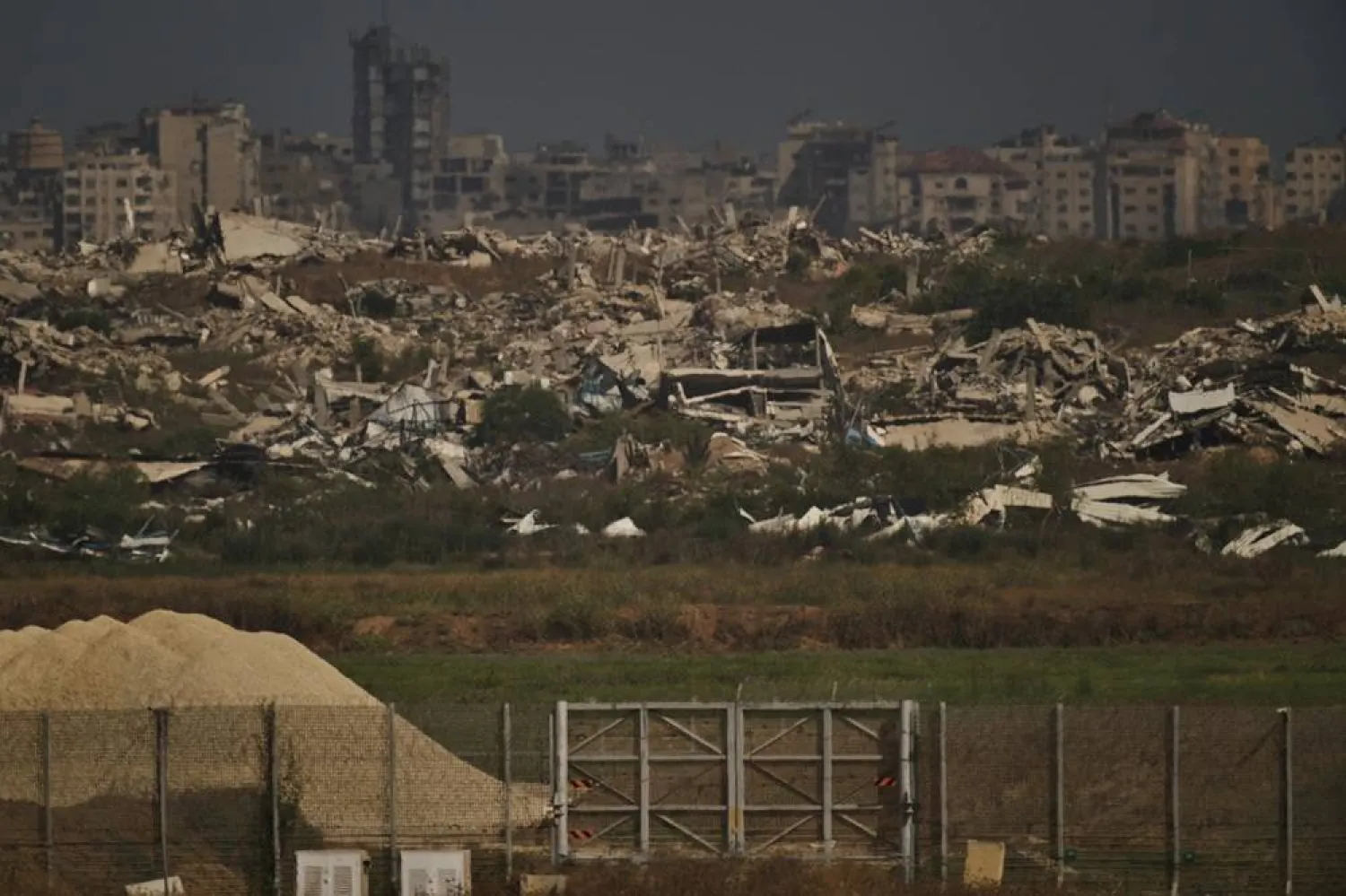
 Buildings that were destroyed during the Israeli ground and air operations stand in the northern Gaza Strip as seen from southern Israel, Thursday, July 2, 2026, on the 1,000th day of war since the Hamas-led attack on Israel sparked the war in Gaza. (AP)
Buildings that were destroyed during the Israeli ground and air operations stand in the northern Gaza Strip as seen from southern Israel, Thursday, July 2, 2026, on the 1,000th day of war since the Hamas-led attack on Israel sparked the war in Gaza. (AP)
TT

Trump’s Board of Peace Planning Pilot ‘Humanitarian Zone’ in South Gaza, Says Official

 Buildings that were destroyed during the Israeli ground and air operations stand in the northern Gaza Strip as seen from southern Israel, Thursday, July 2, 2026, on the 1,000th day of war since the Hamas-led attack on Israel sparked the war in Gaza. (AP)
Buildings that were destroyed during the Israeli ground and air operations stand in the northern Gaza Strip as seen from southern Israel, Thursday, July 2, 2026, on the 1,000th day of war since the Hamas-led attack on Israel sparked the war in Gaza. (AP)

US President Donald Trump's Board of Peace is planning a pilot "humanitarian zone" in southern Gaza which would aim to accommodate tens of thousands of vetted Palestinian civilians, a board official told AFP.

The official said the zone could act as a "starting point" for the Palestinian technocratic committee meant to assume the day-to-day governance of Gaza's transitional phase out of war under Trump's 20-point plan.

The pilot zone, which the board is eyeing for Rafah in the southern Gaza Strip, would be secured by multinational troops from the International Stabilization Force (ISF), a fledgling body which operates under the Board of Peace.

The National Committee for the Administration of Gaza (NCAG), the group of Palestinian technocrats established by the Board of Peace, would carry out screening and access control, supported by the ISF.

The concept of closed humanitarian zones, which has been discussed in various forms for several months, has raised serious reservations, with diplomats and NGO officials working in Gaza telling AFP on condition of anonymity that such a mechanism seems to them to be incompatible with international humanitarian law.

Movement in and out "will remain free for all unarmed civilians," the board official told AFP on condition of anonymity.

Efforts to advance the US-backed ceasefire plan for Gaza have been stalled for months, with the NCAG stuck in Cairo and yet to actually enter the territory.

Since the truce between Israel and Hamas came into effect last October, Israeli forces have expanded their presence in Gaza, and now control more than 60 percent of the territory.

"There's one pilot project we're looking at particularly, that maybe you can get the NCAG a starting point, you can enable tens of thousands to come if they wish voluntarily to this area, and you start giving them a space where they exercise effective governance and they're the administration," the official said.

- 'Buffer' -

The official said the board was "looking at Rafah" as a location for the project but remained vague on its exact positioning. He said that no building work had begun.

Rafah, which sits at Gaza's southern edge, was effectively razed by Israeli bombing during the war and the area is now largely under Israeli military control.

The ISF would act as a "kind of buffer" separating the Palestinian population from the Israeli military, the official said.

"A screening mechanism will ensure that armed individuals and fighters cannot enter these safe humanitarian zones," he said.

"This function will not be performed by the Israeli military, which will have no contact with the civilian population and no role in separating these areas from the rest of Gaza," the official said.

The Board of Peace was formally established earlier this year as part of the US-backed ceasefire plan for Gaza endorsed by the UN Security Council.

It aims to facilitate a transition away from Hamas rule while supporting the restoration of civilian administration and basic services.

Diplomats and NGO officials working in Gaza say that grouping civilians into demarcated areas subject to access controls could amount to forced displacement of the population, restrict Palestinians' freedom of movement and undermine the principle of impartiality.


Morocco’s King Names El Mansouri First Woman Head of Gov’t

Fatima Ezzahra El Mansouri, Morocco’s newly appointed head of government. (AFP)
TT

Morocco’s King Names El Mansouri First Woman Head of Gov’t

Fatima Ezzahra El Mansouri, Morocco’s newly appointed head of government. (AFP)

King Mohammed VI has appointed Fatima Ezzahra El Mansouri, a leader of the Authenticity and Modernity Party (PAM), as Morocco’s head of government, making her the first woman named to the post. She has been tasked with forming a government.

The appointment places El Mansouri at the center of a demanding political period. Her government will face expectations over social policy and regional inequality as Morocco prepares to co-host the 2030 World Cup.

Early life and political background

El Mansouri was born in Marrakech on Jan. 3, 1976, and is 50. Her family comes from the Rehamna region near the city.

Her late father, Abderrahmane El Mansouri, served as pasha of Marrakech for three decades and was Morocco’s ambassador to the United Arab Emirates.

Growing up close to public administration, politics and diplomacy shaped her early interest in law and public service.

Education

El Mansouri attended French schools in Marrakech and earned her baccalaureate at Lycée Victor Hugo. She later studied law in France, obtaining a postgraduate diploma in business contract law from the University of Montpellier.

She also earned a diploma in Anglo-American business law from New York University and a degree in private law from Mohammed V University in Rabat, according to the supplied account.

From law to politics

After completing her studies, El Mansouri established a law practice in Marrakech specializing in property and commercial transactions.

She joined PAM when it was founded in 2008. A year later, at 33, she was elected mayor of Marrakech, becoming the first woman to lead the city’s municipal council. The supplied account describes her as the second woman to become a mayor in Morocco.

Government and party leadership

El Mansouri went on to serve in parliament. She returned to the Marrakech mayoralty in September 2021 and was appointed minister of national territory planning, urban planning, housing and city policy the following month.

In February 2024, she became coordinator of PAM’s collective leadership, strengthening her position within the party before her appointment to form a government.

The challenges ahead

El Mansouri’s appointment is a milestone for women in Moroccan politics.

Her government will also be judged on its response to demands for improved living standards, efforts to narrow the gap between cities and less-developed areas, and preparations for the 2030 World Cup.


Israel Kills Commander of Hamas Armed Wing’s Northern Brigade

Palestinians attend the funeral of Izz al-Din al-Beik and his aide, Mohannad Abu Foul, in Gaza City on Tuesday. (EPA)
TT

Israel Kills Commander of Hamas Armed Wing’s Northern Brigade

Palestinians attend the funeral of Izz al-Din al-Beik and his aide, Mohannad Abu Foul, in Gaza City on Tuesday. (EPA)

Israel killed Izz al-Din al-Beik, commander of Hamas’s Qassam Brigades Northern Brigade, in a dawn strike on an apartment in northwestern Gaza City yesterday, four Hamas sources told Asharq Al-Awsat. Israeli officials also announced his killing.

The sources said al-Beik, known as “Ashmawi,” died immediately when three missiles struck the apartment in the Al-Nasr neighborhood. They said the missiles were probably fired by warplanes to ensure he was killed.

The body of his personal aide, Mohannad Abu Foul of Jabalia refugee camp, was found that morning.

Israeli Prime Minister Benjamin Netanyahu and Defense Minister Israel Katz announced the operation. The Israeli military later said it had killed al-Beik, accusing him of planning attacks and trying to rebuild the Northern Brigade after it suffered heavy losses in the war.

The strike hit at 3:30 a.m., an Asharq Al-Awsat correspondent reported. Fire engulfed the apartment and burned for more than half an hour before civil defense crews put it out.

The Israeli military appeared to have used missiles that caused intense fires, which could kill a target through either the blast or the toxic smoke they produced.

Israel’s Channel 12 gave a different account of the number of missiles fired. It said two struck the room where al-Beik was sleeping, followed by three more in case he had been in another room and to ensure he was dead.

The building stands beside another hit in a similar daylight strike about two months ago. That attack killed Adham Nasman, the Qassam Brigades’ Gaza Brigade operations commander, who had played a prominent role in the Oct. 7, 2023, attack.

Previous attempt

Al-Beik survived an assassination attempt in late May, days after the killings of Izz al-Din al-Haddad and Mohammed Odeh. The two had led the Qassam Brigades in Gaza in succession after Mohammed Sinwar.

That strike killed Imad Aslim, deputy commander of the Gaza Brigade and commander of its Zeitoun Battalion. Sources told Asharq Al-Awsat at the time that Aslim had been due to meet al-Beik and the brigade’s new commander, Mohannad Rajab. Neither al-Beik nor Rajab had arrived when the strike hit.

Al-Beik’s killing came about two weeks after Israel killed Mohammed al-Yazouri, commander of the Qassam Brigades’ Khan Younis Brigade, and Nail Abu Obeid, commander of its Rafah Brigade. Both had replaced commanders killed by Israel in similar operations.

The Qassam Brigades have lost most of their longtime leaders and military council members. The latest strikes indicate that Israel is targeting members appointed to its new military council to replace them.

Hamas sources have previously told Asharq Al-Awsat that the group’s structure is flexible and that it quickly replaces commanders who are killed.

Who Was Al-Beik?

Al-Beik, 48, was from the Falouja area of Jabalia refugee camp, a major Hamas stronghold. A prominent member of the group for years, he joined in the late 1990s after becoming active in mosques.

He began working with the Qassam Brigades when the second intifada broke out and became heavily involved in resisting Israeli incursions into Jabalia camp and the nearby town of Beit Lahiya. He was among the first to use Yassin anti-armor projectiles against a major Israeli operation in Jabalia in 2004.

Hamas sources told Asharq Al-Awsat that al-Beik led one of the Qassam Brigades’ first special units in Jabalia, now known as the Nukhba.

He then commanded the camp’s Imad Aqel, or western, Battalion for many years before becoming the Northern Brigade’s intelligence chief. He took command of the brigade after Ahmed al-Ghandour was killed in November 2023.

As intelligence chief, al-Beik was regarded as a favorite of Mohammed Odeh, then the Qassam Brigades’ intelligence chief for Gaza, the sources said. The two were close and both came from Jabalia camp.

The sources said al-Beik led efforts to thwart what became known during the war as the “Generals’ Plan,” which they said aimed to displace residents of northern Gaza. He stayed with his fighters in direct battles against Israeli forces, they said.

One Hamas source who knew him well described al-Beik as a skilled sniper and a popular figure who had also overseen Northern Brigade operations for a time. He survived several attempts on his life before and during the war.

In one attempt inside Jabalia camp during the latter half of the war, his aide was killed but al-Beik escaped.


Abbas Calls For Unified Arms, End to ‘Coup’ in Seven-Point Palestinian Reconciliation Plan

 An Israeli soldier stands inside a Palestinian-owned home in the West Bank after Israeli settlers attacked and set it on fire on Tuesday. (Reuters)
An Israeli soldier stands inside a Palestinian-owned home in the West Bank after Israeli settlers attacked and set it on fire on Tuesday. (Reuters)
TT

Abbas Calls For Unified Arms, End to ‘Coup’ in Seven-Point Palestinian Reconciliation Plan

 An Israeli soldier stands inside a Palestinian-owned home in the West Bank after Israeli settlers attacked and set it on fire on Tuesday. (Reuters)
An Israeli soldier stands inside a Palestinian-owned home in the West Bank after Israeli settlers attacked and set it on fire on Tuesday. (Reuters)

Palestinian President Mahmoud Abbas has set out seven principles for reconciliation talks expected to be held in Cairo, including an end to the fallout from what his document calls the “coup in Gaza,” four sources from Palestinian factions told Asharq Al-Awsat.

Fatah and Hamas delegations began preparing for the talks yesterday. The sources, including one from each movement, said Abbas’s document, titled “The Palestinian-Palestinian Path to Palestinian Reconciliation,” calls for “one system, one law and one legitimate armed force.”

It also calls for adherence to the Palestine Liberation Organization and its platform, recognizing the PLO as the Palestinians’ sole legitimate representative.

The document calls for peaceful popular resistance and a political settlement based on a two-state solution and international resolutions.

It proposes a technocratic government appointed by Abbas to govern the West Bank, East Jerusalem and the Gaza Strip, and assigns responsibility for negotiating a comprehensive peace agreement to the PLO.

Hamas’s position on the principles is not yet known. A senior Hamas source said the movement was open to talks that would serve what he called the “broader Palestinian interest” and achieve “a genuine partnership aimed at changing the status quo.”

Preparations for Palestinian talks

Delegations from Palestinian factions are preparing to arrive in Cairo in stages for bilateral meetings that could lead to a broader national dialogue.

Fatah is expected to participate after previously declining such a dialogue and refusing to meet with Hamas bilaterally.

No arrival dates or dates for the broader dialogue have been finalized.

Six sources from different Palestinian factions told Asharq Al-Awsat separately that, under Palestinian and Egyptian arrangements, a Hamas leadership delegation would arrive in Cairo, followed by a Fatah delegation headed by Jibril Rajoub.

Other figures already in Cairo, including Azzam al-Ahmad, would join them. Delegations from other factions are also expected, with some of their leaders already in the Egyptian capital.

A Fatah source said al-Ahmad had met Palestinian figures in recent days to discuss elections to the Palestinian National Council.

He may join the delegation coming from Ramallah for the factional meetings, the source said. Egypt has reservations about holding council elections now without a consensus, the source added.

On Abbas’s instructions, Fatah’s Central Committee recently formed a committee to take part in the national dialogue. Rajoub will chair it, with Mohammad Shtayyeh and Majed Faraj as members.

Election delay grows more likely

The bilateral meetings and any broader dialogue would address Palestinian affairs and internal unity, including legislative elections scheduled for November, the sources said.

Their accounts indicated an increasing likelihood of a delay.

One source said that, although no decision had been announced, “Israel is likely not to allow the elections to take place.”

The source said Israel would seek to block voting in East Jerusalem and carry out military operations in the West Bank to disrupt the elections, while conditions in Gaza were also difficult.

Two sources from different factions, one of them left-wing, said the factions recognized the difficulties and saw a need to postpone the vote.
