


Trump Says the US Will Give License to Ukraine to Produce Patriot Defense Systems

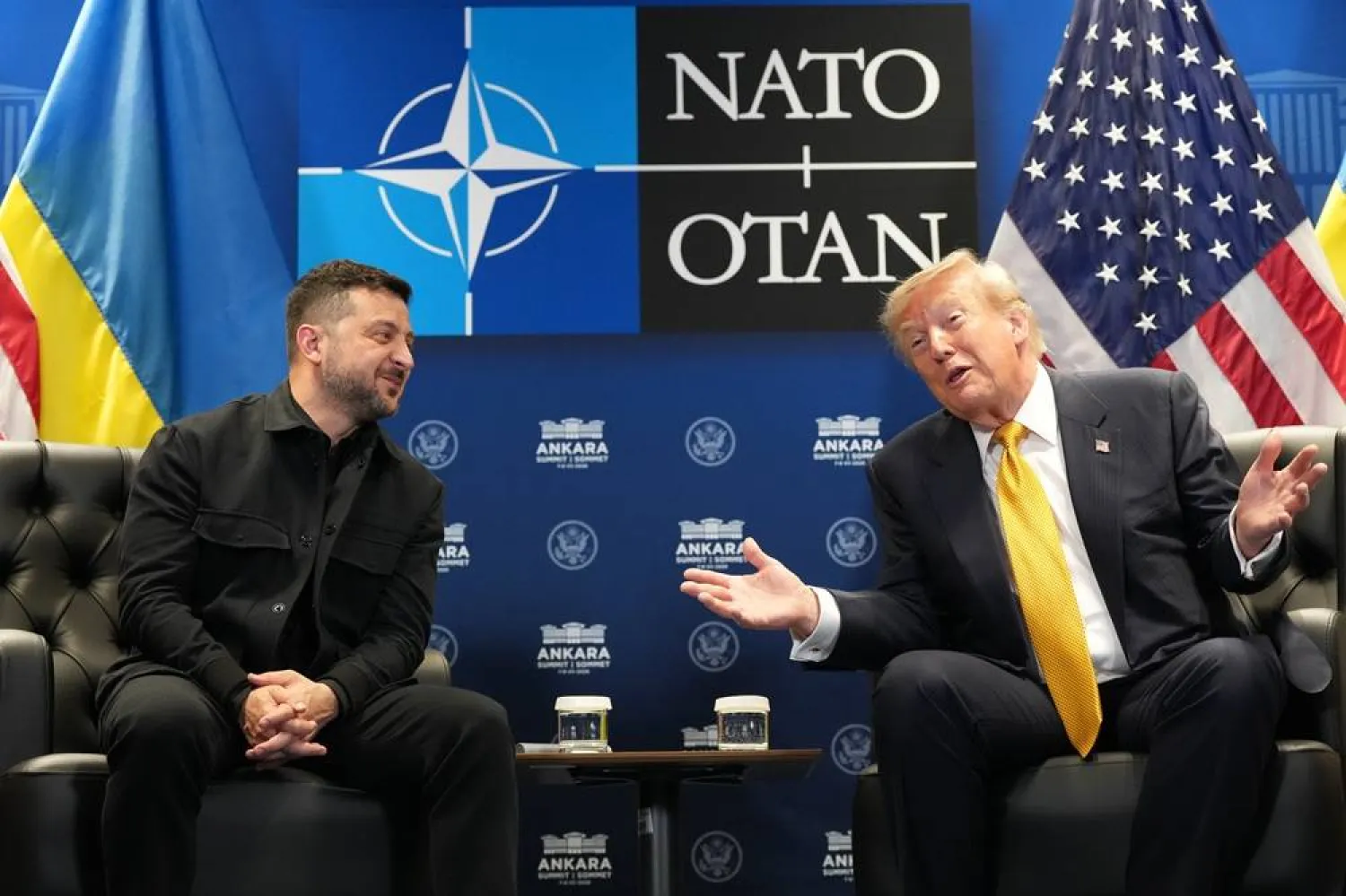
US President Donald Trump meets with Ukraine's President Volodymyr Zelenskyy on the sidelines of the NATO summit in Ankara, Türkiye, Wednesday, July 8, 2026. (AP)
TT

Trump Says the US Will Give License to Ukraine to Produce Patriot Defense Systems

US President Donald Trump meets with Ukraine's President Volodymyr Zelenskyy on the sidelines of the NATO summit in Ankara, Türkiye, Wednesday, July 8, 2026. (AP)

President Donald Trump said Wednesday that the US will give a license to Ukraine to manufacture Patriot air defense systems to help counter Russian missile attacks, a huge coup for Ukraine which has badly needed the technology for the war now in its fifth year.

“We’ll give them the right to make Patriots. We’ll show them how to do it,” Trump said as he met with Ukrainian President Volodymyr Zelenskyy at a NATO summit in Türkiye. “I think they can produce them pretty quickly.”

Patriots are expensive, in high demand and take a long time to produce. Zelenskyy has for years been asking for more of them, and more recently for a license so that Ukraine can manufacture its own.

The tone of Trump's meeting with the Ukrainian leader was a break from earlier encounters which ended in acrimony, and Trump praised Zelenskyy's willingness to reach a deal on ending the fighting in Ukraine.

He said the Ukrainian president has “done an amazing job” and “been very effective” in the war.

“We’ve actually developed a good relationship. It’s hard to believe,” Trump said, adding he believed a deal on ending the war was on the horizon and that the US would “work on some kind of security package” to provide to Ukraine.

Trump takes aim at NATO partners

Trump wasn't as friendly with some of his NATO partners, saying he was unhappy with the alliance for pushing back against his efforts to take control of Greenland and for not supporting his war in Iran.

NATO's European members plus Canada have scrambled to meet the increased defense spending targets Trump has demanded, as the US draws down the number of troops it has in Europe and insists the continent take more responsibility for its own security.

But Trump reopened old wounds as he arrived at the meeting of 32 NATO leaders by insisting again that the United States should control Greenland, a semiautonomous Danish territory. He blasted some European countries for refusing to participate in the Iran campaign, singling out Spain as “a terrible partner in NATO” and renewing his threats to cut off trade.

Ahead of the summit, Trump said Greenland “is very important” for the US but not for Denmark, declaring, “We need it for protection of the world, not just the United States.”

But Denmark's Prime Minister Mette Frederiksen said her country is “ready to defend every inch of NATO including our own territory” in the event of an attack, and would rely on NATO allies to honor their commitment to defend each other.

Trump’s criticisms have in the past drawn European countries closer together as they confront wars in Ukraine and Iran, a ballooning trade deficit with China, and threats from Russia.

The president's renewed interest in Greenland could put at risk the entire future of NATO, which was founded in 1949 to counter the threat to European security posed by the Soviet Union during the Cold War.

NATO Secretary-General Mark Rutte sought to tamp down the president's ire by giving him credit for recent increases in defense spending from NATO allies.

“Grab the win. It’s there,” Rutte told Trump on Wednesday.

NATO chief backs latest US strikes on Iran

Ahead of the summit, Rutte praised Trump for the series of US strikes on Iran overnight, after Tehran struck three merchant ships in the Strait of Hormuz.

“I think what you did last night was absolutely necessary,” Rutte said to Trump. “It was a very strong response, and I’m with you on this.”

The US strikes, as well as the revoking of a license allowing Iran to sell its oil on global markets, underscored the fragility of an interim deal to end months of fighting.

Trump said of the interim agreement with Iran: “For me, I think it’s over” — but added he will allow talks to continue.

“It’s just a waste of time dealing with them,” he said.

NATO leaders sought to show Trump they were boosting defense

Rutte has dedicated a huge amount of energy to keeping Trump's support for NATO and to holding the summit together.

The NATO chief pointed to countries including Estonia, Latvia, Poland and Denmark that are investing more in defense, but noted the Trump administration expects “the Europeans and Canadians will equalize their spending with the United States.”

Last month Rutte went to Washington to hail the “Trump Trillion” — the $1.2 trillion that European allies and Canada have added to defense spending since Trump came to power in 2017.

As leaders converged on Ankara, Rutte hosted a “big reveal” event to showcase the many deals planned for the increased spending — much of it to be spent on US companies, creating thousands of jobs for Americans.

At last year's summit, the allies agreed to invest 5% of their gross domestic product on defense — 3.5% on their defense budgets and 1.5% on infrastructure so troops and equipment can move faster in times of conflict.

Yet figures released by NATO on Tuesday showed that Slovenia, Belgium, Spain and the Czech Republic have struggled to meet the alliance’s old spending target of 2% of GDP.

The Trump administration wants to see a leaner “NATO 3.0,” with Europe taking responsibility for its own security, including Ukraine, with conventional weapons while America would continue to provide its nuclear umbrella.

The Pentagon has launched a six-month review of US military presence in Europe, leaving allies to seek clarity on just how deeply Trump intends to cut US force numbers.

Zelenskyy pushes for NATO entry

Zelenskyy made a fresh appeal Tuesday for Ukraine to be allowed to join the alliance, saying Ukrainian armed forces are highly experienced and would only boost NATO’s defense capabilities.

He's highlighted Ukraine’s adaptability and its ability to strike deep inside Russia. He said Ukraine’s armed forces are “eliminating” on average 30,000 Russian troops every month.

In a declaration following Wednesday's summit, NATO leaders pledged to provide Ukraine with $80 billion to help meet its defense needs this year and next, noting “the long-term threat Russia poses to Euro-Atlantic security.”

Concern has been mounting among some countries with borders near Russia that Moscow might be preparing a hybrid attack — a combination of conventional warfare with tactics like cyberattacks — on the continent as President Vladimir Putin struggles to secure victory in Ukraine.



Egypt Tries to Revive US-Iran Negotiations

 Vessels near the Strait of Hormuz, as seen from Musandam, Oman, August 17, 2026. (Reuters)
Vessels near the Strait of Hormuz, as seen from Musandam, Oman, August 17, 2026. (Reuters)
TT

Egypt Tries to Revive US-Iran Negotiations

 Vessels near the Strait of Hormuz, as seen from Musandam, Oman, August 17, 2026. (Reuters)
Vessels near the Strait of Hormuz, as seen from Musandam, Oman, August 17, 2026. (Reuters)

The top diplomats for Egypt and Iran discussed efforts to bring Tehran and Washington back to the negotiating table to settle the war, Egypt's foreign ministry said on Saturday.

Iranian Foreign Minister Abbas Araghchi and Egyptian counterpart Badr Abdelatty also discussed the Iranian-Omani talks on the management of the Strait of Hormuz, the ministry said.

Araghchi briefed Egypt's foreign minister about “Iran’s view of ongoing developments, the course of negotiations and their challenges,” the ministry said, without elaborating.

There was no immediate statement from Araghchi.


Putin Says Ukraine Opened ‘Pandora’s Box’ with Strikes on Economic Targets

 Russian President Vladimir Putin gives an interview to journalist Pavel Zarubin in Moscow, Russia, August 22, 2026. (Sputnik/Mikhail Metzel/Pool via Reuters)
Russian President Vladimir Putin gives an interview to journalist Pavel Zarubin in Moscow, Russia, August 22, 2026. (Sputnik/Mikhail Metzel/Pool via Reuters)
TT

Putin Says Ukraine Opened ‘Pandora’s Box’ with Strikes on Economic Targets

 Russian President Vladimir Putin gives an interview to journalist Pavel Zarubin in Moscow, Russia, August 22, 2026. (Sputnik/Mikhail Metzel/Pool via Reuters)
Russian President Vladimir Putin gives an interview to journalist Pavel Zarubin in Moscow, Russia, August 22, 2026. (Sputnik/Mikhail Metzel/Pool via Reuters)

Russian President Vladimir Putin said in comments published on Saturday that Kyiv had opened "Pandora's box" with its strikes on Russian economic targets, saying that Russia would hit back at Ukraine's "most sensitive economic sectors".

Ukraine has this summer escalated a campaign of drone strikes targeting Russian economic infrastructure, including oil refineries and online retailers' warehouses, seeking to ‌destroy infrastructure it ‌says is central to Russia's ‌war ⁠effort.

Russia has responded ⁠with strikes against Ukrainian economic infrastructure, including Ukrainian grain exports via the Black Sea.

"The Kyiv regime set out to damage our economy. What did it do? It opened this Pandora’s box itself. Well then, expect a response targeting your ⁠most sensitive economic sectors," Putin said ‌in comments to ‌a Russian state television journalist.

He said that the strikes, ‌which have jeopardized Ukraine's agricultural exports, would ‌not cause global food shortages, because Russia would be able to replace Ukrainian exports, even as Kyiv has targeted Russian grain export infrastructure.

"We do face ‌challenges regarding the shipment of our goods, but we will resolve these issues. ⁠Consequently, ⁠there will be no shortage on the global market," Putin said.

Russia and Ukraine had previously adhered to a Turkish-brokered deal to protect grain exports on the Black Sea. But Russia exited the deal in 2023.

The Russian leader also restated his position that Moscow is open to peace talks, but only on the basis of "realities on the ground", rather than what he called "exotic" proposals that he said had been made by Ukraine via intermediaries.


Iran Condemns US Plans to Announce New Sanctions

Iranian people walk past an anti-US mural in Tehran, Iran, 17 August 2026. (EPA)
TT

Iran Condemns US Plans to Announce New Sanctions

Iranian people walk past an anti-US mural in Tehran, Iran, 17 August 2026. (EPA)

Iran on Saturday denounced US plans to announce new sanctions that could put further strain on the country’s economy and have an impact on its most important trading partners including China.

After nearly six months of war since the US and Israel launched airstrikes against Iran on February 28, the sides are not firing at each other but also showing no sign of pursuing peace talks.

Oil shipments are at a virtual standstill in the Strait of Hormuz, with Tehran threatening to strike any unauthorized oil tankers that try to transit the vital waterway, and Iran's economy is already under immense pressure from sanctions.

US Treasury Secretary Scott Bessent is due to hold a press conference at 2 p.m. EDT (1800 GMT) on Monday after threatening "the toughest sanctions in history" on Iran.

Bessent has also urged cooperation with Washington by China, which buys more than 80% of Iran's shipped oil, according to 2025 data from ‌analytics firm Kpler. ‌Beijing has urged diplomacy.

Iran's Foreign Ministry spokesperson, Esmaeil Baghaei, said on Saturday the imminent US announcement of ‌new ⁠economic sanctions was an "assertion ⁠of extraterritorial sovereignty over every independent member state of the United Nations."

"Such secondary sanctions find no foundation in international law," he said in a post on X.

The chief of staff of Iran's armed forces, Major General Ali Abdollahi, promised on Friday that Iran would respond to enemy threats militarily with "crushing, punishing and devastating responses.”

US President Donald Trump, who has warned of economic consequences against any country that provides "any type of lifeline to Iran," said on Friday that Washington was observing "what happens" in the conflict.

"They would love to make a deal, but they're not ready to make the right deal, in my opinion," Trump said of Iran.

HORMUZ TRAFFIC HALTED

While the US has effectively blockaded Iranian vessels in their ports, the Strait of ⁠Hormuz remained bottled up with thousands of seafarers stranded on hundreds of vessels.

Only four commodity ships ‌sailed along the strait on Thursday, none of them large crude carriers or liquefied ‌natural gas tankers, ship-tracking data showed.

However, Iran has granted permission for a number of Iraqi oil tankers to pass through the Strait following repeated requests from ‌Baghdad, Iran’s state news agency IRNA reported on Saturday.

IRNA said obtaining special permission for Iraqi tankers was one of Baghdad’s main requests ‌during a visit to Iraq by Parliament Speaker Mohammad Baqer Qalibaf.

US Energy Secretary Chris Wright said the US military helped move a seven-day average of 8 million barrels a day of oil through the strait. That's down from more than 20 million per day before the war or about one of every five barrels consumed worldwide.

US attacks have severely diminished Iran's economy and devastated its navy and air force, but Tehran maintains enough missile and drone capability ‌to impede oil tanker traffic and attack regional rivals.

Abdollahi, the armed forces chief of staff, sought to underline Iran's missile capabilities during a visit to an underground plant manufacturing ballistic missiles that was reported ⁠by state television on Saturday.

"This ⁠plant has been able, much better than in the past, to produce equipment superior both in capacities and quality and in quantity," he said.

Trump, meanwhile, has yet to achieve objectives he set at the start of the war such as dismantling Iran's nuclear program - the state of which remains uncertain given that UN inspectors have been shut out since 2025 - and creating conditions for Iranians to overthrow their clerical rulers.

Thousands have been killed, mainly in Iran, where 168 Iranian school children were killed on the first day of the war. The US has reported more than 750 military personnel wounded and 18 killed.

While Iran remains defiant, President Masoud Pezeshkian has also called for a diplomatic solution.

"It would be better to end the war today, when we are powerful and have dignity, and the whole world acknowledges our victory and emphasizes that America, contrary to all regulations, attacked our schools, hospitals, and infrastructure and is hated in the world," the ISNA news agency quoted him as saying on Friday.