Merz: US Approves Sale of Tomahawk Missiles to Germany

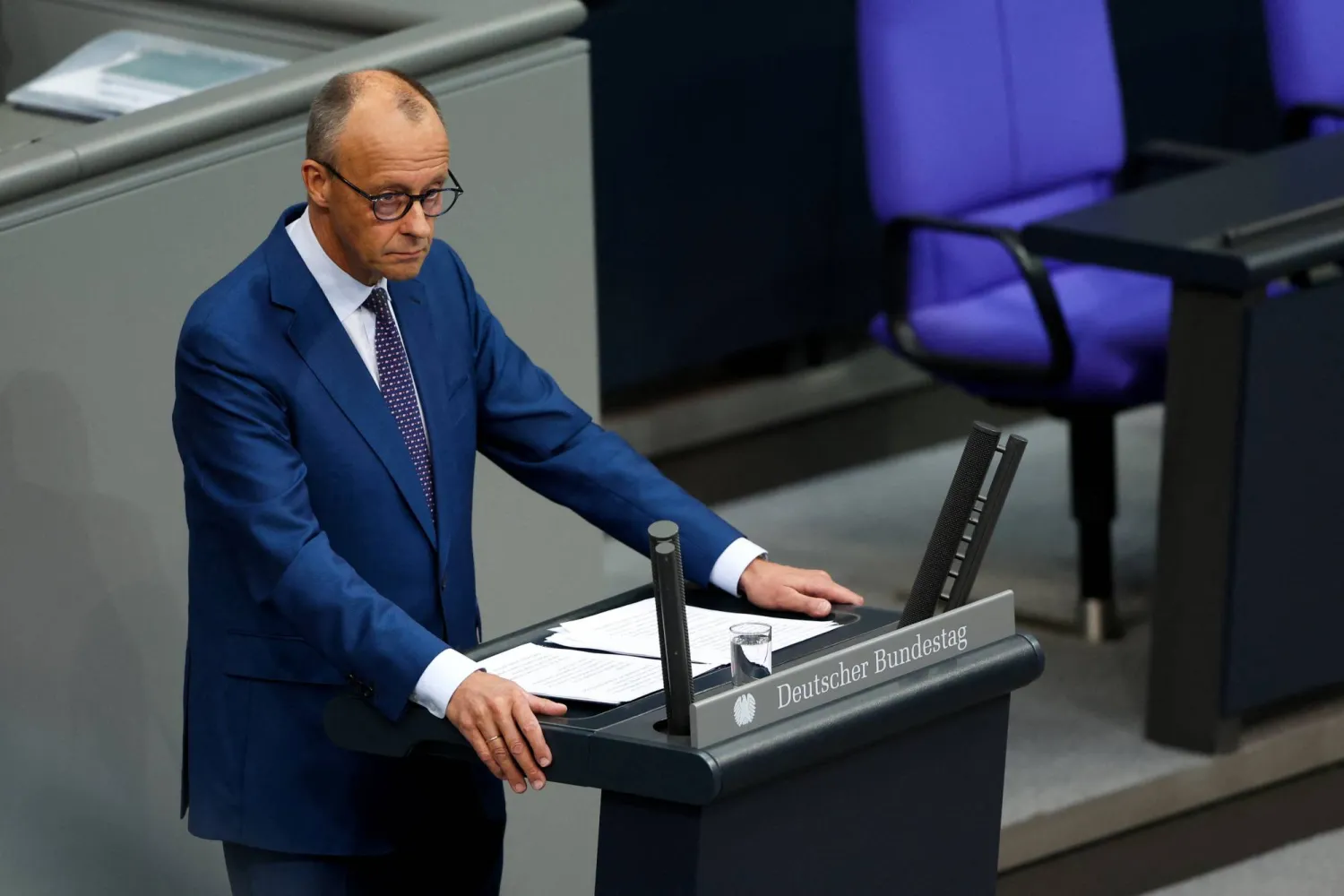
German Chancellor Friedrich Merz attends a plenum session of the lower house of parliament, the Bundestag, in Berlin, Germany, July 9, 2026. REUTERS/Maryam Majd
TT

Merz: US Approves Sale of Tomahawk Missiles to Germany

German Chancellor Friedrich Merz attends a plenum session of the lower house of parliament, the Bundestag, in Berlin, Germany, July 9, 2026. REUTERS/Maryam Majd

The United States has approved the sale of Tomahawk cruise missiles to Germany, Chancellor Friedrich Merz said Thursday, despite previous doubts that a planned deployment of the missiles would go ahead.

"On the sidelines of the NATO meeting in Ankara, we agreed with the American government that American Tomahawk missiles will be purchased by us and stationed in Germany," Merz told MPs in a statement to parliament.

The fate of the Tomahawks had been unclear after President Donald Trump announced in May that he would reduce US military presence in Germany, ⁠which ⁠had been seen as a cancellation of a plan under the previous administration to deploy a US battalion with long-range Tomahawk missiles to Germany.

Berlin has pushed for the move as a powerful deterrent against Russia while Europeans develop such weapons of their own.


UN Health Agency Wants More Details from Russia on Suspected Pneumonic Plague Case

 A man walks past the building of the Irkutsk Anti-Plague Research Institute of Siberia and the Far East in Irkutsk, Russia, on Wednesday, Oct. 7, 2026. (AP)
A man walks past the building of the Irkutsk Anti-Plague Research Institute of Siberia and the Far East in Irkutsk, Russia, on Wednesday, Oct. 7, 2026. (AP)
TT

UN Health Agency Wants More Details from Russia on Suspected Pneumonic Plague Case

 A man walks past the building of the Irkutsk Anti-Plague Research Institute of Siberia and the Far East in Irkutsk, Russia, on Wednesday, Oct. 7, 2026. (AP)
A man walks past the building of the Irkutsk Anti-Plague Research Institute of Siberia and the Far East in Irkutsk, Russia, on Wednesday, Oct. 7, 2026. (AP)

A top official with the World Health Organization said Wednesday it doesn’t know how a lab worker in Siberia died, and she urged Russia to provide more information about a case that prompted global concerns about suspected pneumonic plague.

Maria Van Kerkhove, WHO director of Epidemic and Pandemic Management, said the UN health agency doesn’t know what the “causative agent” was behind the woman’s Oct. 2 death, which unconfirmed reports in Russia blamed on pneumonic plague — a less common but severe form of plague that can spread from person to person.

In its tersely worded statements, Russia's public health watchdog, Rospotrebnadzor, does not link the case to pneumonic plague, saying only that the lab worker had contracted pneumonia of “unknown” origin and that “extensive” testing found no evidence her illness was caused by any of the pathogens she worked with at the Irkutsk Anti-Plague Research Institute of Siberia and the Far East.

“We don’t understand how she was infected,” Van Kerkhove said. “We need information in a timely way. We need regular information. We need answers to the follow-up of the questions that we have asked.”

“We have posed these questions to our colleagues in the Russian Federation. In fairness, they have responded. We’ve gone back with more questions,” she said.

The comments suggested the UN health agency has more questions than answers about the situation at the lab, which focuses on plague and was founded about a century ago to study the disease in Siberia, where it occurs naturally in wild animals.

Russia has released little information about the case

Russian authorities have kept a tight lid on information about the case, which has been surrounded by secrecy.

While it has raised global concerns, Russian state TV and other national state-controlled media have largely steered clear of the subject. Some news outlets withdrew earlier reports about the case.

Rospotrebnadzor said Sunday the lab worker was diagnosed with “pneumonia of unknown etiology,” meaning its origin was not known.

A state TV station in Irkutsk reported she died Oct. 2 in a hospital in Shelekhov, a town just outside Irkutsk. Officials have quarantined that hospital and were monitoring the worker's contacts.

Russia has said the pneumonia initially presented as a “typical” acute respiratory viral infection, the WHO has said, acknowledging that pneumonia is commonplace.

WHO Director-General Tedros Adhanom Ghebreyesus said Russian authorities had indicated that no case of plague had recently been reported in the Irkutsk region, and that they had placed about 200 contacts in quarantine.

Russia says preventive measures are underway

US President Donald Trump said he would discuss the issue during a call with Russian President Vladimir Putin because Wednesday is the Kremlin leader's 74th birthday.

“They’re sharing it a little bit with our people. We expect them to share it a lot with our people,” Trump said.

Kremlin spokesman Dmitry Peskov said earlier Wednesday that a Putin-Trump call hasn’t been set yet but could be organized quickly.

Asked if the incident was a sign that plague might be developed as a bioweapon, Trump said, “We don’t think so. We’re going to find out soon enough, but we don’t think so.”

When asked if the situation was similar to dealing with China on COVID-19 in his first term, Trump suggested Russia was staying relatively quiet, just as China did before the virus turned into a pandemic. “China didn’t say much and Russia is not saying much either, but they do say they have it very much under control,” he said.

Dr. Erica Schwartz, director of the US Centers for Disease Control and Prevention, said the threat to the US “is extremely low.” She travel from that area of Russia to the US each year is limited — and mostly comes through New York’s John F. Kennedy International Airport.

Government agencies are working “to make sure that we know exactly if anyone from that area comes into the United States,” Schwartz said during a Wall Street Journal health forum Wednesday.

Russian health authorities reported a full range of preventive measures had been carried out, including tracing the dead woman’s contacts, medical monitoring and lab tests, the WHO said.

The Geneva-based organization cited media reports that a second employee had pneumonia of undetermined cause.

Health experts urge more Russian openness

Peskov referred all questions to Rospotrebnadzor, which does not mention suspected plague in its reports and has not responded to a request for comment.

In its latest statement Tuesday, the agency said that “the sanitary and epidemiological situation in the Irkutsk region, the cities of Irkutsk and Shelekhov is calm.” Authorities were completing a “complex of prophylactic measures and medical observation over contacts,” it said, adding that so far they have found two cases of COVID-19 and two cases of rhinovirus.

“No other infectious pathogens have been found among contacts,” it said.

Judy Twigg, professor of political science at Virginia Commonwealth University, noted that while the measures taken by Russian health authorities “have been swift and serious,” officials sought to play down the situation and “any statements that strayed from that party line ... were edited or deleted within hours.”

“What we are watching is less a failure to respond than a failure of candor,” Twigg said in written comments.

Vasily Vlassov, professor at the department of healthcare administration and economics at Russia’s Higher School of Economics, said the measures taken appeared “sensible,” focusing on treating the sick, isolating them and their contacts, looking for new cases and carrying out disinfection.

He said it wasn't clear whether more transparency was possible if those dealing with the situation didn’t have enough certainty, and “maybe, they still don’t.” Deceiving the public, however, “always turns out to be harmful,” he said.

Distrust of Russia’s official narrative is “natural” and “almost inevitable,” Vlassov said.

In the Soviet era, dangerous outbreaks of infection had “a thick veil of secrecy — people were told nothing.”

The lab worker who died was described as highly diligent

The news outlet Lyudi Baikala — or “People of Baikal” — identified the dead lab worker as Darya Shipilova, 28, and said she first was hospitalized with cold symptoms Sept. 29 and died three days later.

It quoted colleagues as saying she was a highly qualified and diligent researcher. They also emphasized that security rules at the facility are extremely strict.

The report quoted Shipilova's neighbors as saying disinfection experts did several cleanups of her apartment, leaving a strong antiseptic smell.

Shipilova’s mother, who worked as a doctor in the past, described her daughter as hard-working and dedicated, according to independent Russian news outlet Glubina, adding that she had not gotten official documents describing the cause of death.

Twigg noted that Russia criminalized “false information” about threats to public safety in 2020 amid the COVID-19 pandemic, “so silence is the one safe move for everyone below the top.”

“Personalist regimes without electoral accountability tend to treat bad news as a loyalty problem rather than focusing on the actual problem to be addressed,” she said.

She warned that “the public’s understandable reaction to the lack of information carries real dangers.”

“A government that is not believed when it says ‘there is no outbreak’ will not be believed when it must actually say ‘there is one; do the following.’ We saw this with COVID,” she said.

Pneumonic plague and the more well-known bubonic plague — also called the Black Death — are caused by the same bacteria, said Simon Clarke of the University of Reading in the UK Pneumonic plague results from breathing in the bacteria, causing an infection in the lungs.

The bacterium, called Yersinia pestis, has not been eliminated, but it is not spread very easily and it is treatable with antibiotics.



France Summons Iran Ambassador Over ‘Disinformation Campaign’ on School Protests

Students run through tear gas near Sciences Po university as they protest against under-resourced schools, in Paris, Wednesday, Oct. 7, 2026. (AP)
TT

France Summons Iran Ambassador Over ‘Disinformation Campaign’ on School Protests

Students run through tear gas near Sciences Po university as they protest against under-resourced schools, in Paris, Wednesday, Oct. 7, 2026. (AP)

The French foreign ministry on Wednesday summoned the Iranian ambassador to protest against a "disinformation campaign conducted by the Iranian authorities" over high school protests that have rocked France.

The ambassador was told "the misleading content disseminated online" by official accounts of the Iranian foreign ministry was "absolutely unacceptable", the ministry said in a statement, after Tehran on Tuesday summoned the French ambassador over the treatment of protesters in France.

Iran accused France of "violent treatment" of the protesters and "extensive and flagrant human rights violations" during the demonstrations, which intensified last week and have seen clashes between demonstrators and the security forces.

But the French foreign ministry said that the summoning of its ambassador to Tehran was "baseless".

Rights groups including Amnesty International have accused French authorities of using disproportionate force against protesters, with police firing tear gas and blast balls and using batons to control crowds.

Iran's anger over events in France came after Iranian security forces used deadly force earlier this year to crack down on anti-government protests that peaked on January 8-9.

Rights groups have said thousands were killed and organizations, including Amnesty, have accused Iranian security forces of directly firing on protesters.

Norway-based rights group Iran Human Rights says it has identified 4,219 people killed during the protests -- almost all on January 8-9 -- but has warned the toll is likely far higher.

Amnesty has described the Iran crackdown as the "unprecedented massacres of thousands of protesters and bystanders".

Iran has termed the protests as "riots" and emphasized the deaths of members of the security forces.


Rubio Says West Must Choose Between National Power or Decline

US Secretary of State Marco Rubio speaks at the Pnyx hill, where ancient Athenians held democratic assemblies, with the ancient Parthenon temple atop the Acropolis seen in the background, in Athens,on October 7, 2026. (AFP)
TT

Rubio Says West Must Choose Between National Power or Decline

US Secretary of State Marco Rubio speaks at the Pnyx hill, where ancient Athenians held democratic assemblies, with the ancient Parthenon temple atop the Acropolis seen in the background, in Athens,on October 7, 2026. (AFP)

US Secretary of State Marco Rubio on Wednesday insisted on the US right to flex its "national power" in a fiery speech in Athens and said that Europe had to "awaken from its long slumber."

"We are at an inflection point... not only in the history of my nation but an inflection point in the whole of our civilization," Rubio said in a speech beneath the Acropolis.

"Either we choose to act now, or lose the choice to act at all," the top US diplomat said.

The United States under President Donald Trump has made its choice, according to Rubio.

"We choose the unapologetic pursuit of national power: to take back control of our critical supply chains, to reindustrialize our economy, to rebuild our defense, to fight for dominance of the technologies and industries of the future," he said.

"There is new competition between great powers again. There is vulnerability, aggression, terrorism, a whole universe of new threats and attacks again," Rubio said.

"We must rebuild our institutions and our alliances to face these threats together," he said.

Rubio said that in Europe he saw encouraging signs of what Washington hoped "will be the beginning of a generational shift, skyrocketing defense spending, a flurry of new partnerships and programs, expanded manufacturing and production."

"We believe that Europe can awaken from its long slumber and rekindle the fire that was lit here millennia ago," he said.

- 'Critical' alliance -

His speech, which was packed with praise for the ancient Greeks, followed an address in February when he argued that Europe was threatened by mass immigration and called for it to defend Christian civilization.

Earlier Wednesday, Rubio, who arrived from Iceland as part of a European tour, underlined the "critical" US alliance with Greece.

He flagged the energy sector, and announced a joint agreement on information-sharing on drug trafficking and terrorism.

"As you see a world that faces... destabilizing events, you recognize how important this alliance with Greece is to the United States," he said, referencing conflict in the Middle East and the Russian invasion of Ukraine.

In the Middle East, he argued that Iran had "lost complete control" of the strategic Strait of Hormuz, seeking to offer reassurance at a time when the United States is struggling to find a way out of the war just weeks before key US legislative elections.

Rubio took part Wednesday in a "strategic dialogue" with Greece on regional and energy security amid high tensions triggered by the wars in Iran and Ukraine.

He is to meet conservative Prime Minister Kyriakos Mitsotakis on Wednesday evening, before departing for Lisbon on Thursday.

The wars in Iran and Ukraine have highlighted the fragility of energy supply routes, and Greece is positioning itself as a key hub in southeastern Europe, particularly for the transport of natural gas.

Recently opened gas pipelines and port infrastructure have enabled Greece to contribute to the energy corridor through eastern Europe to Ukraine.