Heatwave Linked to More Than 5,000 Deaths in Germany, Institute Says

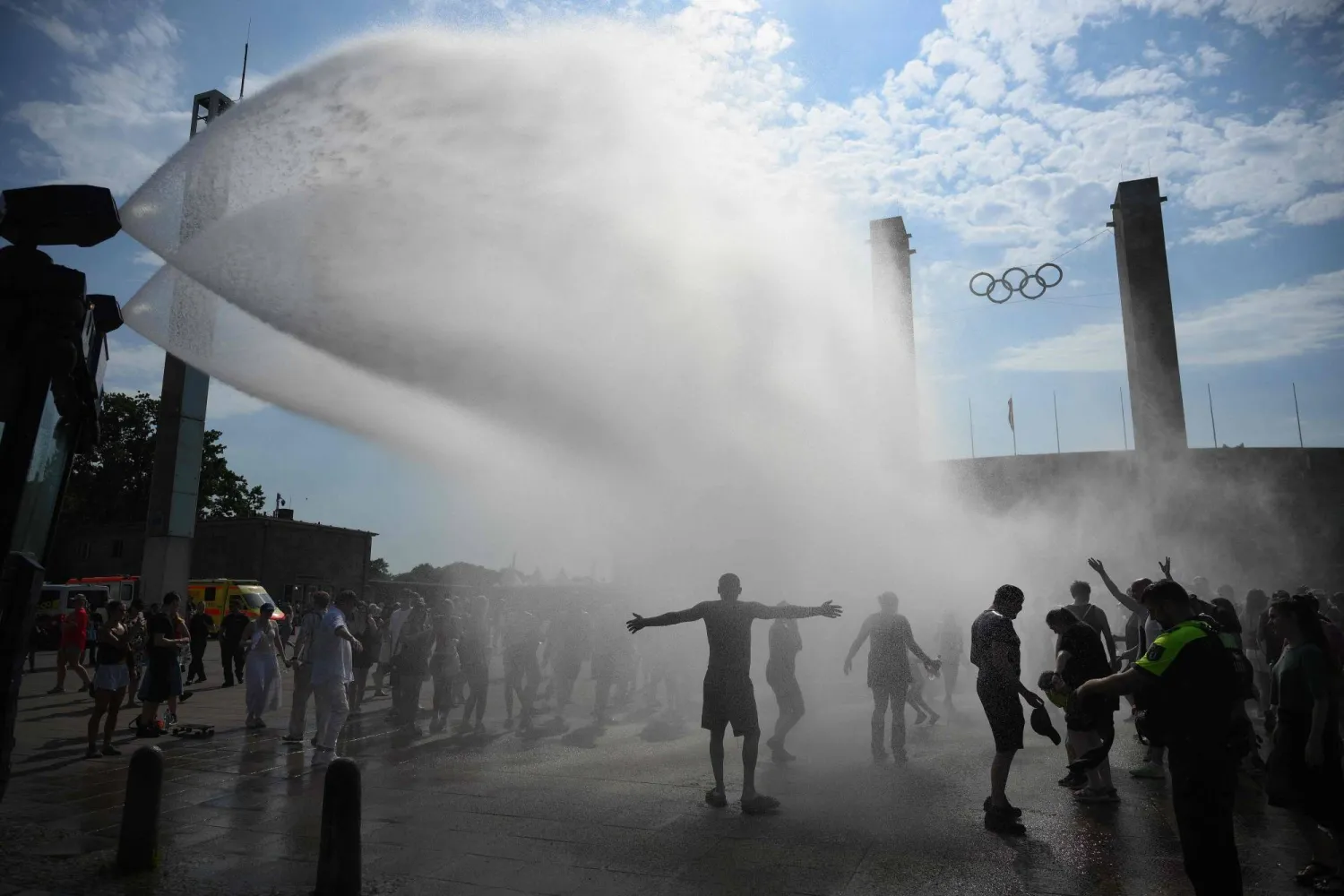
Police use water cannon to spray people with water as the arrive at the Olympic stadium for a concert of US singer Bruno Mars on June 28, 2026, in Berlin, as the German capital is expected to reach temperatures around 40 degrees Celsius during a heatwave in Europe. (AFP)
TT

Heatwave Linked to More Than 5,000 Deaths in Germany, Institute Says

Police use water cannon to spray people with water as the arrive at the Olympic stadium for a concert of US singer Bruno Mars on June 28, 2026, in Berlin, as the German capital is expected to reach temperatures around 40 degrees Celsius during a heatwave in Europe. (AFP)

Germany has recorded an estimated 5,120 heat-related deaths so far this year, most of them in late June when weekly average temperatures far exceeded 20 degrees Celsius, the Robert ‌Koch Institute (RKI) ‌for public health ‌said on ⁠Thursday.

Around 4,270 of ⁠the deaths were among people aged 75 and older, the RKI said in a weekly report. More women ⁠than men died, mainly ‌because ‌they make up a higher ‌share of the very old.

The ‌German data add to a grim picture across Europe. The EU's Copernicus Climate ‌Change Service said in a bulletin on Thursday ⁠that ⁠Western Europe had its hottest June on record with an average of 20.74 degrees.

National authorities have reported more than 4,700 excess deaths during the June 20-28 heatwave in France, Belgium, Spain and the Netherlands.


Alpacas, Mini Pigs on the Loose after Floods Hit China Zoo

A drone view shows rescue workers conducting relief operations in flood-affected Maling town, after the Liulan reservoir dam breach, following heavy rainfall brought by typhoon Maysak, in Hengzhou, Guangxi Zhuang Autonomous Region, China, July 8, 2026. China Daily via REUTERS
TT

Alpacas, Mini Pigs on the Loose after Floods Hit China Zoo

A drone view shows rescue workers conducting relief operations in flood-affected Maling town, after the Liulan reservoir dam breach, following heavy rainfall brought by typhoon Maysak, in Hengzhou, Guangxi Zhuang Autonomous Region, China, July 8, 2026. China Daily via REUTERS

At least 100 animals, including alpacas, miniature pigs and zebras, escaped a zoo in southern China's Guangxi region after floods damaged their enclosures.

Typhoon Maysak has ravaged southern and central China this week, killing 39 people in Guangxi and forcing the evacuation of 130,000.

The province's Guigang Zoo asked the public Wednesday for help in finding its escaped animals, saying some enclosures had been damaged by "continuous heavy rainfall".

It provided a list of missing creatures, including "two North American raccoons, four porcupines and thirty peacocks", according to a statement posted by a local district's Culture, Sports and Tourism Bureau.

The zoo said some of the escapees "may be frightened and potentially aggressive".

"If you spot any of the animals, please keep a safe distance," AFP quoted the statement as saying.

"Do not attempt to catch, approach or tease them, as this could be dangerous," the zoo warned.

Meanwhile, videos of villagers knee-deep in floodwater and frantically trying to catch snakes swimming in a flooded Guangxi town with their bare hands and nets went viral on social media this week.

Wu Zhi, the head of a local village committee, told state-owned media Red Star News that around 800 to 900 snakes escaped on Monday after a breeding farm was washed away in Hengzhou city.

The city "immediately bolstered its reserves of medical resources and urgently expanded the stock of antivenom" at the local hospital, state broadcaster CCTV reported.


EU Moves Closer to Kicking Kids off Social Media

Instagram, TikTok, Snapchat, Kick, YouTube, Facebook, Twitch, Reddit, Threads and X applications are displayed on a mobile phone in this picture illustration taken on December 9, 2025. (Reuters)
TT

EU Moves Closer to Kicking Kids off Social Media

Instagram, TikTok, Snapchat, Kick, YouTube, Facebook, Twitch, Reddit, Threads and X applications are displayed on a mobile phone in this picture illustration taken on December 9, 2025. (Reuters)

Restrictions on children's use of social media in the European Union could come as early as this summer, as a long-awaited expert report next week is expected to recommend limiting minors' access to online platforms.

After Australia became the first country in the world to ban under-16s from social media, several EU nations including Denmark and Greece demanded a similar move.

The EU says all options are on the table, from a blanket ban on children from social media platforms to restrictions on certain services and features.

It appears there is little appetite for a broadbrush approach and EU officials insist no decisions have been taken before the panel tasked by EU chief Ursula von der Leyen delivers its recommendations on July 13.

Von der Leyen has indicated in the past she supports restrictions, with a formal announcement expected in September -- although that could change.

"It is not the question when children or teenagers would have access to social media, I would say it's more the question when social media has access to our children and teenagers," she said last week.

She is under pressure as some European capitals including Paris have already drawn up their own legislation, although Brussels on Monday told France to amend its draft law since it encroached on the European Commission's powers.

The EU says it will do more to protect children online -- not just on social media.

"Whatever decisions are made on age limits, we must also tackle the business models and design choices shaping children's online experiences every day," EU consumer protection commissioner Michael McGrath told AFP.

Risk-based limits?

The panel is not expected to recommend a blanket social media ban either.

For an idea on what to expect, observers point to a German panel that put forward two options last month: a statutory minimum age of 13 -- which many platforms have -- or restrictions on individual services and features.

The European Commission, the EU's digital watchdog, has been closely watching how the ban unfolded in Australia -- where there have been challenges -- and could opt for a different approach.

Brussels could take a risk-based approach, prohibiting features it views as harmful rather than banning platforms like Instagram, Snapchat or TikTok.

Bans have been growing in popularity worldwide, with Britain and Indonesia taking similar steps. Many EU states like Greece and Spain have also prepared their own bans, though Estonia fiercely opposes such a move.

A majority of Europeans surveyed in France, Germany, Italy, Poland, and Spain, for a YouGov poll published on Thursday want platforms to remove "harmful" design features like endless scroll and personalized content feeds.

Digital rights experts say bans are not the right way to go, arguing the EU should instead make platforms safer for children with the legal armory it has.

"We don't think that exclusion is the answer. We need to enforce our existing laws," Simeon de Brouwer of digital rights group EDRi told AFP, adding he hoped new strengthened consumer protection rules would be "ambitious".

McGrath said the new law expected later this year would "recognize children as vulnerable consumers" and that minors "must be protected by design".

'Responsibility lies with platforms'

Such steps are backed by Europeans.

The YouGov poll found 75 percent of the over 5,100 adults surveyed said platforms should be inaccessible to minors until they can prove they are safe.

"We must focus on measures that ensure the responsibility lies with the platforms to prove their products are safe before they can be used by children, or anyone," Michiel van Hulten, EU director at Reset Tech, said.

The EU has a significant legal weapon in the form of an online content law that forces the world's biggest platforms to ensure harmful and dangerous content is swiftly removed and bans targeted advertisements to children.

But de Brouwer said the EU was "timid" about enforcing the law. While the EU told Chinese-owned TikTok to change its "addictive design", it has only told US-based Meta to enforce age verification, he said.

An EU official told AFP, however, the commission is set to issue findings against Meta's Facebook and Instagram in a probe looking at how their services may cause addictive behavior in children before the summer ends.


Teeth Bared in Greece's Bear-human Showdown

An aerial view shows the southern Athenian suburb of Glyfada on July 2, 2026. (Photo by Aris MESSINIS / AFP)
TT

Teeth Bared in Greece's Bear-human Showdown

An aerial view shows the southern Athenian suburb of Glyfada on July 2, 2026. (Photo by Aris MESSINIS / AFP)

Living in a mountain village in northern Greece, retired furrier Dimitris Despas is no stranger to brown bear encounters -- the latest one in his garden just weeks ago.

"The bears have surrounded us. They come into the house yards, cause damage, eat the fruit off the trees," the 65-year-old told AFP at his home in Kleisoura, just east of the city of Kastoria.

The population of brown bears in Greece's mountainous Western Macedonia region has grown steadily in past decades due to hunting bans and other conservation efforts.

The 900 bears counted in a 2025 survey by Greek authorities was almost twice the figure of the previous survey six years ago.

There have been increasing complaints from farmers about damaged crops and residents over bear incursions into inhabited areas, sparking angry social media exchanges with those who defend the animals' protected status.

"A few days ago, a bear was roaming here in the village's central square at dusk. Another animal injured a fellow villager, thankfully only lightly. We're now afraid to leave our homes," Despas said.

Just in Kastoria prefecture, forestry services received over 300 complaints from citizens reporting bears in residential areas between 2025 and last month.

More than 2,000 people in the Kastoria area have joined a Facebook group titled 'Not living with bears'. It shares stories of encounters and pressures state authorities to take action.

"We are in danger," said one group administrators, Dimitris Mitsopoulos. Bears have been photographed outside schools at times when children are inside, he added.

The bears "are in the wrong place. They are wild beasts; they are not pets for us to be able to say that we live together," the 53-year-old graphic designer said.

The showdown became radical in June when three bears were found dead in two days Western Macedonia, according to the leading wildlife groups Arcturos and Kallisto. One was a recently rewilded young female.

Two had gunshot wounds, while the third -- named Circe when she was rescued and nurtured for a year by Arcturos -- apparently ate poisoned bait, the organization said.

In the town of Grevena further to the south, 48-year-old Lefteris Zioutis regularly posts images of intruding bears on social media.

"There are more than 10 bears moving about around our town, frequently entering urban areas," the works contractor and self-styled nature lover told AFP.

"A few days ago, they were wandering near the city's library and cinema," said Zioutis, who estimates that he has photographed more than 100 different bears since early 2025.

"Because of the increase in the population, people are now very disturbed. Damage is being done to farmers, livestock breeders and beekeepers," he said.

Iason Bantios, spokesperson for the Callisto wildlife group, said animal damage to crops and livestock "is a longstanding issue".

"We understand the concerns of residents in affected areas, but what we tell them is that, with proper information and preventive and deterrent measures, the phenomenon of bears approaching inhabited areas can be drastically reduced," he said.

"Under no circumstances, however, can this concern serve as a vehicle for promoting views that call for the adoption of lethal and illegal methods against bears, as we recently saw in Western Macedonia," he said.

The Arcturos sanctuary in Nymfaio, 1,350 meters (4,450 feet) up the slopes of Mount Vitsi, about 600 kilometers (375 miles) northwest of Athens, hosts 20 bears.

Originating from Greece and other countries, most were dancing bears in captivity, or animals that lived in zoos. Some were orphaned cubs.

Data shows that bears are recolonizing areas from which they had disappeared for decades during the 20th century.

But urbanization, changing land use and the abandonment of grazing and other traditional farming practices, appear to have significantly reduced available food sources, the wildlife groups noted. The human presence, which in the past acted as a deterrent to bears approaching inhabited areas, has also fallen.

"Greece has done well in the field of protection, as wild animal populations have recovered," said Arcturos director Alexandros Karamanlidis.

"But this success also creates obligations, since we now need to manage the interactions between animals and humans," he said.

"Generations of animals have grown up finding food of high nutritional value more easily near residential areas. We are heading, with mathematical certainty, towards more unpleasant situations," Karamanlidis said.