


Bayeux Tapestry is at the British Museum after Secret Journey from France

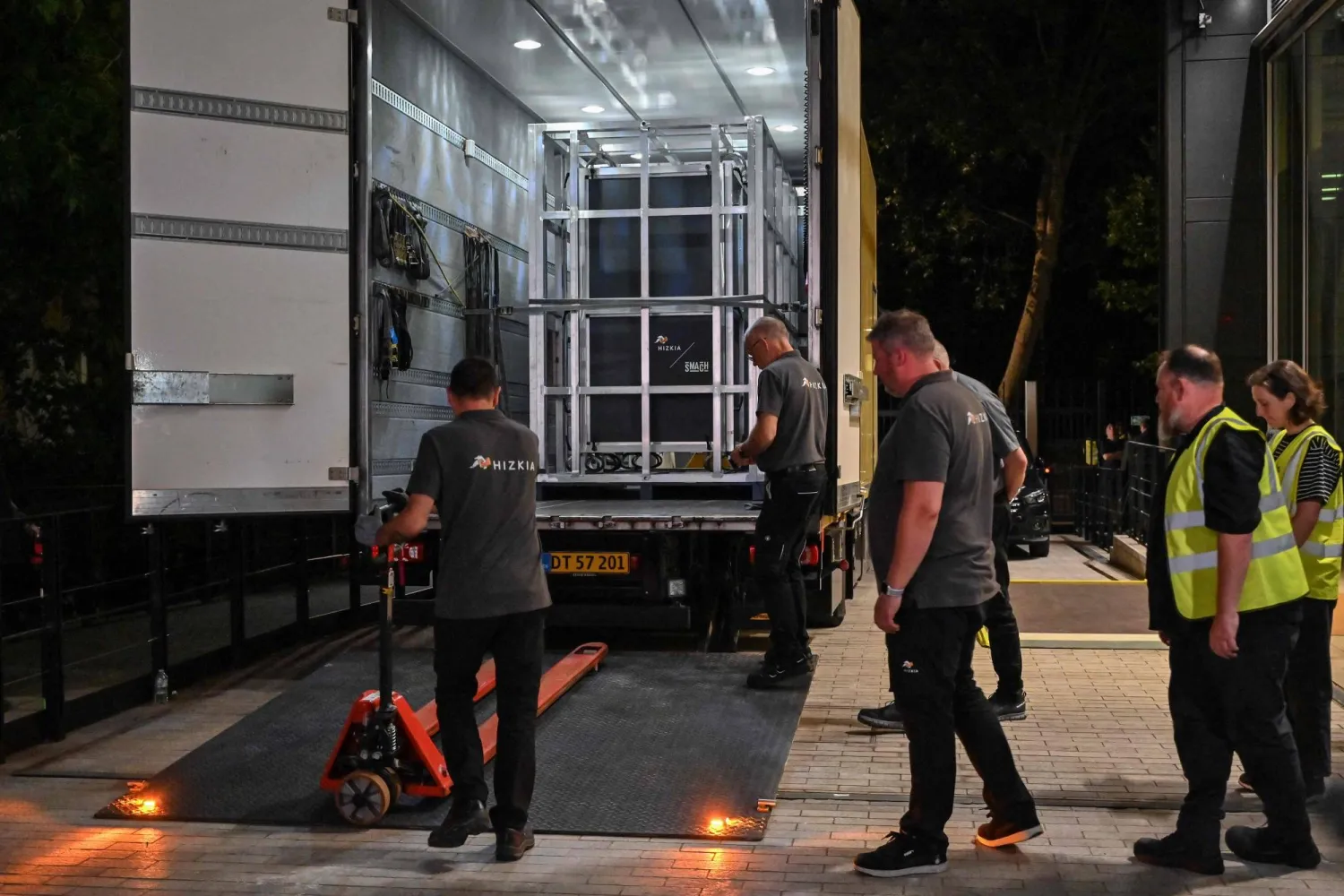
Workers prepare to unload a specially designed crate (back L) carrying the Bayeux Tapestry at the British Museum in central London early on July 10, 2026. (Photo by Richard A. Brooks / AFP)
TT

Bayeux Tapestry is at the British Museum after Secret Journey from France

Workers prepare to unload a specially designed crate (back L) carrying the Bayeux Tapestry at the British Museum in central London early on July 10, 2026. (Photo by Richard A. Brooks / AFP)

After almost 1,000 years, the Bayeux Tapestry is back on English soil.

In scenes like a heist movie in reverse, the priceless Medieval artwork was spirited into the British Museum on Friday in the dead of night, after a high-tech, tight-security operation where any slip-up could have spelled disaster.

On loan from its home in France, the tapestry will go on display at the London museum from Sept. 10 until July 2027. It's a public homecoming for a vivid visual record of the 1066 Norman invasion, the last successful conquest of England.

The tapestry's arrival in London has been widely anticipated, but due to security concerns all details of when and how it would arrive have been kept under wraps.

“It feels extraordinary that after so much work and planning and care and thought that it’s actually happening,” The Associated Press quoted British Museum Director Nicholas Cullinan as saying as he awaited the arrival after a secrecy-shrouded journey.

“It’s the first time in 1,000 years that such an important piece of British — French too — history is going to be on these shores,” he said. “It’s incredibly exciting.”

The 70-meter (230-foot) tapestry was folded accordion-style in a climate-controlled case that was placed inside a shock-absorbing cradle. That went into a truck that crossed from France on a vehicle shuttle train through the Channel Tunnel.

After an 11-hour, 350-mile (560-kilometer) trip, escorted by police, the truck backed slowly into a loading bay at the museum, where workers gingerly eased the container, the size of a small car, to the ground. Museum staff and British and French diplomats who had been watching in hushed silence broke into applause.

The priceless cargo will spend several days acclimatizing before it is carefully unpacked and unfolded for an exhibition that the museum expects to be one of the most popular in its history. Some 100,000 tickets were sold in their first day on sale this month.

“It was like trying to get tickets to Glastonbury,” Cullinan said. “I don’t take for granted that people care that much about a 1,000-year-old embroidery. I think that’s an amazing thing.”

The tapestry is a symbol of Anglo-French relations Stitched in wool thread on linen fabric, the artwork depicts the events leading up to the Battle of Hastings in October 1066, when William, Duke of Normandy defeated King Harald’s Anglo-Saxon army. The invasion ended Saxon rule and made William the Conqueror the first Norman king of England.

Historians believe the tapestry was commissioned by Bishop Odo of Bayeux, William’s half brother, and was probably sewn by women in England — possibly nuns — before being taken across the Channel. It has spent most of the last millennium in the town of Bayeux in northwest France, apart from two short periods at the Louvre in Paris.

The tapestry symbolizes the sometimes fractious, intertwined histories of France and Britain, and securing the loan was a high-stakes diplomatic mission. It was announced during a state visit to the UK by French President Emmanuel Macron in July 2025. The loan coincides with renovations at the museum in Bayeux that houses it.

In return, the British Museum will loan treasures from the Sutton Hoo hoard — artifacts from a 7th century Anglo Saxon ship burial — and other items to museums in Normandy.

Retired British diplomat Peter Ricketts, who helped secure the deal as the UK’s special envoy for the tapestry, said “it’s an extraordinary mark of friendship and confidence in the UK to entrust this object to us for a year.”

“Macron, when he offered us the tapestry, I think he understood that it would have far more impact in the UK than it does in France, because it’s more fundamental to our national story,” he said. Everybody (in Britain) knows 1066.”

It's a vivid record of 11th century life and death It features 627 people and 737 animals and tells its story in 58 scenes brimming with vivid and sometimes gory detail. There are scenes of hand-to-hand combat, mutilated bodies and the unlucky Harold, felled by an arrow through his eye.

“It has an emotional richness that is really difficult to get from written sources,” said Millie Horton-Insch, project curator for the British Museum exhibition. “It just brings people closer to this history than any other object can. It’s not the same as reading a text. You are looking at something that was handled by the people who lived through it and felt compelled to record these events in this way. “

She said the document’s survival for 10 centuries despite myriad dangers — “moths, mice, mold damp, fire” — is miraculous, and may be partly due to its humble materials.

“It’s not really made of any blingy fabric,” she said. “It’s not gold, it’s not silver. There wasn’t the same temptation to cut it up and make it into vestments or repurpose it for anything.”

Some French cultural figures opposed the loan, arguing that moving the tapestry was too risky. Cullinan said the expert teams went to great lengths to ensure its safety, including making two trial runs of the journey to show it would not cause the fragile item too much stress.

“Such care has gone into it. I can’t think of a level of care for any other museum loan,” he said.
He said he understands why there are concerns.

“The tapestry arouses great interest and passion,” he said. “Which is a wonderful thing."


Les Invalides in Paris: Icon of the French Military and Napoleon’s Final Resting Place

A view of the Les Invalides complex during the opening of the Olympic Games in Paris in 2024. (Reuters)
TT

Les Invalides in Paris: Icon of the French Military and Napoleon’s Final Resting Place

A view of the Les Invalides complex during the opening of the Olympic Games in Paris in 2024. (Reuters)

French Prime Minister Sébastien Lecornu will receive on Monday Prince Minister Mohammed bin Salman, Saudi Crown Prince and Prime Minister, in the Cour d’Honneur, or Court of Honor, at the historic Les Invalides complex in Paris, according to a statement from the French PM’s office.

The complex houses the Army Museum and Napoleon Bonaparte’s tomb and is crowned by its famous gilded dome.

Three-and-a-half centuries of history

Les Invalides, officially known as the Hôtel National des Invalides, dates back more than three-and-a-half centuries, to 1670, when King Louis XIV ordered and financed its construction to house sick, wounded and elderly soldiers.

A site was chosen on the Grenelle plain near Paris, on the banks of the Seine. Architect Libéral Bruant carried out the project between 1671 and 1675, designing a quadrangular complex whose buildings stand behind a monumental facade leading to a central courtyard.

The complex welcomed its first residents in 1674, before construction was completed, and later housed more than 4,000 veterans. It included a hospital, care home, barracks, monastery and manufacturing workshops. Some residents made shoes, textiles, clothing and illuminated books under a system combining military discipline with religious life.

In the spring of 1676, architect Jules Hardouin-Mansart replaced Bruant and took charge of building the churches. The soldiers’ church was completed in 1679, while Louis XIV inaugurated the domed royal church in 1706.

According to official French sources, the original plans envisaged a church with a double altar, but the site today comprises two separate buildings: the Saint-Louis Cathedral and Dôme Church.

The dome rises 107 meters and remained the tallest structure in Paris until the Eiffel Tower was built. According to information from the Army Museum, it is covered with around 550,000 sheets of gold leaf weighing a total of 12.6 kilograms.

Cour d’Honneur

Located in Paris’ 7th arrondissement, the complex has a northern facade about 195 meters long, with its buildings arranged around 19 interior courtyards.

The Cour d’Honneur is the largest. It measures 102 meters by 64 meters and is surrounded by four buildings with two levels of arcaded galleries.

Used for military and national ceremonies and events, the courtyard displays a collection of 60 bronze cannons documenting 200 years of French field artillery history.

At the center of the southern gallery stands a statue of Napoleon dressed as a colonel of the Chasseurs à Cheval of the Imperial Guard. It was moved to Les Invalides in 1911 after previously standing atop the Vendôme Column.

The complex also played a role in the French Revolution. In July 1789, revolutionaries seized rifles and cannons from Les Invalides and immediately used them in the storming of the Bastille.

The institution came close to being abolished. Saint-Louis Church was closed to worship and used to display flags seized from France’s enemies, while the Dôme Church was transformed into the Temple of Mars.

In 1800, Napoleon ordered the remains of military commander Turenne transferred there, giving the building a new role as a burial place honoring France’s military figures.

Napoleon’s final resting place

After Napoleon died on the island of Saint Helena in 1821, King Louis-Philippe decided in 1840 to return his remains to Paris.

Architect Louis Visconti carried out extensive excavation work to create a tomb beneath the dome, where the emperor’s remains were placed in April 1861.

At its center stands a red quartzite sarcophagus on a green granite base. The site also contains the tomb of military engineer and commander Sébastien Vauban, as well as the graves of Napoleon II, Joseph and Jérôme Bonaparte, generals Bertrand and Duroc, and marshals Ferdinand Foch and Hubert Lyautey.

The Army Museum was established in 1905 through the merger of the Artillery Museum, which had been housed at the complex since 1871, and the Historical Museum of the Army, founded in 1896.

The museum holds around 500,000 objects, including weapons, armor, uniforms, paintings and documents, covering military history from prehistoric times to the 11th century.

Les Invalides also houses the Museum of Relief Maps and Museum of the Order of Liberation, as well as facilities belonging to the National Institution of Invalides, which continues the complex’s original mission of caring for wounded and disabled military personnel and veterans.


Riyadh to Host Security and History Dialogue Conference in September

File photo of the Saudi flag/AAWSAT
TT

Riyadh to Host Security and History Dialogue Conference in September

File photo of the Saudi flag/AAWSAT

Under the patronage of Minister of Interior Prince Abdulaziz bin Saud bin Naif bin Abdulaziz, the Ministry of Interior will organize the Security and History Dialogue Conference in Riyadh from September 6 to 8, 2026, with the participation of experts, researchers, and academics from Saudi Arabia and abroad.

The conference organizing committee said the event serves as a national platform for exploring the Kingdom’s history through the lens of security and development, aiming to deepen awareness of the Kingdom’s journey, strengthen national identity, and produce documented knowledge for researchers and future generations, SPA reported.

The conference will feature more than 50 dialogue and interactive sessions, with over 160 experts and specialists and more than 30 partner organizations.

Discussions will cover the Saudi state’s history and its security, developmental, economic, social, and cultural dimensions, as well as national identity, international relations, the development of security institutions, and the role of security in supporting investment and quality of life.


From the Louvre to AlUla: How Culture Built a Strategic Bridge Between Riyadh and Paris

Saudi Arabia and France boosted their culture cooperation through nine executive programs signed during President Emmanuel Macron’s visit to the Kingdom in December 2024. (SPA)
TT

From the Louvre to AlUla: How Culture Built a Strategic Bridge Between Riyadh and Paris

Saudi Arabia and France boosted their culture cooperation through nine executive programs signed during President Emmanuel Macron’s visit to the Kingdom in December 2024. (SPA)

When Saudi artifacts were exhibited at the Louvre Museum, the Saudi-French relationship had not yet reached its current breadth. At the time, culture was a window through which the French could discover the Kingdom's history, while Riyadh was testing a new avenue to introduce its heritage beyond its borders.

More than a decade and a half later, the landscape has changed. Culture has become one of the foundational components of the Saudi-French relationship, and AlUla has turned into one of the clearest examples of this cooperation.

Meanwhile, cinema, museums, heritage, tourism, sports, and major events have entered the network of interests linking the two nations.

The visit by Prince Mohammed bin Salman, Saudi Crown Prince and Prime Minister, to France comes at a time when these fields have become part of the Kingdom's new economy, rather than merely a cultural activity running parallel to political relations.

AlUla: When culture becomes an economic project

In AlUla, antiquities intersect with tourism, engineering with the environment, and arts with the economy. The Saudi-French partnership in the governorate has expanded the scope of cooperation to encompass urban planning, heritage, tourism, culture, education, training, and the arts, presenting a model that differs from the traditional relationship between an investing nation and foreign companies.

The project is not limited to developing a historical site, but is rather based on building a global destination that rests on local identity and benefits from international expertise.

This type of cooperation aligns directly with the goals of Saudi Vision 2030 to transform culture, tourism, and entertainment into active components of the economy.

A journey that began at the Louvre

AlUla was not the beginning; in 2010, the Louvre Museum hosted the "Roads of Arabia. Archaeology and History of the Kingdom of Saudi Arabia" exhibition, marking a milestone that reflected growing French interest in Saudi history. This was preceded by another exhibition in Paris in 1986, while the UNESCO headquarters in Paris hosted the Saudi Cultural Days events in 2012.

These milestones reveal a long trajectory in which the cultural relationship has shifted from introducing Saudi Arabia abroad to building joint projects within the Kingdom itself.

Culture and the economy come together

The most significant change is that culture is no longer a sector isolated from the economy. Tourism requires transport, hospitality, and technology; museums require engineering, operation, and education; and major events require sports, media, and digital services. Consequently, culture has become part of an interconnected economic system.

This is evident in the expanding scope of potential cooperation between the two countries to include tourism, hospitality, the creative economy, electronic gaming, and sports - sectors that align with the Kingdom’s direction toward building a more diversified economy.

Sports: A new opportunity for partnership

Sports give the relationship an added dimension. France's hosting of events related to the Esports World Cup, coinciding with the Crown Prince's visit, offers an example of the shift of sports from a space of competition to a space for economic and cultural rapprochement.

Saudi sports itself has become a global industry attracting investments, talents, and events, while France possesses extensive experience in organizing tournaments and major events.

Interests intersect here just as they do in culture and tourism: Saudi Arabia provides a growing market, projects, and capital, while France provides long-standing industrial, organizational, and cultural expertise.

Education: The least visible, longest-lasting investment

The exchange is not limited to projects; cooperation between universities, research centers, and educational institutions in both countries opens a different path for knowledge transfer and human capital development.

The importance of this track is evident in the sectors where the Kingdom aims to expand, particularly science, technology, innovation, health, and engineering.

While projects can be built within a few years, the talent that manages them can create an impact that lasts for decades.

Partnership and different experiences

The Saudi experience differs from the French one in many details, but this very difference creates space for cooperation.

France possesses a long history in culture, museums, arts, and creative industries, while Saudi Arabia is experiencing a vast transformation which it is reshaping its culture, tourism, entertainment, and sports sectors.

Therefore, the new partnership is not based on transferring a ready-made model from Paris to Riyadh, but rather on blending French expertise with the new Saudi project. This is what makes culture in the relations between the two countries more than a "soft file"; it is one of the tools through which to build a new economy, introduce peoples to one another, and forge shared interests that are not easily affected by changing political files.

Past to future

For nearly a century, Saudi-French relations have progressed through multiple stages: from the initial diplomatic representation to the historic meeting between King Faisal and de Gaulle, followed by expansion into the economy and defense, culminating in a new vision for partnership during the reign of Custodian of the Two Holy Mosques King Salman bin Abdulaziz.

Today, Riyadh does not go to Paris merely to speak of the past, but rather of a future city, a new museum, a tourist destination, an advanced creative and technological industry, an energy project, and a long-term investment.

Within this transformation lies one of the clearest characteristics of the Saudi-French relationship: the bridge that began with culture now carries the economy, politics, and technology along with it.
