


Greek Anti-terror Police Arrest 3 After Blast Kills Woman

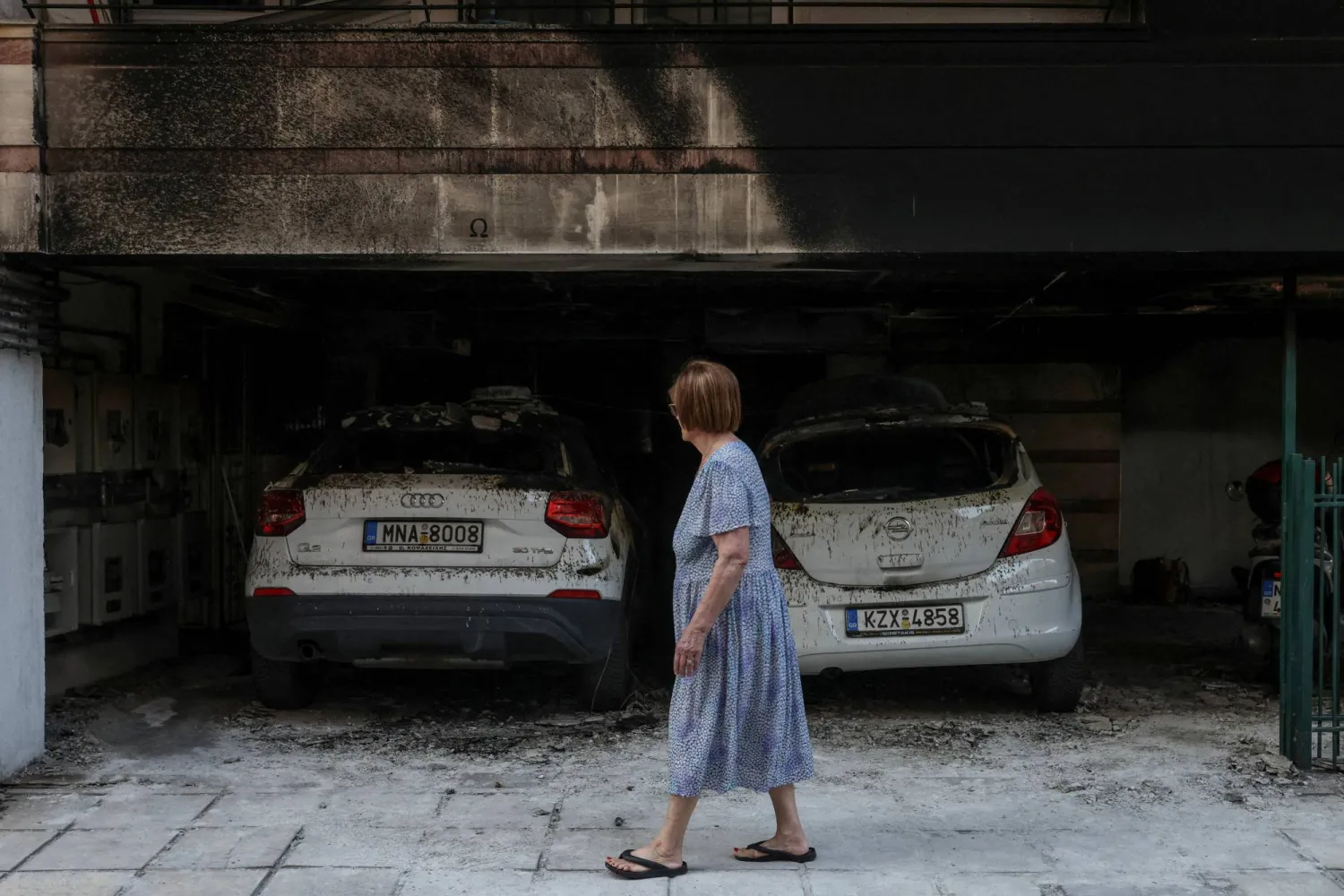
FILE PHOTO: A woman walks past damaged cars and a building after attackers firebombed three residential buildings linked to Greece's governing party in the northern city of Thessaloniki, Greece, July 1, 2026. REUTERS/Alexandros Avramidis/File Photo
TT

Greek Anti-terror Police Arrest 3 After Blast Kills Woman

FILE PHOTO: A woman walks past damaged cars and a building after attackers firebombed three residential buildings linked to Greece's governing party in the northern city of Thessaloniki, Greece, July 1, 2026. REUTERS/Alexandros Avramidis/File Photo

Police in Greece on Friday said they had arrested three people in connection to attacks this month that targeted ruling party politicians, killing a woman in a car explosion.

Hours later, two more people were held over a 2010 deadly firebomb attack that left three dead.

In the recent case, "three individuals have been arrested" by anti-terror police in Thessaloniki and the island of Crete, the police said in a statement.

The July 1 attacks at dawn in the northern city of Thessaloniki targeted the homes and vehicles of three politicians from Greece's ruling New Democracy party with homemade gas canister explosives.

The mother of former party candidate Afroditi Nestora died from injuries caused by an explosion, apparently while trying to put out the fire.

The attack also injured Nestora, her father and two other people.

Four vehicles in the garage of Nestora's home were burnt, police said.

Greek media identified the other two targets as the party's local executive committee chairman Zisis Ioakimovic and former MP Savvas Anastasiades.

Prime Minister Kyriakos Mitsotakis, the New Democracy leader, expressed "outrage and anger" at what he termed a "cowardly, terrorist and murderous attack".

Leftist and anarchist groups often use improvised explosives to target political figures, banks and companies in Greece -- causing damage but rarely any casualties.

The improvised explosives were made from small butane canisters, police said, and the attacks appear to have been carried out by the same people.

Greek media on Friday identified the detainees as young anti-establishment figures known to police.

Government spokesman Pavlos Marinakis has said that the attacks took place within 15 minutes.

Also Friday, police in Athens said they had arrested two people and were seeking a third over the 2010 bank attack.

On May 5, 2010 an anti-austerity protest saw a firebomb lobbed at the Marfin bank in central Athens, leading to the death of three bank workers, including a pregnant woman.

Three bank officials received manslaughter sentences for negligence but the culprits were never caught.

The attack came just three days after the socialist government of George Papandreou signed the first of three eventual bailouts with the European Commission, the European Central Bank and the IMF that would total 350 billion euros.



Zelensky Rejects Wartime Elections, Says Would 'Split' Ukraine

(FILES) Ukraine's President Volodymyr Zelensky arrives to attend a meeting with Serbian President at the Palace of Serbia, in Belgrade on August 8, 2026. (Photo by Andrej ISAKOVIC / AFP)
TT

Zelensky Rejects Wartime Elections, Says Would 'Split' Ukraine

(FILES) Ukraine's President Volodymyr Zelensky arrives to attend a meeting with Serbian President at the Palace of Serbia, in Belgrade on August 8, 2026. (Photo by Andrej ISAKOVIC / AFP)

President Volodymyr Zelensky said in remarks made public Sunday that it would be too dangerous for Ukraine to hold an election while it fights Russia's invasion, after a call by his former defense minister to organize a vote.

"I believe that in a war like this, elections as such are a huge risk. Elections right now are a tsunami for the country that will split Ukraine," Zelensky said in the comments.

Ukraine has suspended elections under martial law, a measure still widely supported by the population as the country focuses on fighting off Russian forces.

"If we want to destroy the country, then we can move in the direction of elections during these times of war," the 48-year-old leader added.

He held a briefing with a group of journalists including AFP on Saturday, the first in months amid several political crises.

The latest upheaval saw thousands take to the streets after Zelensky fired his defense minister, Mykhailo Fedorov.

The ousted Fedorov this week made a surprise call to find a way to organize a vote - but without offering a roadmap, and prompting even some of his supporters to distance themselves from him.

Experts have cited a flurry of obstacles, including how soldiers, millions of Ukrainian refugees and people from occupied territories would vote, as well as disinformation threats from Russia.

Only 15 percent of Ukrainians believe elections should be held before the end of hostilities, according to a poll by the Kyiv Institute of Sociology.

Zelensky made numerous jab at his opponent during the briefing.

"I believe he is going himself -- or is being pushed - toward wrong things," Zelensky said of Fedorov.

The former minister had pushed for reforms but clashed with the military's command and their traditionally stiff approach.

The public initially took his side and pushed for the dismissal of commander-in-chief Oleksandr Syrsky.

Zelensky said people had the right to protest but warned against "disrespectful" attitudes to military people.

"Since when has marketing started to outweigh the people who are giving their lives?" he said.

After a political crisis that had weakened him, Zelensky was able to cast himself as a rampart against division.

"I believe that society and soldiers must not be divided," he said, "We must acknowledge that there is this risk -- that there may be movement in that direction, toward dangerous developments."


Iran President: US Memorandum is Best Path Out of Stalled War

A handout photo made available by the Iranian Presidential Office shows Iran's President Masoud Pezeshkian attending a press conference in the capital Tehran, on August 8, 2026. (Photo by Iranian Presidential Office / AFP) /
TT

Iran President: US Memorandum is Best Path Out of Stalled War

A handout photo made available by the Iranian Presidential Office shows Iran's President Masoud Pezeshkian attending a press conference in the capital Tehran, on August 8, 2026. (Photo by Iranian Presidential Office / AFP) /

Iranian President Masoud Pezeshkian defended a recent memorandum of understanding as the best way for the country to move beyond what he described as a situation of “neither war nor peace.”

In a speech published by state-run IRNA early on Sunday, he said members of Iran’s Supreme National Security Council believed the memorandum represented the best possible agreement based on what he described as dignity, wisdom and the national interest.

“There is not a single provision in this agreement that amounts to capitulation,” Pezeshkian said. “The supreme leader sets the policies, and we will follow that path.”

The deal known as the Memorandum of Understanding that US President Donald Trump signed in June set an ambitious 60-day deadline for ending the war with Iran and reaching an accord on its nuclear program.

That period ended last week, but the two sides remain far apart, with no signs of compromise on the crucial issue of reopening the Strait of Hormuz, vital to global shipping.

While stressing that Tehran did not intend to back down in the face of its adversaries, Pezeshkian also linked the agreement to Iran’s economic prospects, saying the country could not attract investment in this stalled phase.

“Capital and money are extremely sensitive to risk,” The Associated Press quoted him as saying. “We have to remove this risk from the country.”

Nearly six months into the war with the United States and Israel, the Iranian economy is suffering under sanctions and a naval blockade that is making it extremely difficult for the country to export oil, its most valuable product.

Meanwhile, the hard-line new leader of Iran’s Supreme National Security Council, Mohsen Rezaei, threatened Tehran’s neighbors against joining the new US effort to hurt Iran’s economy.

“If (Trump) wants to do something, we will retaliate in a seismic manner,” he said in an interview with the state broadcaster that aired Saturday.

Rezaei was named this month as part of senior appointments widely seen as hardening Tehran’s political and military stance. His interview with IRIB is his most extensive public statement since then.


Iran Executes Man Accused of Aiding US, Israel in Anti-govt Protests

An Iranian man reads a copy of the Iranian daily newspaper Hamshahri displaying a picture of US President Donald Trump and a title reading in Persian, 'The empty gun of sanctions,' reporting the new harsh economic threat by Trump against Iran, outside a kiosk in Tehran, Iran, 22 August 2026. EPA/ABEDIN TAHERKENAREH
TT

Iran Executes Man Accused of Aiding US, Israel in Anti-govt Protests

An Iranian man reads a copy of the Iranian daily newspaper Hamshahri displaying a picture of US President Donald Trump and a title reading in Persian, 'The empty gun of sanctions,' reporting the new harsh economic threat by Trump against Iran, outside a kiosk in Tehran, Iran, 22 August 2026. EPA/ABEDIN TAHERKENAREH

Iran on Sunday executed a man accused of carrying a chainsaw during January anti-government protests who was charged with acting as an agent of Israel and the United States.

The judiciary said Majid Adineh had been convicted of "operational action in favor of hostile groups" in nationwide rallies that broke out late last year.

He is one of a string of people put to death over the protests, which were sparked by economic hardships in Iran.

Adineh was accused of "deliberate arson, gathering and collusion with the intention of committing crimes against the country's internal security,” AFP quoted the judiciary's Mizan Online website as saying in a report Sunday.

"Based on numerous documents and evidence in the case and the defendant's statements, the Karaj Revolutionary Court sentenced him to death and confiscation of all his property."

An appeal by Adineh was unsuccessful and the Supreme Court upheld the verdict, with his execution carried out Sunday morning, Mizan said.

He and another suspect were arrested on January 9 in Alborz province, west of Tehran, carrying "a revolver, ammunition, two tasers, two tear gas canisters, a rechargeable chainsaw, and a bottle of gasoline," Mizan added.

The protest movement was initially sparked in late December by grievances over high living costs but rapidly evolved into widespread anti-government demonstrations that peaked on January 8 and 9.

Iranian authorities reported more than 3,000 deaths from the unrest, attributing the violence to "terrorist acts" orchestrated by the United States and Israel.

The number of executions in Iran has risen since the start of the Middle East war, which broke out on February 28 with US-Israeli strikes against Iran.

A large number of the executions have been linked to the protests, with other cases related to the war.

Iranian authorities executed at least 1,639 people last year, a record high since 1989, according to Iran Human Rights, an NGO based in Norway, and Together Against the Death Penalty (ECPM), which is headquartered in Paris.