


Israel Hunts Hamas Figures as Gaza Killings Continue

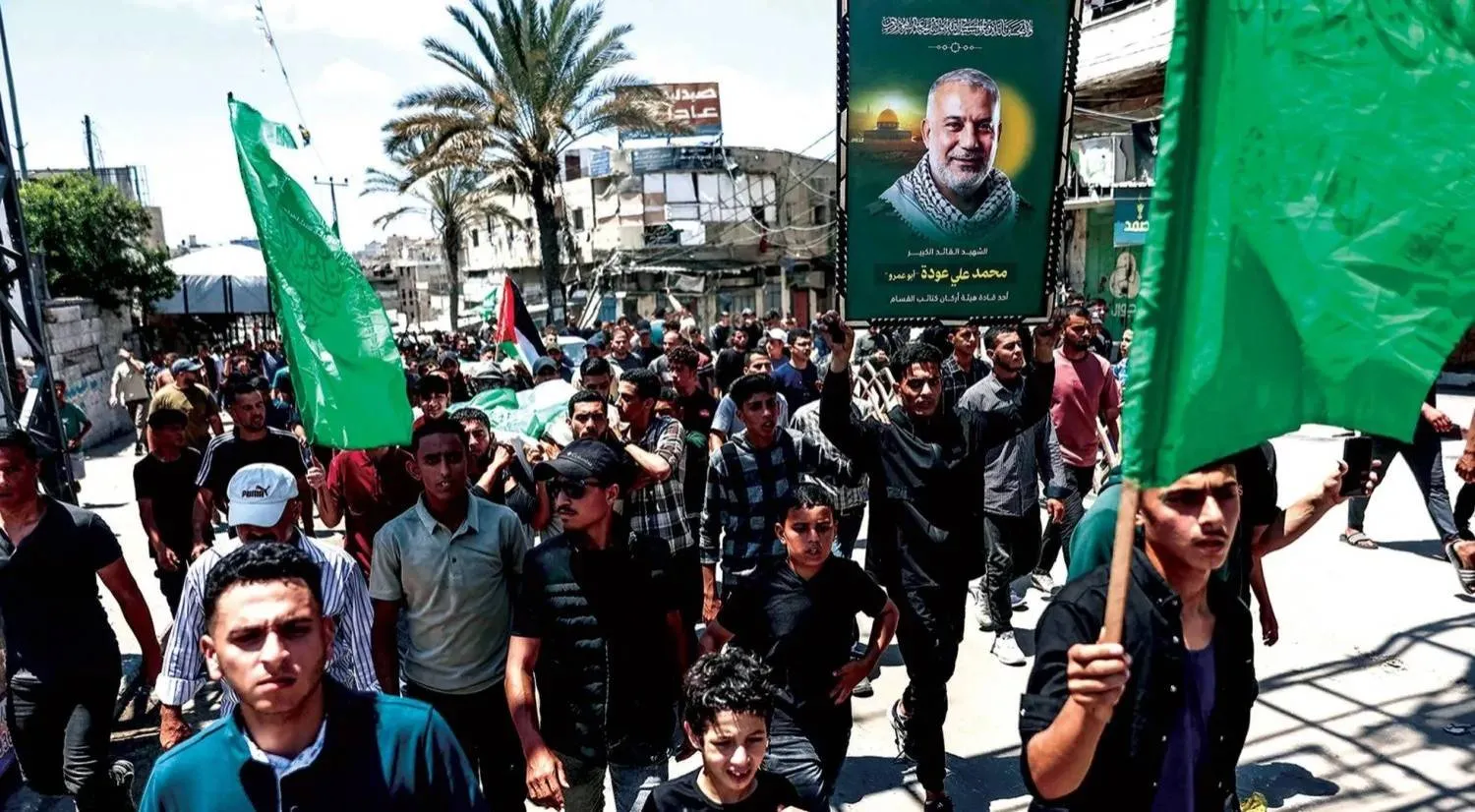
Palestinians carry the body of Mohammed Odeh, a commander in Hamas’ military wing, during his funeral in Gaza City on May 27, 2026. (AFP)
TT

Israel Hunts Hamas Figures as Gaza Killings Continue

Palestinians carry the body of Mohammed Odeh, a commander in Hamas’ military wing, during his funeral in Gaza City on May 27, 2026. (AFP)

Israel tried on Thursday to kill Hamas spokesman Hazem Qassem, the only senior figure from the group to have appeared publicly in Gaza in recent weeks, as it presses a campaign of assassinations against Hamas leaders and prominent operatives, particularly in its armed wing.

Qassem survives

Several Israeli media outlets cited local reports saying Qassem had been seriously wounded after a Hamas-affiliated media activist posted about the attack on X.

But informed Hamas sources told Asharq Al-Awsat that Qassem had survived and was in good health.

They said he had left the vehicle targeted by an Israeli drone near Haidar Roundabout, west of Gaza City, only minutes before the strike. His escort was killed.

Israel had not commented on the attack by the time of publication.

The attempt came days after Qassem appeared at a news conference announcing the dissolution of the Government Work Follow-up Committee, Hamas’ governing body in Gaza.

Israeli Foreign Minister Gideon Saar called the move misleading, saying Hamas still refused to disarm.

Qassem, 46, is one of Hamas’ younger and most prominent figures in Gaza. He has appeared regularly in interviews and news conferences and has repeatedly spoken positively about negotiations in Cairo.

His position has at times differed from that of Hamas leaders abroad, who have offered a different assessment of conditions in Gaza, drawing criticism of him from inside and outside the movement.

Israel widens its targets

A Hamas political source told Asharq Al-Awsat that the attack showed Israel was expanding its target list and seeking to eliminate anyone who emerged as a public symbol of the movement.

The source said Israel was targeting Hamas figures across political, military, economic, religious and social spheres.

Qassem was wounded at least once during the war and suffered a serious injury that nearly led to the amputation of his foot. He later recovered.

He remained in northern Gaza and did not move south during the early siege of the area, when Israel controlled the Netzarim Corridor separating northern Gaza from the central and southern parts of the enclave.

Israel has repeatedly targeted Hamas spokesmen during the war.

Among them was Abdel Latif al-Qanou, who had served alongside Qassem since 2016. He was killed in March 2025 in a strike on a tent where he was living in Jabalia, northern Gaza.

The Hamas source said Qassem had become one of the movement’s main political figures in Gaza after the killing of many senior leaders and had recently emerged as its most visible media representative.

He also takes part in decisions made through consultations within Hamas institutions, the source said.

Qassem recently represented Hamas at Fatah’s eighth conference after receiving an invitation from its leadership.

His attendance drew criticism from parts of Fatah’s grassroots base because of his repeated public attacks on the movement’s leadership and the Palestinian Authority.

Some Fatah leaders defended his participation, saying it was important given the state of internal Palestinian affairs.

Assassinations continue

The attempt on Qassem was the most prominent since the killing of senior commanders from the general staff of the Izz al-Din al-Qassam Brigades, Hamas’ armed wing, including Ezz al-Din al-Haddad, Mohammed Odeh and Imad Islim.

It came as Israel continued to target senior operatives from Hamas and other Palestinian factions.

In recent days, Israeli forces have focused on members of the Al-Quds Brigades, Islamic Jihad’s armed wing, who took part in the Oct. 7, 2023 attack and were involved in holding Israeli hostages.

Asharq Al-Awsat documented the killing of at least five of them in less than two weeks.

Among the latest was Rashid al-Qadi, killed on Wednesday. Israel said he worked in Islamic Jihad’s military manufacturing unit.

Israel said on Friday that it had killed Yahya Hamdan in Khan Younis a day earlier. It said he belonged to Hamas’ elite Nukhba force and had taken part in the attack on the Re’im military base on Oct. 7.

Israel also killed Waheed Abu Salem, a Khan Younis resident, on Tuesday. It accused him of taking part in the attack and of capturing and holding Israeli hostages.

Asharq Al-Awsat learned that Abu Salem had worked with Ahmed Sarhan, a commander in the Al-Nasser Salah al-Din Brigades.

An Israeli special forces unit had previously entered Khan Younis and killed Sarhan during an attempt to capture him.

Sources told Asharq Al-Awsat at the time that Sarhan had been responsible for capturing and holding Israeli civilian Arbel Yehoud.

Israel had insisted on her release under hostage exchange agreements before allowing displaced Palestinians to return from southern Gaza to the north.

One of the most prominent figures killed in recent days was Fadi Daghmash, a senior Qassam Brigades commander whose rank was equivalent to brigade commander.

He had previously held a rank equivalent to battalion commander before moving from the training department to military logistics.

Israel also killed Hamouda Abu Daqqa and Mohammed Abu Taima, both from Khan Younis, in separate strikes.

The two were commanders in Hamas’ elite forces and military intelligence and had been involved in major attacks and in holding Israeli hostages.

Israel also killed Huthaifa al-Hawajri, a Jabalia resident who had seized an Israeli drone after it crashed in Gaza City’s Rimal neighborhood during the war.



Barrack: Israeli Strike on Syria’s Abu al-Duhur Base Sought to Bait Türkiye

Abu al-Duhur airbase following strikes, Syria, August 18, 2026. REUTERS/Stringer
TT

Barrack: Israeli Strike on Syria’s Abu al-Duhur Base Sought to Bait Türkiye

Abu al-Duhur airbase following strikes, Syria, August 18, 2026. REUTERS/Stringer

The Israeli strike on the Abu al-Duhur military base in northern Syria near the Turkish border last Tuesday, may have been intended to provoke Ankara and is considered a “very dangerous game,” US Special Envoy to Syria and Ambassador to Türkiye Tom Barrack said on Saturday.

Eight Israeli airstrikes hit the airbase early Tuesday, targeting the runway and storage facilities, Syria’s state-run Al-Ikhbariya had reported.

In response, Ankara accused the Netanyahu government of using “cheap politics” for electoral gain and seeking to portray Türkiye as a new threat.

According to Barrack, the incident escalated from another Israeli strike in Syria into a moment that could have triggered a far more dangerous regional confrontation.

The ambassador invoked the downing of a Russian jet in late 2014 that escalated regional tensions.

In a YouTube interview with podcast host Mario Nawfal and in comments to PBS NewsHour, Barrack said the incident in which Israeli jets, without advance warning, struck the airbase in Syria - around 80 kilometers east of the Turkish border - intended to “bait” or provoke Ankara.

He described a situation in which fighter jets operate near a border without coordination or warning as a “very dangerous game.”

Last Tuesday, Israeli Prime Minister Benjamin Netanyahu’s office described the airstrikes as a warning to Türkiye against expanding its military presence in Syria or helping rebuild the Syrian armed forces.

In return, Syrian Foreign Minister Asaad al-Shaibani told Axios that Damascus had previously informed Israel there were no plans to establish a Turkish military base at Abu al-Duhur, which was being rehabilitated for use by the Syrian Air Force.

For its part, the Turkish presidency rejected the Israeli allegations as “baseless,” accusing Netanyahu of promoting them ahead of Israel’s October elections and calling on the international community to curb Israeli actions threatening regional peace and stability.

Barrack said Israel might have received intelligence indicating Turkish military personnel or military assets could be stationed at the Syrian base.

According to Barrack, Israel raised the concern with the United States about six days before the strike.

“We have some intelligence that there might be Turkish movement into this site, which we would be very concerned about,” Barrack said about the message delivered to Washington.
Barrack then confirmed reports that Mossad chief Roman Gofman had spoken with al-Shaibani several days before the strike to convey Israel’s concerns. He described the talks as a two-hour, in-depth conversation.

Despite those contacts, Israeli forces struck the base’s runways without Türkiye receiving advance warning of the operation.

Scenarios of Israeli Strikes on Abu Al-Duhur Base

According to Barrack, one possibility that led to the strikes on Abu al-Duhur is that “the Israelis were baiting the Turks.”

He directly linked this possibility to Israeli politics, saying that the strike may have been a “very aggressive but maybe a well-received pre-election concept.”

He added that another possible reason for the attack on Abu Duhur was a miscommunication between the Israeli military and the country’s intelligence agency.

Barrack said it was likely that Israel had intelligence suggesting Türkiye may be bolstering its presence in the area and “a commander somewhere in the field made a decision ‘We’re not going to let that happen’... What they didn’t do is tell us or Türkiye.”

Barrack said the Turkish leadership exercised “maximum restraint and patience” when they saw Israeli aircraft, and that they did not allow tensions to escalate into direct conflict.

He told PBS NewsHour that Türkiye had explicitly stated it has no aggressive intentions or posture toward Israel and does not want to participate in any military operation or direct conflict. “What the Turks want is a sovereign and independent Syria, and that is what we, Israel, and all the countries of the region want,” he said.

While the American diplomat acknowledged “Israel's legitimate security concerns,” he stressed that diplomacy and maintaining open channels of communication “are a priority under the current circumstances.”

Cheap Politics

For its part, Ankara said the Netanyahu government is seeking to portray Türkiye as a new threat as part of “cheap politics” aimed at gaining an electoral advantage.

Türkiye's Communications Directorate on Friday warned that Israel's increasingly aggressive threat rhetoric poses serious risks to regional and global stability.

It said the “cheap politics” pursued by Netanyahu and his associates, which it said was also designed to secure an advantage in elections, has no resonance in Israeli society, the region, the international community or Türkiye.

The directorate strongly rejected remarks by the Israeli Prime Minister's Office concerning President Recep Tayyip Erdogan.

The office on Friday called Erdogan an “antisemitic dictator.”

The directorate described the comments as an “impertinent rant” devoid of historical facts and political seriousness and another sign of the desperation of an administration seeking to evade accountability for war crimes and crimes against humanity.


Blast Targets Security Forces’ Bus Near Damascus, Causing Injuries

Injuries were reported among the passengers. (SANA)
TT

Blast Targets Security Forces’ Bus Near Damascus, Causing Injuries

Injuries were reported among the passengers. (SANA)

An explosive device targeted a bus carrying security forces near the Syrian capital Damascus on Saturday, resulting in injuries among the passengers, state media reported.

"An explosive device targeted a bus carrying Internal Security Forces personnel on the Maarounah-al-Tal road in Damascus countryside, leaving several personnel injured," state news agency SANA reported.

"Authorities are investigating the attack and working to identify those responsible," the news agency added, without immediately providing further details.

It published pictures showing a badly damaged bus at the side of a road, with its windows and one of its doors blown out, with glass scattered on the front seat.

Syria's authorities have faced significant security challenges since overthrowing longtime ruler Bashar al-Assad in late 2024, with Damascus and its suburbs the site of multiple attacks.

Earlier in August, a bus blast wounded 14 people in Jaramana, a town near Damascus.

In July, two blasts went off near a hotel where visiting French President Emmanuel Macron had been staying, though he was not in the facility at the time.

That blast killed one person and wounded 36 others, with authorities later saying they had arrested those responsible, adding that they were part of the ISIS group.


Israel Says It Has Serious Concerns with Hamas Disarmament Deal

Mourners carry flag-draped body bags containing the remains of Palestinians killed in Israeli strikes during the war with Hamas and recently recovered from the rubble, during a mass funeral in Gaza City on August 20, 2026. (AFP)
TT

Israel Says It Has Serious Concerns with Hamas Disarmament Deal

Mourners carry flag-draped body bags containing the remains of Palestinians killed in Israeli strikes during the war with Hamas and recently recovered from the rubble, during a mass funeral in Gaza City on August 20, 2026. (AFP)

Israel has shared “serious security concerns” with the White House regarding the proposed disarmament deal with Hamas, an Israeli official said as Israeli strikes overnight and into Sunday evening killed at least 17 people, including children, in Gaza.

The remarks by Doron Spielman, spokesperson for Israeli Prime Minister Benjamin Netanyahu's office, were some of the first public comments since US President Donald Trump announced the agreement.

Spielman told The Associated Press that Israel's intelligence assessment is that Hamas remains committed to rebuilding its military rather than genuinely demilitarizing. He said the Israeli military would not withdraw from Gaza — where it controls more than 60% of the territory — before Hamas disarms.

“Our assessment is that if we redeploy before Hamas is truly disarmed, it will quickly expand its presence throughout Gaza, rebuild its terrorist infrastructure, once again threaten Israeli communities, and seek to carry out another Oct. 7-style attack,” he said, referring to the Hamas attack on Israel in 2023 that triggered the war in the Gaza Strip.

“Disarming means physically giving up the weapons. Nothing less,” Spielman said.

His comments come days after Hamas said that it would begin disarming as part of the US-brokered ceasefire signed nine months ago to end the nearly three-year-long conflict. It marks a potential breakthrough in ending the conflict, but many hurdles, conditions and long timelines remain.

Hamas says it's agreed to disarm but the process has obstacles

Trump’s 20-point ceasefire plan calls on the militant group to surrender its weapons and destroy its vast network of tunnels. It also envisions Israeli forces withdrawing from Gaza, the arrival of a new technocratic Palestinian government, deployment of an international security force and the rebuilding of the battered Palestinian enclave.

Hamas disarming has been a sticking point and has deadlocked negotiations for months. In announcing the deal on social media on Thursday, Trump said it would be carried out in “carefully structured phases.”

A copy of the agreement obtained and verified by the AP said that all weapons held by the Hamas-run police will be transferred to the US-backed Palestinian technocratic committee, known as the National Committee for the Administration of Gaza, upon its arrival in the enclave. It’s not clear when that would happen since it is contingent on other steps.

A process to decommission and store heavy weapons and to dismantle military production sites and tunnels will begin after the arrival of the Palestinian committee and the deployment of international forces. The process will be linked to a phased Israeli withdrawal, according to the agreement.

The areas Israel controls in Gaza have been mostly destroyed and depopulated. Most of the territory’s 2 million Palestinians are in the other part, where hundreds of thousands live in squalid tent camps and destroyed neighborhoods.

Israel appears unlikely to pull back significant forces or make other concessions ahead of its October elections. Prime Minister Benjamin Netanyahu faces a tough reelection battle, with his far-right coalition partners urging him to keep up the pressure on Hamas and leave forces in Gaza, and opponents accusing him of failing to prevent the Oct. 7, 2023, attack.

Hamas-led fighters attacked Israeli communities then, killing around 1,200 people, mostly civilians, and taking 251 others hostage. Israel responded with a punishing military offensive that has killed more than 73,000 people, according to the Gaza Health Ministry.

The ministry, part of the Hamas-run government, maintains detailed records viewed as generally reliable by UN agencies and international organizations. It does not distinguish between civilians and fighters but says women and children make up around half of all fatalities.

Israel warns that Hamas is rearming

While Spielman said Israel greatly appreciates Trump’s commitment to its security and to finding a durable resolution, the government's position on disarmament is based on detailed intelligence saying that Hamas continues to rearm, recruit fighters, and rebuild its military capabilities.

The White House did not provide additional comments on Sunday, when asked specifically about Israel’s assessment that Hamas remains committed to rebuilding its military.

US officials, who briefed reporters on the disarmament agreement last week, said that Israel had been consulted at every step of the negotiations and was not being asked to do anything more than what it had committed to as part of the ceasefire and hostage release agreement signed last October.

It's unclear what exactly Israel conveyed to the White House. Two people with knowledge of the deal told the AP that Israel had communicated its issues with it to former British Prime Minister Tony Blair, who's part of the Trump-led Board of Peace. One of them said that among the points Israel wanted was freedom to conduct military operations in Gaza. They spoke anonymously because they were not authorized to speak to the media.

According to another person familiar with the deal, the Israelis raised two other issues: that Qatar and Türkiye not be involved in verifying the stages of the agreement, and that Hamas’ weapons be destroyed after confiscation. The person spoke on condition of anonymity because they were not authorized to speak to the media.

Israel continues to strike Gaza

Since the ceasefire was signed last October, Israel has continued striking Gaza, saying it’s targeting Hamas and its infrastructure.

Local Gaza hospitals said at least 17 were killed in the latest Israeli strikes, including children. A strike on a residential apartment in southern Gaza killed three family members, including their 4-year-old child, according to Nasser hospital, where the bodies arrived.

The Israeli military said the strikes had targeted militant operatives.