Eni Warns Oil Market Risks Breaking Out of Current Range if Iran War Continues

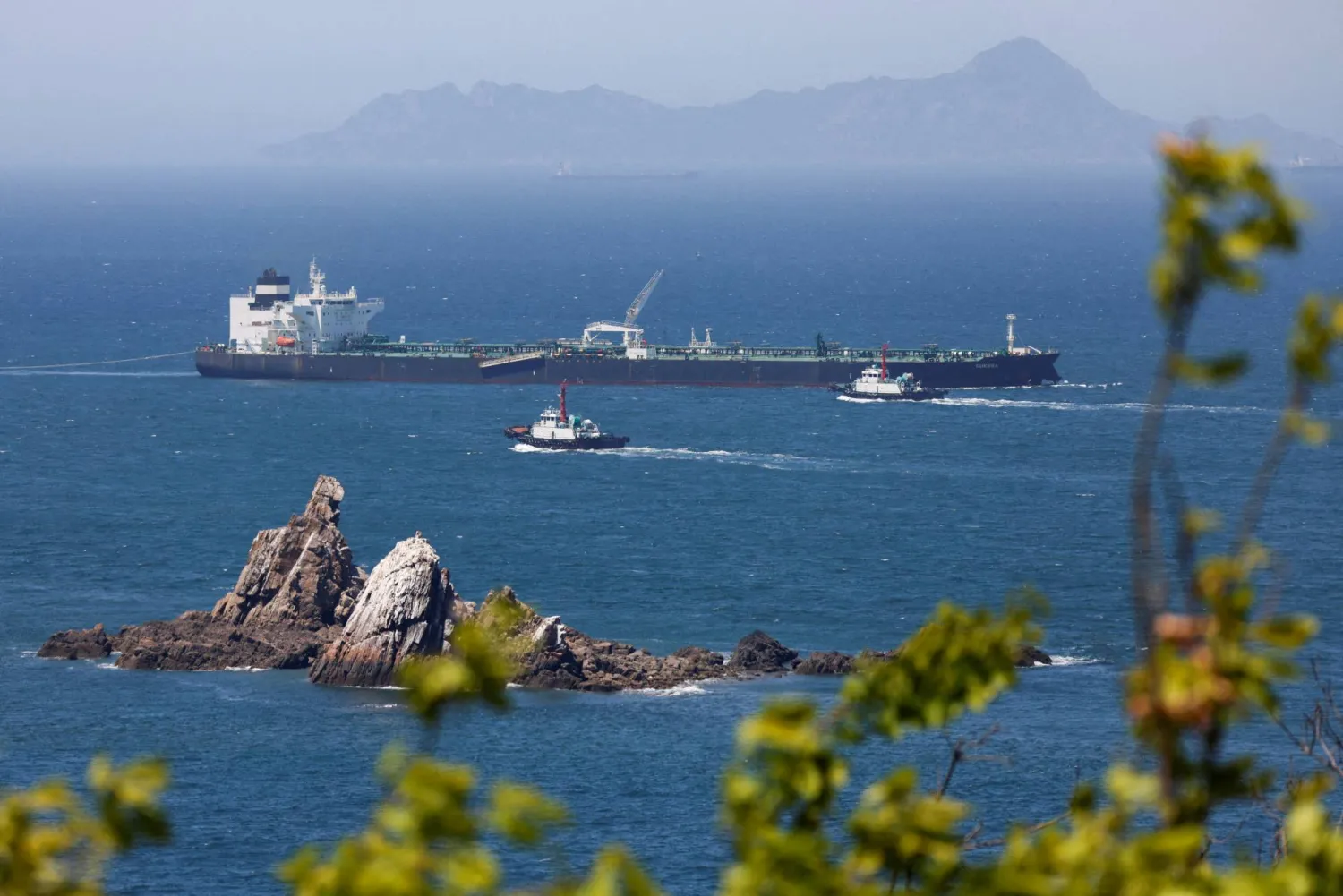
 Tugboats guide the crude oil tanker Odessa, carrying UAE crude after passing through the Strait of Hormuz with its Automatic Identification System transponder turned off, navigates the waters at Daesan port, where it is expected to discharge crude oil, in Seosan, South Korea, May 8, 2026. (Reuters)
Tugboats guide the crude oil tanker Odessa, carrying UAE crude after passing through the Strait of Hormuz with its Automatic Identification System transponder turned off, navigates the waters at Daesan port, where it is expected to discharge crude oil, in Seosan, South Korea, May 8, 2026. (Reuters)
TT

Eni Warns Oil Market Risks Breaking Out of Current Range if Iran War Continues

 Tugboats guide the crude oil tanker Odessa, carrying UAE crude after passing through the Strait of Hormuz with its Automatic Identification System transponder turned off, navigates the waters at Daesan port, where it is expected to discharge crude oil, in Seosan, South Korea, May 8, 2026. (Reuters)
Tugboats guide the crude oil tanker Odessa, carrying UAE crude after passing through the Strait of Hormuz with its Automatic Identification System transponder turned off, navigates the waters at Daesan port, where it is expected to discharge crude oil, in Seosan, South Korea, May 8, 2026. (Reuters)

The global oil market will break out of its roughly $80-$100 range by the first quarter of 2027 at the latest, boosting inflation and reducing energy demand, if the Middle East conflict continues, Claudio Descalzi, the CEO of Italian state-controlled group Eni said.

The release of stockpiles has helped to keep crude prices largely within that range ⁠so far, he said in an interview with Il Sole 24 Ore newspaper published on Saturday.

Oil prices ended the week with solid gains despite easing from their midweek peaks following renewed US-Iran hostilities and attacks on shipping in the Strait of Hormuz.

Brent crude climbed above $75 a barrel before falling to the $70 averages, close to its pre-war trading.

Descalzi said the strategy carries growing risks because global reserves are finite.

“The long-term solution is greater energy security through diversification of supply sources and routes,” he said.

In March, the International Energy Agency (IEA) said its member countries have agreed to release 400 million barrels of oil in an attempt to bring down oil prices as the Iran crisis and the consequent disruption of shipments through the Strait of Hormuz inflicted massive shocks to energy markets.

The IEA’s maximum drawdown capability aims to decrease the safety margin in oil markets, increasing the likelihood of sharp, structural price fluctuations if any new supply disruptions emerge.

Every $5 increase in oil prices adds roughly $190 billion ⁠in annual costs to the global economy, according to Reuters calculations based on oil demand of 104 million barrels per day.

At current Brent prices, it would likely cost more than $70 billion to replace reserves drawn down ⁠to mitigate Iran war supply loss.

Descalzi said global oil stocks have fallen by an average 3.8 million barrels per day, accelerating ⁠to 4.6 million bpd in May, as a result of disruption linked to the Iran war that began at the end of February.

He said countries should focus on producers in North ⁠and sub-Saharan Africa, Latin America and Southeast Asia, while reducing dependence on controlled maritime passages.

Eni has limited exposure to the ⁠Middle East, while most of its upstream production is in Africa and Latin America.

Power demand generated by artificial ⁠intelligence technologies and the rapid expansion of data centers has increased the urgency of ensuring security of energy supply.


While Global Oil Demand Drops, US Drivers Keep Buying More Gas

A man stands near his car at a gas station in Austin, Texas - July 10, 2026 (AFP)
TT

While Global Oil Demand Drops, US Drivers Keep Buying More Gas

A man stands near his car at a gas station in Austin, Texas - July 10, 2026 (AFP)

While global oil demand is set to decline this year due to the US-Iran conflict, gasoline consumption in the United States increased in the second quarter of 2026.

Gasoline prices surpassed $4.50 on average for a gallon of regular in the US in May, rising more than 50% since the start of the war, according to AAA data.

But that didn’t stop drivers from hitting the road; in fact, gasoline consumption rose in the US during the second quarter of the year, according to AP.

One reason may be because the percentage of household income spent on gasoline in the US has been declining for years, said Daniel Sternoff, senior fellow at the Center on Global Energy Policy at Columbia University. Plus, many people have been transitioning from remote work to in-office jobs, he added.

“Even though it’s a really political price that people pay a lot of attention to, if you are in the higher quintiles of income in the US, you might grumble about it, but you’re not really driving less just because of that increase in prices,” Sternoff said.

Jim Burkhard, vice president and head of crude oil research at S&P Global Energy, said, “The future of Hormuz is probably more uncertain today than it was at the beginning of the war.”

Burkhard said Iran is still trying to control the strait, while the US has not been able to fully restore normal operations, making a return to prewar conditions unlikely.

Global oil demand averaged just 97.9 million barrels per day in May, down 5.3 million barrels per day from a year earlier. Much of the decline was in Asia, which relies heavily on oil from the Middle East.

According to a report from the International Energy Agency Global, oil demand is set to decline this year for the first time since the height of the COVID-19 pandemic in 2020.

The drop, which the agency expects to amount to about 1 million barrels per day in 2026, is due to higher oil prices and disruptions to physical supply that weighed heavily, but unevenly, on various parts of the world, the report said.

The supply disruptions were caused by the war between the US and Iran, which left ships loaded with crude oil stranded in the Arabian Gulf for more than three months, unable to safely travel through the Strait of Hormuz, a major route for oil and gas shipments.

But the main exception to the global slump in oil usage was in the US, where gasoline use increased in the second quarter of 2026, despite the fact that pump prices were about 50% above their prewar levels in May, the report said.


Fitch Affirms Saudi Arabia at 'A+', Outlook Stable

A view of the Saudi capital, Riyadh. (SPA)
TT

Fitch Affirms Saudi Arabia at 'A+', Outlook Stable

A view of the Saudi capital, Riyadh. (SPA)

Fitch Ratings has affirmed Saudi Arabia's Long-Term Foreign-Currency Issuer Default Rating (IDR) at "A+" with a Stable Outlook, the agency said on Friday.

The rating reflects strong fiscal and external balance sheets, with government debt/GDP and sovereign net foreign assets (SNFA) considerably stronger than the "A" and "AA'" medians, and significant fiscal buffers in the form of deposits and other public sector assets, it added.

"Oil dependence and World Bank Governance Indicators (WBGI) have improved but remain weaknesses. Geopolitical risk is high, but the economy and public finances have been resilient to the US-Iran war," it stressed.

"Fitch forecasts real GDP growth will slow to 0.6% in 2026 due to disruption to trade caused by the closure of the Strait of Hormuz," it continued.

"Flows through the East-West pipeline supported oil production during the war and we expect output to be ramped up to meet external demand following the reopening of the Strait and to rebuild domestic stocks, but at an annual average of 9m b/d it will be below the 2025 level," it said.

"Non-oil growth will be hit by an inability to export petrochemicals during the closure of the Strait, but consumer spending held up and business confidence is recovering."

"Growth will rebound in 2027 as the normalization of flows through the Strait allows higher oil and petrochemicals production, before easing to 2.9% in 2028 The phased opening of gigaprojects (many of which have launched initial operations), the proximity of key events and guidance that the Public Investment Fund will keep domestic spending largely unchanged in its new five-year plan, will also support growth," Fitch noted.

The King Fahd Industrial Port in Yanbu, Saudi Arabia (SPA)

"The fiscal deficit is projected to narrow in 2026 owing to higher oil revenues, as prices will offset lower volumes. Spending will also rise, reflecting the impact of the war, but much of the jump in 1Q was the precautionary frontloading of spending from later in the year," it said.

Fitch forecasts that lower oil revenues will widen the deficit to 4.7% in 2027, consistent with a fiscal breakeven oil price of USD94/b.

Spending is expected to decline in 2027, due to an easing of war-related pressures, lower capex and ongoing efforts to reduce rigidities in current spending. Expenditure adjustment will allow the deficit to narrow in 2028 despite a projected further fall in oil prices.

"Our fiscal projections are consistent with a further increase in debt/GDP, which we project at 41.3% at end-2028 (projected peer median of 58.1%), from 31.8% at end-2025. based on deposits remaining around 10% of GDP," said Fitch.

"Fitch forecasts a small current account surplus for 2026 due to higher oil export revenues. Lower oil prices and ongoing domestic demand growth that has a heavy component of imported goods, services and labor, will lead to a deficit of 5% of GDP by 2028. Current account deficits will be financed by external borrowing and the ongoing reorientation of public assets to domestic from foreign investments," it continued.

"Banks have been resilient to the war and did not require any support measures from the central bank," it stressed. "At end-1Q, non-performing loans were 1.1% and the Tier 1 capital ratio 19.2%, both improved from end-2024. Credit growth has slowed, particularly mortgages, in response to policy measures, and is being outpaced by deposit growth."

Fitch maintained its mid-year 2026 sector outlook for Saudi banks at "neutral".


Renewed US-Iran Conflict Narrows Egypt’s Economic Growth Prospects

 A traditional market in Egypt’s Giza Governorate. (Asharq Al-Awsat) 
 A traditional market in Egypt’s Giza Governorate. (Asharq Al-Awsat) 
TT

Renewed US-Iran Conflict Narrows Egypt’s Economic Growth Prospects

 A traditional market in Egypt’s Giza Governorate. (Asharq Al-Awsat) 
 A traditional market in Egypt’s Giza Governorate. (Asharq Al-Awsat) 

The renewed US-Iran conflict in the Middle East is expected to further curb Egypt’s economic growth prospects as global oil prices are forecast to rise again, while several sectors of the economy continue to grapple with the effects of months of conflict, analysts say.

In its latest World Economic Outlook report released days ago, the International Monetary Fund (IMF) lowered its forecast for Egypt’s economic growth in fiscal year 2026-27 to 4.4 percent, down from the 4.8 percent projected in April. The IMF cited “the continuing impact of the Iran conflict — particularly the closure of the Strait of Hormuz — on the Middle East, weaker investment, higher financing costs, and persistent uncertainty.”

Economist Wael El-Nahas said the downgrade is “not limited to Egypt but reflects the global economy as a whole in light of the conflict’s repercussions,” describing the revision as both natural and expected.

Speaking to Asharq Al-Awsat, El-Nahas noted that the current period of skirmishes between the two sides could be viewed as a period of tacit understandings, allowing oil supplies to keep flowing while limiting sharp increases in food prices and other commodities. However, he warned that a renewed conflict would bring “a much worse period.”

Financial markets researcher Mohamed Mahdy Abdulnabi told Asharq Al-Awsat that geopolitical tensions are the main driver behind the weaker growth outlook.

He said Egypt faces several challenges under the current circumstances, including higher borrowing costs, greater reluctance among lenders to extend new financing, declining foreign investment, stagnation in the private sector, and continued losses at the Suez Canal.

President Abdel Fattah al-Sisi has previously estimated the canal’s losses at $10 billion, citing regional tensions and their impact on Red Sea shipping.

Abdulnabi warned that if the conflict persists, pressure on Egypt’s economy will intensify. “When global oil prices fell below $70 a barrel, the Egyptian government did not cut domestic fuel prices. But as soon as prices began rising again, discussion resumed over the automatic fuel pricing mechanism and the need to increase fuel prices,” he remarked.

The government raised fuel prices by between 14 and 30 percent last March, just 10 days after the US-Iran conflict erupted, amid rising energy import costs.

El-Nahas warned that global oil prices could climb above $100 a barrel, noting that Egypt’s current state budget is based on an assumed oil price of about $75 a barrel. Any increase, he said, would raise the country’s energy import bill and widen the budget deficit. He also cautioned that it could trigger another round of fuel price hikes, further worsening the cost-of-living crisis.

Egypt’s annual inflation rate stood at 14.3 percent in June, down slightly from 14.6 percent in May.

Despite the risks, El-Nahas stressed that some sectors, particularly tourism, still have strong growth prospects despite the renewed US-Iran conflict.