


Trump Suggests a Standing Order to Attack Iran if it Assassinates Him. But Vance Would Make the Call

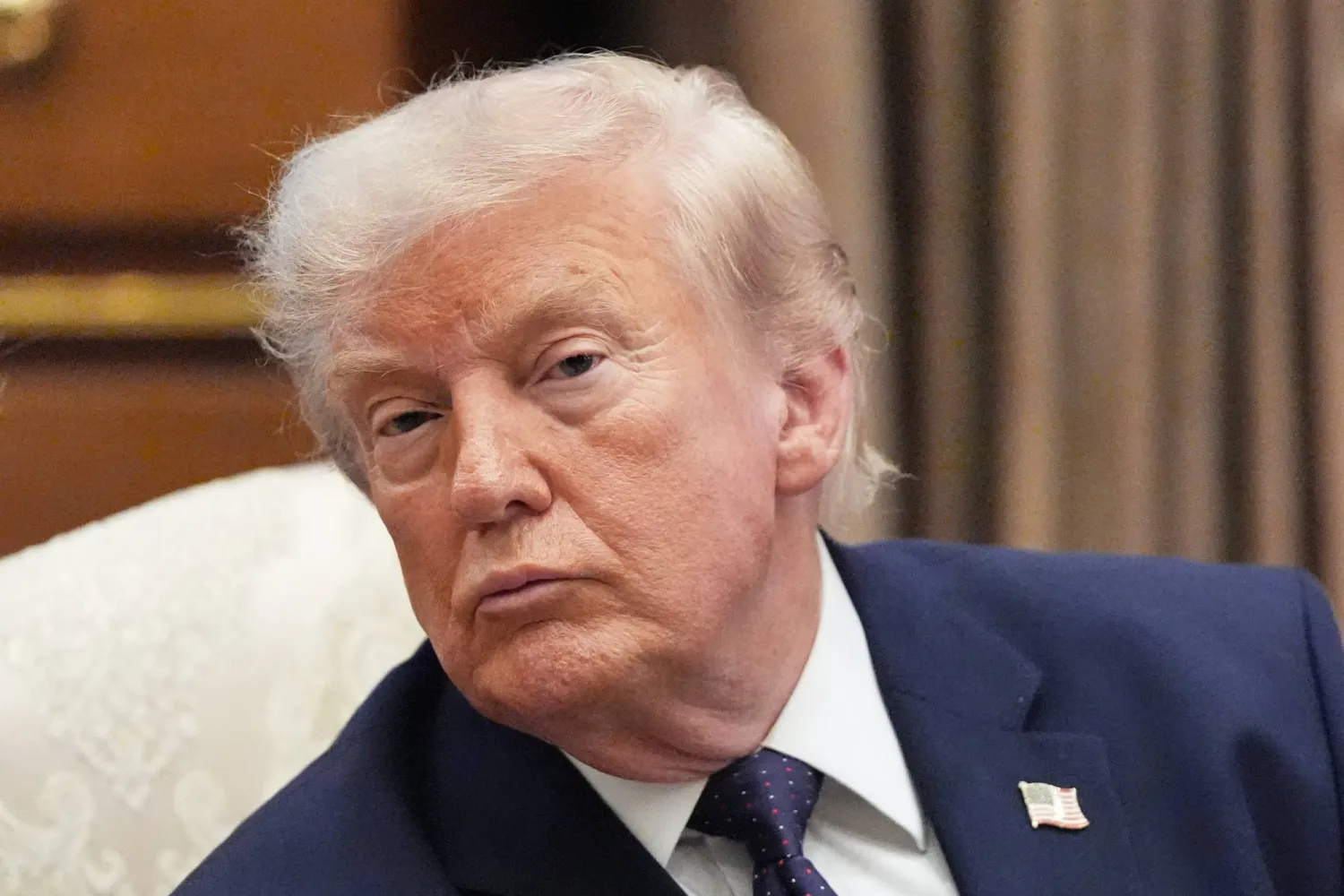
President Donald Trump listens to a translator at the beginning of a bilateral meeting with Turkish President Recep Tayyip Erdogan at the NATO summit in Ankara, Türkiye, Tuesday, July 7, 2026. (AP Photo/Alex Brandon)
TT

Trump Suggests a Standing Order to Attack Iran if it Assassinates Him. But Vance Would Make the Call

President Donald Trump listens to a translator at the beginning of a bilateral meeting with Turkish President Recep Tayyip Erdogan at the NATO summit in Ankara, Türkiye, Tuesday, July 7, 2026. (AP Photo/Alex Brandon)

President Donald Trump is suggesting he has left standing orders for the US military to destroy Iran “at levels they've never seen before” if Tehran follows through on its long-standing threats to kill him.

But the US government has no way to create an automatic, preauthorized “dead man’s switch” that would prompt immediate retaliation, The Associated Press said.

Instead, if Trump were killed, the transfer of power to his successor is governed by the 25th Amendment and the Presidential Succession Act of 1947. Vice President JD Vance instantaneously would become commander in chief and have authority for any retaliation.

Under such a scenario, Vance could do exactly what Trump called for, though there also is a chance he could decide not to follow his predecessor's orders — or offer a direct response in a different way.

“The US has, for a whole variety of reasons, never utilized a technical ‘dead man’s switch,'” said Garrett M. Graff, author of “Raven Rock: The Story of the US Government’s Secret Plan to Save Itself -- While the Rest of Us Die.”

The United States does have extensive contingency plans for continuity of government in the event of a nuclear attack or other major catastrophe that wipes out most or all of Washington. But those plans also do not allow for immediately launching retaliatory strikes upon the death of a president, even if that president had demanded that the military be ready to do so.

Trump nonetheless posted on his social media website Saturday that Iran had made threats “to assassinate, or attempt to assassinate” him and he said 1,000 “missiles are Locked and Loaded and aimed at the Islamic Republic of Iran, with thousands more to immediately follow, should the Iranian Government act on its threat.”

Iran's supreme leader, Mojtaba Khamenei, said hours later that Iranians would continue to avenge the killing of his father, Ali Khamenei. The elder Khamenei died in the initial US and Israeli strikes that started the war in late February, and he was mourned in funeral events throughout Iran this week. His son said retaliation “is the will of our nation and must certainly be carried out.”

“We pledge to take revenge for the pure blood of you and all the martyrs of these two wars from the criminal and disgraceful killers," he said in remarks aired on state television. "This revenge is the will of our nation and must certainly be carried out.”

The White House on Saturday did not immediately answer questions about what would become of Trump's military orders should he be killed.

During those recent funeral events, mourners repeatedly held posters or banners calling for Trump to be killed along with Israeli Prime Minister Benjamin Netanyahu.

The Wall Street Journal reported this week that Israel alerted US officials to fresh Iranian plots to kill Trump. The White House has refused to comment, but Trump appeared to reference such threats in comments during this week's NATO summit in Türkiye, saying, “They want to take out the US leader — me.”

Sabrina Singh, former Biden administration deputy Pentagon press secretary, said “Iran wanting to target senior American leaders is something that we know is happening."

“You have to take these as credible threats,” Singh said.

US retaliations would almost certainly come, just not automatically Trump was targeted in two domestic assassination attempts during the 2024 presidential campaign and saw a gunman storm the White House Correspondents' Association dinner he was attending in April.

The US and Iran once again began trading strikes, jeopardizing last month's initial deal to end the war. Asked about Iranian threats, Trump told reporters aboard Air Force One, “I’m No. 1 on their list."

Graff said the US prepared years of plans for how nuclear launch authority would devolve in the event of a surprise attack. That included, during 30 years of the Cold War, the country keeping fleets of airborne command posts flying 24 hours a day with a general aboard one of them who could take over nuclear launch orders in the event Washington was lost.

“What I believe Trump is saying is that he’s left standing orders to attack if he’s killed, e.g., that the Pentagon should proceed with standard launch protocols,” Graff said. “There’s a lot of reason to doubt the legality of such standing orders, since in the event of a president’s death, the nuclear launch authority would immediately pass to the vice president or designated successor — and ultimately it would be up to him or her to determine whether to proceed.”

Trump’s post only refers to firing missiles at Iran, which the US has done scores of times since its war with Iran began. He did not expressly threaten involving nuclear weapons.

Graff said that, in addition to leaving standing orders in case of his death, Trump also might say “something to Vance like, ‘If I’m killed, nuke Iran,'" and that would make” more sense and would be absolutely legal.”

Biden administration once warned Iran about Trump, too Washington receiving credible threats against the president and top US leaders from Iran and other foreign adversaries is not uncommon and is often disclosed via national security briefings or other classified means. But far less common is Trump declaring publicly that he personally has been targeted by Iran.

Still, this is not the first time Washington has threatened Iran over threats against Trump.

In 2022, the Biden administration warned Iran against attacking US citizens after the Justice Department's disclosure that a member of Iran’s Revolutionary Guard Corps had planned to assassinate John Bolton, Trump's first-term national security adviser. Now a Trump critic, Bolton last month pleaded guilty to illegally retaining classified documents in a case led by Trump’s Justice Department.

President Joe Biden’s national security adviser Jake Sullivan said in 2022 that “should Iran attack any of our citizens, to include those who continue to serve the United States or those who formerly served, Iran will face severe consequences.”

Two years later, in the heat of Trump’s campaign against Democrat Kamala Harris, Biden's vice president, the Biden administration again quietly warned Iran. This time, officials made clear that an attack on Trump would be considered an act of war.



Chinese Foreign Minister Calls for US and China to 'Overcome Obstacles' Ahead of Presidential Summit

US and Chinese flags are seen in this illustration created on March 20, 2025. REUTERS/Dado Ruvic/Illustration/File Photo
TT

Chinese Foreign Minister Calls for US and China to 'Overcome Obstacles' Ahead of Presidential Summit

US and Chinese flags are seen in this illustration created on March 20, 2025. REUTERS/Dado Ruvic/Illustration/File Photo

China's foreign minister said his country and the United States should overcome obstacles between the nations ahead of an expected summit next month between US President Donald Trump and Chinese President Xi Jinping.

Wang Yi met with US ambassador to China David Perdue on Wednesday and called on both sides to “focus on the positive agenda, properly manage differences, remove interference and overcome obstacles to high-level exchanges between the two countries,” Chinese state broadcaster CCTV reported Thursday.

China-US relations “still face various risks and challenges,” he acknowledged in a statement released by CCTV.

Trump and Xi met in May in Beijing and pledged to keep the relationship stable and maintain the fragile trade truce. Trump invited Xi to meet Sept. 24 in the US, but the exact date of the Chinese leader's visit has not been confirmed, The Associated Press said.

Since then, however, the US and China have continued to take targeted economic action against each other, including the US banning imports of new Chinese-made humanoid robots and China banning American entities engaging in trade and other activities in China.

Also on Thursday, China's Ministry of Foreign Affairs spokesperson Lin Jian said at a regular press conference that China and the US were maintaining communication about the two leaders' upcoming meeting “within the year.”

China-US tensions had been elevated since Trump's return to the White House last year, with the US at one point saying tariffs on China would be up to 145%, although the tariff levels came down substantially later. Tensions have eased in recent months and several agreements were made during the leaders' May meeting, including the setting up of boards of trade and investment between the two countries.

However, the Trump administration has recently been deliberating new tariffs of 7.5% on China as a result of an ongoing US probe against 16 economies on excess industrial capacity and production. An official decision has not yet been finalized or made public. The US also said last month that it was imposing a 12.5% tariff on China as a result of a US probe on forced labor against 60 economies.

In response to the potential 7.5% new tariffs by the US, China's Ministry of Commerce on Thursday told reporters that China “firmly opposes” the US probe on excess capacity, adding that the US was “politicizing economic and trade issues.”

Beijing will continue to closely monitor developments and “reserves the right to take all necessary measures” if needed, the Commerce Ministry added.

Last month, China also hit back against Western criticism of overcapacity in a report titled “China’s Position on the So-called Excess Capacity Issue,” saying China never sought a large trade surplus.


More than 1,300 are Missing in Nepal and Tibet after Catastrophic Floods Caused by Glacier Collapse

People amid damage in the aftermath of flash floods in Devighat in the Nuwakot district in Nepal, Thursday, Aug 27, 2026. (AP Photo/Niranjan Shrestha)
TT

More than 1,300 are Missing in Nepal and Tibet after Catastrophic Floods Caused by Glacier Collapse

People amid damage in the aftermath of flash floods in Devighat in the Nuwakot district in Nepal, Thursday, Aug 27, 2026. (AP Photo/Niranjan Shrestha)

Rescue teams searched on Thursday for hundreds of missing people along the Nepal-China border after a catastrophic and deadly torrent of floods and mud swept through several communities a day earlier following a glacier collapse.

The disaster left at least 168 people dead and more than 1,300 missing, including foreigners and pilgrims, and displaced hundreds of people across the Himalayan region.

Videos of the tragedy showed the flood swallowing up people as they tried to escape, and destroying buildings and bridges. On Thursday, drone footage from Nepal showed the scale of the destruction.

The region’s steep valleys are economic lifelines and travel corridors, but are precarious when disaster strikes. Images showed what appeared to be the second floors of buildings in Nuwakot slathered in mud after the torrent rushed by. Debris hung from tree branches and wires, vehicles were buried and some stunned survivors were caked in mud. The floods halted travel in some areas.

There was little time for anyone to flee.

Resident Jaleshwar Kumar Sahni received a phone call on Wednesday morning from an area close to the border that a lot of water was flowing through there, and later the flash floods destroyed everything in just 15 minutes.

“We don’t have anything left,” he said.

Warming climate threatens communities

The Himalayan mountain range spans several countries in South Asia and has many of the world’s highest peaks and remaining glaciers.

The steep slopes and the lush valleys below the Himalayan mountain range are especially vulnerable to flooding and landslides, and extreme weather events. Melting glaciers have become more common because of warming because of human-caused climate change.

Researchers in Kathmandu found earlier this year that glaciers across the Hindu Kush Himalaya region are melting faster, with ice loss rates doubling since 2000.

Helicopters deployed as roads were damaged

The disaster has left at least 165 dead and 826 people missing in Nepal, and three dead and 558 missing in Tibet, authorities said.

Nepalese officials said that dozens of bridges were destroyed and nearly 40 kilometers (25 miles) of roads were damaged, complicating search efforts.

The Nepalese army has rescued more than 100 people from flood-affected areas through helicopter operations on Thursday morning, army spokesperson Brig. Gen. Raja Ram Basnet said.

At least eight foreign nationals were airlifted to the country’s capital, Kathmandu, he said, adding that army teams also evacuated people trapped inside facilities linked to the Trishuli hydropower project.

Rescuers found bodies hundreds of kilometers downstream from the disaster zone in Chitwan district. Dozens of injured people have been transported to Kathmandu for advanced medical care.

Bishal Kumar Bhandari, chairman of the Nepal Red Cross Society, said they have shifted focus from rescue to large-scale relief operations in the flood-hit districts. He said that around 1,200 people were displaced from at least three villages.

In Tibet, a mudslide that struck near the land border crossing of Gyirong Port on Wednesday left mud in the surrounding areas more than 1½ meters (5 feet) deep on average, with some road sections exceeding 2 meters (6 feet), Chinese state broadcaster CCTV reported. Roads leading to the port were all damaged, while secondary collapses or landslides might occur as rain continued in the area, it added.

CCTV said that a barrier lake has also been discovered in the direction of the port, posing challenges to the rescue operation. Chinese authorities deployed a large military transport aircraft to send a team to the region, it said.

While electricity supply and communication resumed in the central urban areas in Gyirong town, those linked to the port were cut off, it said.

Hundreds of foreigners are missing

According to Nepal’s Tourism Board, 517 of the missing people in the country were foreigners and 178 of them were from India. It wasn't immediately clear how many missing Indian nationals were on a pilgrimage to Mount Kailash in Tibet, a sacred site for Hindus.

More than 60 of those unaccounted for in Nepal were from the US and the rest were from 30 other countries, ranging from Ukraine and the UK to South Africa and Japan, the Tourism Board said.

In addition, China’s Ministry of Foreign Affairs spokesperson Lin Jian said that nearly 100 Chinese citizens were missing on the Nepal side. CCTV earlier reported 260 of those missing in Tibet were foreigners.

Experts say glacier collapse caused devastating floods

The US Geological Survey first reported a magnitude 4.4 earthquake early Wednesday, about 66 kilometers (41 miles) north of Kathmandu, near the border.

The USGS later updated its analysis to say the seismic event it measured was a magnitude 5.2 glacier collapse that sent debris flowing downstream with catastrophic impact on communities. It said its determination was based on data from nearby seismic stations, long period seismic waves and satellite imagery, and that no earthquake had occurred.

Climate experts at the Kathmandu-based International Center for Integrated Mountain Development said an avalanche from a glacier likely caused Wednesday’s flash flood.

“Hydrological observations indicate the exceptional speed and magnitude of the flood wave,” they said in an emailed statement, noting that water levels at one point on the Trishuli river rose by as much as 9 meters (27 feet) over half an hour.

The Lhende Khola River, a tributary of the Bhotekoshi, had maximum flooding, they said.

The disaster in Nepal and Tibet is not a one-off. The increasingly unstable Himalayan ice system threatens communities, infrastructure and water supplies across one of the world’s most densely populated regions.

The region saw similar flash floods in August 2025, when a glacial lake in Tibet overflowed because of high temperatures. Nine people were killed, and critical infrastructure, including a bridge connecting Nepal and China, was damaged.


Iran Unable to Import Petrol amid US Blockade

Drivers queue at a petrol station to refuel in Tehran, on August 25, 2026. (AFP)
TT

Iran Unable to Import Petrol amid US Blockade

Drivers queue at a petrol station to refuel in Tehran, on August 25, 2026. (AFP)

Iran has been unable to import enough petrol to make up for insufficient domestic production because of a US naval blockade, a senior Iranian official said.

"Petrol production is insufficient, and because of the US naval blockade, we cannot import it," the official IRNA news agency quoted Vice President Mohammad Jafar Ghaempanah as saying on Wednesday.

The remarks came as Iranians have in recent days queued outside petrol stations, with the war with the United States increasingly shifting towards economic pressure on Tehran, said AFP.

On Monday, the Iranian president's chief of staff Mohsen Haji-Mirzaei said petrol quotas would be reviewed, without elaborating.

War broke out between Iran and the United States on February 28. Tehran has since seized control of the strategic Strait of Hormuz, with Washington imposing a naval counter-blockade on Iranian ports.

Ghaempanah criticized the distribution of highly subsidized fuel in Iran, saying the current system disproportionately benefits people who own multiple vehicles.

"The distribution of petrol in the country is inequitable. Owners of several vehicles benefit from subsidies, unlike those who do not own one," he said.

Iran, a major oil producer with some of the world's cheapest fuel, has for years heavily subsidized petrol, making any changes to pricing politically sensitive.