

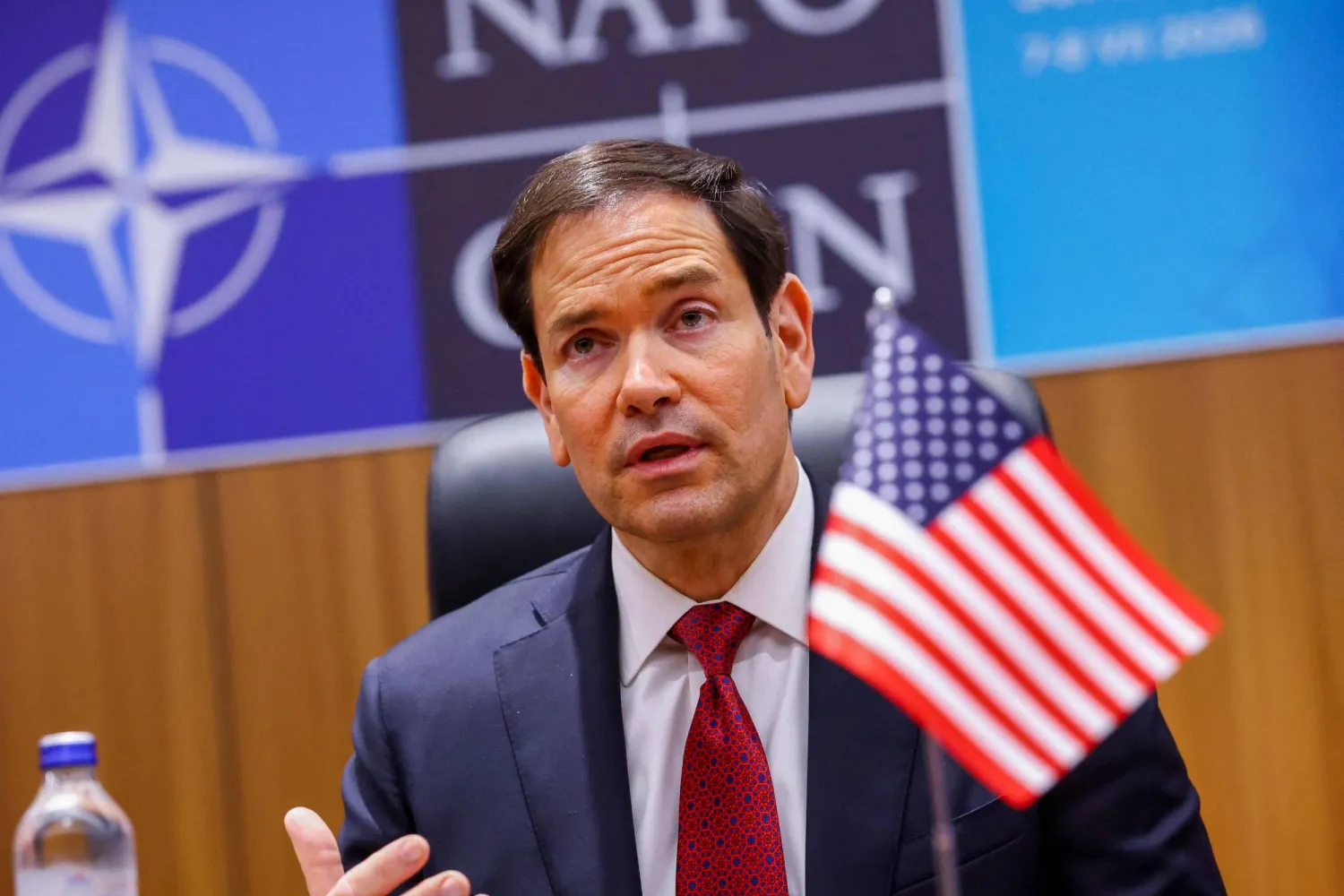

US Vows Campaign to End ICC ‘Threat’ to Americans

US Secretary of State Marco Rubio attends a trilateral meeting with Japanese Foreign Minister Motegi Toshimitsu and South Korean Foreign Minister Cho Hyun (not pictured) on the sidelines of the NATO Summit in Ankara on July 7, 2026. (AFP)
TT

US Vows Campaign to End ICC ‘Threat’ to Americans

US Secretary of State Marco Rubio attends a trilateral meeting with Japanese Foreign Minister Motegi Toshimitsu and South Korean Foreign Minister Cho Hyun (not pictured) on the sidelines of the NATO Summit in Ankara on July 7, 2026. (AFP)

The United States on Monday announced a campaign against the Hague-based International Criminal Court (ICC), accusing the tribunal of posing "an intolerable threat to US sovereignty" and threatening sanctions.

"The ICC and its friends are waging a war against our country, not with bullets or missiles, but with statutes, compacts and the force of so-called international law," Secretary of State Marco Rubio said in a video statement.

The State Department said in a statement the campaign will "systematically disable the ICC's ability to operate, target American servicemen or officials, or otherwise threaten American sovereignty."

Relations between the government of Donald Trump and the ICC have been extremely poor, with several court officials, including its chief prosecutor, already under US sanctions.

The sanctions bar the officials from entering the United States and block property and financial transactions involving them in the world's largest economy.

The measures have often focused on ICC investigations involving Israel, a US ally. The court issued arrest warrants in 2024 for Israeli Prime Minister Benjamin Netanyahu and others.

However, in its statement, the State Department focused on what it called the ICC's "intolerable threat to US sovereignty," saying the court "claims the authority to prosecute and even imprison American servicemen and officials operating on behalf of America's national interest."

"Americans never signed up for this, and all American presidents since the ICC's ratification have maintained that the ICC does not have jurisdiction over Americans," the State Department said.

The department listed a range of measures it was considering against the court, including having American diplomats call other nations to urge withdrawal from the body, as well as travel bans and sanctions against ICC officials.

Established in 2002, the ICC prosecutes individuals accused of the gravest atrocities, including war crimes, crimes against humanity and genocide.

Neither Israel nor the United States is a party to the international treaty that established the ICC. Russia is also not a member, and its President Vladimir Putin has been the subject of an ICC arrest warrant since March 2023.



Russian Document Reveals How Moscow Sought to Deepen Ties with Iran to Evade US Sanctions

Russian President Vladimir Putin with Iran's President Masoud Pezeshkian during a session held on the sidelines of the BRICS summit (EPA) 
TT

Russian Document Reveals How Moscow Sought to Deepen Ties with Iran to Evade US Sanctions

Russian President Vladimir Putin with Iran's President Masoud Pezeshkian during a session held on the sidelines of the BRICS summit (EPA) 

An official Russian document obtained and reviewed by Fox News reveals how Moscow sought to deepen its relationship with Iran to bypass US sanctions, laying out plans for alternative financial channels, nuclear cooperation, Iranian production of Russian aircraft components, well as open new financial avenues.

The 44-page Russian-language document was approved on the Russian side on Sept. 2, 2024. It indicated that Russia had drawn up a comprehensive plan for the period 2024-2026, which included the creation of alternative financial channels, the use of national currencies in transactions, strengthening nuclear cooperation, projects in the oil and gas sectors, the production of spare parts for Russian aircraft in Iran, and the continuation of the operation of the Bushehr nuclear power plant by Rosatom.

The roadmap also calls for Russia to help establish production in Iran of individual parts and assemblies for Russian aircraft.

Russian authorities were instructed to determine which aircraft parts could be repaired or manufactured in Iran, identify Iranian companies capable of producing them, certify selected sites through Russia’s aviation regulator Rosaviatsiya and conclude a localization agreement, according to Fox News.

The document also proposed building a railway line from the Iranian border with Azerbaijan to ports on the Arabian Gulf. However, it remains unclear which of these projects are still being implemented, given the changes brought about by the current war.

Russia has maintained close ties with Iran for years, but those relations have intensified since Russia's invasion of Ukraine. US reports say Iran has provided drone support to Russia, but Tehran has categorically denied them.

This cooperation was further strengthened as the US exerted pressure on Iran through economic sanctions, amid reports that Moscow had offered Tehran assistance in the production of cruise missiles.

Keti Korkiya, a research analyst with the Foundation for Defense of Democracies’ Russia program, reviewed the document for Fox News Digital and said its significance lies less in any single project than in the architecture Moscow was trying to build around the relationship.

“The roadmap is not revelatory: people paying close attention to the relationship between Russia and Iran will see many collaborations between the two countries that have been public for years,” Korkiya said in written analysis provided to Fox News Digital.

“What is more revealing is the architecture of the relationship Moscow is trying to build,” she said, pointing to financial mechanisms, transportation routes, energy investment and aviation cooperation as different ways of reducing vulnerabilities created by sanctions and Western economic pressure.


Trump Administration Prepares Sanctions against International Criminal Court

(FILES) This general view shows the exterior of the International Criminal Court (ICC) in The Hague on March 28, 2026. (Photo by JOHN THYS / AFP)
TT

Trump Administration Prepares Sanctions against International Criminal Court

(FILES) This general view shows the exterior of the International Criminal Court (ICC) in The Hague on March 28, 2026. (Photo by JOHN THYS / AFP)

President Donald Trump's administration has prepared sanctions against the entire International Criminal Court and plans to announce them soon, two sources familiar with the matter said, a move that would step up its attack on the global tribunal that prosecutes war crimes and genocide worldwide.

The Trump administration has made no secret of its disdain for the court and has worked to undermine it. US officials want the ‌court to drop ‌its arrest warrants against Israeli leaders as well as ‌a ⁠past probe into American ⁠troops in Afghanistan, Reuters said.

US Secretary of State Marco Rubio in July announced a campaign to isolate the court, calling on other countries to withdraw from the tribunal. Washington has imposed sanctions on a number of ICC judges and prosecutors but has so far held off from imposing sanctions on the court itself, although the move has long been considered as one of the options.

The State Department did not immediately respond to a request ⁠for comment.

Sanctions against the court have been prepared, the sources said, ‌even though the exact timing of an ‌announcement remained unclear. The Wall Street Journal cited officials who said the decision could be finalized ‌as soon as this week during the United Nations General Assembly meeting.

Targeting the ‌entire organization directly, as well as entities that cooperate with it, could severely undermine the court's work.

Any entity-wide sanctions imposed by the US Treasury would prohibit US citizens and companies from providing funds, goods, or services to the court without a license from the US Treasury's Office ‌of Foreign Assets Control (OFAC). Banks often over-comply with such US sanctions because they depend on access to the American financial system.

Among ⁠the court's operations ⁠that could be affected by sanctions against the entire organization are the purchasing of IT services and insurance, the hiring of investigators and conducting everyday financial transactions, such as paying dozens of American employees, the ICC's registrar and president have warned.

Trump's opposition to the court goes back to his first term. It surfaced again with a plan to penalize ICC officials, an idea developed in November 2024 when Trump was reelected and the ICC issued an arrest warrant for Netanyahu for alleged war crimes and crimes against humanity in the Gaza conflict.

The ICC was established in 2002 by the international community to prosecute war crimes, genocide and crimes against humanity. It asserts jurisdiction only if a member state is unable or unwilling to prosecute atrocities itself.

The United States has never been a member.


Russia Vows Strikes on Kyiv in Response to Election-day Attacks

Smoke rises behind a multi-story building following a reported Ukrainian drone attack in Dzerzhinsky, Moscow region, Russia, 20 September 2026. EPA/STRINGER
TT

Russia Vows Strikes on Kyiv in Response to Election-day Attacks

Smoke rises behind a multi-story building following a reported Ukrainian drone attack in Dzerzhinsky, Moscow region, Russia, 20 September 2026. EPA/STRINGER

Russia vowed Sunday to "intensify" its strikes on Kyiv in response to a wave of Ukrainian drone attacks on Moscow during three-day parliamentary elections.

"In response to the Kyiv regime's attacks on civilian targets within Russia, the Russian army will continue and intensify its high-accuracy strikes against military targets in Kyiv," the Russian defense ministry said, accusing Ukraine of attempting to "disrupt the democratic will of Russian citizens.”

Ukrainian forces fired more than 1,000 drones at Russia overnight, including hundreds that were launched toward Moscow, officials said Sunday, as the Kremlin was wrapping up the third and last day of its parliamentary elections.

Moscow’s mayor described the wave of drones as the “largest ever” drone attack on the Russian capital and said there had been damage to the Moscow Oil Refinery, which is among several sites that supply the Russian capital, and a residential building.

Across the wider Moscow region, the attack killed two people and wounded 20, local Gov. Andrei Vorobyov said. The dead were a 74-year-old man and a 44-year-old woman, he said.

Writing on social media, Ukrainian President Volodymyr Zelenskyy said that Kyiv had used a range of missiles and drones in the attack — including Ukraine's domestically made Flamingo and Pelican missiles — to hit oil and logistics facilities.