‘Gus’ the T. Rex Fetches Record $50.1 Mn at US Auction

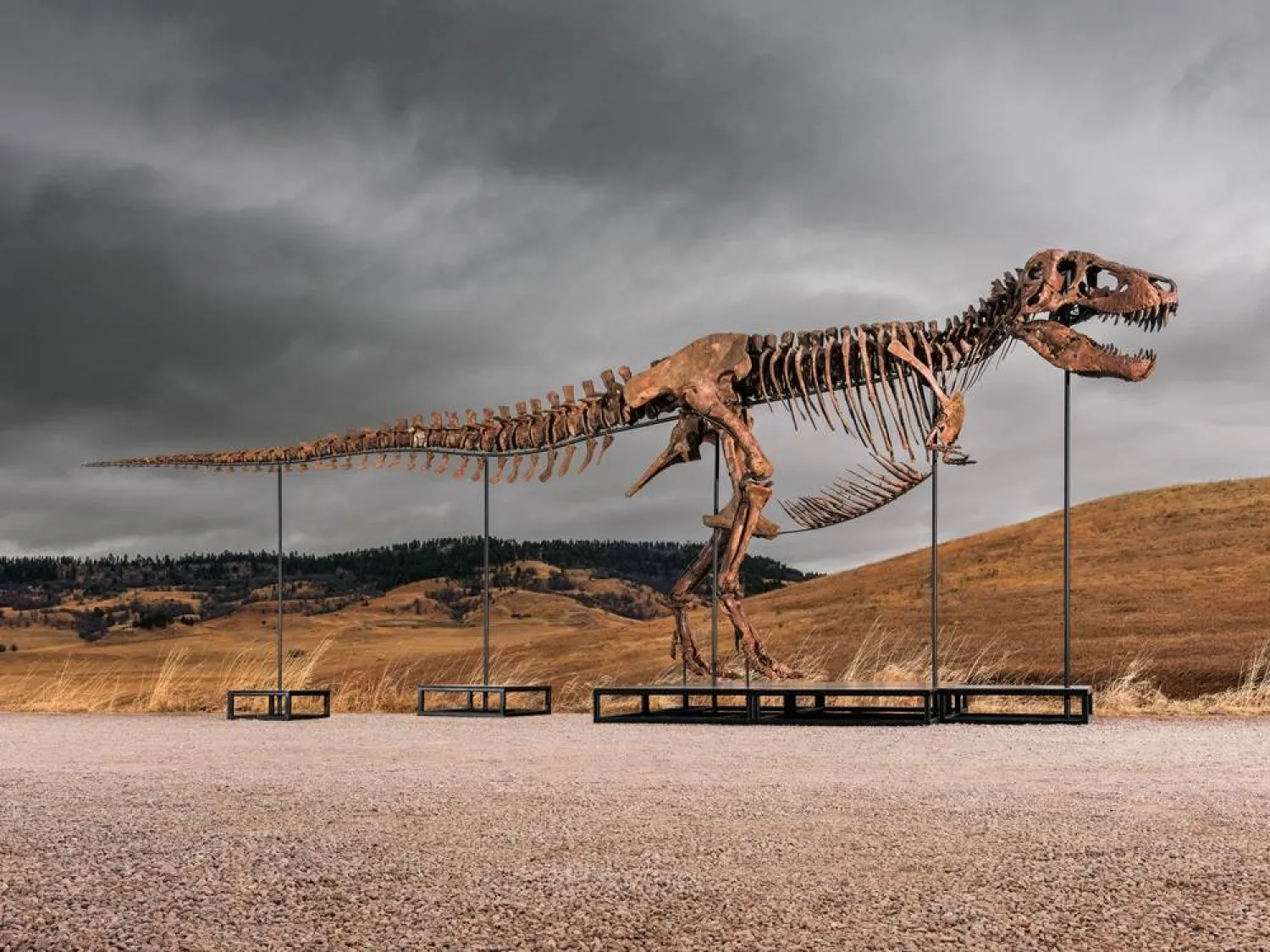
This undated photo provided by Sotheby's on Tuesday, July 14, 2026, shows "Gus," one of the largest and most complete Tyrannosaurus rex specimens ever discovered. (Matthew Sherman/Sotheby's via AP)
TT

‘Gus’ the T. Rex Fetches Record $50.1 Mn at US Auction

This undated photo provided by Sotheby's on Tuesday, July 14, 2026, shows "Gus," one of the largest and most complete Tyrannosaurus rex specimens ever discovered. (Matthew Sherman/Sotheby's via AP)

A Tyrannosaurus rex skeleton nicknamed "Gus" sold Tuesday for $50.1 million at Sotheby's in New York, making it the most valuable dinosaur fossil bought at auction after a 10-minute battle between seven bidders.

"Gus" is one of the world's most complete T. rex skeletons -- with 183 fossilized bones -- and was discovered on a cattle ranch in South Dakota in 2021.

The giant beast lived some 72 to 66 million years ago -- a period characterized by a warm climate, high sea levels and vast floodable coastal plains.

The skeleton measures 38 feet (11.6 meters) in body length, making it one of the largest T. rexes ever discovered. It is roughly 63 percent complete.

Tuesday's purchase by an anonymous buyer highlights a surging market for dinosaur bones -- a trend that has drawn criticism from some paleontologists over the specimens going into private hands.

"The United States is the only country in the world where fossils like this are considered personal property," Cassandra Hatton, head of science and natural history at Sotheby's, told AFP before the auction.

"If you own the land, you own the fossil and you have the right to sell it. So if you want a dinosaur, this is the only place that you can get it," she said.

The previous record for a fossil auction was "Apex" the Stegosaurus, bought for $44.6 million in 2024 by hedge fund billionaire Ken Griffin.


New Zealand’s PM Proposes Banning Children from Using Social Media

 New Zealand's Prime Minister Christopher Luxon speaks to media during a visit to aircraft manufacturing company "NZ Aero" with Thailand's Prime Minister Anutin Charnvirakul (not pictured) in Auckland on August 21, 2026. (AFP)
New Zealand's Prime Minister Christopher Luxon speaks to media during a visit to aircraft manufacturing company "NZ Aero" with Thailand's Prime Minister Anutin Charnvirakul (not pictured) in Auckland on August 21, 2026. (AFP)
TT

New Zealand’s PM Proposes Banning Children from Using Social Media

 New Zealand's Prime Minister Christopher Luxon speaks to media during a visit to aircraft manufacturing company "NZ Aero" with Thailand's Prime Minister Anutin Charnvirakul (not pictured) in Auckland on August 21, 2026. (AFP)
New Zealand's Prime Minister Christopher Luxon speaks to media during a visit to aircraft manufacturing company "NZ Aero" with Thailand's Prime Minister Anutin Charnvirakul (not pictured) in Auckland on August 21, 2026. (AFP)

New Zealand's Prime Minister Christopher Luxon has unveiled a proposed law banning children younger than 16 from using social media platforms, citing what he said Monday was “harm being done to a generation” of young people.

However, the bill hasn't yet attracted enough support to pass into law because two of the three parties in Luxon's coalition government will vote against it. Passage would require support from opposition lawmakers, who have yet to decide how they would vote.

There also wasn't enough time for lawmakers to hold a vote on the proposal before Parliament dissolved on Oct. 1 ahead of November’s election, Luxon said. Bills are required to pass three rounds of voting, usually over a period of months, before they become law.

Proposal comes after other countries enact age bans If reelected, Luxon is seeking to make his government the latest worldwide to enact age restrictions for social media platforms after dozens of countries have either introduced or are mulling such measures.

He said 2025 research showed a third of New Zealand teenagers spent at least five hours a day on social media.

“Social media is exposing them to harmful content, addictive technology and pressures they are not equipped to deal with and it’s affecting their family life, mental health, sleep, and education,” Luxon said.

The proposal would require social media platforms including Instagram, TikTok, Snapchat and Facebook, to “take reasonable steps” to check users were older than 16, according to material supplied by Luxon's party Monday. This could include “existing account information, facial age estimation, digital ID services and formal ID,” the material said.

Excluded from the proposed law are messaging platforms such as WhatsApp, online gaming platforms like Roblox and AI apps with productivity uses, including ChatGPT, Gemini and Copilot.

No penalties are proposed for parents or children, but tech firms could be fined up to 10% of their global revenue for failing to meet their obligations. Platforms regularly used by children would be required to assess and report on the risks their networks posed, Luxon said.

Prospect of a ban has divided New Zealand's government Luxon's government has mulled such a law since Australia's world-first social media ban for under 16-year-olds took effect in December 2025. However, it's been vehemently opposed by the other two parties that make up the government along with Luxon's center-right group National — libertarian ACT and populist NZ First.

Both minor parties repeated Monday their plans to vote against the law. Lawmakers from the largest opposition party, center-left Labour, haven't decided if they'd vote for it, leader Chris Hipkins said Monday.

Since Australia's law came into force, countries including Canada, Brazil and Indonesia have enacted bans too, while many other countries are studying or developing laws. Child safety advocates and some parents have welcomed age restrictions, while privacy groups say the rules can be cheated and that forcing users to supply identification raises privacy concerns.

In January, a month after Australia's ban was enacted, social media platforms told an Australian regulator they had revoked access to about 4.7 million accounts identified as belonging to children.

Luxon's government enacted a ban in 2024 on the use of cellphones during the school day for students of all ages.


Australia’s Wild Macadamias... a Rare Gene to Cope with Climate, Illnesses

Australia’s wild macadamias (Shutterstock)
TT

Australia’s Wild Macadamias... a Rare Gene to Cope with Climate, Illnesses

Australia’s wild macadamias (Shutterstock)

While grown in huge numbers commercially, macadamias are a vulnerable crop. A group of wild Australian nut hunters is seeking to change that, according to The Guardian.

Ian McConachie has always been partial to a macadamia nut. As a boy in Brisbane in the 1940s he used to climb fences to steal them from people’s back yards. “We’d put them in a little hole in the concrete under the house and hit them with a hammer.”

Now 90, he has spent much of his life devoted to the nut, including developing a tree that has raised $2 million in royalties for the Macadamia Conservation Trust, which seeks to preserve this scrappy rainforest plant.

Today macadamias are a $2 billion global industry, grown in industrial quantities in subtropical climates in Hawaii, the Americas, Africa and Asia. But there was a time when Aboriginal people traded them for rum and tobacco with the white settlers here on this country.

“It is the world’s finest nut,” McConachie said. “It is an Australian icon and our only native plant that has become a commercial food.”

A couple of kilometers from here lives Macadamia integrifolia, which genetic testing has shown is the genesis tree of 70% of macadamia trees grown commercially around the world.

There are three other species: M tetraphylla is also grown commercially, while M ternifolia and M jansenii are almost inedible, wild and rare.

Macadamias have been cultivated commercially since the 1920s, starting in Hawaii.

Australia didn’t start commercial production until the 1960s. Only two to three generations out of the wild is “terribly young in the world of horticulture”, McConachie said. “So we simply don’t know what the potential of the wild macadamia tree is.”

All four macadamia species are native to a tiny patch of Australian subtropical rainforest in south-east Queensland and northern NSW.

“Which is pretty much where everyone wants to live,” said Denise Bond, executive director of Wild Macadamia Conservation. “They [the trees] like expensive real estate, which makes them incredibly endangered because we’ve got so little rainforest left.”

Wild trees may hold the key to the next generation of climate- and disease-resilient nuts.

McConachie said for commercial macadamia farming, “one of the very few things Australia has got going for it is the wild trees and their genetic potential.”

But more than 80% of the habitat that these trees evolved in over 120 million years is reduced to remnant now.

One of the macadamia species, M jansenii, is seriously endangered, so rare “a bushfire could totally wipe them out,” McConachie said.

Their locations are kept secret to protect them. While the nuts are too bitter to eat, “it could be a major tool in terms of climate change because it is so hardy.” The other three species are listed as threatened or vulnerable.

McConachie has spent decades walking the remnant rainforests not far from where he lives, to find and document wild macadamias in situ. In August, he and fellow macadamia conservationist Russell Bennet took The Guardian on one of their hunts.

Bennet, a Kabi Kabi man, custodian and elder, who is driving, is known for his ability to spot them. “It’s some genetic ability handed down through the ancestors, I reckon,” he said.

First Nations Australians, though, have received vanishingly little financial benefit from the nut’s global popularity.

When he finds a new undocumented tree, Bennet said: “it’s almost like finding gold. You can go through a lot of rainforest and not see one.”

Except in September, when they flower and put on a show. The rest of the year, their dark leaves retreat into the rainforest, easily overlooked.

In 1981, McConachie and his wife, Jan, bought a rundown dairy farm near Wolvi. He flirted with other trees, mangoes, lychees, stone fruit, but quickly came back to his great love.

After an extensive selection trial, he found a particularly hardy and accommodating tree, named it MCTI and secured planter breeding rights.

“It has sold about a million and a half trees,” he said, “and raised about $2 million in royalties.”

All of that has been donated to Wild Macadamia Conservation.

“We’re probably all a bit eccentric,” he said of the group, “but we’re passionate about the need to conserve the wild genetics.”


London's Natural History Museum Reopens Hall Closed for 83 Years

The skeleton of a blue whale hanging from the ceiling in the Hintze Hall at the Natural History Museum in London, England (Natural History Museum)
TT

London's Natural History Museum Reopens Hall Closed for 83 Years

The skeleton of a blue whale hanging from the ceiling in the Hintze Hall at the Natural History Museum in London, England (Natural History Museum)

A gallery that has remained closed to the public since World War Two is to reopen at London's Natural History Museum next month, according to BBC.

The gallery, which has remained hidden from view since 1943, will reopen from September 16, featuring 50 objects which show our evolving relationship with the natural world.

The exhibition, named Nature and Us, is part of a transformation project called NHM150, which aims to open a new or revamped showcase every year until the museum's 150th anniversary in 2031.

Dr. Doug Gurr, director of the NHM, said: “For the first time in over 80 years, visitors will be able to step into this beautiful historic space and explore our changing relationship with the natural world.”

The museum describes the display as “experimental” during the initial 18-month period, with visitors invited to share their views on what they would like to see in the permanent gallery, which is due to open in 2029.

The exhibition is located on the second floor of the museum's main Waterhouse Building. It was originally used as an osteology and mammals gallery.

However, after the museum's original herbarium was damaged during World War Two, the space was repurposed to house the botanical collections and closed to the public.

Among the key specimens on display is a miniature model of a Crystal Palace dinosaur, alongside other objects that show how early scientists and artists understood the prehistoric world.

Other items include a Victorian skeleton of a monk seal named Jenny, highlighting how wild animals were once exploited for entertainment, as well as the jaw of one of Britain's earliest known domesticated dogs, dating back about 14,300 years.

The Natural History Museum in South Kensington is free to visit and open seven days a week.