US Reports ‘Wave of Strikes’ on Iran as War Returns

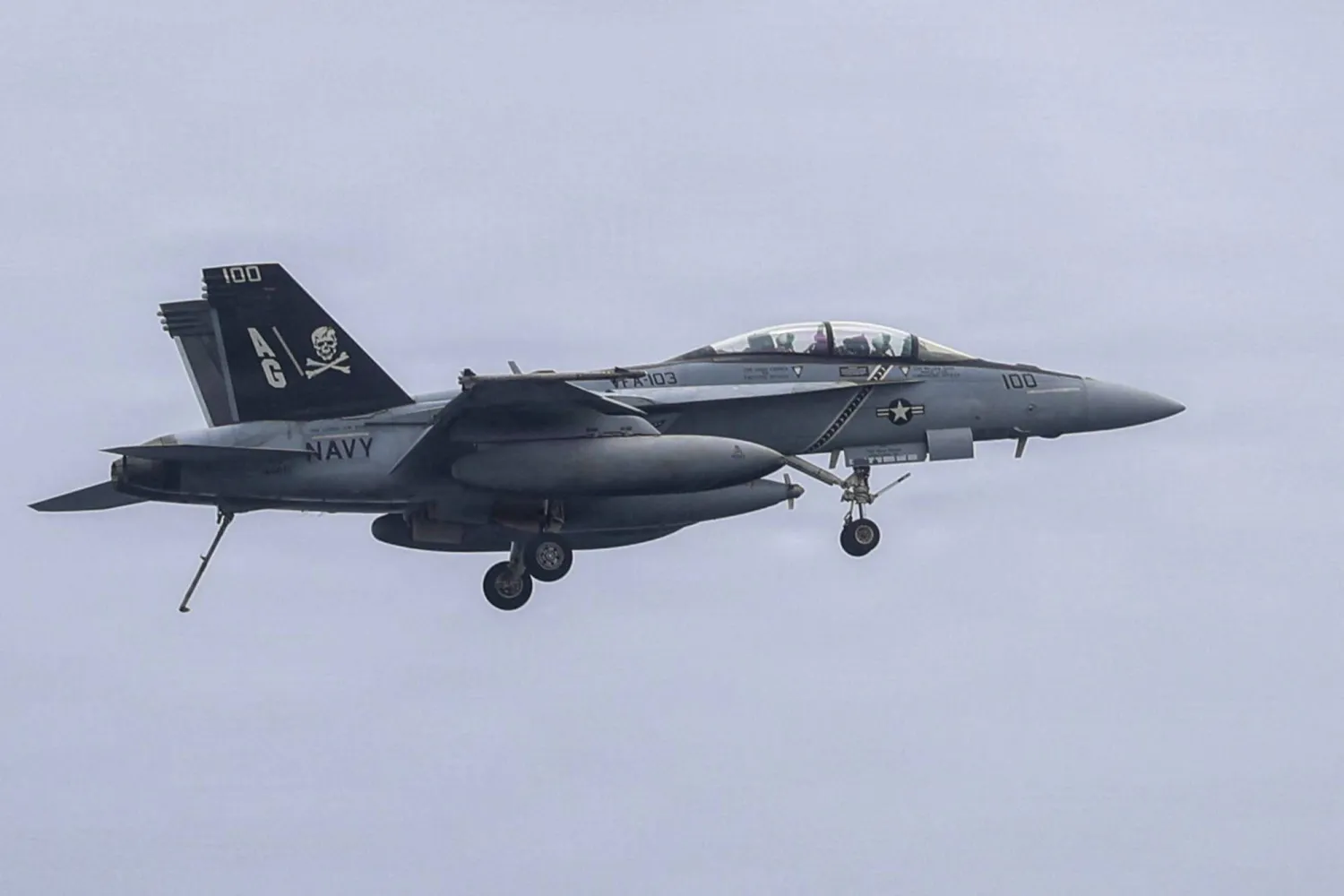
This US Navy handout photo released on July 10, 2026 and taken on June 29 by US Central Command Public Affairs shows an F/A-18F Super Hornet, attached to Strike Fighter Squadron (VFA) 103, preparing to land on the flight deck of Nimitz-class aircraft carrier USS George H.W. Bush (CVN 77). (US Navy/AFP)
TT

US Reports ‘Wave of Strikes’ on Iran as War Returns

This US Navy handout photo released on July 10, 2026 and taken on June 29 by US Central Command Public Affairs shows an F/A-18F Super Hornet, attached to Strike Fighter Squadron (VFA) 103, preparing to land on the flight deck of Nimitz-class aircraft carrier USS George H.W. Bush (CVN 77). (US Navy/AFP)

The United States launched a wave of strikes against Iran on Wednesday, after it reimposed a naval blockade in a return to war between the two foes.

Nearly a month after they signed a memorandum of understanding towards ending the Middle East war, the two sides resumed fighting with strikes on targets across the region.

Iran's Revolutionary Guards said they targeted Bahrain, where the military said it had intercepted attacks against civilian targets, while Jordan's armed forces said they had downed three missiles from Iran.

US President Donald Trump, meanwhile, threatened to widen strikes next week to hit power plants and bridges unless Tehran returns to the negotiating table.

"Next week it gets really bad for them," he told Fox News. Despite a return to hostilities, mediated talks between the two sides have not formally ended.

At the heart of the resumption of hostilities has been the dispute over the Strait of Hormuz, a waterway that is crucial for global oil and gas flows.

- Agreement 'dismantled' -

Iran blockaded Hormuz after the US and Israel launched their massive attack on February 28, using it for leverage against its foes for months before briefly reopening it, and then again vowing it would be closed "until the US ends its aggression".

The US, in turn, has reimposed its own blockade of Iran's ports, though Trump has backed down on a planned 20 percent levy on ships using the strait.

Deputy Foreign Minister Kazem Gharibabadi said the renewed US blockade "has, in a way, dismantled the Islamabad memorandum", referring to the interim deal reached last month to halt hostilities and pursue peace talks.

Days after the return to war, US Central Command (CENTCOM) said it launched "a wave of strikes... designed to further degrade military capabilities Iranian forces have used to attack commercial shipping in the Strait of Hormuz."

Iranian state media reported explosions near the port city of Bandar Abbas, on the island of Qeshm and on Bandar Imam Khomeini. It later said fresh US strikes hit the southern port city of Bushehr, home to the country's only civilian nuclear plant.

In the capital Tehran, there was no sign of a return to conflict, with ordinary Iranians thronging cafes to watch the France-Spain World Cup semifinal in huge crowds, AFP journalists saw.

But in Kuwait, repeatedly targeted throughout the war, people were anxious.

"Every day, I wake up wondering whether the situation will de-escalate or worsen," said Mustafa Mohamed, a 39-year-old Sudanese accountant in the Gulf country.

"It has become difficult to feel at ease or plan anything because uncertainty grips everyone."

George Atef, a 38-year-old Egyptian civil servant in Kuwait, said: "What exhausts me most is not knowing when this situation will end -- the waiting itself has become draining."

- Trump scraps levy -

Since the war began, Iran has asserted its control over the Strait of Hormuz and opened fire on ships for taking routes it says are unauthorized.

"The retaliatory operations of the fighters will continue, and the Strait of Hormuz will remain closed until the United States ends its acts of aggression," the Guards said.

A Norwegian tanker was hit by an explosion caused by an unidentified device off the Omani coast early Tuesday, the crisis response company MTI Network said.

And Kuwait said one of its naval vessels was struck during an Iranian missile and drone barrage, wounding four crew members.

Trump meanwhile said he was scrapping a planned levy on ships passing through the Strait of Hormuz that he announced Monday.

Since last week, renewed US attacks have killed at least 30 people in Iran, government spokesman Fatemeh Mohajerani said.

Separately, the military announced that seven of its personnel were killed in Wednesday's strikes on the southeast.

Israeli Prime Minister Benjamin Netanyahu, whose country has not so far rejoined the war, warned Iranian leaders on Tuesday that Israel would deal a heavy blow if they launched an attack on his country.

Speaking from Dimona, a southern town widely believed to house Israel's undeclared nuclear arsenal, he told them: "Do not count on things remaining quiet if you attack us."


Military Helicopter Crashes in Southern Türkiye, Killing 4

Rescuers and security officers examine the wreckage of an ambulance helicopter after it collided with a hospital building and crashed into the ground, in Mugla, Türkiye, December 22, 2024. REUTERS/Kenan Gurbuz Purchase
TT

Military Helicopter Crashes in Southern Türkiye, Killing 4

Rescuers and security officers examine the wreckage of an ambulance helicopter after it collided with a hospital building and crashed into the ground, in Mugla, Türkiye, December 22, 2024. REUTERS/Kenan Gurbuz Purchase

A military helicopter crashed in southern Türkiye on Thursday, killing four personnel, the Turkish Defense Ministry said.

The aircraft crashed for unknown reasons in Samankoy, a neighborhood on the southern outskirts of the provincial capital Malatya in the early evening.

“As a result of an accident involving our S-70 helicopter in Malatya, for a reason not yet determined, 4 of our heroic comrades-in-arms aboard the helicopter were martyred,” the ministry said in a social media post.

“We pray that God will have mercy on our martyrs and offer our condolences and prayers for strength to their grieving families, our Turkish Armed Forces, and our noble nation.”

According to The Associated Press, TV images showed the wreckage of the helicopter burning near a cluster of buildings in an otherwise open area of land. The Demiroren News Agency reported that flames had spread to a nearby house but reported no casualties on the ground.

Police, firefighters and medical teams were dispatched to the crash.


Trump Says US Does Not Need Iran Deal

US President Donald Trump and Vice President JD Vance look on during a Veterans Day ceremony at Arlington National Cemetery in Arlington, Virginia, US, November 11, 2026. REUTERS/Kylie Cooper
TT

Trump Says US Does Not Need Iran Deal

US President Donald Trump and Vice President JD Vance look on during a Veterans Day ceremony at Arlington National Cemetery in Arlington, Virginia, US, November 11, 2026. REUTERS/Kylie Cooper

President Donald Trump said on Thursday the US does not need a deal with Iran and directed Vice President JD Vance, who has played a role in efforts to resolve the war, to focus "his complete and total attention" on alleged crime and corruption in Democratic-run cities and states.

Trump's directive came a day after the Wall Street Journal reported that Vance was considering face-to-face peace talks with a hard-line Iranian security official and a week after the vice president blamed the costly war with Iran for Republicans' midterm elections drubbing.

Trump's comments marked a shift in tone after he had suggested ⁠in recent weeks ⁠that Iran would be more willing to strike a deal in the eight-month conflict after the US elections.

"We don’t need a deal with Iran. Those days have long since passed. We’ve got their money, Hundreds of Billions of Dollars, and we’ve got their Strait!" Trump wrote on social media, referring to the Strait of Hormuz, the critical ⁠shipping route near Iran where the US military has been working to secure safe passage for international shipping.

Trump said he asked Vance to focus instead on a domestic issue the president previously put in his portfolio: leading an effort targeting alleged fraud in Democratic-run cities and states throughout the US.

"Our Budget could be quickly BALANCED with the correction of this large-scale criminal activity. CORRUPTION is in the Democrat Leadership’s blood!" Trump wrote on Thursday.

Vance's office did not immediately respond to a request for comment.

The Wall Street Journal reported on Wednesday that ⁠Vance was considering ⁠meeting with a senior Iranian security official, a move that would have put Vance at the center of peace negotiations. Reuters has not confirmed the potential talks.

Vance, who is viewed as a leading contender for the 2028 Republican presidential nomination, distanced himself from the war last week after Republicans' midterm election rout by Democrats.

The vice president blamed the costs of the Iran war in part for the party's losses. He also said an earlier recommendation to end the war was "sound advice."

Trump responded to Vance's position by defending the war as necessary to stop Iran from obtaining a nuclear weapon.


Iran: Four Tankers Struck by Explosions in Strait of Hormuz

Iran: Four Tankers Struck by Explosions in Strait of Hormuz
TT

Iran: Four Tankers Struck by Explosions in Strait of Hormuz

Iran: Four Tankers Struck by Explosions in Strait of Hormuz

Four oil tankers were hit by explosions in the Strait of Hormuz, Iran's military said on Thursday, adding that the vessels had ignored warnings and entered what it considers restricted areas of the strategic waterway.

Tankers are still facing attacks across the strait, despite a rebound in traffic and expectations of a de-escalation in the war between the United States and Iran that have been reflected in falling oil prices.

Iran's Revolutionary Guards Navy said two supertankers were disabled by explosions on Wednesday after they ignored ⁠warnings against using what ⁠it said was an "unauthorized route".

Reuters could not immediately verify the Iranian account.

The two vessels "exploded after hitting naval mines", Iranian state media reported, broadcasting what it said was video footage of the incidents.

Iran's army later said two other tankers had hit mines on Thursday afternoon while sailing through the eastern Strait of Hormuz after ignoring ⁠warnings and disabling their radar systems, state TV reported. The tankers entered a restricted area and subsequently caught fire, it reported.

Earlier in the US-Israeli war with Iran, which began in February, the IRGC Navy announced its attacks on tankers. More recently, however, it has instead reported that vessels have caught fire after hitting naval mines while traversing the southern part of the strait, which it has declared an unauthorized route.

In several of those cases, the United Kingdom Maritime Trade Operations agency (UKMTO) has said vessels had been struck by unknown projectiles.

The ⁠UKMTO said ⁠in reports on Thursday that a vessel was hit by an unidentified projectile about 14 nautical miles northwest of the UAE emirate of Ras Al-Khaimah on Wednesday while exiting the strait, causing a fire in its engine room.
Firefighting efforts were under way and all crew had been evacuated, it added.

At least 10 ships were hit in the first 10 days of November, after 37 attacks in October, which was the highest monthly tally since the conflict began in late February, according to data from the Washington Institute for Near East Policy.