


US Strikes Expand into Northern Iran as it Disables Ship Trying to Run Blockade

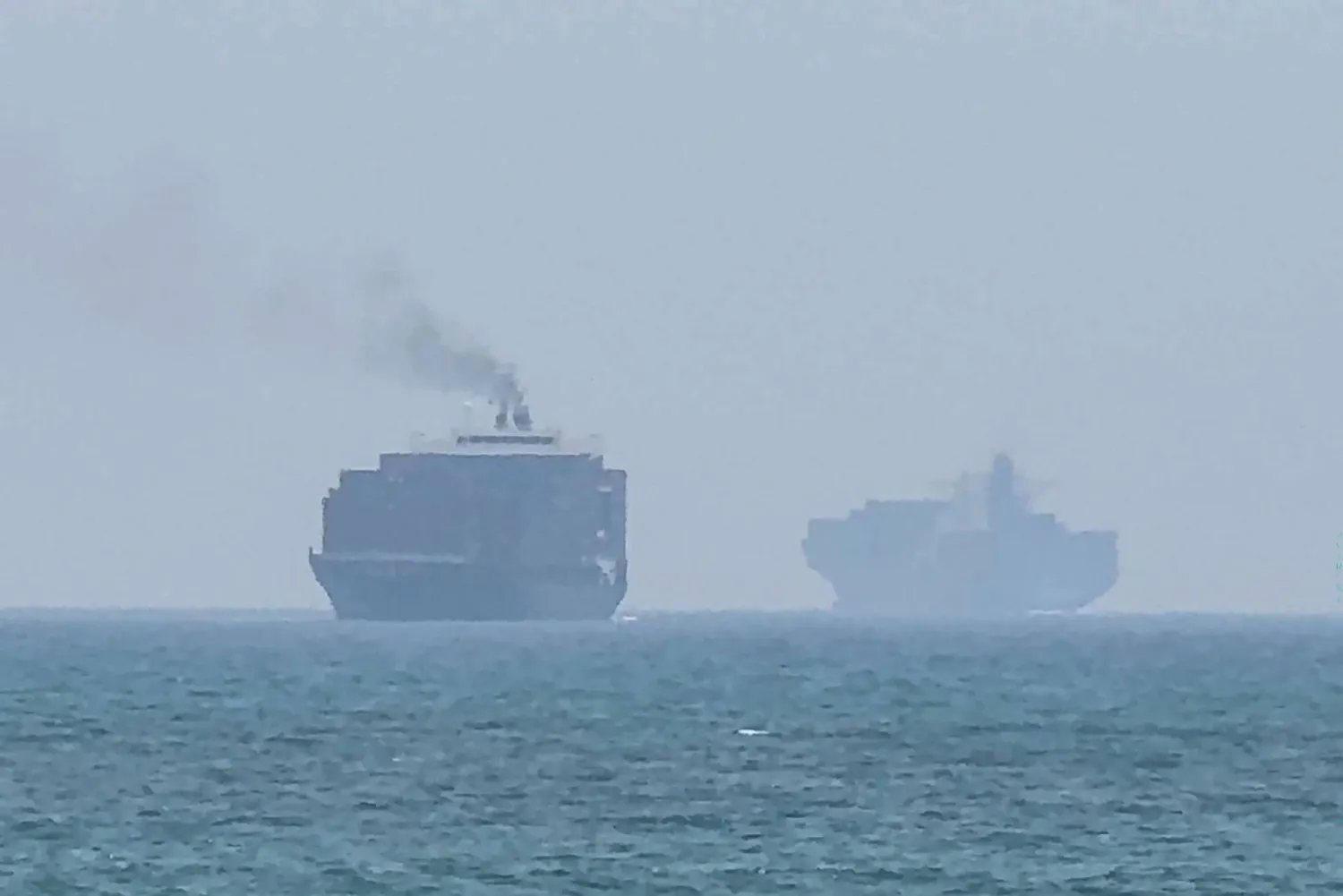
TOPSHOT - This frame grab taken from AFPTV video footage on July 12, 2026 shows cargo ships anchoring near the Strait of Hormuz off the eastern coast of the United Arab Emirates at Khor Fakkan. (Photo by AFPTV / AFP)
TT

US Strikes Expand into Northern Iran as it Disables Ship Trying to Run Blockade

TOPSHOT - This frame grab taken from AFPTV video footage on July 12, 2026 shows cargo ships anchoring near the Strait of Hormuz off the eastern coast of the United Arab Emirates at Khor Fakkan. (Photo by AFPTV / AFP)

The United States intensified its strikes targeting Iran early Thursday, hitting targets further north as American forces also fired into a ship it accused of trying to break its naval blockade on Iran.

Iran retaliated with missile and drone fire targeting Bahrain, Jordan and Kuwait before dawn.

Days of back-and-forth strikes by the US and Iran across the Middle East — and renewed threats to the Strait of Hormuz — have shredded the interim deal to end the Iran war and could tip the region back into all-out war. Already, Iranian officials say US strikes have killed more than 35 people and wounded over 300 others. Strikes also reached into areas around Iran’s capital, Tehran, for the first time of this latest round of violence, The Associated Press said.

When the US and Israel launched the war on Iran on Feb. 28, Tehran effectively closed the strait to shipping traffic, a move that sent the price of oil, fertilizer and many other goods soaring far beyond the region and gave Iran major leverage in negotiations.

US and Iran trade threats as attacks intensify

Those rising prices pose a particular challenge to US President Donald Trump and his Republican Party, which hopes to retain control of Congress in elections in November. But Washington has struggled to successfully reopen the waterway, leading to Trump reimposing the naval blockade Wednesday.

Iran’s parliament speaker and lead negotiator, Mohammad Bagher Qalibaf, said Iran was prepared for a fuller military confrontation if the US does not live up to the terms of the interim deal, and Iran’s paramilitary Revolutionary Guard threatened to halt all energy exports from the Middle East over the blockade.

“The export of oil and gas from the region will be either for everyone or for no one,” the Guard said.

Trump again insisted Iran was ready to strike a peace deal, but he did not elaborate.

“They don’t like what we’re doing, and they do want to settle. We’ll find out whether or not we settle with them, or we just finish it off,” he said Wednesday at the US Army War College in Pennsylvania.

Trump separately said on social media that Tehran made a goodwill gesture by releasing an American citizen wrongly detained in Iran since 2024. He didn’t release further details. Human rights lawyer Jared Genser released a statement identifying the detainee as his client Dena Karari, a US-Iranian citizen who runs a nonprofit and was charged with espionage.

Iran did not immediately acknowledge the release and her case was not publicly known, as is sometimes the case with detentions in Iran.

Both the US and Iran launch attacks as blockade is reimposed

The US strikes early Thursday hit around Tehran, state media reported. It also reported that American attacks targeted Semnan province, home to Iran’s ballistic missile production and space program.

On Wednesday, the US resumed striking Iran during daylight, further showing the increasing tempo of the attacks. An attack on Greater Tunb Island, a strategic point in the Strait of Hormuz, targeted Iranian defense and missile sites, Central Command said.

Meanwhile, the US military said it opened fire on the Curacao-flagged oil tanker Belma sailing toward Kharg Island, Iran’s main oil export terminal in the Arabian Gulf. After the ship “ignored multiple warnings,” a US aircraft disabled the merchant vessel by firing a missile into the ship’s smokestack.

Another American strike Wednesday targeted a barracks for Iran’s 388th Mechanized Infantry Brigade, which operates tanks and armored vehicles, in Sistan and Baluchestan province, Iranian state television reported. The report said Americans fired at least 13 missiles in the attack and the seven dead included conscripts and career soldiers. A number of troops were wounded.

Iran retaliated Thursday with missile and drone attacks on Bahrain, Jordan and Kuwait, authorities in those countries home to US forces said. There was no immediate acknowledgment of damage or casualties from the attacks.

The Strait of Hormuz remains at the heart of the fighting

The latest round of fighting is focused on the Strait of Hormuz. How to reopen the strait has bedeviled the US since Iran choked it off in the early days of the war.

During the interim deal, some ships began moving through the passage using a route near Oman overseen by the US military that is outside Tehran’s control.

In recent days, Iran attacked ships using that route — and back-and-forth attacks ensued. The US has threatened to reopen the strait by force — but experts say that would require a much bigger armada if not tens of thousands of ground troops. Imposing the blockade is another way to put pressure on Iran.

But in the meantime, oil prices are rising. The price for Brent crude oil, the international standard, traded above $85 a barrel on Thursday — more than 15% higher than the price before the war, but still well below the nearly $120 reached at the height of the conflict.



Iran and Oman Agree on Temporary Route in Hormuz Strait

A handout picture provided by the Iranian Foreign Ministry Office, shows Iranian Foreign Minister Abbas Araghchi (top-R) and Omans' Foreign Minister Badr al-Busaidi (Top-L) meeting in Tehran on August 25, 2026. (Iranian Foreign Ministry Office / AFP)
TT

Iran and Oman Agree on Temporary Route in Hormuz Strait

A handout picture provided by the Iranian Foreign Ministry Office, shows Iranian Foreign Minister Abbas Araghchi (top-R) and Omans' Foreign Minister Badr al-Busaidi (Top-L) meeting in Tehran on August 25, 2026. (Iranian Foreign Ministry Office / AFP)

Omani Foreign Minister Badr al-Busaidi met with his Iranian counterpart, Abbas Araghchi, in Tehran, Iran's capital, on Tuesday to discuss a framework for managing ship traffic in the Strait of Hormuz.

A joint statement by the two countries, located on opposite sides of the narrow strait, said the proposed framework includes a “joint temporary navigational corridor” and both countries working to clear mines from the waterway.

The statement said Iran and Oman will continue technical negotiations toward establishing a permanent shipping corridor and an agreement on the future administration of the strait.

Iranian Deputy Foreign Minister Kazem Gharibabadi told state TV that the two countries had reached an understanding on a temporary route.

Traffic into the Gulf from the Gulf of Oman would pass entirely through Iranian waters, while the outbound route would pass partly through Iranian waters and partly through Oman’s territorial waters.

Iran and Oman would then hold negotiations over 30 to 60 days to “reach an understanding on a new permanent and sustainable route,” he said.

About a fifth of the world’s traded oil passed through the strait before the United States and Israel attacked Iran on Feb. 28.

It’s unknown whether the US will accept the emerging deal.

Iran’s president and other senior officials also discussed the strait with a delegation from Pakistan that left Tehran on Tuesday following talks on reviving negotiations to end the Iran-US conflict, the Pakistani military said.


Trump Says Strait of Hormuz Has Been Demined, Warns Iran Not to Plant More

Vessels in the Strait of Hormuz are visible near the beach of Bandar Abbas, Iran, August 25, 2026. Majid Asgaripour/WANA (West Asia News Agency) via REUTERS
TT

Trump Says Strait of Hormuz Has Been Demined, Warns Iran Not to Plant More

Vessels in the Strait of Hormuz are visible near the beach of Bandar Abbas, Iran, August 25, 2026. Majid Asgaripour/WANA (West Asia News Agency) via REUTERS

US President Donald Trump said on Tuesday that all mines had been detonated or removed from international waters of the Strait of Hormuz and that Iran has been told that any ship or boat placing new mines will be destroyed.

In a post ⁠on Truth Social, ⁠Trump said the United States, through its Space Force, was watching "every square inch" of the Strait, a key waterway in the global energy supply chain.

"There is ⁠a Zero Tolerance policy on mine placement in full force and effect," Trump said.

The US and Iran have not conducted air strikes on each other's militaries for weeks, but attacks on vessels in the Strait of Hormuz have continued as the two sides vie for ⁠control of ⁠the narrow maritime passage.

Oil transits through the strait were at 5 million barrels per day on Monday, provisional data from shiptracker Vortexa showed, down from more than 20 million per day before the war or about one of every five barrels consumed worldwide.


Ukraine’s Zelenskiy Sees Window for US Mediation Until Summer 2027

 Ukraine's President Volodymyr Zelenskiy attends a press conference following a meeting of the so-called Coalition of the Willing group, amid Russia's attack on Ukraine, in Kyiv, Ukraine August 24, 2026. (Reuters)
Ukraine's President Volodymyr Zelenskiy attends a press conference following a meeting of the so-called Coalition of the Willing group, amid Russia's attack on Ukraine, in Kyiv, Ukraine August 24, 2026. (Reuters)
TT

Ukraine’s Zelenskiy Sees Window for US Mediation Until Summer 2027

 Ukraine's President Volodymyr Zelenskiy attends a press conference following a meeting of the so-called Coalition of the Willing group, amid Russia's attack on Ukraine, in Kyiv, Ukraine August 24, 2026. (Reuters)
Ukraine's President Volodymyr Zelenskiy attends a press conference following a meeting of the so-called Coalition of the Willing group, amid Russia's attack on Ukraine, in Kyiv, Ukraine August 24, 2026. (Reuters)

Ukraine sees a window of opportunity for US mediation to end Russia's war in Ukraine until the end of next summer and has drafted one page of ideas with US and European officials to be presented to Moscow, President Volodymyr Zelenskiy said.

Zelenskiy said that a ceasefire and a previously discussed US proposal for a free economic zone in Ukraine's eastern Donbas area — to be administered by a third party — were among the ideas in the ‌document.

"It contains ‌one of the ideas for a ceasefire — that ‌is ⁠the main point. The ⁠second part concerns what the Americans proposed regarding a free economic zone," Zelenskiy told reporters in a weekend briefing.

Zelenskiy said that he saw a window to end the nearly four-and-a-half years of fighting that stretched from the G20 summit in the US in December this year until the end of summer 2027, given the looming campaign for the ⁠2028 presidential election in the US.

Zelenskiy said earlier this ‌month that Ukraine had handed proposals to ‌US negotiators for a plan to end the war, without providing more detail.

US-led ‌peace talks fell apart earlier this year as Ukraine refused Russian ‌demands to cede more territory and as Washington became increasingly preoccupied with the conflict with Iran.

US negotiators Steve Witkoff and Jared Kushner were last in Moscow in January and have not yet visited Kyiv.

Zelenskiy said the third ‌element in the draft proposal was the role that the European Union and NATO would play and ⁠what "Ukraine is ⁠prepared to do to achieve this". He did not elaborate further.

"These three ideas I've mentioned are not exclusively Ukrainian ideas," Zelenskiy said, adding they were developed jointly with the Americans and the Europeans, with some stemming from previous talks US negotiators had with Ukraine and Russia.

Russia was open to listening to new proposals on how to reach a settlement on the Ukraine conflict, but they should reflect the "realities on the ground", a senior Russian diplomat said in an interview published last week.

Moscow's key objective is capturing the remainder of Donbas, where it has been making a push to advance into Ukraine's so-called fortress belt of eastern cities.