

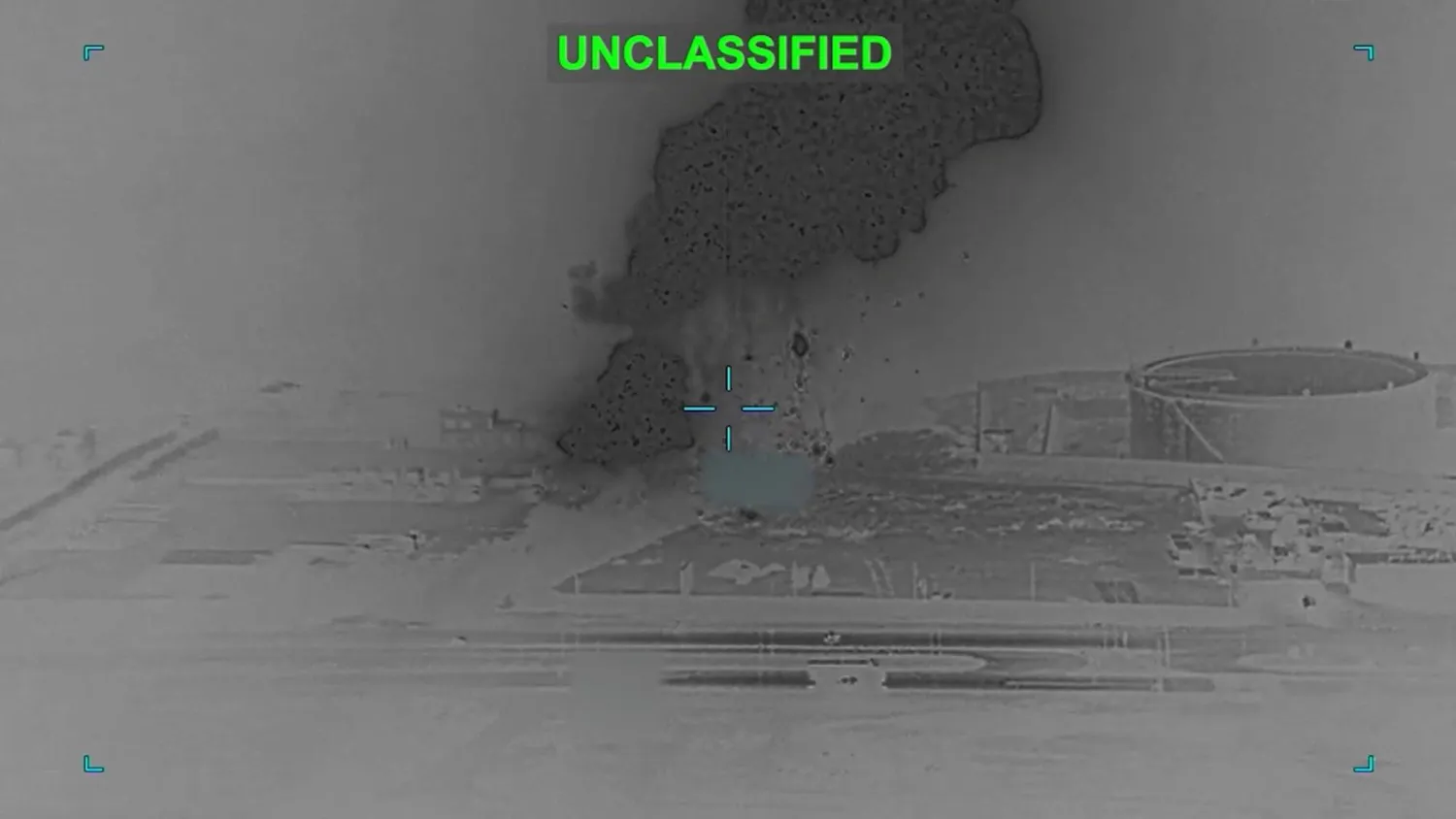

US Strikes Bridges and Collapses a Tower as its Iran Campaign Expands

Smoke rises following a strike at an unknown location during what the US military says is its latest wave of strikes on Iran. US Central Command/Handout via REUTERS
TT

US Strikes Bridges and Collapses a Tower as its Iran Campaign Expands

Smoke rises following a strike at an unknown location during what the US military says is its latest wave of strikes on Iran. US Central Command/Handout via REUTERS

The United States expanded its airstrike campaign against Iran early Friday by hitting more bridges and collapsing a tower at a key Iranian port, part of US President Donald Trump’s threats to start striking infrastructure to pressure Tehran to ease its chokehold on the Strait of Hormuz.

Iran launched new missile attacks several countries in the Middle East, including Qatar, a key mediator in the war.

The interim ceasefire agreed to last month has collapsed, and the region has endured days of back-and-forth attacks by the US and Iran as they battle for control of the strait. Iranian officials say US strikes have killed dozens of people and wounded hundreds of others, with new casualties reported in Friday’s strikes.

When the US and Israel launched the war on Iran on Feb. 28, Tehran effectively closed the strait to shipping traffic, a move that sent the price of oil soaring and gave Iran major leverage in negotiations.

Speaking in a primetime address to the American public, Trump insisted the war was going well.

“We are likewise winning big in Iran, and you will see the fruits of that labor very, very shortly,” Trump said.

The US airstrikes hit bridges overnight into Friday in Iran’s southern Hormozgan province, killing at least seven people, Iranian state television reported. The attacks hit Bandar Khamir, a city on Iran’s coast on the Strait of Hormuz.

The highway and railway bridge strikes appeared aimed at cutting off Bandar Abbas, Iran’s main port, from roads leading into Iran’s central region onward to Tehran, the capital.

While other routes still are open, the US strikes could expand further, potentially disrupting both the movement of military materiel and goods needed for Iran’s 90 million people.

The US military’s Central Command said it hit dozens of targets in its latest airstrikes, which concluded at dawn Friday, the sixth night in a row of American attacks.

The strikes also collapsed a tower at Iran’s Chabahar port on the Gulf of Oman, a key trade route for landlocked, neighboring Afghanistan, the state-run IRNA news agency reported.

US Defense Secretary Pete Hegseth shared the image of the surveillance tower collapsing, part of his effort to assert American control over the strait.

That image had circulated social media via activists prior to Hegseth sharing it.

Chabahar port, which Iran had been running with support from India, has been a repeated target of American airstrikes. Iranian state media acknowledged a third round of strikes on the facility without immediately acknowledging the tower’s collapse.

According to The Associated Press, Iran described the tower as overseeing commercial traffic into the port. However, the Revolutionary Guard also operates at ports across the country.

On Friday, Qatar twice warned the public to take shelter as a barrage of Iranian missiles targeted the nation. People heard explosions overhead as air defenses fired to intercept the missiles. Qatar’s Interior Ministry said falling debris wounded a child.

Qatar, along with Pakistan, is a key mediator in trying to reach an end to the Iran war. But talks have broken down over Iran’s chokehold on the Strait of Hormuz.

Iran also targeted Bahrain and Kuwait early Friday. Jordan's military said it intercepted three incoming missiles Friday morning launched by Iran.

Explosions also could be heard Friday morning in Irbil and Sulaymaniyah in northern Iraq’s semiautonomous Kurdish region as air defenses targeted incoming fire. There was no immediate word on any damage.


US House Republicans Push Forward on Trump Funding Plan for Iran War, Election Overhaul

 House Budget Committee Chairman Jodey Arrington, R-Texas, right, joined at left by Rep. Brendan Boyle, D-Pa., the ranking member, speaks during a markup on the Fiscal Year 2027 spending plan, at the Capitol in Washington, Thursday, July 16, 2026. (AP)
House Budget Committee Chairman Jodey Arrington, R-Texas, right, joined at left by Rep. Brendan Boyle, D-Pa., the ranking member, speaks during a markup on the Fiscal Year 2027 spending plan, at the Capitol in Washington, Thursday, July 16, 2026. (AP)
TT

US House Republicans Push Forward on Trump Funding Plan for Iran War, Election Overhaul

 House Budget Committee Chairman Jodey Arrington, R-Texas, right, joined at left by Rep. Brendan Boyle, D-Pa., the ranking member, speaks during a markup on the Fiscal Year 2027 spending plan, at the Capitol in Washington, Thursday, July 16, 2026. (AP)
House Budget Committee Chairman Jodey Arrington, R-Texas, right, joined at left by Rep. Brendan Boyle, D-Pa., the ranking member, speaks during a markup on the Fiscal Year 2027 spending plan, at the Capitol in Washington, Thursday, July 16, 2026. (AP)

Republicans in the US Congress forged ahead on Thursday with a $95 billion budget plan to meet President Donald Trump's demands for new defense funding for the Iran war, farm assistance and a sweeping overhaul of voting requirements ahead of the November midterm elections.

A Republican-controlled budget panel in the US House of Representatives approved the resolution on Thursday, clearing it for a full House vote as early as next week.

If passed, it would pave the way for a special budget reconciliation bill intended to clear the Senate with a simple majority rather than the 60 votes needed for most legislation in that chamber.

That could enable Republicans, who hold 53 of ‌the Senate's 100 seats, ‌to bypass Democratic opposition and advance legislation directing $60 billion for defense, $13 billion for ‌intelligence, $12 ⁠billion for agriculture, ⁠and $10 billion to enact Trump’s signature voter ID bill, the SAVE America Act, over the next decade.

But it was too early to say whether a House reconciliation bill would qualify under strict Senate rules or even garner a simple majority.

"We're not going to get any help from our Democrat colleagues to do what I believe are ... critical things," budget committee chair Jodey Arrington, a Texas Republican, told his fellow panel members, who approved the resolution for full House consideration in a 20-14 party-line vote.

Democrats criticized the measure for not addressing soaring prices for gasoline, food and other products ⁠that voters say is their top issue.

"The American people know that this is ‌a failed presidency, and this has been a failed Republican majority," said ‌Representative Brendan Boyle, the committee's top Democrat.

House Republican leaders hope to pass the blueprint as early as next week. But it ‌was not clear that the chamber's narrow Republican majority could advance the measure.

Earlier on Thursday, the House ‌was unable to pass a veterans benefits bill because of opposition from Republican hardliners.

In the Senate, the blueprint faces likely opposition from defense hawks who want more Pentagon spending, deficit hawks who want spending cuts to pay for the outlays and others who fear that Trump's partisan voter ID bill could hamper efforts to win the November midterm elections.

The SAVE America Act, ‌which Trump calls his No. 1 legislative priority, lacks the votes to pass the Senate as a standalone bill, given vehement opposition from Democrats who say it ⁠would disenfranchise millions of ⁠Americans.

Republicans intend to use reconciliation to offer states grant money as an incentive to require voters to show photo ID at polling places and proof of citizenship to register to vote, and to turn over state voter rolls to the Department of Homeland Security.

Republicans defeated 14 Democratic amendments to advance party priorities including reinstating healthcare, food assistance, educational funding cut by previous bills, curbing Trump's immigration crackdown, revoking Trump tariffs and eliminating spending on the Iran war.

The defense segment is intended to help fund the Iran war, replenish US military weapons stockpiles depleted by the Middle East conflict and boost military readiness, according to Republican lawmakers.

"This budget resolution is a poorly planned, poorly drafted backdoor deal to pay for President Trump's decision to start a war with Iran. It's irresponsible ... and we see it played out every single day on the news," said Democratic Representative Becca Balint of Vermont.

The resolution contains no offsets for the new $95 billion in spending. But Republican committee staff said it would reduce overall spending by capping discretionary spending. The resolution would authorize spending legislation to help US farmers facing higher fuel and fertilizer costs from the war.


Israel’s Parliament Dissolves Ahead of Oct. 27 Elections

 Members of the Knesset attend a session of the Israeli Parliament in Jerusalem on July 16, 2026, before the start of the election recess ahead of the October 27 general election. (AFP)
Members of the Knesset attend a session of the Israeli Parliament in Jerusalem on July 16, 2026, before the start of the election recess ahead of the October 27 general election. (AFP)
TT

Israel’s Parliament Dissolves Ahead of Oct. 27 Elections

 Members of the Knesset attend a session of the Israeli Parliament in Jerusalem on July 16, 2026, before the start of the election recess ahead of the October 27 general election. (AFP)
Members of the Knesset attend a session of the Israeli Parliament in Jerusalem on July 16, 2026, before the start of the election recess ahead of the October 27 general election. (AFP)

Israel’s parliament dissolved early Friday after passing a marathon of bills in the last moments of Prime Minister Benjamin Netanyahu’s governing coalition.

The Knesset, which was scheduled to break for its summer recess on Friday, will not reconvene before the elections scheduled on Oct. 27.

The expected dissolution comes as Netanyahu is struggling to hold onto power ahead of the next elections as Israel grinds toward the third anniversary of the Oct. 7 attack that sparked nearly three years of war.

Israeli polls are showing a groundswell of support for opposition parties, led by former Prime Minister Naftali Bennett and a popular centrist former military chief.

Over the past week, the Knesset passed several controversial laws in marathon sessions as Netanyahu attempted to ram through several of his pet projects.

Earlier this week, the Knesset passed two bills that effectively halt the enlistment of ultra-Orthodox men in the military in an attempt to ensure ultra-Orthodox parties join Netanyahu’s coalition in the next government.

The Knesset also recently passed several bills connected with Netanyahu’s attempts to overhaul the judiciary, including increasing government control over broadcast media and weakening the role of the attorney general.

Attorney General Gali Baharav-Miara has opposed the overhaul, and been a frequent target of Netanyahu and the Israeli right.

“We are completing a four-year term, we passed nine budgets and hundreds of bills, I thank you for the trust you placed in me, through which together we succeeded in maintaining a four-year term,” Knesset Speaker Amir Ohana said as he announced the dissolution.

Completing a full, four-year term is a rare occurrence throughout Israeli history.

The last time Israel’s government fulfilled a full term without breaking for early elections was in 1988. Israel has no term limits, and Netanyahu has served more terms than any other prime minister in Israel’s history, but it is rare even for him to finish a full, four-year term.

Between 2019 and 2022, Israelis went to the polls five times. Israel holds elections on average every 2.4 years, making it second-lowest ranked country in the OECD for periods between elections, a marker of political instability, according to the Israel Democracy Institute.


North Korea Calls Seoul a ‘Puppet’ for Its Role in US Maritime Exercise

 Flight deck crew move a fuel tank from an F-18 fighter jet onboard the USS Theodore Roosevelt as the aircraft carrier participates in Rim of the Pacific (RIMPAC) military exercises in waters south of the Hawaiian Islands, US, July 13, 2026. (Reuters)
Flight deck crew move a fuel tank from an F-18 fighter jet onboard the USS Theodore Roosevelt as the aircraft carrier participates in Rim of the Pacific (RIMPAC) military exercises in waters south of the Hawaiian Islands, US, July 13, 2026. (Reuters)
TT

North Korea Calls Seoul a ‘Puppet’ for Its Role in US Maritime Exercise

 Flight deck crew move a fuel tank from an F-18 fighter jet onboard the USS Theodore Roosevelt as the aircraft carrier participates in Rim of the Pacific (RIMPAC) military exercises in waters south of the Hawaiian Islands, US, July 13, 2026. (Reuters)
Flight deck crew move a fuel tank from an F-18 fighter jet onboard the USS Theodore Roosevelt as the aircraft carrier participates in Rim of the Pacific (RIMPAC) military exercises in waters south of the Hawaiian Islands, US, July 13, 2026. (Reuters)

North Korean ‌state media on Friday called South Korea a "puppet" following its participation in a maritime exercise led by the US, saying Seoul and Washington would need to bear responsibility for any "unpredictable escalation" in the region.

The comments from North Korean state media outlet KCNA came after the Rim of the Pacific Exercise (RIMPAC) in Hawaii last week, which saw the South Korean navy lead the maritime forces for the first time.

The exercise is billed as the world's largest international maritime exercise and is held ‌every two ‌years. Some 30 countries took part this year, ‌including ⁠Japan, Canada and ⁠Australia, according to the RIMPAC website.

The KCNA said that "the South Korean puppet forces took part as a main component" at a time when "military collusion is becoming increasingly overt," referring to the recent strengthening of South Korean-Japanese military cooperation and of South Korea's relationship with NATO.

This marks the first time in about ⁠a year and three months that North Korea ‌has used the term “puppet” ‌to refer to Seoul, following an incident in April 2025 in which ‌a fuel tank and gun pods attached to an ‌air force aircraft detached and fell in a mountainous area in Gangwon Province during a training exercise.

The KCNA also said that RIMPAC was not just a "routine drill against a hypothetical adversary" but rather ‌a war demonstration by the US and its allies targeting countries in the Indo-Pacific.

"All these facts ⁠point to ⁠which forces are truly shaking the foundation of world peace and security and they foreshadow the possibility of unwanted situations occurring on the Korean Peninsula and in the region if not anticipated," it said.

It further criticized a joint Washington-Seoul Marine Corps exercise, stating the joint air drill simulated "deep infiltration into enemy rear areas" from the US Navy's USS Essex.

The criticism comes as North Korea has highlighted its naval modernization drive.

Earlier this month, KCNA reported that leader Kim Jong Un observed the launch of a strategic cruise missile and tests of weapons systems aboard the new 5,000-ton destroyer Kang Kon.
