


Trump Accuses China of 2020 Election Interference, Contradicting US Intel

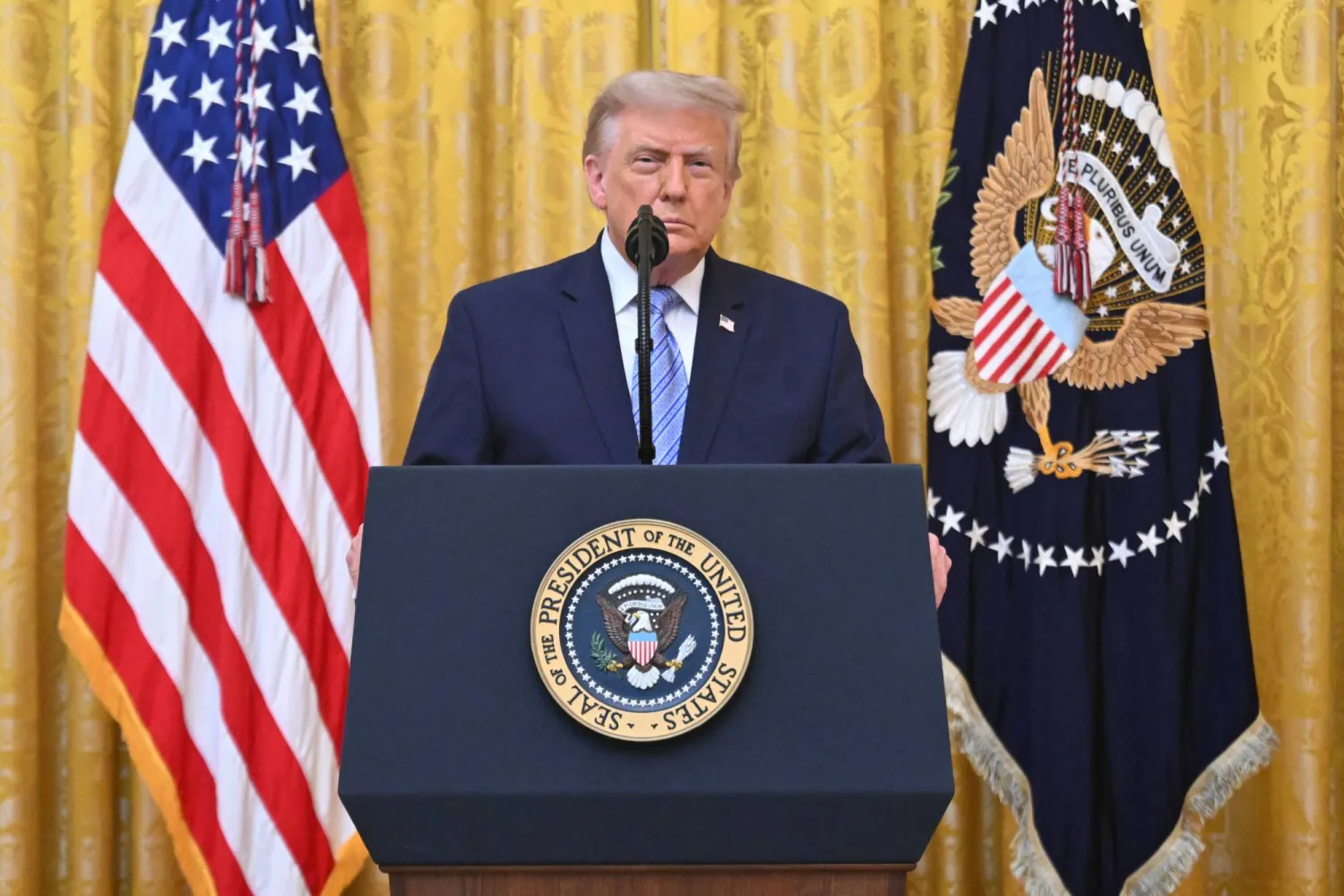
President Donald Trump speaks in the East Room of the White House, Thursday, July 16, 2026, in Washington. (Saul Loeb/Pool via AP)
TT

Trump Accuses China of 2020 Election Interference, Contradicting US Intel

President Donald Trump speaks in the East Room of the White House, Thursday, July 16, 2026, in Washington. (Saul Loeb/Pool via AP)

US President Donald Trump declassified documents on Thursday that he asserted showed Chinese interference in US elections, reviving his long-running attacks on election security despite a US intelligence assessment that found no evidence Beijing affected the 2020 vote that he lost.

The 25-minute prime-time address underscored Trump's effort to make election security a central political issue ahead of November's midterm elections, when his fellow Republicans will be defending their slender congressional majorities.

Trump used his remarks to again press Republicans in Congress to pass legislation imposing new voter identification and citizenship requirements, despite longstanding findings that voter fraud in US elections is rare. The bill has stalled in the Senate amid fierce Democratic opposition.

TRUMP ASSERTS 'SHOCKING VULNERABILITIES'

Trump said the declassified material would reveal "shocking vulnerabilities in our election infrastructure." But many appeared to show the opposite, or were not related to US election infrastructure at all.

The speech came at a challenging political moment for Trump and Republicans, with his approval rating weighed down by the unpopular Iran war and high energy prices.

Trump briefly mentioned the war at the outset, saying the US was "winning big," while listing a series of domestic accomplishments, including tax cuts and his immigration crackdown, before turning to election security.

The president said he was declassifying sensitive information that showed China had illicitly acquired 220 million US voter files, including names, addresses and other data.

He asserted ‌that members of the ‌US intelligence community deliberately suppressed information about the extent of China's activities.

An unclassified 2021 US intelligence assessment found no indications any ‌foreign actor ⁠attempted to or ⁠succeeded in altering "any technical aspect" of the 2020 presidential election vote, including voter registrations, ballots, tabulations or results.

That assessment was conducted under John Ratcliffe, then Trump's director of national intelligence and now his CIA director.

The report also found China had pursued an effort dating to at least 2008 to collect information on US voters, public opinion, political parties, candidates and top government officials, likely aiming to use the material to predict election results.

Two people familiar with the matter said the US voter data obtained by China was not confidential – voter files are routinely purchased by political consultants – and could not be manipulated.

Ahead of Trump's speech, some White House officials expressed concern that disclosing the China information could be misleading, sources told Reuters.

Trump's harsh language about China risked rocking a relationship that has steadied following last year's costly trade war. Trump hopes to meet with Chinese President Xi Jinping in September about improving trade relations.

China's Foreign Ministry did not immediately respond to a request for comment on ⁠the speech. Before the address, Liu Chang, spokesperson for the Chinese embassy in Washington, said: "China has never and will never ‌interfere in the presidential elections of the US."

FAMILIAR CLAIMS GOING BACK YEARS

Trump has spent years raising doubts about ‌electoral outcomes, falsely asserting that his 2020 loss to Democrat Joe Biden was rigged. He has also advanced other false claims, including that mail-in balloting is rife with fraud, voting machines are untrustworthy and ‌non-citizen voting is widespread.

Numerous courts and vote recounts found no evidence of large-scale fraud in the 2020 election.

Nevertheless, Trump's campaign has gained traction with his supporters. A Reuters/Ipsos ‌poll in April found 63% of Republicans believe Trump's claim that the 2020 election was stolen, a share that has remained largely unchanged in recent years despite the absence of evidence.

Trump said on Thursday that his administration had uncovered evidence of more than 275,000 non-citizens registered to vote in just four states, but it was not clear how many had actually voted.

In some previous cases, systems intended to verify citizenship status have mistakenly flagged some naturalized US citizens as non-citizens. Studies have found that non-citizens casting actual ballots is exceedingly uncommon.

POLITICAL HEADWINDS

While Trump cast US elections as highly vulnerable, he did not provide evidence of any actual votes in 2020 that were altered or manipulated.

Two of the three major US television networks and CNN decided not to broadcast the speech on their primary platforms, eschewing a practice typically reserved for major addresses on issues of national import.

Trump again urged Republican lawmakers to advance a bill, the SAVE America Act, that would require photo ID to vote and proof of US citizenship to register and would significantly curtail mail-in voting. Democrats and voting-rights advocates say the legislation is intended to suppress legitimate votes.

The bill has passed the Republican-controlled US House of Representatives several times with a simple majority, but it does not have the 60 votes to overcome a Democratic filibuster in the Republican-controlled Senate.

Some Republican leaders have urged Trump to focus on issues that matter most to Americans, including high living costs, rather than focus on the 2020 vote.

Democrats need to flip only three Republican seats to take a majority in the 435-seat US House. They face an uphill battle to win control of the 100-seat Senate with critical races unfolding in Republican-leaning states.



2 Ships Ablaze in Romanian Black Sea Waters, 7 Sailors Missing

A screengrab from an aerial footage shows San Marino-flagged tanker ship that caught fire in Romanian territorial waters, released October 15, 2026. Romanian Interior Ministry/Handout via REUTERS
TT

2 Ships Ablaze in Romanian Black Sea Waters, 7 Sailors Missing

A screengrab from an aerial footage shows San Marino-flagged tanker ship that caught fire in Romanian territorial waters, released October 15, 2026. Romanian Interior Ministry/Handout via REUTERS

Rescuers were searching for seven missing crew on Thursday from one of two chemical tankers that caught fire overnight inside Romanian territorial waters in the Black Sea, after Russian drones strayed into Romanian airspace, Romanian officials said.

Romanian officials stopped short of explicitly linking the fires onboard the ships to the Russian drones. But the incidents follow drone strikes on at least five other cargo ships near the coasts of Romania and neighboring fellow NATO member Bulgaria over the past 10 days.

At least 23 sailors were lost from those strikes, which unlike the latest incidents took place ⁠just outside NATO's territorial ⁠waters.

The two ships hit overnight were both anchored in the Black Sea near the mouth of the canal leading into the Danube River, a major shipping route used by Ukraine as Russia has attacked Ukraine's own Black Sea ports.

Romania's naval authority said it received an emergency alert from the San Marino-flagged tanker. Seven of its 12 crew were missing and 5 were rescued, Reuters reported.

The interior ministry said it had sent two Black Hawk helicopters to the ⁠search and rescue mission, as well as two ships with medical staff on board.

"At the moment, the rescue cannot be done safely because of very big waves," it said in a statement.

Late on Wednesday, a Comoros-flagged chemical and oil tanker also caught fire. Romanian authorities initially said it was not clear whether it had been attacked. All its crew were safe.

Romania shares a 614-km (381-mile) border with Ukraine, much of it along the Danube. It has reported repeated breaches of its airspace by Russian drones over the past four years.

Both vessels caught fire near the mouth of the Danube River's Sulina Canal leading to the Black Sea, where ships often anchor waiting to pass because of ⁠delays from weather and ⁠congestion.

Increasing attacks on Black Sea shipping connected with the Russia-Ukraine war in recent months have threatened to cause a global food crisis, as both countries are major exporters of grain, as is Romania.

"We're looking at the Black Sea as a global food artery," Romanian Foreign Minister Oana Toiu told a security conference in Warsaw earlier this week.

"It is currently, unfortunately, the deadliest sea when it comes to the number of casualties of sailors in the last months. That means we need to increase our investments in deterrence, defense."

Bulgarian Prime Minister Rumen Radev said EU leaders would discuss on Thursday a proposed moratorium on attacks on civilian ships in the Black Sea.

Russia has been bombing Ukraine's Black Sea ports, forcing Kyiv to rely increasingly on Danube River ports and shipping routes close to the coasts of Bulgaria and Romania. For its part, Ukraine has targeted Russian ships near the mouth of the Don River in the Azov Sea.


Moscow Arrests Swede for 'Illegally' Crossing into Russia and Planning Attacks

People walk near the Kremlin, in Moscow, Russia, 25 September 2026. EPA/MAXIM SHIPENKOV
TT

Moscow Arrests Swede for 'Illegally' Crossing into Russia and Planning Attacks

People walk near the Kremlin, in Moscow, Russia, 25 September 2026. EPA/MAXIM SHIPENKOV

Russia's security services arrested a Swedish man they said fought for Ukraine for "illegally" crossing into Russia and allegedly planning attacks on military infrastructure, Russian media reported Thursday.
Russia's FSB security service, quoted by state news agencies, said an unnamed Swede was arrested in the northwestern Pskov region near the Lithuanian border, adding that "under the pretext of joining the Russian armed forces, he travelled to Russia to carry out acts of sabotage and terrorism on military facilities".


Washington Divided Over Renewed Strikes on Iran

US Secretary of War and CENTCOM commanders favor resuming the war against Iran, according to Axios. (CENTCOM)
TT

Washington Divided Over Renewed Strikes on Iran

US Secretary of War and CENTCOM commanders favor resuming the war against Iran, according to Axios. (CENTCOM)

Divisions have emerged within the Trump administration over whether to resume major military operations against Iran, with Defense Secretary Pete Hegseth and US Central Command (CENTCOM) leadership favoring fresh strikes while most presidential advisers advocate continued economic pressure, Axios reported.

The disagreement comes after President Donald Trump and Israeli Prime Minister Benjamin Netanyahu discussed a possible joint operation against Iranian military and nuclear facilities last week, according to US and Israeli officials and another informed source.

On Wednesday, Netanyahu warned that Iran’s proxies were seeking to launch missiles and carry out attacks.

Speaking to Israeli Army Radio, he said he opposed a preemptive strike on Tehran ahead of the elections, arguing that the timing was inappropriate. He nevertheless vowed to eliminate Hamas and Hezbollah and bring down Iran within two years.

Military Option Remains Open

The discussions suggest military escalation remains possible despite Trump’s insistence that he will not attack Iran before the US midterm elections, scheduled a week after Israel’s October 27 vote.

A US official said Netanyahu appeared eager to resume hostilities, but Trump had offered no firm commitment.

“Go ahead and prepare,” Trump reportedly told Netanyahu, a remark the official said could signal imminent action, a later operation or no attack at all.

A White House official denied that the leaders had discussed resuming the war, reiterating Trump’s position on the midterms.

Netanyahu’s office confirmed regular contacts with Washington but declined to discuss their substance.

According to the sources, Trump initially appeared inclined toward renewed strikes before becoming more hesitant.

Hegseth and CENTCOM leaders remain the strongest advocates of military action, while most advisers argue that sanctions and other economic measures are increasingly effective.

The debate pits military action aimed at disrupting Iran’s capabilities against sustained pressure intended to extract concessions without another round of fighting.

US and Israeli forces remain on alert, although preparations do not indicate that a final decision has been made.

Nuclear Concerns

Israel says intelligence indicates Iran is rebuilding parts of its nuclear program, concerns Netanyahu raised with Trump.

Israeli officials are particularly worried that Tehran could use the Pickaxe Mountain facility for uranium enrichment.

Senior Trump administration officials met for hours at Camp David on October 2 to discuss possible renewed strikes, including operations against Iranian military installations.

Whether the intelligence concerns will prompt military action or strengthen Washington’s negotiating position remains unclear.

The electoral calendar further complicates the calculations. A renewed offensive could provoke hundreds of Iranian ballistic missile launches toward Israel, potentially widening the conflict and disrupting its elections.

Diplomacy Continues

Meanwhile, Qatari mediators are awaiting Tehran’s response to Washington’s latest counterproposal to end the war, which demands nuclear concessions.

A US official said negotiations had not collapsed but were making little progress.

The official said Tehran had expected Trump to retreat under wartime pressure and with the midterms approaching, but the president had demonstrated that those calculations were mistaken.

On Tuesday, Trump again called Iran a “failed state” and said Washington would make a decision concerning Tehran “very soon.”