

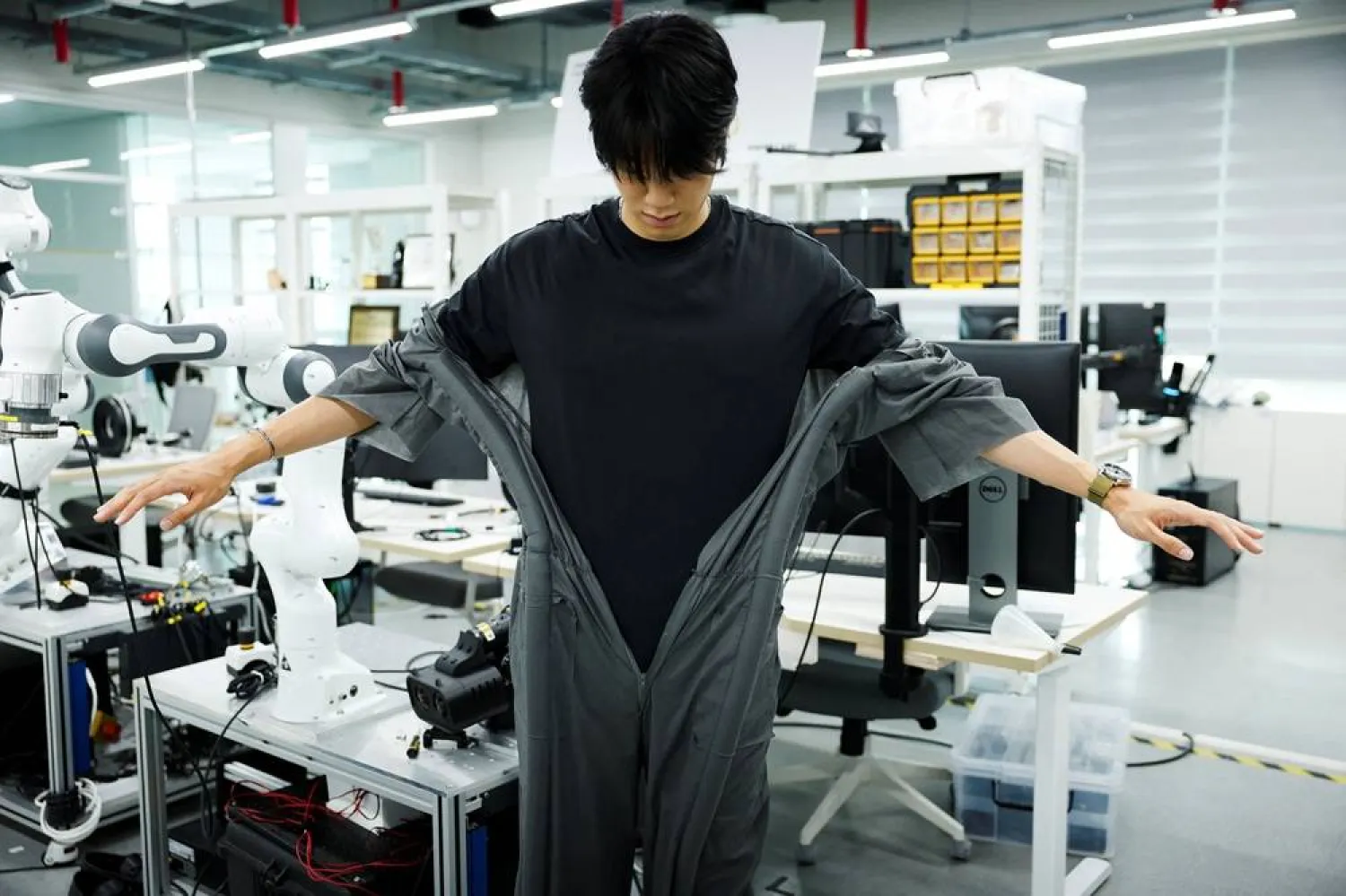

South Korea-US Team Unveils Robotic Technology That Dresses the Wearer

 Hwang Jae Yun, a graduate student of Civil and Environmental Engineering at the Korea Advanced Institute of Science and Technology (KAIST), demonstrates wearing a self-dressing robot at KAIST in Daejeon, South Korea, July 14, 2026. (Reuters)
Hwang Jae Yun, a graduate student of Civil and Environmental Engineering at the Korea Advanced Institute of Science and Technology (KAIST), demonstrates wearing a self-dressing robot at KAIST in Daejeon, South Korea, July 14, 2026. (Reuters)
TT

South Korea-US Team Unveils Robotic Technology That Dresses the Wearer

 Hwang Jae Yun, a graduate student of Civil and Environmental Engineering at the Korea Advanced Institute of Science and Technology (KAIST), demonstrates wearing a self-dressing robot at KAIST in Daejeon, South Korea, July 14, 2026. (Reuters)
Hwang Jae Yun, a graduate student of Civil and Environmental Engineering at the Korea Advanced Institute of Science and Technology (KAIST), demonstrates wearing a self-dressing robot at KAIST in Daejeon, South Korea, July 14, 2026. (Reuters)

A team of South Korean and US researchers has unveiled a robotic technology that allows a person to suit up without using their hands or aid from others, with potential for applications in chip cleanrooms and emergency services.

The technology developed by researchers at South Korea's KAIST and Stanford University uses soft and flexible "vines" powered by air pressure embedded in clothing. When pressurized, the vines glide the fabric up close to the wearer's body like an ivy plant climbing on a structure, even if the person does not remain standing ‌still.

"When I was ‌riding a bicycle, it started to ‌rain ... ⁠and I thought it ⁠would be helpful if a raincoat could be put on automatically (as I ride)," said KAIST postdoctoral researcher Kim Nam Gyun, the lead author of a paper on the technology.

"The vine robot stays close to the person and dresses them by turning the clothing inside out as it moves, allowing it to climb stably along ⁠the shape of the body,” Kim said, adding ‌it takes about 10 seconds to ‌put on a full suit.

A key to the technology's potential is ‌it does not require the wearer to stand motionless and ‌it works without a complex control algorithm, the researchers said.

Inspired by climbing ivy, the robot advances by growing at its tip rather than shifting its whole body, enabling stable movement along curved surfaces, said Ryu Jee-Hwan, ‌a professor of civil and environmental engineering at KAIST.

“It can pass through narrow gaps, grow while ⁠adapting to ⁠the shape of its surrounding environment, and move regardless of whether the surface is slippery, sticky, or sloped,” he said.

Beyond immediate applications for helping the elderly and disabled, the team sees potential for use where the user needs to suit up and off quickly and without using the hands, including in semiconductor cleanrooms and by emergency workers requiring personal protective equipment.

Ryu said given the explosive growth of AI, there was usually much attention on the software powering systems, but the team's self-dressing robot was an example of how mechanical engineering could complement software.

The study was published in IEEE Robotics and Automation Letters, a peer-reviewed journal.


China's Xi Calls for Step Up of Global Effort in AI, as US Curbs Squeeze China’s Tech Access

 Chinese President Xi Jinping speaks at the opening ceremony for the World AI Conference in Shanghai, China, July 17, 2026. (Reuters)
Chinese President Xi Jinping speaks at the opening ceremony for the World AI Conference in Shanghai, China, July 17, 2026. (Reuters)
TT

China's Xi Calls for Step Up of Global Effort in AI, as US Curbs Squeeze China’s Tech Access

 Chinese President Xi Jinping speaks at the opening ceremony for the World AI Conference in Shanghai, China, July 17, 2026. (Reuters)
Chinese President Xi Jinping speaks at the opening ceremony for the World AI Conference in Shanghai, China, July 17, 2026. (Reuters)

Development and governance of artificial intelligence should be a global effort, Chinese President Xi Jinping said Friday, while reiterating China’s objections to what he called the “overstretching” of national security concerns.

Speaking at a conference in Shanghai, Xi said AI should not be dominated by any single nation.

American-led restrictions have blocked China from accessing some of the world's most advanced technologies, spurring China's efforts to build its own know-how and intensifying the tech race between the world’s two biggest economies.

“The development of artificial intelligence should not be a solo performance by any single country but rather a symphony of global cooperation,” Xi said at China's annual World Artificial Intelligence Conference in Shanghai. Others attending included the leaders of Kazakhstan, Cambodia and Thailand and UN Secretary-General António Guterres.

“We should together oppose the practice of overstretching the concept of national security in the field of artificial intelligence, and of placing one’s own security above that of other countries,” he said, repeating a longstanding Chinese complaint.

Over the next five years, he said China will provide 5,000 training opportunities on artificial intelligence to developing countries.

China will expand AI cooperation with the Association of Southeast Asian Nations, the League of Arab States, the African Union, the Community of Latin American and Caribbean States, the Shanghai Cooperation Organization and the BRICS countries, Xi said.

He promised to provide access for 30 countries to a Chinese-developed AI meteorological system that provides early warning systems.

A day earlier, 29 countries including Pakistan, Russia and Kazakhstan signed an agreement with China to establish a World Artificial Intelligence Cooperation Organization. State media described it as an intergovernmental organization headquartered in Shanghai promoting global AI governance.

More than 1,100 companies and 1,400 guests are participating in the annual AI conference this year, state media said.

During the conference, tech giant Huawei will be showcasing its powerful AI computing system, the Atlas 950 SuperPoD,.

Some technology analysts now believe China has become an innovator in AI and is no longer just catching up with the US. China’s five-year plan until 2030 has prioritized progress in frontiers of science and technology including AI.

China’s open-source AI models, like DeepSeek, have been seen as appealing and often times more affordable alternatives globally to US AI models, which are largely closed-source, and especially across the developing world.


Fujitsu and Leading Japanese Robotics Companies to Use Nvidia Technology in 'Physical AI'

From left, Nvidia CEO Jensen Huang, Fujitsu CEO Takahito Tokita, Fanuc CEO Kenji Yamaguchi, Yaskawa CEO Masahiro Ogawa and Kawasaki Heavy CEO Yasuhiko Hashimoto pose for the media at an event to announce a new initiative in Tokyo, Thursday, July 16, 2026. (AP Photo/Yuri Kageyama)
TT

Fujitsu and Leading Japanese Robotics Companies to Use Nvidia Technology in 'Physical AI'

From left, Nvidia CEO Jensen Huang, Fujitsu CEO Takahito Tokita, Fanuc CEO Kenji Yamaguchi, Yaskawa CEO Masahiro Ogawa and Kawasaki Heavy CEO Yasuhiko Hashimoto pose for the media at an event to announce a new initiative in Tokyo, Thursday, July 16, 2026. (AP Photo/Yuri Kageyama)

Japanese communications company Fujitsu is leading a major push in artificial intelligence using Nvidia’s technology, bringing together what it said was the best in Japan’s manufacturing prowess in robotics with AI.

The technology area known as “physical AI” refers to smart, futuristic robots that can think on their own, not just follow programmed directions, to work safely alongside people in factories, homes and hospitals.

The initiative was announced in Tokyo on Thursday by Nvidia Corp. Chief Executive Jensen Huang and Fujitsu Chief Executive Takahito Tokita, along with the CEOs of Japan’s top makers of industrial robots, Fanuc Corp., Yaskawa Electric Corp. and Kawasaki Heavy Industries.

The latest announcement comes on top of a deal announced by Nvidia and Fujitsu last year.

The executives expressed hopes that the robots can address the nation’s acute labor shortage.

Japan is among the most rapidly aging societies in the developed world and the smart robots could help take care of the elderly living alone, The Associated Press quoted them as saying.

Huang said physical AI was a good fit for Japan because of the country's reputation for manufacturing quality because robots that move independently could potentially be dangerous.

“Japan’s excellence is a philosophy, a way of life. ‘Made in Japan’ means the highest quality, the highest precision. Japan sets the standard for the state-of-the-art in modern manufacturing,” he said.

Huang listed Japan’s prized concepts in fine manufacturing such as “kaizen,” which means “continuous improvement.”

The companies did not give a specific time frame for the arrival of such robots in daily life. They stressed efforts were underway with what they called the first phase of the collaboration coming later this year.

There has been no decision on setting up a joint venture, although that could come later, they said.

Japan has acknowledged it has fallen behind some nations, including China and the US, in AI, and has been eager to play catch-up.

The government of Prime Minister Sanae Takaichi recently announced a plan to drum up more than 370 trillion yen ($2.3 trillion) in public and private investment in various technology fields by 2040, including physical AI, semiconductors and data centers.

Silicon Valley-based Nvidia, which offers an open-source technology, has been aggressive in forging various ties in Japan, including with leading banks, automaker Toyota Motor Corp., video game maker Sega and national research institute Riken.


EU Accepts Action Plan by Elon Musk’s X to Become More Transparent

Teens pose for a photo while holding smartphones in front of the X logo. (Reuters)
TT

EU Accepts Action Plan by Elon Musk’s X to Become More Transparent

Teens pose for a photo while holding smartphones in front of the X logo. (Reuters)

‌The European Union, which fined Elon Musk's social media network X €120 million ($137.2 million) last year, said on Wednesday it had accepted an action plan by X to comply ‌with transparency ‌rules under ‌the ⁠EU's Digital Services Act.

"The ⁠European Commission has accepted X's action plan to comply with transparency obligations and researchers' access to data ⁠under the Digital ‌Services ‌Act," it said in ‌a statement.

"The approved ‌measures represent an important step in enabling researchers, civil society and the public ‌in general to gain more transparency into ⁠X's ⁠systems, in particular to monitor X's systemic risks and to assess the platform's broader impact on its users and European society as a whole," it added.
