


EU Plans Measures to Help EU Banks Build Scale and Compete with US Rivals

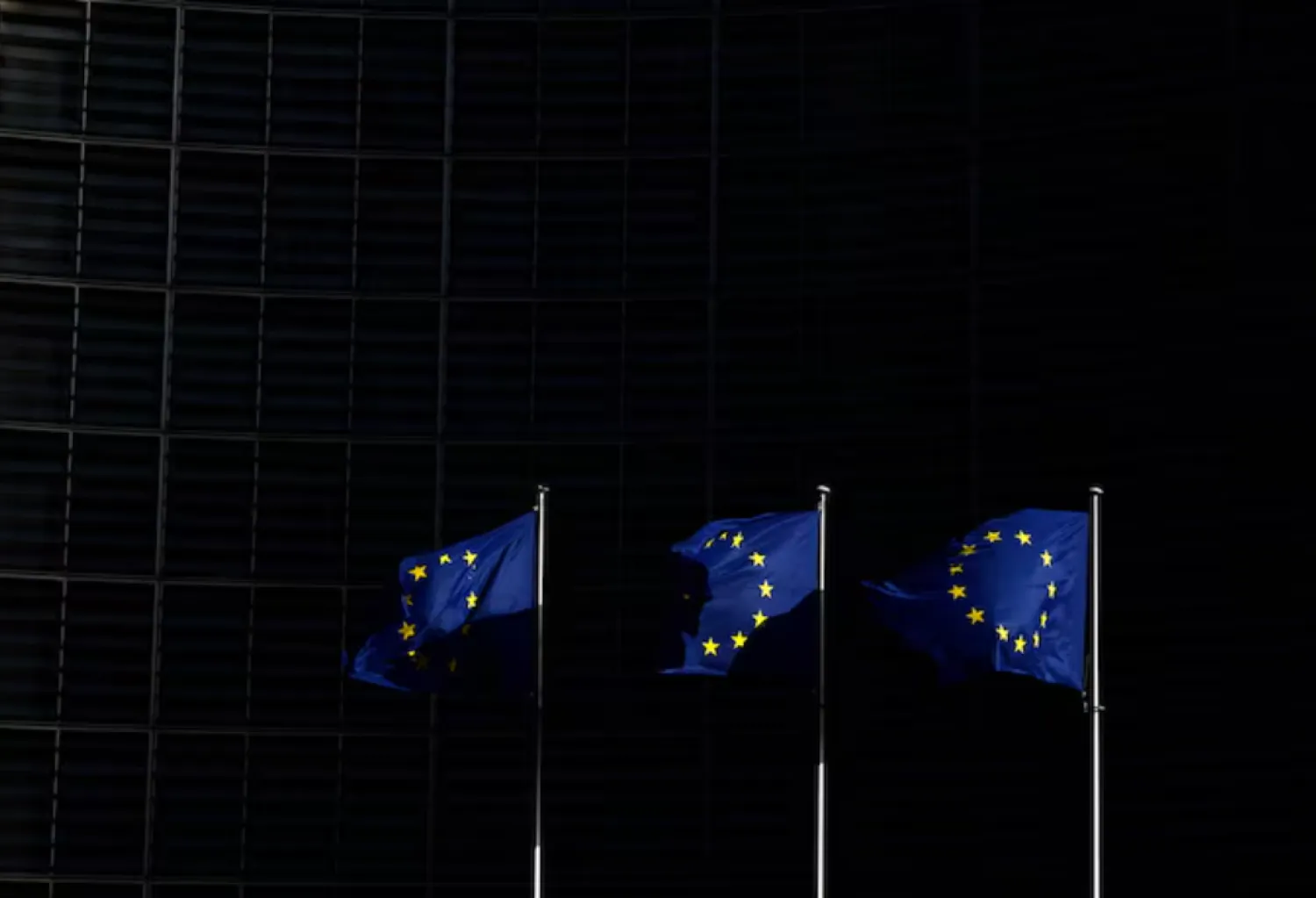
European Union flags flutter outside the European Commission headquarters in Brussels, Belgium Februrary 26, 2026. REUTERS/Yves Herman/File Photo
TT

EU Plans Measures to Help EU Banks Build Scale and Compete with US Rivals

European Union flags flutter outside the European Commission headquarters in Brussels, Belgium Februrary 26, 2026. REUTERS/Yves Herman/File Photo

The European Commission aims to limit political interference in European Union banking mergers and remove obstacles to cross-border banking within the bloc to allow EU banks to compete more effectively against larger US rivals.

An EU executive report released on Friday says internal barriers are preventing EU banks from expanding, leaving them at a disadvantage to US lenders that have benefited from economies of scale in a more integrated US market. EU mergers remain largely within national borders.

"This leads to an outcome where many banking groups in the EU are large relative to the size of their home economy, but not relative to the size of the EU or the banking union economy or international competitors," the report said.

Unjustified national interventions in cross-border bank mergers were preventing banks from acquiring scale at the EU level to reach a critical size, it said. The criticism comes after Germany rejected in June an offer from Italy's UniCredit to take over Commerzbank. UniCredit began its pursuit of Commerzbank back in September 2024, but has faced strong opposition - highlighting how hard it is to pull off cross-border banking deals in Europe.

While Germany officially cited the price offered by the Italian bank as the reason for its rejection, the government has also made clear that Commerzbank is a key lender to German companies and should remain under German ownership.

"It is a mistake from our point of view. If it's okay by the supervisor and the competition authority, cross-border mergers are good things," a senior EU official said, adding that US banks were outcompeting European peers across many business lines in Europe.

"The main driver of competitiveness is not the rulebook ... it's the absence of scale," the official said.

The EU executive, the report said, will propose a range of measures in the first quarter of 2027.

These include plans to crack down on EU members that breach EU rules limiting the circumstances under which they can intervene in proposed mergers.

Other proposals would allow cross-border banking groups to meet capital and liquidity requirements more at the parent level, rather than the current system with additional requirements for subsidiaries. Removing such constraints could release €230 billion ($263.1 billion) of liquid assets, the report said.

It will also replace its proposal from a decade ago to create a European deposit insurance scheme with a new plan to simply deposit insurance measures in the bloc.

The banking industry gave the report a mixed reception. French banking lobby FBF described the report as containing "several positive orientations" but said concrete measures on key issues were required, including better regulatory coordination and limits on country-specific rules. Christian Sewing, Deutsche Bank CEO and president of the Association of German Banks, urged swift action, calling for adjustments to the lower limit on capital requirements known as the output floor, relief for trade finance and improvements on software investments, as well as urging a review of financial stability buffers.



Pentagon Inks Tomahawk Deal Amid Reports of Missile Shortfall

A visitor walks past Raytheon stand at the 53rd International Paris Air Show at Le Bourget Airport near Paris, France June 21, 2019. (Reuters)
TT

Pentagon Inks Tomahawk Deal Amid Reports of Missile Shortfall

A visitor walks past Raytheon stand at the 53rd International Paris Air Show at Le Bourget Airport near Paris, France June 21, 2019. (Reuters)

The Pentagon announced a $22.9 billion contract with Raytheon on Monday for Tomahawk missiles amid reports of a shortfall due to the war with Iran.

Acting US Navy Secretary Hung Cao said the contract will "accelerate Tomahawk missile delivery to our warfighters at unprecedented speed."

"Guaranteeing our naval and joint forces have the lethal firepower they need to deter aggression and protect the homeland is paramount," Cao said in a statement. "The Department is utilizing every available tool to meet the demands of our current operations."

An analysis by the Center for Strategic and International Studies (CSIS) think tank released last month found that US stocks of Patriot and THAAD air defense missiles have been slashed by the conflict with Iran.

Before it began in late February, the United States had more than 2,300 Patriot and more than 450 THAAD interceptors -- figures that CSIS estimated have been roughly halved or more in the subsequent months of war.

The Washington Post reported this month that President Donald Trump had demanded answers from Pentagon chief Pete Hegseth about munitions shortages at a recent cabinet meeting.

Trump and Hegseth both later denied that the United States was faced with dwindling missile stocks.

Tomahawk missiles are mainly launched from submarines and warships and can travel more than 1,600 kilometers (1,000 miles).


UN Laments ‘Unacceptable’ Toll of 350 Aid Workers Killed in 2025

UN Under-Secretary-General for Humanitarian Affairs and Emergency Relief Coordinator Tom Fletcher briefs the media about the humanitarian crisis in the Gaza Strip during a press conference at the European headquarters of the United Nations (UNOG), Geneva, Switzerland, Aug. 22, 2025. (EPA)
TT

UN Laments ‘Unacceptable’ Toll of 350 Aid Workers Killed in 2025

UN Under-Secretary-General for Humanitarian Affairs and Emergency Relief Coordinator Tom Fletcher briefs the media about the humanitarian crisis in the Gaza Strip during a press conference at the European headquarters of the United Nations (UNOG), Geneva, Switzerland, Aug. 22, 2025. (EPA)

The number of aid workers killed worldwide in 2025 reached 350, with the most fatalities in Gaza and Sudan, the United Nations said Monday, calling attacks on humanitarians "unacceptable."

The death toll, however, was slightly lower than that of 2024, when 377 aid workers were killed.

The UN Office for the Coordination of Humanitarian Affairs (OCHA) cited the figures from the research and advisory group Humanitarian Outcomes in a statement marking World Humanitarian Day.

Some 186 humanitarians were killed in Gaza -- the deadliest place for aid workers for the third year running -- followed by Sudan with 71 killed.

"More than 1,000 aid workers have been killed in just three years and that is utterly unacceptable," Tom Fletcher, under-secretary-general for humanitarian affairs, said in the statement.

"But just calling it out will not protect the next aid worker. States must uphold international humanitarian law and use every tool to protect civilians and our colleagues," he said. "And for those who break the rules, there must be real consequences."

Since the start of 2026, 82 more aid workers have been killed, 97 injured and 39 abducted worldwide.

OCHA voiced particular concern over the proliferation of armed drones "that are putting lethal power into ever more hands and sending more explosive weapons into towns and cities."

In Sudan, armed drones caused 80 percent of civilian deaths in the first four months of 2026, hitting markets and health facilities, the statement said, also noting casualties from drone attacks in the Russia-Ukraine war.

"Weaponized drones have become the new face of an old danger: the deliberate or reckless destruction of civilian life," Fletcher said.


Reports: UK PM Exchanged Messages with Trump Aide Imposter

Prime Minister Andy Burnham speaks with apprentices and staff at the met office during a visit on August 14, 2026 in Exeter, United Kingdom. (Reuters)
TT

Reports: UK PM Exchanged Messages with Trump Aide Imposter

Prime Minister Andy Burnham speaks with apprentices and staff at the met office during a visit on August 14, 2026 in Exeter, United Kingdom. (Reuters)

New British Prime Minister Andy Burnham exchanged messages with someone posing as Susie Wiles, the White House chief of staff, several media outlets reported on Monday.

According to Politico, which broke the story quoting anonymous sources, the British leader sent a "few messages" via an unspecified communication channel to a person he believed to be Wiles before becoming suspicious.

The incident was deemed serious enough for the British embassy in Washington to raise the matter with the White House, according to two sources cited by Politico.

Neither the date nor the content of the exchanges is known.

Burnham succeeded former Labour Party leader Keir Starmer as prime minister on July 20.

"We do not comment on national security matters," a spokesperson for Burnham's Downing Street office said, without denying the exchanges.

Burnham is not the first prominent British politician to fall victim to this type of hoax.

In 2024, the British government released a video of a phone call in which the then foreign minister David Cameron was duped by someone posing as former Ukrainian president Petro Poroshenko.

The Foreign Office explained at the time that it had disclosed the incident to preempt any attempt by the perpetrators to manipulate the footage.