


Egypt’s Greece, Cyprus Partnerships Do Not Hinder Ties With Türkiye

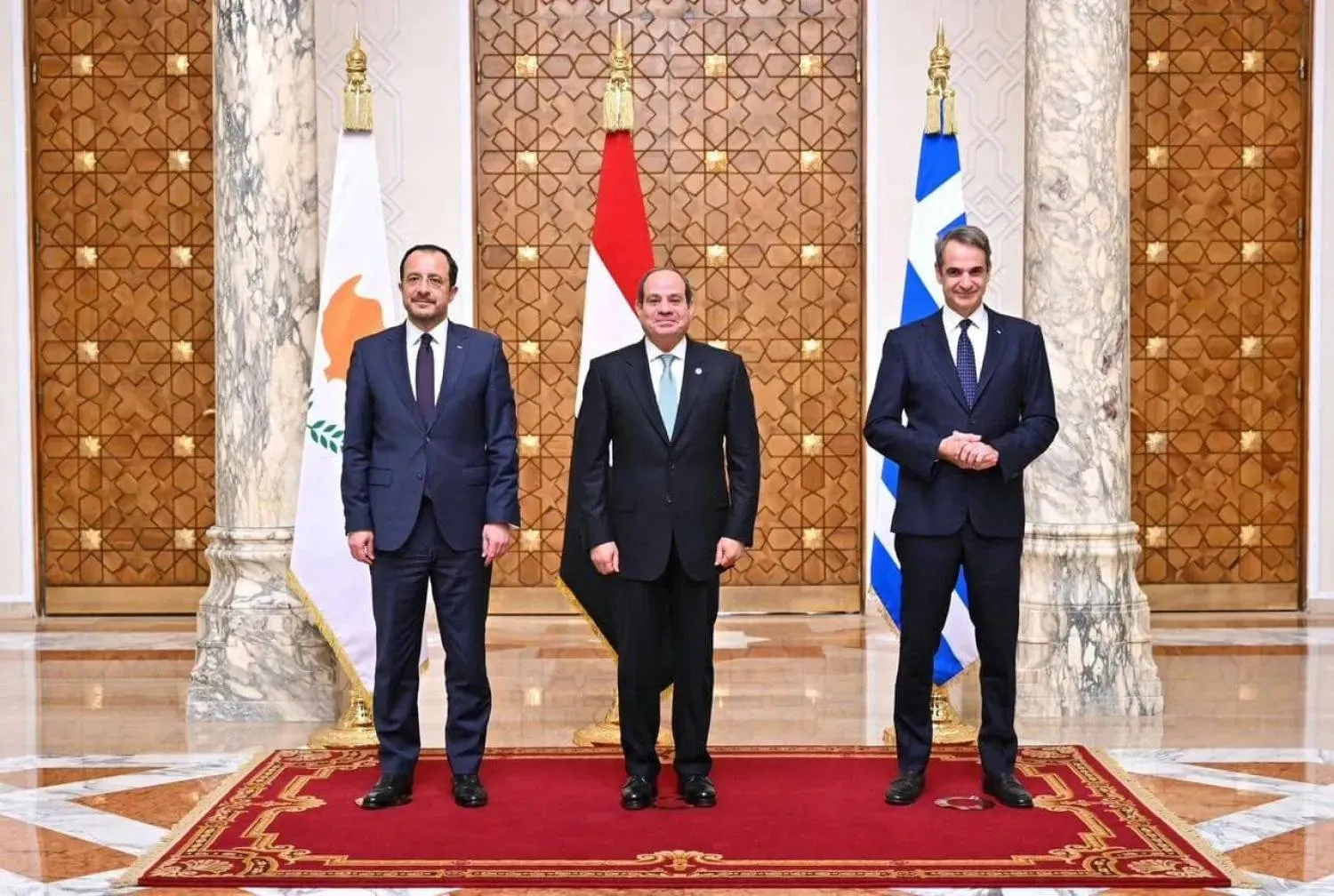
Egyptian President Abdel Fattah al-Sisi stands between Cypriot President Nikos Christodoulides and Greek Prime Minister Kyriakos Mitsotakis (Egyptian Presidency)
TT

Egypt’s Greece, Cyprus Partnerships Do Not Hinder Ties With Türkiye

Egyptian President Abdel Fattah al-Sisi stands between Cypriot President Nikos Christodoulides and Greek Prime Minister Kyriakos Mitsotakis (Egyptian Presidency)

Growing cooperation between Cairo and Ankara, which has expanded into defense and military coordination, is raising questions about its impact on the strategic partnership linking Egypt with Greece and Cyprus since 2014.

The development comes as Türkiye’s relations with Athens and Nicosia remain constrained by long-standing disputes over maritime boundary demarcation and energy issues in the Eastern Mediterranean.

Egyptian experts who spoke to Asharq Al-Awsat acknowledged that balancing Cairo’s regional relationships was no easy task. They stressed, however, that the Egyptian-Turkish rapprochement was not directed against Cyprus or Greece and could also serve their interests.

They said Egypt could play a role in bringing the sides closer together, given its determination to maintain balanced relations with all three countries.

Established partnership

Egypt, Greece and Cyprus have maintained a strategic partnership since the first presidential-level meeting of their trilateral cooperation mechanism in 2014.

At the time, relations between Cairo and Ankara were deeply strained following the fall of Muslim Brotherhood rule after the June 30 uprising. Some analyses suggested that Egypt had turned to partnerships with Cyprus and Greece to balance Türkiye.

Egypt, Cyprus and Greece launched a summit-level trilateral cooperation mechanism, holding its first meeting in Cairo in November 2014.

The three countries have since taken turns hosting their meetings annually, with the 10th round held in Cairo in January 2025.

Earlier this year, Cairo hosted political consultations among the foreign ministers of Egypt, Greece and Cyprus.

Egyptian Foreign Minister Badr Abdelatty highlighted “the special nature of the relations linking Cairo with Athens and Nicosia, which contributed to a convergence of views on establishing the trilateral summit mechanism.”

He described the mechanism as “a model for cooperation and regional integration.”

The latest step in the growing relationship between Egypt and Türkiye was the signing of a letter of intent on defense cooperation during Egyptian Defense Minister Ashraf Salem Zaher's visit to Ankara last Sunday.

It was the first visit of its kind since President Abdel Fattah al-Sisi traveled to Ankara on May 8, 2013, when he was serving as defense minister.

Greek caution

Greek newspaper eKathimerini examined the growing Egyptian-Turkish rapprochement in a report published on July 15.

It said that while the rapprochement did not directly threaten Greek interests so far, it was increasing concerns amid broader regional geopolitical shifts.

Rakha Ahmed Hassan, a member of the Egyptian Council for Foreign Affairs and a former ambassador, said Egypt stressed on all occasions and in its meetings with Türkiye, Greece and Cyprus that there was no way to resolve their disputes except through dialogue and negotiation.

“Egypt seeks to maintain a balance in its relations with the three countries,” Hassan told Asharq Al-Awsat.

“Egypt’s task in achieving this balance is not easy because of the difficulty of the situation itself,” he said.

“Türkiye does not recognize the international law of the high seas concerning the division of maritime boundaries and the economic maritime zone in the Eastern Mediterranean, while Greece and Cyprus insist on its application. Egypt is also a signatory to this 1982 law.”

The main disputes between Türkiye, on one side, and Greece and Cyprus, on the other, center on complex geopolitical and economic issues.

Chief among them is the Cyprus conflict, the oldest of these disputes. It dates back to 1974, when Turkish forces intervened in the northern part of the island following a coup backed by the military council then ruling Greece.

Ankara says its intervention was intended to protect Turkish Cypriots, while Cyprus and Greece consider it an occupation of the northern part of the island.

The disputes also include disagreements over maritime boundary demarcation, airspace, the continental shelf and exclusive economic zones in the Aegean Sea and the Eastern Mediterranean.

These disputes intensified with natural gas discoveries and competition over the exploitation of energy resources in the Eastern Mediterranean.

Egypt as a bridge

Bashir Abdel Fattah, an Egyptian academic and international relations researcher, said Egypt had begun paying greater attention to the Mediterranean dimension of its foreign relations a decade or more ago, focusing on Cyprus and Greece.

“Egypt demarcated its maritime borders with them and entered into security arrangements, regular military exercises and high-level security and strategic coordination,” Abdel Fattah told Asharq Al-Awsat.

“The two countries also play an important role in strengthening Egypt’s relations with the European Union. At the same time, Egypt restored momentum to its relationship with Türkiye after a period of political disagreements.”

Abdel Fattah said there was no contradiction between Egypt’s rapprochement with Türkiye and its close relations with Greece and Cyprus.

“Cairo is keen to diversify its relationships, and this is its sovereign right,” he said.

“Contrary to any concerns, Egypt could serve as a bridge for rapprochement between Türkiye, Greece and Cyprus and help resolve disputes over maritime boundary demarcation and the sharing of Eastern Mediterranean resources.”

Relations between Egypt and Türkiye have grown rapidly since 2023, as ties between the two countries returned to normal and Sisi and Turkish President Recep Tayyip Erdogan exchanged visits.

This was reflected in military cooperation, particularly in training and cooperation in the defense industries.

Amr el-Shobaki, an adviser at the Al-Ahram Center for Political and Strategic Studies, said the Egyptian-Turkish rapprochement, particularly in the military field, could understandably concern Israel.

“But it will never be directed against Greece and Cyprus,” Shobaki said.

“On the contrary, through this rapprochement with Türkiye, Egypt could play a major role in easing tensions between Türkiye, Greece and Cyprus because of its strong and distinguished relations with all three countries.”

Shobaki told Asharq Al-Awsat that it was natural for Greece and Cyprus to monitor developments in the rapprochement between Egypt and Türkiye, given the sensitivity of their position toward Türkiye.

“But they undoubtedly have strong confidence in Egypt because of the strength of their relations with it,” he said.


10 Syria Security Personnel Wounded in Clashes in Sweida

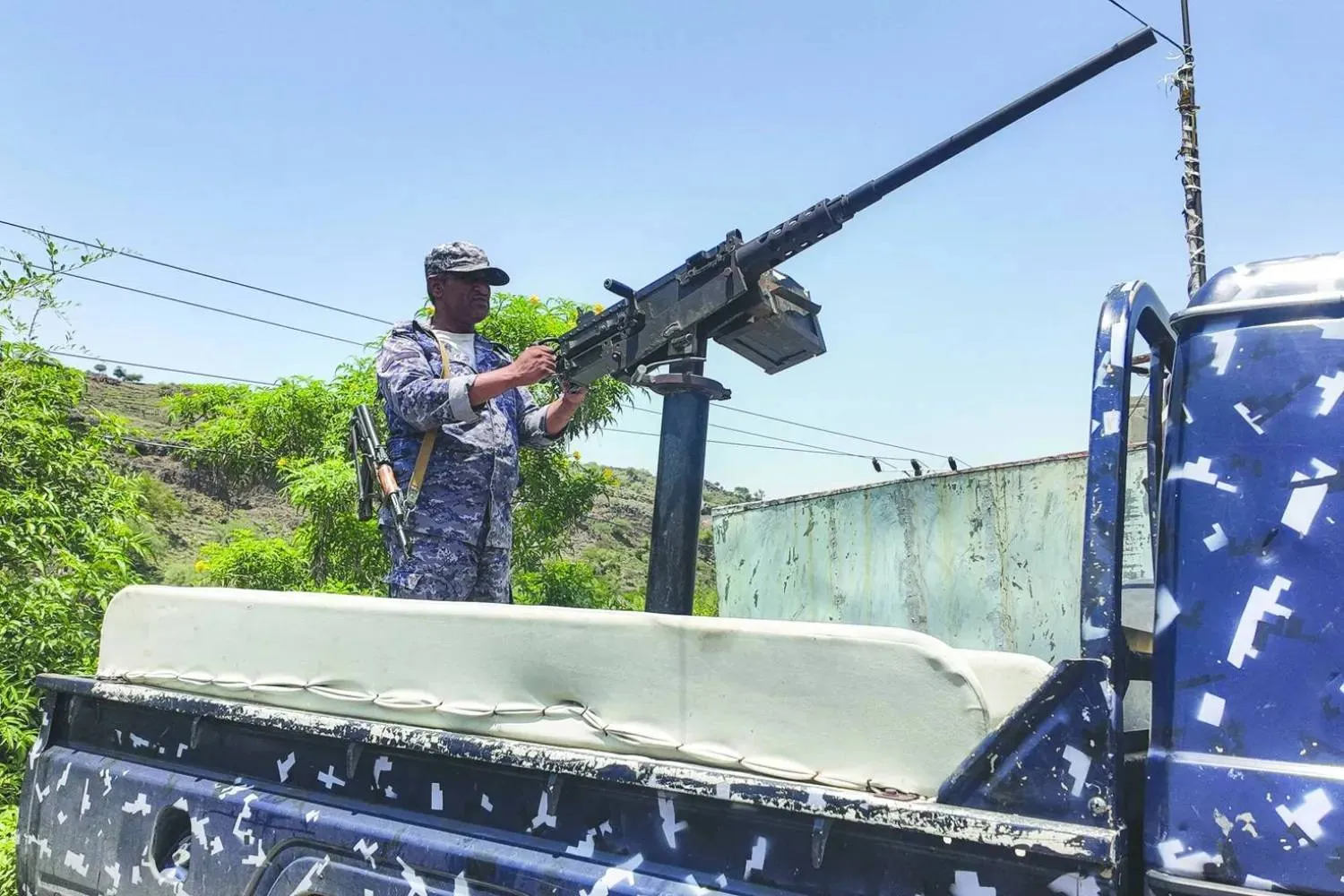
A Syrian army officer puts on his blast suit during a demining operation, by the Syrian Ministry of Defense's military engineering department, to clear land mines in Qarah in the Damascus countryside on August 23, 2026. (AFP)
TT

10 Syria Security Personnel Wounded in Clashes in Sweida

A Syrian army officer puts on his blast suit during a demining operation, by the Syrian Ministry of Defense's military engineering department, to clear land mines in Qarah in the Damascus countryside on August 23, 2026. (AFP)

Clashes with local armed groups in Syria's Druze-majority province of Sweida left 10 government security personnel wounded, state media reported Tuesday.

The unrest, which took place on Monday, came after two civilians were killed in similar clashes west of Sweida city, according to two local security sources.

Syrian state television, citing the Internal Security Command in Sweida province, said the number of wounded personnel had risen to 10 after "outlaw groups" targeted points in the Tal Hadid area and the Walgha axis.

State media had previously reported that four were wounded "while confronting attacks by outlaw groups in the western countryside of Sweida".

Sweida city and other parts of the southern province are under the control of local armed groups and constitute the last areas outside the power of Syria's new authorities, who are seeking to extend their rule across the entire country after toppling longtime ruler Bashar al-Assad in 2024.

Among those groups is the so-called National Guard, which is affiliated with Druze Sheikh Hikmat al-Hijri.

In a statement on Monday night, the group accused government forces of "firing a number of mortar shells and indiscriminately firing 23mm machine guns... with the aim of harming civilians", adding that a child was wounded as a result.

The group said it was "responding to the sources of fire with appropriate means".

Government forces and Druze armed groups had been exchanging fire since Saturday night, the Syrian Observatory for Human Rights said on Sunday.

A Druze security source told AFP on condition of anonymity that a shell launched Sunday from a government-controlled area "targeted the outskirts of the city of Sweida, striking a tractor and killing two people on board, the driver and a woman who was with him".

Tensions have been high in Sweida since clashes between Druze and government-aligned forces last year led to some of the worst communal violence since the fall of Assad.


Lebanon Urges Greece to Help Implement Truce with Israel

Greek President Konstantinos Tasoulas (R) talks next to Lebanese President Joseph Aoun (L) during their meeting at the Presidential Palace in Athens, Greece, 31 August 2026. (EPA)
TT

Lebanon Urges Greece to Help Implement Truce with Israel

Greek President Konstantinos Tasoulas (R) talks next to Lebanese President Joseph Aoun (L) during their meeting at the Presidential Palace in Athens, Greece, 31 August 2026. (EPA)

Lebanese President Joseph Aoun asked Greece on Monday for support to help implement a ceasefire agreement with Israel and end Israeli attacks on his country, hours after Greece and Israel announced a multibillion arms deal.

The June 26 accord, brokered by the United States, says both sides must cease hostilities and allow the Lebanese army to restore control over the entire country.

Beirut wants Israel to withdraw from all territory it has occupied in southern Lebanon. Israel first wants Lebanese group Hezbollah evacuated from the sector.

"Lebanon and the Lebanese people are tired of wars, and from the start of the negotiations with Israel the aim was to put an end to the state of hostility," Aoun told a press conference in Athens alongside Greek President Konstantinos Tassoulas.

"The framework agreement ... cannot be implemented unilaterally. It needs to be implemented on both sides," he insisted.

"We request Greece's assistance as much as possible to help Lebanon."

Lebanon was dragged into the US-Israeli war against Iran in March, when Israel launched a massive bombardment of its neighbor and invaded, while Hezbollah fired missiles at Israeli territory.

Since then, Aoun said, Israeli strikes have killed 4,300 Lebanese, wounded 12,000 and destroyed 60-70 villages.

"Solving the problem by military force will not succeed," he said, insisting on the total withdrawal of Israeli forces from his country.

After a later meeting, Greek Prime Minister Kyriakos Mitsotakis said Greece supported "the sovereignty, independence and unity of Lebanon" and would support "all efforts aimed at de-escalation and mutual comprehension".

On Monday, Greece and Israel announced Athens was buying a $3.5-billion aerial defense system from Israel.


Iraq Sentences Kidnapper of US Journalist to 15 Years in Prison

American freelancer Shelly Kittleson. (Facebook)
TT

Iraq Sentences Kidnapper of US Journalist to 15 Years in Prison

American freelancer Shelly Kittleson. (Facebook)

Iraq's judiciary has sentenced a man to 15 years in prison for the kidnapping of an American journalist who was abducted earlier this year by a powerful Iran-backed group, a judicial source said Monday.

At the height of the Middle East war, on March 31, Kataeb Hezbollah kidnapped journalist Shelly Kittleson in Baghdad, holding her for several days before setting her free just hours before the United States and Iran agreed to a ceasefire.

Iraqi authorities arrested one member of the group at the time.

According to a document shared by local media, a criminal court on Sunday sentenced Amir Rahim Jabbar to 15 years in prison under an "anti-terrorism law... for the crime of kidnapping" Kittleson.

A judicial source verified to AFP the document's authenticity, and a Kataeb Hezbollah source confirmed the ruling against one of its members.

Kittleson, who shared a copy of the ruling on X, said she was "grateful to the Iraqi judiciary".

Kataeb Hezbollah is among several pro-Iran armed groups that intervened in support of Tehran during the Middle East war, claiming attacks on US facilities in Iraq and across the region.

Under mounting US pressure to curb Tehran's influence, the new Iraqi government of Prime Minister Ali al-Zaidi says it is committed to ensuring that pro-Iran armed groups, which Washington designates as terrorist organisations, hand over their weapons to the state.

The issue has fuelled tensions in Iraq, with several groups, including Kataeb Hezbollah, refusing to disarm.

Earlier this month, Kataeb Hezbollah accused Zaidi of engaging in "provocative and irresponsible actions".

Baghdad was once notorious for kidnappings and attempted abductions, but they have decreased as the security situation in Iraq improved in recent years.
