


Mount Olympus, Home of Ancient Greek Gods, is a Candidate for UNESCO World Heritage List

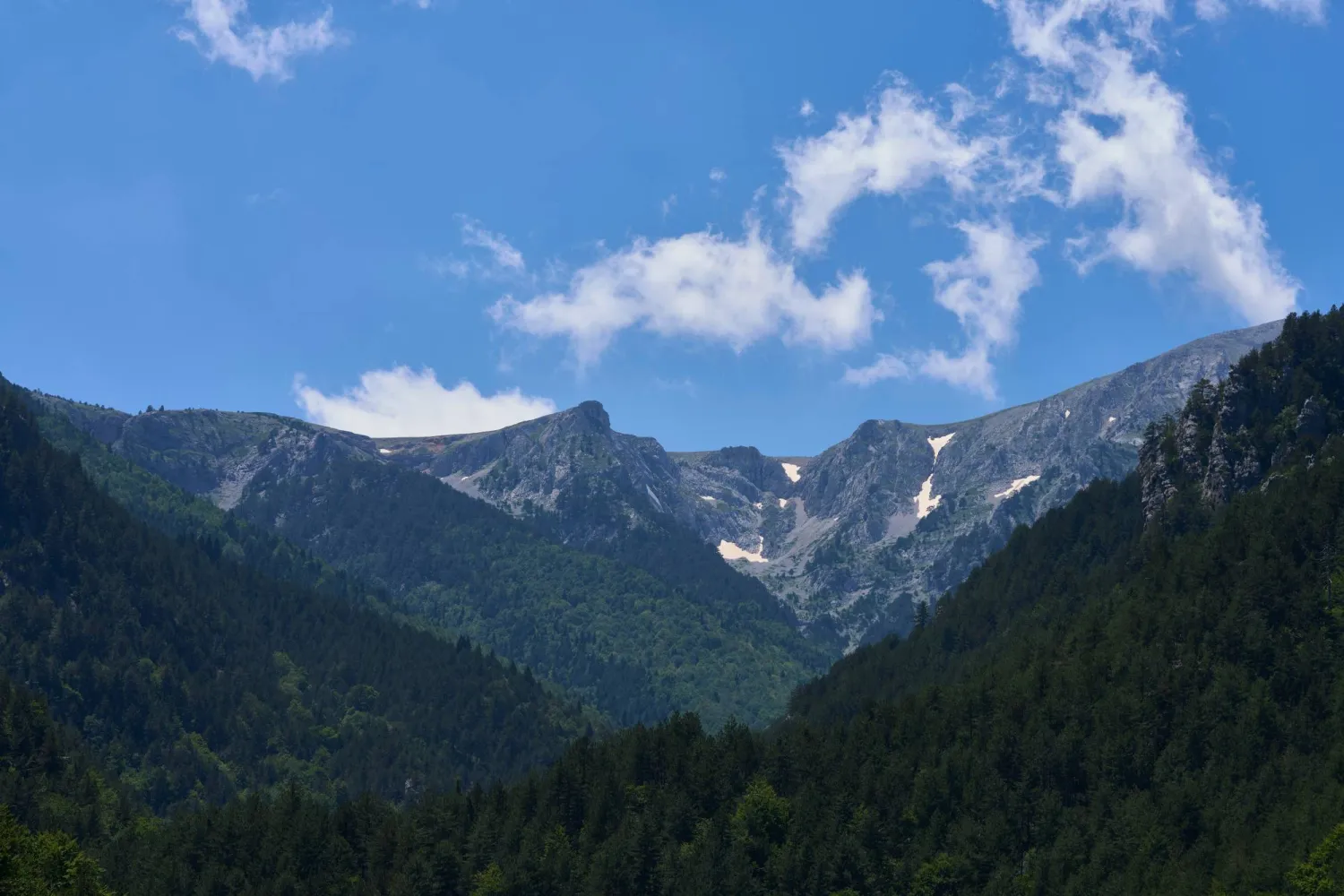
Snow patches remain on the upper slopes of Mount Olympus in northern Greece, Tuesday, July 14, 2026. (AP Photo/Petros Giannakouris)
TT

Mount Olympus, Home of Ancient Greek Gods, is a Candidate for UNESCO World Heritage List

Snow patches remain on the upper slopes of Mount Olympus in northern Greece, Tuesday, July 14, 2026. (AP Photo/Petros Giannakouris)

Snow-capped for much of the year, Mount Olympus, mythological home of ancient Greece’s 12 Olympian gods, has captured the imagination through the millennia. Rising to 2,918 meters (9,573 feet) from a base practically at sea level, the ancient Greeks believed the throne of Zeus, king of the gods, stood on the highest of its craggy, often mist-shrouded peaks.

Now, modern-day Greeks hope their tallest mountain will be inducted into UNESCO’s World Heritage List as a mixed cultural and natural site. The nomination is to be discussed when the World Heritage Committee meets in Busan, South Korea from Sunday through July 29.

“Olympus is our life. It is the place we grew up in,” said Evagelos Geroliolios, mayor of Dion-Olympus, based in Litochoro, the mountain’s main town. “It is the place we see every day, but at the same time, it is also a place which carries with it myth, history, biodiversity, extraordinary beauty and a very great cultural weight.”

Few locations are as central to ancient Greek mythology as Mount Olympus. It was here that Zeus was said to have established his court after overthrowing his father, Cronus, in a 10-year war that ended the reign of the Titans.

Interest in Olympus may receive another boost with the theatrical release this week of Christopher Nolan’s “The Odyssey,” a new adaptation of Homer’s epic, in which the mountain serves as the home of Zeus and the Olympian gods who influence Odysseus’ journey.

On one of Olympus’s lower peaks, excavations have uncovered an open-air sanctuary, with the oldest finds dating to the Hellenistic period, which ran from 323 B.C. to 30 B.C. According to Greece’s original UNESCO nomination, the sanctuary is believed to have been one mentioned by the ancient philosopher and historian Plutarch, who in the 2nd century wrote of processions to one of Olympus’s peaks for animal sacrifices to Zeus.

The mountain retained religious significance into the Christian era. Α chapel on the peak of Prophet Elias, at 2,803 meters, is believed to be the highest altitude chapel in the Christian Orthodox world. The mountain’s Enipeas Gorge holds the remains of a monastery founded in 1542, while a roughly 20-minute walk from there leads to the Holy Cave of St. Dionysios, a chapel built into a cave from where a small spring flows, believed to carry holy water.

The mountain’s slopes, which reach practically to the sea, also host a wealth of flora and fauna, including endemic species. It is this blending of culture, myth, natural beauty and biodiversity that locals hope will see their mountain declared a World Heritage site, The Associated Press reported.

Sunflowers bloom in Kalyvia Varikou, near Litochoro in northern Greece, backdropped by Mount Olympus, Wednesday, July 15, 2026. (AP Photo/Petros Giannakouris)

“It is a place we love. It is a place that many people from all over the world visit to see, to live, to experience. We want to protect it,” Geroliolios said. Its inclusion on UNESCO’s list would be “something very big that goes beyond not just local boundaries, but national boundaries. It is something that concerns the entire world. It is very important.”

Greece began the process to have Mount Olympus recognized as a World Heritage site in 2014, inscribing it on its Tentative List — the mandatory first step in any nomination. The Tentative List is where countries include sites they can then formally nominate over the next five to 10 years.

The nomination process includes a preliminary assessment followed by submission of a full nomination file, which is then evaluated over 14 months by advisory bodies, including the International Council on Monuments and Sites, ICOMOS, and the International Union for Conservation of Nature.

Recommendations by the advisory bodies are then discussed during the World Heritage Committee’s annual meeting, where representatives of 21 countries vote on nominated sites.

Greece's Mount Olympus nomination is far from certain. A draft of the Busan meeting's agenda indicates the committee will refer the nomination back to Greece and request further details.
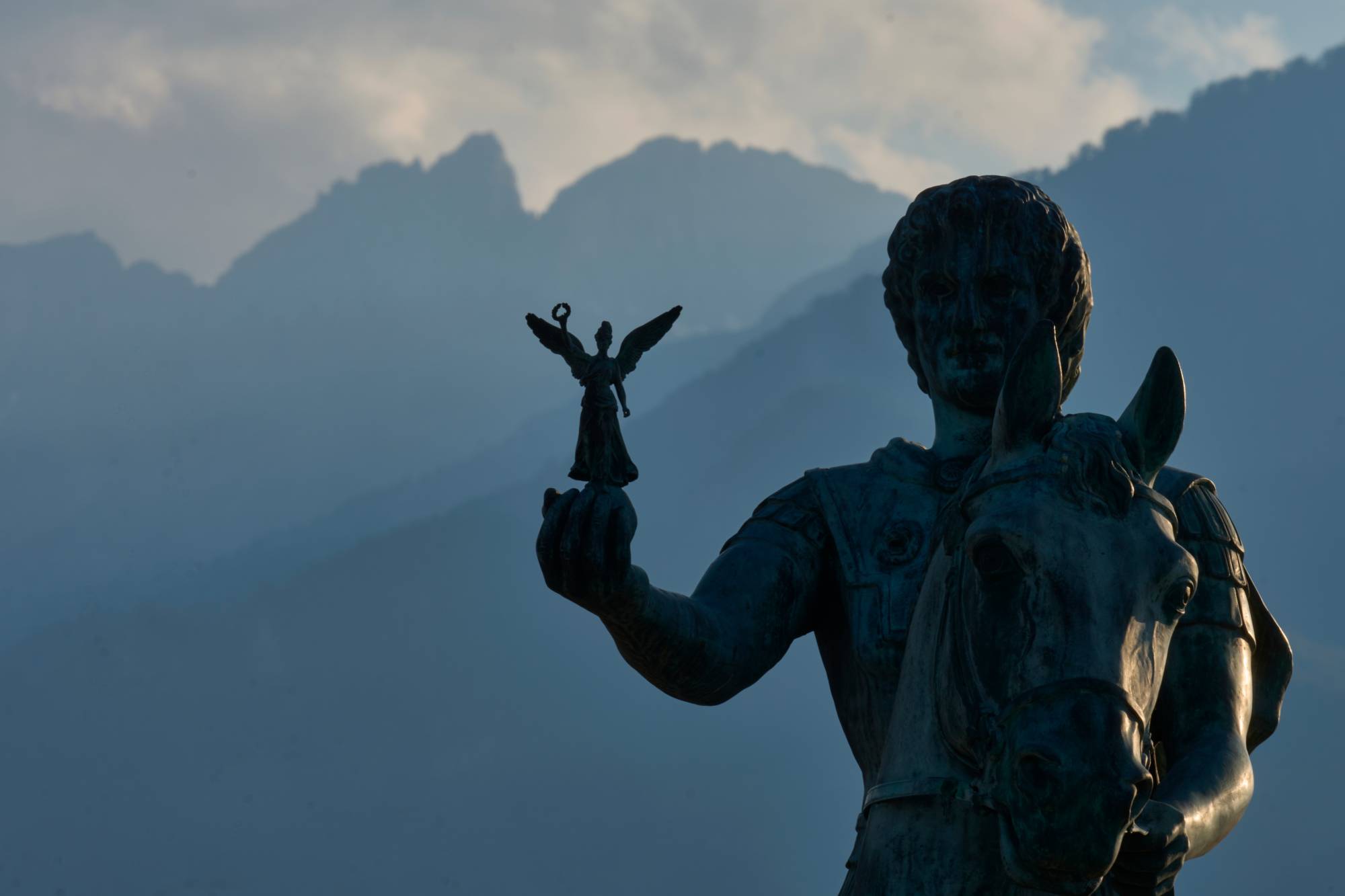
A statue of Alexander the Great holding Nike, the Greek goddess of victory, stands near Litochoro in northern Greece, Tuesday, July 14, 2026, backdropped by Mount Olympus' highest peaks, Mytikas and Stefani. (AP Photo/Petros Giannakouris)

Still, locals hope the mountain’s cultural and natural wonders will secure it a place and will play a role in securing more protection for the mountain.

The need for protection The mayor, Geroliolios, said inclusion on the World Heritage list “places some greater obligations on our part to protect this environment.”

Environmental protection is also foremost in the mind of mountain guide Babis Marinidis, president of the Alpine Club of Litochoro.

Including Olympus on UNESCO’s World Heritage list would likely attract more people to the mountain and the surrounding area, Marinidis said. “How many people can this mountain, this ecosystem, bear?” he asked.

Although much of Olympus was designated a national park decades ago and there are regulations in place, many are openly flouted, with Marinidis saying visitors regularly ignore “no swimming” or “no camping” signs.

The ever-growing number of visitors had led local authorities to consider imposing entrance fees and registering visitor numbers. “I used to be against that,” Marinidis said. “But now with so many people, I believe some limit must be imposed.”


Riyadh to Host Security and History Dialogue Conference in September

File photo of the Saudi flag/AAWSAT
TT

Riyadh to Host Security and History Dialogue Conference in September

File photo of the Saudi flag/AAWSAT

Under the patronage of Minister of Interior Prince Abdulaziz bin Saud bin Naif bin Abdulaziz, the Ministry of Interior will organize the Security and History Dialogue Conference in Riyadh from September 6 to 8, 2026, with the participation of experts, researchers, and academics from Saudi Arabia and abroad.

The conference organizing committee said the event serves as a national platform for exploring the Kingdom’s history through the lens of security and development, aiming to deepen awareness of the Kingdom’s journey, strengthen national identity, and produce documented knowledge for researchers and future generations, SPA reported.

The conference will feature more than 50 dialogue and interactive sessions, with over 160 experts and specialists and more than 30 partner organizations.

Discussions will cover the Saudi state’s history and its security, developmental, economic, social, and cultural dimensions, as well as national identity, international relations, the development of security institutions, and the role of security in supporting investment and quality of life.


From the Louvre to AlUla: How Culture Built a Strategic Bridge Between Riyadh and Paris

Saudi Arabia and France boosted their culture cooperation through nine executive programs signed during President Emmanuel Macron’s visit to the Kingdom in December 2024. (SPA)
TT

From the Louvre to AlUla: How Culture Built a Strategic Bridge Between Riyadh and Paris

Saudi Arabia and France boosted their culture cooperation through nine executive programs signed during President Emmanuel Macron’s visit to the Kingdom in December 2024. (SPA)

When Saudi artifacts were exhibited at the Louvre Museum, the Saudi-French relationship had not yet reached its current breadth. At the time, culture was a window through which the French could discover the Kingdom's history, while Riyadh was testing a new avenue to introduce its heritage beyond its borders.

More than a decade and a half later, the landscape has changed. Culture has become one of the foundational components of the Saudi-French relationship, and AlUla has turned into one of the clearest examples of this cooperation.

Meanwhile, cinema, museums, heritage, tourism, sports, and major events have entered the network of interests linking the two nations.

The visit by Prince Mohammed bin Salman, Saudi Crown Prince and Prime Minister, to France comes at a time when these fields have become part of the Kingdom's new economy, rather than merely a cultural activity running parallel to political relations.

AlUla: When culture becomes an economic project

In AlUla, antiquities intersect with tourism, engineering with the environment, and arts with the economy. The Saudi-French partnership in the governorate has expanded the scope of cooperation to encompass urban planning, heritage, tourism, culture, education, training, and the arts, presenting a model that differs from the traditional relationship between an investing nation and foreign companies.

The project is not limited to developing a historical site, but is rather based on building a global destination that rests on local identity and benefits from international expertise.

This type of cooperation aligns directly with the goals of Saudi Vision 2030 to transform culture, tourism, and entertainment into active components of the economy.

A journey that began at the Louvre

AlUla was not the beginning; in 2010, the Louvre Museum hosted the "Roads of Arabia. Archaeology and History of the Kingdom of Saudi Arabia" exhibition, marking a milestone that reflected growing French interest in Saudi history. This was preceded by another exhibition in Paris in 1986, while the UNESCO headquarters in Paris hosted the Saudi Cultural Days events in 2012.

These milestones reveal a long trajectory in which the cultural relationship has shifted from introducing Saudi Arabia abroad to building joint projects within the Kingdom itself.

Culture and the economy come together

The most significant change is that culture is no longer a sector isolated from the economy. Tourism requires transport, hospitality, and technology; museums require engineering, operation, and education; and major events require sports, media, and digital services. Consequently, culture has become part of an interconnected economic system.

This is evident in the expanding scope of potential cooperation between the two countries to include tourism, hospitality, the creative economy, electronic gaming, and sports - sectors that align with the Kingdom’s direction toward building a more diversified economy.

Sports: A new opportunity for partnership

Sports give the relationship an added dimension. France's hosting of events related to the Esports World Cup, coinciding with the Crown Prince's visit, offers an example of the shift of sports from a space of competition to a space for economic and cultural rapprochement.

Saudi sports itself has become a global industry attracting investments, talents, and events, while France possesses extensive experience in organizing tournaments and major events.

Interests intersect here just as they do in culture and tourism: Saudi Arabia provides a growing market, projects, and capital, while France provides long-standing industrial, organizational, and cultural expertise.

Education: The least visible, longest-lasting investment

The exchange is not limited to projects; cooperation between universities, research centers, and educational institutions in both countries opens a different path for knowledge transfer and human capital development.

The importance of this track is evident in the sectors where the Kingdom aims to expand, particularly science, technology, innovation, health, and engineering.

While projects can be built within a few years, the talent that manages them can create an impact that lasts for decades.

Partnership and different experiences

The Saudi experience differs from the French one in many details, but this very difference creates space for cooperation.

France possesses a long history in culture, museums, arts, and creative industries, while Saudi Arabia is experiencing a vast transformation which it is reshaping its culture, tourism, entertainment, and sports sectors.

Therefore, the new partnership is not based on transferring a ready-made model from Paris to Riyadh, but rather on blending French expertise with the new Saudi project. This is what makes culture in the relations between the two countries more than a "soft file"; it is one of the tools through which to build a new economy, introduce peoples to one another, and forge shared interests that are not easily affected by changing political files.

Past to future

For nearly a century, Saudi-French relations have progressed through multiple stages: from the initial diplomatic representation to the historic meeting between King Faisal and de Gaulle, followed by expansion into the economy and defense, culminating in a new vision for partnership during the reign of Custodian of the Two Holy Mosques King Salman bin Abdulaziz.

Today, Riyadh does not go to Paris merely to speak of the past, but rather of a future city, a new museum, a tourist destination, an advanced creative and technological industry, an energy project, and a long-term investment.

Within this transformation lies one of the clearest characteristics of the Saudi-French relationship: the bridge that began with culture now carries the economy, politics, and technology along with it.


Saudi Heritage Commission, University of Vienna Study Reveals Pottery Production Identity in Arabia 3,600 Years Ago

Saudi Heritage Commission, University of Vienna Study Reveals Pottery Production Identity in Arabia 3,600 Years Ago
TT

Saudi Heritage Commission, University of Vienna Study Reveals Pottery Production Identity in Arabia 3,600 Years Ago

Saudi Heritage Commission, University of Vienna Study Reveals Pottery Production Identity in Arabia 3,600 Years Ago

The Saudi Heritage Commission, in collaboration with the University of Vienna, has conducted a new international scientific study revealing evidence that specialized production systems emerged in the oases of northwestern Arabia during the Bronze Age.

The findings point to an early form of production identity, offering new insights into the history of trade and innovation in the Arabian Peninsula more than 3,500 years ago, the Saudi Press Agency said on Thursday.

Published in PLOS One, the study drew on archaeological excavations at the oasis of Qurayyah in Tabuk Region.

It found that the two-color pottery discovered at the site was produced through a consistent manufacturing tradition characterized by stable features. These characteristics helped the products spread widely, reflecting a clear production identity associated with both product quality and origin.

The study involved an international team of researchers from the Massachusetts Institute of Technology, Harvard Museum of the Ancient Near East, the Austrian Archaeological Institute, the Austrian Academy of Sciences, TU Wien, and the University of Sydney.

The research partnership sought to employ advanced technologies to study and analyze archaeological finds.

The researchers conducted advanced archaeological and laboratory analyses of a collection of pottery vessels unearthed at the oasis of Qurayyah. The findings helped revise earlier assumptions about what was known as “Midianite Pottery,” suggesting that this pottery type may have originated in the oasis in northwestern Arabia.

The results showed that the earliest painted pottery at Qurayyah dates to around 3,600 years ago, with production peaking around 3,200 years ago.

The pottery spread across areas extending north to the southern Levant and Egypt and south to northern Arabia. Production continued until the end of the Iron Age in the mid-first millennium BCE.

The study underscores the historical importance of the oasis of Qurayyah as a major production center in northwestern Arabia during ancient times.

It also highlights the Heritage Commission’s role in supporting archaeological research, strengthening international scientific partnerships, and using research to deepen knowledge of Saudi Arabia’s history and showcase its cultural heritage globally.