

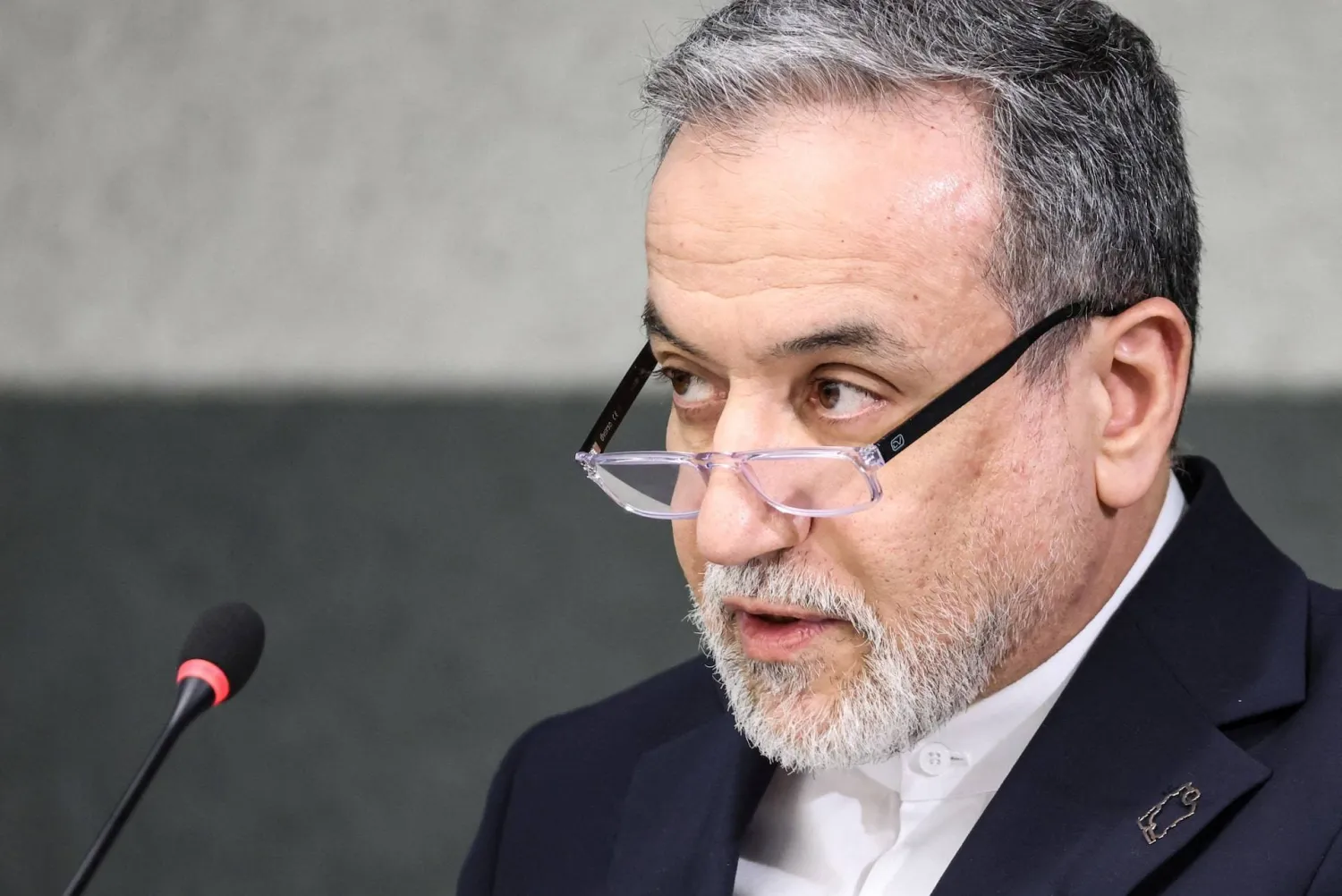

Iran FM Says ‘Security Breach’ Led to Khamenei’s Assassination

Iran's Foreign Minister Abbas Araghchi addresses a special session of the Conference on Disarmament at the United Nations, aside of US-Iran talks in Geneva, Switzerland, February 17, 2026. (Reuters)
TT

Iran FM Says ‘Security Breach’ Led to Khamenei’s Assassination

Iran's Foreign Minister Abbas Araghchi addresses a special session of the Conference on Disarmament at the United Nations, aside of US-Iran talks in Geneva, Switzerland, February 17, 2026. (Reuters)

Iranian Foreign Minister Abbas Araghchi said the February 28 strike that killed former Supreme Leader Ali Khamenei revealed a security breach at the highest levels of power that probably “still exists.”

“Within seconds, three attacks targeted the command center in the Pasteur region, which holds the offices and headquarters of Iran’s Supreme Leader,” Araghchi said in a wide-ranging television interview with conservative pro-government media activist Javad Moghayi.

A number of senior Iranian political and military figures were killed on the first day of the US-Israel war, including Khamenei.

“The crucial point, in my view, is that (the US and Israel) knew about these meetings,” Araghchi said. “That possibly points to a security breach that existed and probably still exists.”

He said the problem was not limited to infiltration. “Sometimes it also involves influencing the direction of decision-making processes,” Araghchi said, adding: “I don't wish to say any more about that publicly.”

The FM also said he did not meet with new Supreme Leader Mojtaba Khamenei in person. “Only a handful of people have met him.”

He explained that at the time of the strike, Ali Khamenei was in his office, the Strategic Council for Foreign Relations was holding its weekly meeting, and the Defense Council had also convened.

“They knew that the Supreme Leader (Ali Khamenei) was in the office every morning. As I understand it, the command center meeting was also being held two or three buildings away, and they chose exactly that moment. An Intelligence Ministry meeting was also taking place at that time,” he said.

Araghchi said he told President Masoud Pezeshkian on the morning of February 28 that “the atmosphere is war.” He said that he then met with Khamenei aide Ali Asghar Mir Hejazi shortly after Israel carried out the deadly attack on a Tehran compound where Khamenei was having his high-level meeting.

Araghchi said that during the war, he and his colleagues remained at the Foreign Ministry. “During the 40-day war, my deputies, colleagues, and I did not leave the Ministry of Foreign Affairs building. There was no safe place,” he said.

Araghchi also revealed that he met with Pezeshkian three days after the outbreak of the war, consulted Ali Larijani five days later, and held an official meeting on the sixth day in a safe location.



Authorities in Ethiopia's Tigray State Denounce Army's Drone Strikes

Former Tigray elements undergoing rehabilitation and reintegration programs by the Ethiopian government (Archive – Ethiopian News Agency)
TT

Authorities in Ethiopia's Tigray State Denounce Army's Drone Strikes

Former Tigray elements undergoing rehabilitation and reintegration programs by the Ethiopian government (Archive – Ethiopian News Agency)

Tigray authorities on Tuesday accused the Ethiopian government of carrying out deadly drone strikes in southern Tigray state, denouncing "a serious escalation" amid fears of a new war.

"There was a drone strike carried out by the Ethiopian government yesterday (Monday) in Merewa," in southern Tigray near the border with the Amhara region, Amanuel Assefa, a Tigray People's Liberation Front (TPLF) official, told AFP.

In a statement sent to AFP on Tuesday, the TPLF said the strikes targeted Tigrayan troops "causing human casualties", without providing further details.

A spokesperson for the federal army has not yet responded to AFP's request for comment regarding the accusations.

Amanuel also claimed that the strikes hit a high school, which AFP was unable to independently verify.

For several months, federal and Tigrayan forces have gathered on either side of the border of Ethiopia's northernmost regional state, with the two sides accusing each other of seeking to trigger a new conflict.

On August 1, fighting pitted federal forces against TPLF troops in northwestern Tigray, near the border with Sudan, according to the TPLF.

The federal government has not commented on the matter.

Tigray, home to around six million people, emerged in 2022 from a two-year war between TPLF forces and the federal army, supported by local militias and the Eritrean army.

The conflict claimed at least 600,000 lives, according to an African Union estimate.

A peace agreement signed in November 2022 put an end to the fighting, but several key points, such as the return of displaced people or the disarmament of the TPLF, have never been implemented.


Ukraine Says Russia Fired N. Korean Missiles in Deadly Attack

Ukrainian rescuers work at the site of a Russian attack on a residential area in Zaporizhzhia, Ukraine, 11 August 2026. (EPA)
TT

Ukraine Says Russia Fired N. Korean Missiles in Deadly Attack

Ukrainian rescuers work at the site of a Russian attack on a residential area in Zaporizhzhia, Ukraine, 11 August 2026. (EPA)

Russian attacks across Ukraine killed at least nine people overnight and wounded dozens, Kyiv said Tuesday, accusing Moscow of launching North Korean missiles in the raid.

The allegation comes after Ukrainian President Volodymyr Zelensky warned -- without providing evidence -- that Moscow was receiving more ballistic projectiles and troops from its ally Pyongyang.

Russia has turned to North Korea for support throughout its four-and-a-half-year invasion.

Earlier in the war, Pyongyang dispatched thousands of troops to help Russia fight back a Ukrainian counterattack into its western Kursk region.

Intelligence from the West, Kyiv and Seoul, has long accused North Korea of supplying weapons to Russia.

The southeastern city of Zaporizhzhia was worst hit in Russia's latest overnight barrage, with six people killed and 19 wounded, Zelensky said.

"The city was struck with North Korean ballistic missiles, Zircons, and guided aerial bombs. It was a vicious attack, calculated to inflict maximum damage specifically on civilian infrastructure," he said.

Three more were killed by Russian drones and missiles in the neighboring Dnipropetrovsk region, the local military administration said.

In the capital Kyiv, Zelensky said an infectious diseases hospital was hit, while strikes on the frontlines cities of Kherson and Kharkiv caused power outages.

A children's hospital in Kyiv was also hit, the health ministry said, posting photos of broken windows and debris in a courtyard.

"Children and medical staff were not harmed, as they were in a shelter at the time of the attack," the ministry said.

Russia's defense ministry said its forces "delivered a group strike with high-precision ground-based weapons, hitting military-industrial enterprises and transport-logistics centers in the cities of Kyiv and Zaporizhzhia".

- Zelensky's N. Korea warning -

Zelensky has recently renewed his warnings of deepening military ties between Moscow and Pyongyang, while appealing for more Western air-defense supplies.

On Monday, he said that Russia received "additional ballistic missiles from North Korea."

Over the weekend, he alleged "a decision has been made for 30,000 to 50,000 North Koreans to be deployed on the territory of Russia."

Kyiv has not explained how it obtained the figures and did not provide a timeframe for the deployment.

But Zelensky is urging allies in the Asia-Pacific to supply air defense to Kyiv in order to counter Pyongyang's capabilities.

Russia and North Korea signed a mutual defense pact in 2024, ahead of Pyongyang sending troops to help push Ukrainian forces out of Russia's Kursk region.

In recent weeks, Russia has considerably stepped-up strikes with ballistic missiles -- a fast and powerful weapon that is hard to intercept.

Dozens have been killed in Kyiv in the attacks.

Only the most advanced air defense, such as the US-made Patriot system, is capable of intercepting them.

Ukraine has been reporting an acute shortage of Patriot interceptors since the US-Israeli war against Iran began in February.

Kyiv has also boosted its own long-range drone strikes against Russia, hitting oil infrastructure and e-commerce warehouses in counterattacks it says are justified and designed to crimp Moscow's logistics and revenue sources.

The latest spiral of escalation has brought the civilian death toll in Ukraine to the highest since the war's first months in 2022, according to the United Nations.


Ceuta Leader Wants Migrant Detention Center after Influx

The future of the migrants left in Ceuta has sparked a battle between the leftist central government and regions governed by the right. Antonio Sempere / AFP
TT

Ceuta Leader Wants Migrant Detention Center after Influx

The future of the migrants left in Ceuta has sparked a battle between the leftist central government and regions governed by the right. Antonio Sempere / AFP

The leader of Ceuta demanded on Monday the detention and expulsion of the thousands of migrants wandering the Spanish north African territory's streets after last month's mass influx from Morocco.

Some 72,000 migrants breached the border in an unprecedented and deadly rush on July 30-31, with 70,000 having since returned to Morocco, according to Spanish government figures.

But the thousands who remain -- including hundreds of unaccompanied children who cannot be summarily deported -- struggle to access food, water, shelter and sanitation while the tiny enclave's resources are overwhelmed, AFP said.

Their future has sparked a political battle between Spain's leftist central government and regions governed by the main conservative Popular Party (PP) and far-right Vox, which resist taking in unaccompanied children under existing legal provisions.

"A space that acts as an internment center for foreigners must be set up, where these people can be held and remain confined," Ceuta's PP leader Juan Jesus Vivas told reporters.

He said the measure "must be achieved urgently" so that the migrants "are not in our streets and that expulsion proceedings can be handled with greater speed and ease".

Vivas called the situation "unsustainable", estimating that between 8,000 and 11,000 migrants were left in Ceuta, well above the government's figure of around 2,500.

Thousands of residents of the territory of 84,000 inhabitants gathered to protest on Sunday at the handling of a crisis that they say has left Ceuta insecure and abandoned.

The Spanish government minister responsible for relations with the regions, Angel Victor Torres, assured Ceuta's population that police and troop numbers had been ramped up, including 40 percent more Civil Guards.

Reuniting the children with their families was "the priority", he added, without mentioning the possibility of expulsions.