


Syria Restructures Security Authority in Response to Pressure

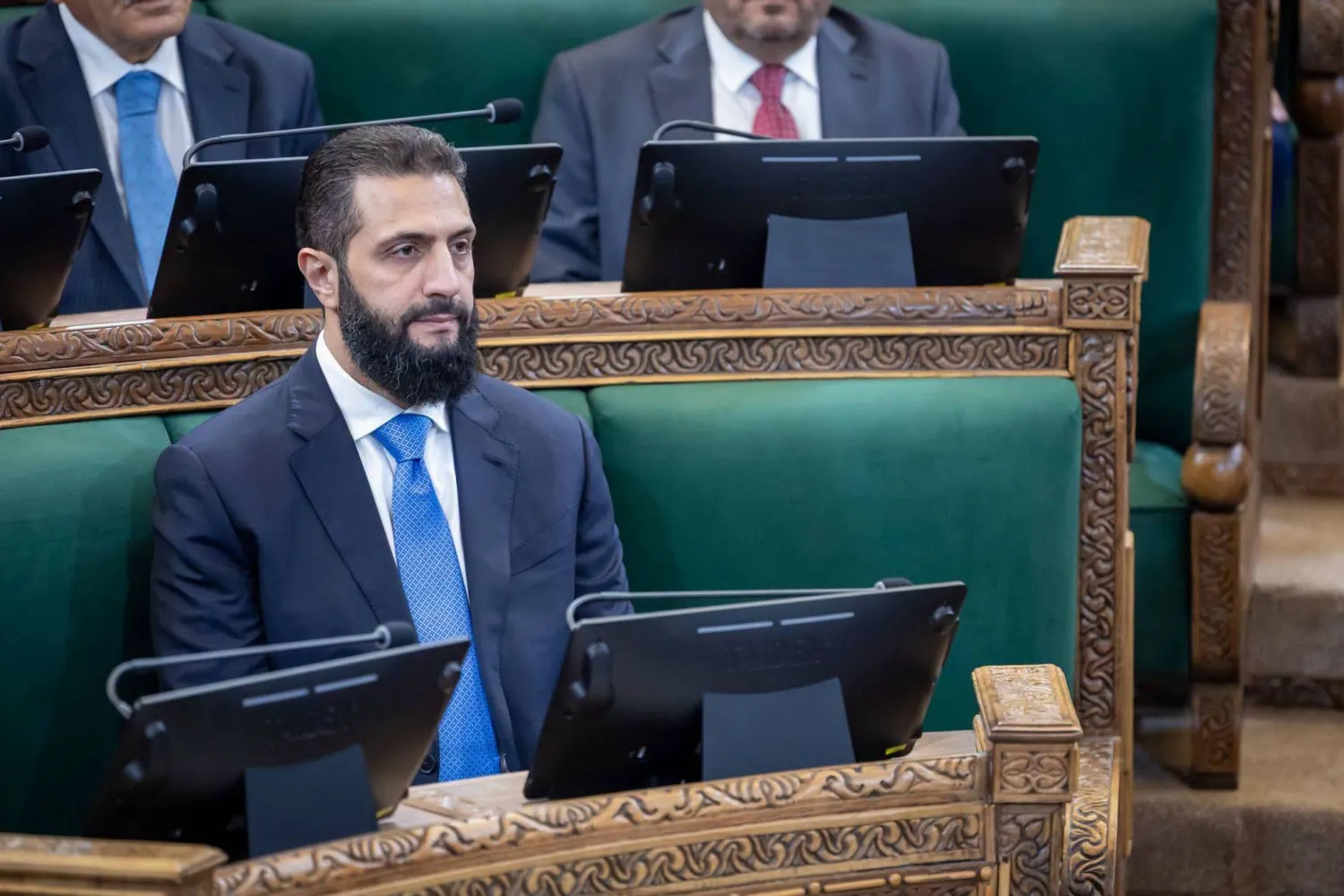
12 July 2026, Syria, Damascus: Syrian President Ahmed al-Sharaa attends the inaugural session of Syria's newly formed People's Assembly in Damascus. (Syrian Presidency)
TT

Syria Restructures Security Authority in Response to Pressure

12 July 2026, Syria, Damascus: Syrian President Ahmed al-Sharaa attends the inaugural session of Syria's newly formed People's Assembly in Damascus. (Syrian Presidency)

A sweeping round of senior security appointments announced Sunday by Syrian President Ahmed al-Sharaa amounts to a fundamental restructuring of the country’s security apparatus, driven by both domestic security concerns and mounting political and economic pressure from abroad, according to Syrian security and strategic affairs analyst Ismat al-Absi.

Speaking to Asharq Al-Awsat, al-Absi said the appointments reflect a clear effort to consolidate security authority in the hands of al-Sharaa and Interior Minister Anas Khattab by placing both Public Security, including policing and internal security, and National Security under a single command.

The move effectively ends the institutional divide and potential rivalry between the Interior Ministry and the intelligence services, making Khattab the sole authority overseeing both strategic and operational security decision-making, al-Absi said.

Hussein al-Salama will assume an executive role reporting directly to Khattab on national security affairs, while the General Intelligence Directorate will be headed by Abdul Qader Tahan within the unified structure.

Al-Absi said the appointments also mark a broader institutional overhaul, noting that the changes are intended to bring the transitional phase to a close by establishing a unified centralized security structure after concerns over overlapping authorities among agencies with different backgrounds, including Hayat Tahrir al-Sham (HTS) and the Syrian Democratic Forces (SDF).

According to al-Absi, the immediate catalysts were recent security pressures, including bombings in Damascus and the interception of weapons allegedly being smuggled from Iraq to Hezbollah in Lebanon.

He said the attacks and the foiled smuggling operations exposed gaps in interagency coordination, border security, and urban surveillance.

The Damascus bombings occurred during French President Emmanuel Macron’s July 6-7 visit - the first by a major Western head of state since al-Sharaa took office in late 2024 - when two explosive devices detonated a few hundred meters from the Four Seasons Hotel, where Macron was staying.

Syrian authorities later announced the arrest of the cell responsible, with preliminary investigations indicating it was affiliated with ISIS.

Economic researcher Firas Shaabo said the security restructuring is also intended to create a safe and stable environment for investment.

He explained that unifying the country’s top security leadership would reduce institutional fragmentation and strengthen coordination, making the changes an integral part of Syria’s broader economic vision.

Given the National Security Office broad oversight powers, the restructuring could reinforce stability, remove obstacles to development and reconstruction, attract foreign investment, stimulate the domestic economy, and reassure the international community and regional partners of the state’s ability to maintain internal stability, he added.



Sudan Gold Mine Collapse Kills 10, Injures 21

Workers break rocks at a gold mine near Abu Delelq in Gadarif State, Sudan. (Reuters)
TT

Sudan Gold Mine Collapse Kills 10, Injures 21

Workers break rocks at a gold mine near Abu Delelq in Gadarif State, Sudan. (Reuters)

A gold mine collapsed in northern Sudan killing at least 10 people and injuring 21 others, two survivors told AFP on Sunday after overnight rescue efforts.

Shafts of the Awny mining area near Sudan's border with Egypt collapsed on Saturday.

By Sunday morning "10 bodies had been recovered and 21 injured miners pulled out", said one of the survivors who was working at the mine when it collapsed, requesting anonymity for security reasons.

Another survivor, also requesting anonymity, told AFP the rescue operation was "being carried out by the miners themselves" with little equipment available.

More miners were feared dead under the rubble and survivors said the search for the missing was ongoing.

Many young Sudanese have joined a dangerous gold rush, working in unregulated mines with their hands and rudimentary tools for meagre daily wages.

They face chemical poisoning and regular mine collapses.

Last week at least 82 people were killed and dozens injured in a collapse in the southern Kordofan region.

Artisanal and small-scale mining, which takes place in unofficial zones or decommissioned mines, accounts for the majority of gold extracted in Sudan.

Even before the war pushed nearly 20 million Sudanese into severe hunger, artisanal mining employed more than two million people, according to industry figures.


CIA Chief Meets Egypt's Sisi in Cairo

FILED - 18 October 2023, Egypt, Cairo: President of Egypt Abdel Fattah El-Sisi is pictured in Cairo. Photo: Michael Kappeler/dpa Pool/dpa
TT

CIA Chief Meets Egypt's Sisi in Cairo

FILED - 18 October 2023, Egypt, Cairo: President of Egypt Abdel Fattah El-Sisi is pictured in Cairo. Photo: Michael Kappeler/dpa Pool/dpa

US Central Intelligence Agency Director John Ratcliffe met Egyptian President Abdel Fattah al-Sisi Sunday in a rare visit to Cairo, as the United States warned of rapid escalation in the Middle East war.

Sisi's office said the meeting, attended by Egypt's spy chief Hassan Rashad, discussed the wars in Iran, the Gaza Strip and Sudan, as well as attacks on Gulf countries and threats to maritime security.

Sisi stressed "the paramount importance of settling regional crises through political and diplomatic tracks," according to a presidency statement.

"This military conflict has the potential to escalate rapidly," it warned.

Sisi's office said Ratcliffe on Sunday "lauded Egypt's pivotal role in supporting efforts aimed at reaching peaceful, comprehensive settlements to regional crises".


Arab Parliament Condemns Houthi Militia Attack Targeting Riyadh

Arab Parliament Condemns Houthi Militia Attack Targeting Riyadh
TT

Arab Parliament Condemns Houthi Militia Attack Targeting Riyadh

Arab Parliament Condemns Houthi Militia Attack Targeting Riyadh

The Arab Parliament has strongly denounced the terrorist Houthi militia's continued attacks, including the attack targeting Riyadh, stressing that it constitutes a flagrant violation of international law and a threat to Arab national security and regional stability.

In a statement on Sunday, Arab Parliament Speaker Mohammed Al-Yamahi expressed the parliament's full solidarity with the Kingdom of Saudi Arabia and its support for the measures it takes to defend itself against any attacks targeting its security and territorial integrity, SPA reported.

Al-Yamahi called on the international community, particularly the UN Security Council, to assume its legal and political responsibilities to stop these blatant attacks, ensure that they are not repeated, and hold those responsible accountable.