

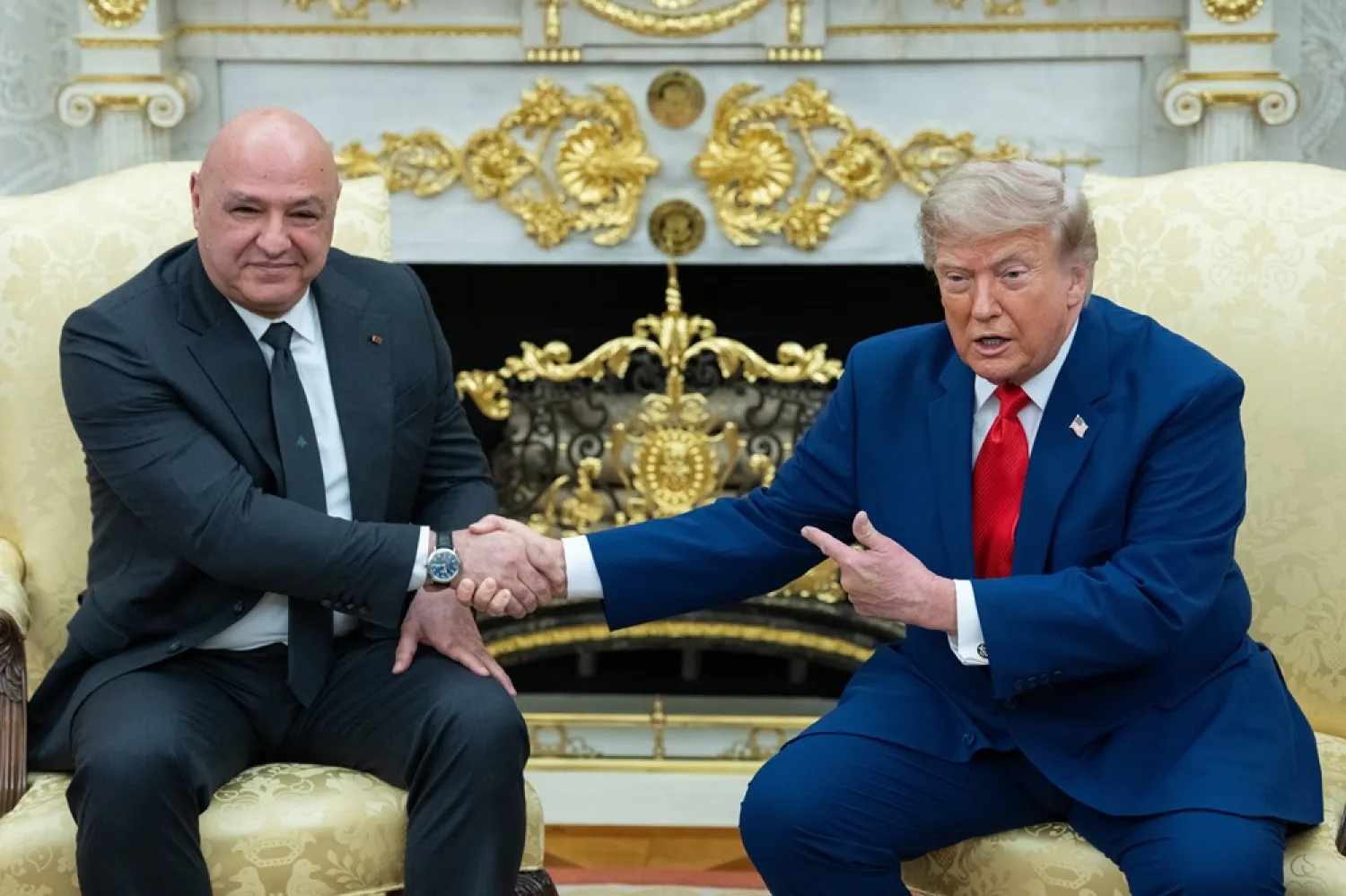

Trump Promises US Help for Lebanon During White House Meeting with Aoun

US President Donald J Trump (R) shakes hands with Lebanese President Joseph Aoun (L) during their meeting in the Oval Office of the White House in Washington, DC, USA, 21 July 2026. (EPA)
TT

Trump Promises US Help for Lebanon During White House Meeting with Aoun

US President Donald J Trump (R) shakes hands with Lebanese President Joseph Aoun (L) during their meeting in the Oval Office of the White House in Washington, DC, USA, 21 July 2026. (EPA)

President Donald Trump pledged to help Lebanon “a lot” during a White House meeting on Tuesday with the country's leader, Joseph Aoun, who came to push for long-term calm after months of war between Israel and the Iran-backed Hezbollah group. 

“It’s been a very badly treated place and country and we’re going to have it properly treated and treated with the respect it deserves,” Trump told Aoun during a meeting which wrapped up the Lebanese leader's four-day visit to Washington. “We’re gonna help it a lot," he said, without giving concrete details. 

The US has pushed for peace in Lebanon but been increasingly distracted by a new round of escalation with the war in Iran, which has destabilized much of the Middle East. On Wednesday, Trump said he had little interest in talks with Iran's leader to end the war — at least for now. 

Lebanon and Israel have held rare direct talks mediated by Washington. Aoun's White House visit was the first by a Lebanese president since 2009. 

Lebanon hopes the talks result in Israeli troops withdrawing from large swaths of southern Lebanon that they currently occupy, and the Lebanese military receiving support to assert full control in areas where Hezbollah had held sway. 

Trump said of Israel’s army fully withdrawing from Lebanon, “They’re in the process of doing that. They’re in the process of redeploying” but didn't elaborate. 

Aoun told Trump, “Your vision is peace,” calling it Trump's “legacy.” 

The US president responded by joking, “I do agree with that" and said Aoun was handsome and “knows how to get to me,” adding, “Now he can have anything.” 

Framework agreement is being tested  

Lebanon and Israel announced a “framework agreement” on June 26, setting a plan for Israeli forces to withdraw and for the disarmament of Hezbollah, which for decades had a strong presence in southern Lebanon. 

It also lays out steps toward an eventual peace agreement between the countries, which have never held formal diplomatic ties and have been nominally in a state of war for nearly 80 years after Israel’s establishment. 

Trump noted Tuesday of Lebanon, “There’s a Hezbollah problem” and suggested that he personally could speak with Hezbollah if Aoun wanted him to. He also floated the idea of having Syria intervene to fight Hezbollah — though didn't fully commit to that. 

Such a concept would be highly unpopular in Lebanon and potentially embarrass Aoun. 

Meanwhile, the State Department announced Monday that operations in three villages deemed part of a “pilot zone” had begun, without giving details. Two of the villages, Froun and Srifa, are not under Israeli military control and the Lebanese army is present, while Israeli forces are in part of Zawtar al-Gharbieh. 

The Lebanese army in a statement said it was preparing for Israel to withdraw from Zawtar al-Gharbieh and that it had begun deploying troops Tuesday.  

The Israeli military said it “will adjust its force posture in one of the pilot areas in order to enable the Lebanese Armed Forces to carry out their mission,” without specifying the location. 

The Lebanese military later said Israeli troops fired near that area in Zawtar al-Gharbieh, without giving details, and warned it could delay deployment. 

An Israeli military official, speaking on condition of anonymity in accordance with military guidelines, said the withdrawal had not yet begun. 

Village mayor waits for safety to be confirmed  

Abed Ezzeldine, mayor of Zawtar al-Gharbieh, said they were waiting for the Lebanese military to say whether it's safe for residents to check on their homes after they fully deploy and patrol the area. He was concerned about safety, given that the Israeli military is still present in a village next door, while Israeli strikes continue nearby. 

“The villages are intertwined, so we don’t feel safe because the Israelis are present there, they’re on our borders and are not very far from us,” Ezzeldine told The Associated Press, who said Zawtar al-Gharbieh is uninhabitable. 

“Once the army gives us permission to enter Zawtar al-Gharbieh, we as civilians will go in, but only to check it out and see how things are and then we will leave,” he said. "We can’t stay because the infrastructure is completely damaged and houses have been leveled. They (the Israelis) have bulldozed the roads.” 

The Lebanese military last week increased its presence in some of the areas expected to be included in the pilot zone, including the three villages, with troops patrolling and setting up checkpoints. 

Rubio says US will support the framework agreement  

Aoun on Sunday met with Secretary of State Marco Rubio, who said Washington will continue to endorse the Lebanese agreement and support its full implementation. Rubio described the meeting as “very positive” and warned that Lebanon will “never be fully at peace” as long as the Hezbollah issue is not resolved. 

“How do you replace Hezbollah? You defeat and replace them with a government that is strong enough to be the sole force of arms in the country,” Rubio said. 

Skeptics in Lebanon fear that a military confrontation with Hezbollah could lead to a civil war. 

Government officials have urged investment in the country's battered infrastructure to empower the weakened state, which Rubio echoed. 

“This is not just about military stuff," he said. "This is about how can we attract more US and international investment into Lebanon.” 

Israel plans on a long-term presence  

Israeli officials, meanwhile, have said they plan to keep military forces long-term in a “security zone” in southern Lebanon. 

Hezbollah has dismissed the US-brokered direct talks and instead backed Washington’s talks with its key ally and patron Iran to end their war, which includes ending the war in Lebanon as a condition. 

Lebanon’s government came to power on a reformist platform in early 2025, vowing to disarm all non-state groups including Hezbollah. It blames Hezbollah for dragging the country into another war with Israel in March, when the group fired several rockets toward northern Israel two days after the US and Israel attacked Iran. 

Beirut's leadership, however, has condemned Israel’s subsequent ground invasion and massive aerial campaign in the country, which has killed over 4,000 people and displaced 1.2 million others. 

While grappling with stark political opposition from Hezbollah and allies within the deeply divided country, Lebanon's leadership insists that Israeli withdrawal and international financial support for Lebanon’s cash-strapped army is crucial for a sustainable security solution. 


Israeli Military Operations Paving Way for Battle in South Lebanon

 Smoke rises as Israeli forces demolish homes in Zawtar al-Sharqiyeh, southern Lebanon, Sunday, Aug. 23, 2026. (AP)
Smoke rises as Israeli forces demolish homes in Zawtar al-Sharqiyeh, southern Lebanon, Sunday, Aug. 23, 2026. (AP)
TT

Israeli Military Operations Paving Way for Battle in South Lebanon

 Smoke rises as Israeli forces demolish homes in Zawtar al-Sharqiyeh, southern Lebanon, Sunday, Aug. 23, 2026. (AP)
Smoke rises as Israeli forces demolish homes in Zawtar al-Sharqiyeh, southern Lebanon, Sunday, Aug. 23, 2026. (AP)

Israeli incursions and raids on southern Lebanon are paving the way for a military battle as the army has been striking heights overlooking villages and towns it is occupying. Israel has also been targeting roads and routes that run deeper into Lebanese territory, notably around Bint Jbeil city, security sources told Asharq Al-Awsat.

The operations and raids are focusing on the Ali al-Taher heights in the eastern sector that Israel has been trying to capture for ten weeks. In the central sector, it has been focusing on routes leading to Bint Jbeil and, closer to the coast, it has been carrying out similar incursions and detonations in the towns of Majdal Zoun and al-Mansouri.

The security sources said the operations appear to be paving the way for a military battle. The attacks are targeting all the hills surrounding Ali al-Taher, especially the al-Dabsha and al-Tahra that were occupied by Israel before it withdrew from the South in 2000.

The sources explained that focusing attacks on the hills and destroying houses around Ali al-Taher means that the troops are trying to isolate the entire strategic area from its surroundings.

For the past week, Israeli raids struck under-constructions houses and villas in the Dawhet Kfar Rumman and Nabatieh al-Fawqa areas, located north and southwest of Ali al-Taher respectively. It also continued to blow up houses in Kfar Tebnint that is located directly west of Ali al-Taher.

Israel has also struck Ali al-Taher itself with artillery and phosphorous bombs.

Lebanese media on Sunday said Israel used artillery to hit Mayfadoun and airstrikes hit Nabatieh al-Fawqa and Dawhet Kfar Rumman.

In the central sector, Israeli troops carried out incursions into four unoccupied towns: Beit Yahoun, Baraachit, Hadatha and Aita al-Jabal, all of which lead to Bint Jbeil, which is occupied by Israel.

The sources said a potential military battle in the future will not be limited to Ali al-Taher, but encompass the central sector.

The incursions are covering an area stretching some five kilometers from Baraachit to Hadatha in an attempt to create a buffer zone close to Ali al-Taher and capture areas that overlooking nearby valleys.


Palestinian Authorities Say Israeli Army Kills Teen in West Bank

Mourners carry the body of Palestinian Islam Ajouri, 14, at Rafidia Hospital in Nablus in the Israeli-occupied West Bank, on August 23, 2026. (Photo by JAAFAR ASHTIYEH / AFP)
TT

Palestinian Authorities Say Israeli Army Kills Teen in West Bank

Mourners carry the body of Palestinian Islam Ajouri, 14, at Rafidia Hospital in Nablus in the Israeli-occupied West Bank, on August 23, 2026. (Photo by JAAFAR ASHTIYEH / AFP)

Israel's military killed a Palestinian teenager in the occupied West Bank on Sunday, Palestinian health authorities said, while an Israeli and a Palestinian were wounded in separate incidents.

Israeli gunfire killed Islam Ahmad Maher Ajouri, 14, in the Askar refugee camp where he lived, outside Nablus in the north of the West Bank, the Palestinian health ministry announced.

Mohammed Abu Kashk, head of the Askar camp services committee, told AFP that the teenager was killed by Israeli forces during a raid on the camp.

"There were no clashes or confrontations that would justify shooting a child and killing him," he said.

According to a source from the Palestinian Red Crescent, Ajouri was hit in the chest by live ammunition. He was pronounced dead at Nablus National Hospital.

At his funeral, his uncle Ahmed Mohamed Zamzoum told AFP that the boy went outside during the army raid. "Every time the Israeli forces enter, one or more martyrs are killed," he said.

The Israeli army told AFP it was verifying the information.

In a separate incident, the army said it apprehended a man suspected of stabbing an Israeli earlier on Sunday in Al-Auja, in the central West Bank.

Israeli rescue service Magen David Adom said the 24-year-old victim had "a penetrating wound".

The man was evacuated to a hospital in Jerusalem, and his condition was described as "moderate".

According to the initial findings of the investigation, the victim parked near a shopping center and was "attacked from behind and stabbed in the shoulder", Israeli police said in a statement.

Hani Najum, the head of the Al-Auja village council, told AFP that "the Israeli army raided the village, deployed in its streets" and imposed a curfew.

In a third incident, the army reported that a "terrorist" attempted "to steal a weapon from an IDF soldier" near the Palestinian town of Taybeh, northeast of Ramallah, and that forces opened fire at the man, saying he was "neutralized".

Palestinian sources told AFP that the man, Aws Akram Maatan, from the village of Burqa east of Ramallah, suffered an injury to his foot and was taken to a Jerusalem hospital for treatment.

The head of the Burqa village council, Sayel Kanaan, said in a statement that Maatan had been shot "without justification".

Violence has surged in the West Bank, which Israel has occupied since 1967, since the start of the war in Gaza sparked by Hamas's October 2023 attack on Israel.

Israeli soldiers or settlers have killed at least 1,100 Palestinians since then, according to an AFP tally based on data from the Palestinian health ministry.

Over the same period, at least 48 Israelis have been killed in Palestinian attacks or during Israeli military operations, according to Israeli figures.


Tunisia Says Recovered 11 Migrants' Drowned Bodies

African migrants rescued by the Tunisian coast guard in October (AFP)
TT

Tunisia Says Recovered 11 Migrants' Drowned Bodies

African migrants rescued by the Tunisian coast guard in October (AFP)

The Tunisian national guard said Sunday it recovered 11 bodies from the sea after a boat carrying migrants sank off the country's southeastern coast, with three people still missing.

The boat was carrying 15 people, only one of whom was rescued after it sank some 14 nautical miles off the shore of Zarzis on Friday night.

"Search operations resulted in the recovery of three bodies yesterday and eight bodies today, bringing the total to 11," the national guard said in a statement.

Searches for the three remaining missing passengers were ongoing, it added.

On Saturday night, residents in Ben Guerdane -- the marginalized city near the Libyan border where 14 of the migrants were from -- staged protests, blocking roads and setting tires on fire over the shipwreck.

Tunisia, whose coast is some 145 kilometers (90 miles) from the Italian island of Lampedusa, is a key departure point for migrants seeking to make the perilous journey across the Mediterranean in search of better lives in Europe.

The central Mediterranean crossing is the deadliest migration route in the world, according to the International Organization for Migration (IOM).

The IOM said earlier this month that the number of migrant deaths on the central Mediterranean route had more than doubled in the first four months of 2026 compared to the same period last year.

At least 914 migrants have died or gone missing along the route this year, according to the IOM.

In 2023, Tunisia signed a 255-million-euro ($290 million) deal with the European Union, nearly half of which was earmarked for tackling irregular migration.

The deal, strongly supported by Italy's hard-right government, aimed to bolster Tunisia's capacity to prevent boats leaving its shore.
