


US Intelligence Says Military Action Unlikely to Change Iran’s Negotiating Position

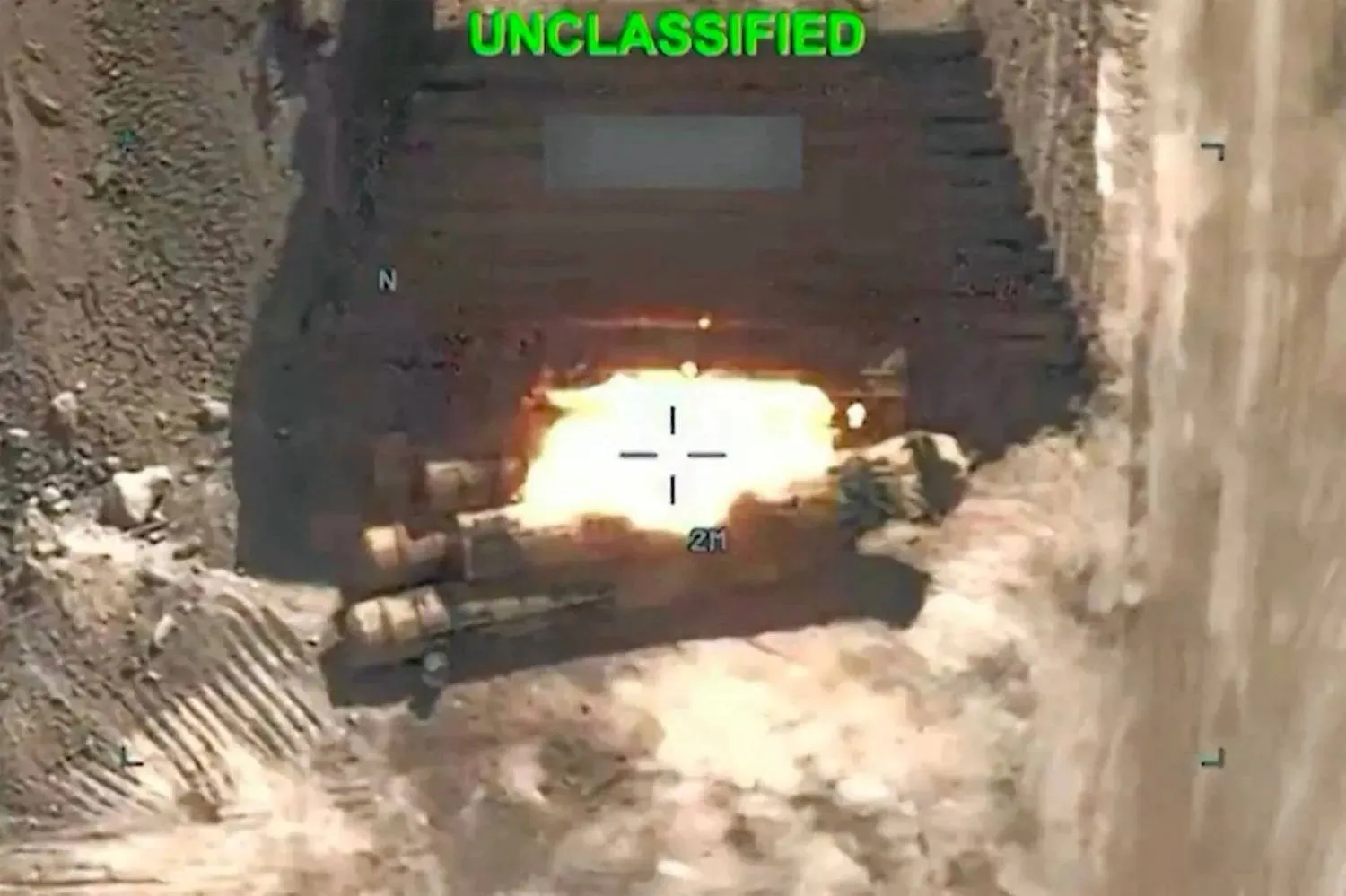
This screen grab from handout video footage released by the US Central Command (CENTCOM) shows what the US military says is the latest wave of precision strikes on strategic Iranian military sites. (CENTCOM/AFP)
TT

US Intelligence Says Military Action Unlikely to Change Iran’s Negotiating Position

This screen grab from handout video footage released by the US Central Command (CENTCOM) shows what the US military says is the latest wave of precision strikes on strategic Iranian military sites. (CENTCOM/AFP)

Iran’s government is unlikely to soften its negotiating position as a result of the ongoing US military strikes, according to a new intelligence assessment described by current and former US officials.

Analysts at US spy agencies have also concluded that Tehran and Washington are, for now, stuck in an indefinite limbo between peace and war, the officials told The Washington Post — an uneasy dynamic given the increasingly deadly nature of the tit-for-tat hostilities between the two nations.

The current and former officials spoke on the condition of anonymity to describe the assessments because of their sensitivity.

The findings, which have been briefed to the US administration, appear to underscore the dilemma President Donald Trump faces in a war that he and Israeli Prime Minister Benjamin Netanyahu began in late February.

Trump’s current course of ever-expanding attacks appears to have led to a stalemate. But with the war deeply unpopular at home, continuing escalation by the US, such as the possible introduction of ground troops, poses political risks for the president with no guarantee of military success.

With the prospect of a wider war erupting again, both Iran and the US signaled they were open to fresh negotiations, although no progress was reported.

Secretary of State Marco Rubio said the US remains open to a diplomatic solution in Iran and that parts of Iran’s government are also open to it, but hardliners have gotten in the way.

“They continue to send signals that they want to talk, that they want to negotiate but their behavior is what we’re responding to and their behavior is they’re launching missiles and drones at ships, including tonight,” Rubio told reporters Sunday evening as he departed for the Philippines.

The latest intelligence report was written primarily by the CIA, where analysts have underscored the Tehran regime’s staying power despite the loss of many of its top leaders and much of its military hardware to US and Israeli attacks.

In May, a CIA analysis concluded that Iran could survive a US naval blockade for at least three to four months before facing more severe economic hardship.

Intelligence assessments like those on Iran are not intended to be concrete predictions of the future, current and former intelligence officials said. Rather, they are a snapshot of current and likely future trends based on all available classified intelligence, including human espionage and technical collection, as well as open-source material.

Jonathan Panikoff, former deputy US national intelligence officer for the Near East, said that the Trump administration appears to believe that if it keeps hitting Iran harder militarily, Tehran eventually will become more flexible.

“That assessment is almost certainly incorrect,” said Panikoff, senior director at the Atlantic Council think tank.

Iran’s government has repeatedly shown that its number one priority is survival of the regime, and that it is willing to suffer blows despite the harm to its people and economy, he said.

“I’m struggling, because I don’t think there’s a lot of great options for the United States,” Panikoff said, adding that he is skeptical Trump would launch a ground invasion.

“You’ll continue to see significant flare-ups in this conflict,” he said, followed by periods of calm and then renewed fighting.

Inside Iran, US officials say they increasingly see tensions within the Tehran government between those Washington considers pragmatists and those seen as hardliners in the Revolutionary Guard Corps and elsewhere whose power has grown.

Rubio said the US has heard directly from Iranians in government that they support a diplomatic agreement, but he acknowledged “there’s a tension” with hardliners who seem to oppose it.



Iran Rejects Trump Claims of US Control over Hormuz as 'Lies'

An Iranian woman walks next to an anti-US billboard at the Enghelab square in central Tehran, Iran, 13 August 2026. Tensions between Iran and the US remain high as opposing claims persist over shipping control in the Strait of Hormuz.  EPA/ABEDIN TAHERKENAREH
An Iranian woman walks next to an anti-US billboard at the Enghelab square in central Tehran, Iran, 13 August 2026. Tensions between Iran and the US remain high as opposing claims persist over shipping control in the Strait of Hormuz. EPA/ABEDIN TAHERKENAREH
TT

Iran Rejects Trump Claims of US Control over Hormuz as 'Lies'

An Iranian woman walks next to an anti-US billboard at the Enghelab square in central Tehran, Iran, 13 August 2026. Tensions between Iran and the US remain high as opposing claims persist over shipping control in the Strait of Hormuz.  EPA/ABEDIN TAHERKENAREH
An Iranian woman walks next to an anti-US billboard at the Enghelab square in central Tehran, Iran, 13 August 2026. Tensions between Iran and the US remain high as opposing claims persist over shipping control in the Strait of Hormuz. EPA/ABEDIN TAHERKENAREH

Iran's military on Thursday rejected as "lies" remarks by US President Donald Trump claiming control of the Strait of Hormuz, saying the strategic waterway was fully under Iranian control.

"The false claims of the United States that ships are passing through the Strait of Hormuz normally ... are nothing more than lies and fabrications," said Ebrahim Zolfaghari, the spokesperson for Iran's central military command, Khatam-al Anbiya.

"The Strait of Hormuz is, as in the past, under the complete management and control of the Islamic Republic of Iran, and no commercial ship or tanker without the permission and supervision of the powerful Iranian armed forces has had and will have the possibility of safe passage through this strait," he said in a video carried by state television.

Iran has kept control of Hormuz, a vital energy conduit, since the outbreak of the war in the Middle East on February 28, requiring vessels to obtain permission and pay transit fees before using the waterway.

In a Wednesday Truth Social post, Trump claimed that the US "has total control over the Strait of Hormuz. I THINK WE WILL KEEP IT!"

"Our Naval Blockade is being called, by everyone, 'A WALL OF STEEL,' and there is nothing Iran can do about it," he added.

On Thursday, the head of Iran's Basij forces under the Revolutionary Guards also said that the strait was under Iranian control.

"Today, you see that the Strait of Hormuz is under the management and control of the Islamic republic, and our country continues on its path in complete security," said Hossein Taeb according to state television.

Iran's top diplomat Abbas Araghchi on Thursday said the US makes miscalculations in regard to the waterway.

"The US has long miscalculated due to intelligence failures. Case in point: The war on Iran. Now, an even bigger miscalculation on the Strait of Hormuz," he said on X.

Iranian parliamentarian and member of the national security commission Behnam Saeedi said the strait is closed to US and Israeli ships.

"Ships belonging to the Zionist regime will not have the right to pass through the Strait of Hormuz under any circumstances, whether in war or peacetime," he told state TV, adding that "US military ships will also be barred from passing through the Strait".

Iran and Oman have been in talks to establish a new route through the strait, but negotiations have not yet been finalized.

Tehran, however, says even if the talks produce a new route, that would not on its own open the waterway unless the US meets Iran's demands.


White House Press Secretary Karoline Leavitt Will Leave at the Month’s End

FILE - White House press secretary Karoline Leavitt watches as President Donald Trump speak to reporters while in flight on Air Force One to Joint Base Andrews, Md., Jan. 11, 2026. (AP Photo/Julia Demaree Nikhinson, File)
TT

White House Press Secretary Karoline Leavitt Will Leave at the Month’s End

FILE - White House press secretary Karoline Leavitt watches as President Donald Trump speak to reporters while in flight on Air Force One to Joint Base Andrews, Md., Jan. 11, 2026. (AP Photo/Julia Demaree Nikhinson, File)

White House press secretary Karoline Leavitt will leave the administration at the end of the month to spend more time with her family, President Donald Trump announced Wednesday.

Leavitt, 28, is the youngest person to hold the role. She was a press aide during Trump's first term and has been one of the most visible advocates of his “Make America Great Again” movement. Trump did not outline any plans for who might replace her, The Associated Press said.

Meanwhile, Trump said he slipped away from Air Force One after a trip last month in Türkiye because the Secret Service and military wanted him on a “different plane” due to a threat he insisted did not scare him.

He downplayed the extraordinary nature of the subterfuge involved in his flight, which saw him stow away in an airport catering container to sneak onto another plane while Air Force One was sent into the sky, essentially as a decoy.


Colombia Enters ‘Final Phase’ of Quake Search as Toll Hits 265

This aerial view shows heavy machinery used by rescuers in the search for survivors amid the rubble of a collapsed building after an earthquake in Pereira, Colombia on August 12, 2026. (AFP)
TT

Colombia Enters ‘Final Phase’ of Quake Search as Toll Hits 265

This aerial view shows heavy machinery used by rescuers in the search for survivors amid the rubble of a collapsed building after an earthquake in Pereira, Colombia on August 12, 2026. (AFP)

Rescuers in Colombia were making last-ditch efforts to locate earthquake survivors early Thursday, as the critical 72-hour window for rescue operations neared its end.

The magnitude 7.4 quake, the strongest to hit Colombia this century, has killed 265 people, injured more than 3,500 and left almost 500 missing, according to local authorities.

In cities such as Cali and Pereira, emergency crews worked through a third night with their bare hands, cranes and sniffer dogs, stopping not to rest but to listen for signs of life.

Thursday morning will mark 72 hours since the quake, a period when survivors are considered most likely to be found alive beneath collapsed buildings.

Cali resident Martha Perez said she felt "helpless" as two relatives were thought to still be trapped under rubble.

"We will hold on to (hope) until the very end," Perez told AFP on Wednesday night.

"As you can see, all of us here -- the entire city of Cali -- are hoping to find more survivors," volunteer rescuer Fernando Loaiza said.

Cali Mayor Alejandro Eder said Wednesday that rescue efforts were "entering the final phase."

Colombia's newly installed president Abelardo de la Espriella has declared the disaster an "economic emergency" and announced three days of national mourning.

"We will do what is necessary," he said in a statement, vowing to "emerge again as a country and as a society."

More than 11,000 dwellings have been destroyed and thousands of families have been rendered homeless, according to official figures.

- Holding onto 'hope' -

In Pereira, crews focused on a collapsed bakery where they believe a street vendor trapped since Monday's earthquake may still be alive beneath the rubble.

Rescuers using equipment that detects vibrations said they had picked up possible signs of life from Pablo Loaiza, prompting anxious relatives to gather near the wreckage.

"They tell us it could be him," said his 16-year-old niece, Sara Loaiza. "My heart is about to burst out of my chest."

Relatives said the trapped man appeared to respond when rescuers asked him to knock twice, then three times from beneath the rubble, drawing applause from those gathered at the scene.

"Every half hour we make everyone be quiet to see if we can find people alive," volunteer rescuer Johana Sanchez told AFP.

"So far, three people have been pulled out alive and three dead."

Many have already spent consecutive nights outdoors, either because their homes were damaged or because they feared aftershocks.

In the town of Roldanillo, Yuliana Mendez picked through the wreckage of the beauty products store where she worked, one of many businesses damaged in the disaster.

"It's like starting over from scratch," she said.

In Pereira's Providencia neighborhood, residents hauled furniture and household items from damaged buildings. Among them was lawyer Ana Paulina Crosthwaite, whose apartment block was left unsafe by the quake.

"We're in a state of shock," she told AFP. "We're not prepared to tell our children that we have to pack whatever we can and start a new life."

Many Colombians have mobilized to help, bringing water, food and supplies to affected neighborhoods, while long lines formed outside blood donation centers.

"It's about wanting to help your community, your city and your country," said blood donor Ferney Cabrera.

The United States announced $15.5 million in emergency aid to Colombia, and the European Union pledged two million euros ($2.3 million).