


Metal Mining’s Carbon Footprint Far Larger Than Thought, Study Finds

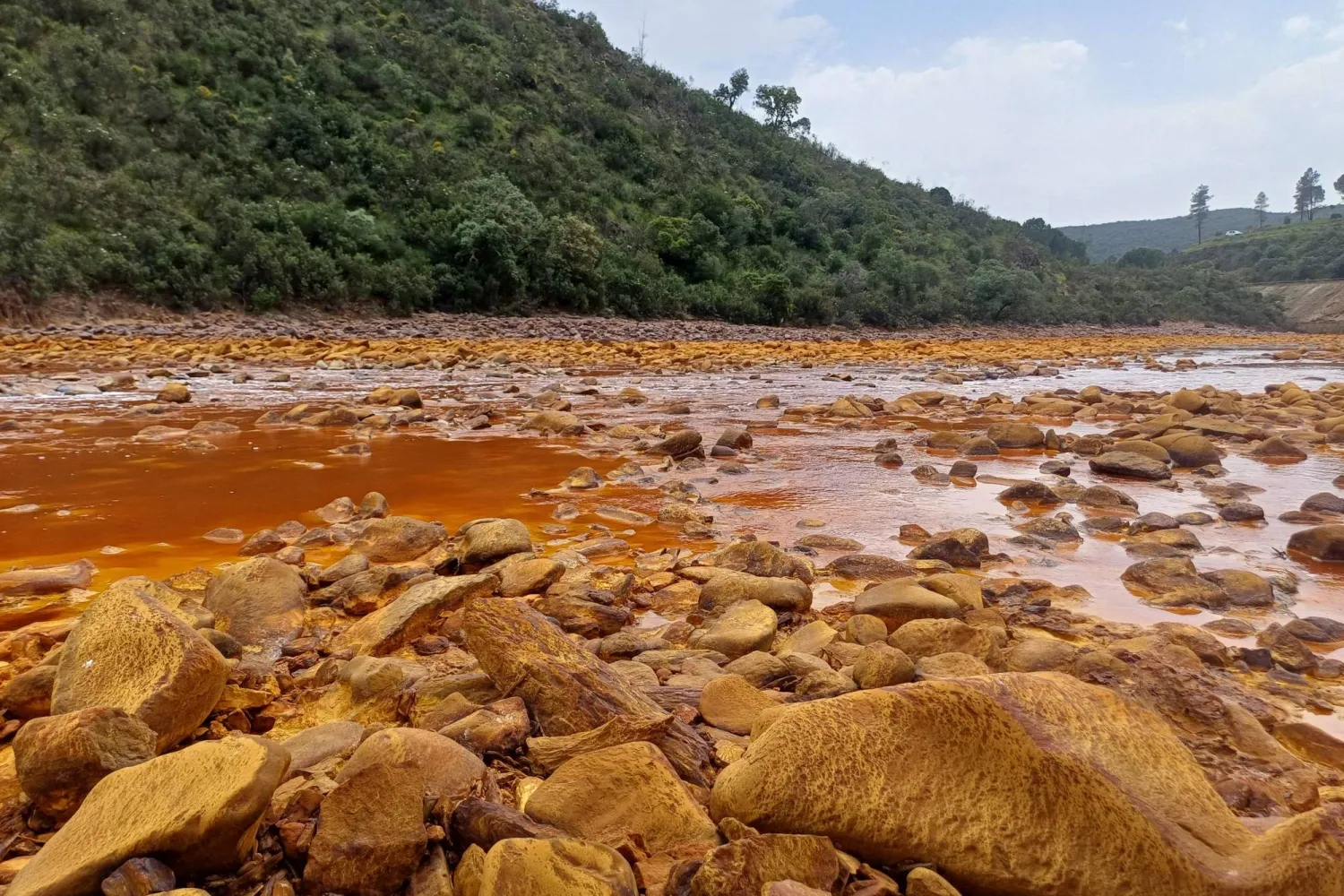
This undated handout photo obtained on July 21, 2026, from Luke Bridgestock of the University of St Andrews shows a view of the Tinto River, with pollution from acid mine drainage, in the Iberian Pyrite Belt in southwest Spain. (Luke Bridgestock / University of St Andrews / AFP)
TT

Metal Mining’s Carbon Footprint Far Larger Than Thought, Study Finds

This undated handout photo obtained on July 21, 2026, from Luke Bridgestock of the University of St Andrews shows a view of the Tinto River, with pollution from acid mine drainage, in the Iberian Pyrite Belt in southwest Spain. (Luke Bridgestock / University of St Andrews / AFP)

From building wind turbines to reinforcing power grids for rising demand from electric cars, transitioning from fossil fuels to greener economies will require a massive increase in metal extraction.

But new research published in Environmental Science and Technology on Wednesday shows the carbon footprint linked to metal mining could be 10 times greater than previously thought, with major implications for the world's climate goals.

"We found an emission source that's not well considered in the mining industry for CO2, that is potentially very large in at least certain settings -- much larger than the well-accounted-for emission sources," senior author Luke Bridgestock of the University of St Andrews told AFP.

"We need to decarbonize the mining industry, and the only way to do that is if we know where the emissions are coming from and have tailored strategies of dealing with each of those emission sources," he added.

Metal mining is energy-intensive, and conventional estimates for its carbon footprint attribute most of its emissions to heavy equipment on-site, as well as diesel transport required to haul ore away.

- Hiding in plain sight -

Bridgestock and colleagues instead looked at acid mine drainage, a common side effect of mining that, despite being well understood, had never been formally quantified before this study.

Metal ores dug up during mining often contain sulfide minerals. When these sulfide minerals interact with oxygen-rich surface waters, they turn it acidic.

As that acidic water reacts with certain rocks -- limestone, for instance -- it releases carbon dioxide into the atmosphere.

Alternatively, the acidic water can flow out to the ocean where its reaction with seawater likewise releases carbon dioxide.

The team focused on the Iberian Pyrite Belt in southwest Spain, a copper-mining region with 82 active or historic mines that generate more acid mine drainage than anywhere else in the world.

By measuring the chemistry of rivers draining the mines, they quantified the extent of acid mine drainage and how much of the water was neutralized through mineral reactions that produce carbon dioxide. They also tracked changes to river water as it mixed with seawater.

Altogether, their results showed that acid mine drainage since industrial-scale mining began in the area in the 19th century had produced a similar amount of carbon dioxide as already known emissions -- meaning the true footprint to date is about double what was previously thought.

- Centuries of emissions -

But that is only part of the story.

Because metal sulfide minerals dug up during mining can take hundreds to thousands of years to fully react with surface water, they will keep generating emissions long after a mine's reserves are depleted.

By the researcher's calculations, that figure is seven to 165 tons of carbon dioxide per ton of copper produced, depending on the sulfide content of the metal ore and local geologic conditions.

The midpoint of that range is roughly ten times greater than conventional carbon footprint estimates.

The team is now testing whether a fast-dissolving mineral called olivine could be used to neutralize the acidic runoff without releasing carbon, potentially cutting emissions drastically.

Bridgestock said the next step is identifying which mining regions are most at risk, so mitigation efforts can be targeted where they matter most.

"Otherwise, we can't get to net zero," he said, "because you'll always have a bunch of emissions from metal mining from this process."


Moto Guzzi’s Renovated Lake Como Headquarters Welcomes Motorcycle-Bound Aficionados

Riders and visitors enjoy Guzzi motorcycles displayed at the museum during the Guzzi opening inaugurating its completely redeveloped historic factory and new museum as the motorcycle maker celebrates its 105th anniversary, in Mandello del Lario, Thursday, Sept. 3, 2026. (AP)
TT

Moto Guzzi’s Renovated Lake Como Headquarters Welcomes Motorcycle-Bound Aficionados

Riders and visitors enjoy Guzzi motorcycles displayed at the museum during the Guzzi opening inaugurating its completely redeveloped historic factory and new museum as the motorcycle maker celebrates its 105th anniversary, in Mandello del Lario, Thursday, Sept. 3, 2026. (AP)

After extensive renovation by the Italian motorcycle manufacturer Moto Guzzi, aficionados this year had fresh reasons for a pilgrimage to the lakeside spot where their beloved two-cylinder bikes are hand-built.

Thousands of Moto Guzzi riders pulled up Saturday for an annual gathering and informal ride along the winding lakeside roads. They started arriving on Thursday for the unveiling of the headquarters, new museum and expanded factory on the shores of northern Italy’s Lake Como.

The headquarters, nestled between a mountainside and the lakeshore, received an additional 5,500 square meters (nearly 60,000 square feet) for factory space and the museum that honors the iconic brand that has been owned by Vespa-maker Piaggio since 2004. Works took five years and cost more than 50 million euros ($58 million).

Timothy Bennett, who lives in the US state of Georgia, was making his second trip to the headquarters after attending a toned-down 100th anniversary celebration during the pandemic. His first Moto Guzzi — made distinctive by its dual cylinders projecting from either side of the bike — was an 850-T, and now he owns a 2018 California 1400 Touring.

“I’ve owned a Moto Guzzi since my 20s,” said Bennett, 58. “The first time I saw one in a magazine, I thought it looked very interesting. And then I went ahead and saved up some money and bought a used one, and fell in love.”

This year, Bennett and other visitors to the World Guzzi Days could peek through new observation points to see workers hand-assembling the motorcycles, just as they have for 105 years. The company prides itself on its processes.

“Moto Guzzi is handmade, it is an artisanal product, it’s a piece of art,” said Matteo Boddi, head of manufacturing for the Piaggio Group. “And we never substitute automation for this core part. Automation is for safety and for sustainability.”

The new factory includes the addition of an automation belt to move parts and engines through the factories and robotics to transport the finished motorcycles for their final test. The factory expansion potentially doubles the maximum production to 30,000 motorcycles a year.

“We tried to make an accessible place both for passionate motorcyclists and people who are just curious about motorcycles being made in Italy, on Lake Como, and may never even have heard of Moto Guzzi before,” said US architect Greg Lynn.

Celebrity spottings and weddings have long been a pastime at Lake Como, known for its majestic views of the Alps. The lake is featured in the James Bond film Casino Royale, and George Clooney owns a villa on its shore. But that glitz isn't why the Moto Guzzi fans turn out in droves.

Roland Rampnoux has been visiting the factory regularly since 1980 and belongs to a 150-strong Moto Guzzi club in Paris. He was impressed by the factory, but his interest was mostly in the bikes and the camaraderie.

“I like the mentality of the people who ride them,” Rampnoux said. “When you see a Moto Guzzi it is immediately recognizable. It is a legendary brand.”


Sydney Sweats in Spring Hot Spell, Faces ‘Extreme’ Bushfire Risk

A ferry passes in front of apartments in Sydney, Australia, August 18, 2026. (Reuters)
TT

Sydney Sweats in Spring Hot Spell, Faces ‘Extreme’ Bushfire Risk

A ferry passes in front of apartments in Sydney, Australia, August 18, 2026. (Reuters)

Australia's most ‌populous city Sydney baked in a burst of sweltering spring heat on Saturday, raising the risk of bushfires and prompting authorities to issue a ban on lighting fires.

The heat comes as a powerful El Nino weather pattern in the Pacific, expected to be among the strongest in decades, drives hotter and drier ‌conditions across ‌southern Australia during the September-November spring ‌season.

On ⁠Saturday, the nation's ⁠weather forecaster said temperatures in the New South Wales capital, home to 5.6 million people, were set to hit 33 degrees Celsius (91.4 degrees Fahrenheit), nearly 13C above average.

At Sydney Airport, the temperature ⁠was already 28.6C (83.48F) at 11:30 ‌a.m. (0130 GMT)local ‌time, more than seven degrees above the September mean ‌maximum temperature, according to forecaster data.

"Fresh ‌to strong and gusty northwesterly winds developing during the morning, combined with dry, unseasonably warm conditions, will result in elevated fire dangers ‌across the Greater Sydney Region today," the forecaster said.

State fire authorities ⁠issued ⁠a total fire ban for Sydney where they rated fire risk as "extreme", the second highest danger rating.

Climate change is causing extreme heat and fire weather to become more common in Australia, a bushfire-prone country of around 27 million. In January, thousands of firefighters battled bushfires in the southeast that razed homes, cut power to thousands of homes and burned swathes of bushland.


How Haze from Indonesian Fires Impacts Southeast Asia

This aerial photo taken from a commercial plane shows haze from Indonesian forest fires blanketing a residential district in Kuching, the capital city of Sarawak state on the island of Borneo on September 5, 2026. (AFP)
TT

How Haze from Indonesian Fires Impacts Southeast Asia

This aerial photo taken from a commercial plane shows haze from Indonesian forest fires blanketing a residential district in Kuching, the capital city of Sarawak state on the island of Borneo on September 5, 2026. (AFP)

Thick smog has blanketed parts of Indonesia as the vast archipelago for weeks battles to contain fires that have burned large swathes of Borneo and Sumatra.

The hazardous smoke has led to an increase in respiratory problems, forced schools to close, and has been drifting to neighbouring countries including -- Malaysia, Singapore, and the Philippines.

Here's what to know:

- Where are the fires? -

Most of the fires are concentrated on Borneo island, home to vast tropical jungle that Indonesia shares with Brunei and Malaysia, as well as Sumatra.

So far this year, nearly 300,000 hectares of land have burned in Indonesia, according to an independent estimate from the Nusantara Atlas portal.

Indonesia saw an uptick in carbon emissions since late July, and by the end of last month the levels were comparable to previous El Nino years of 2015 and 2019, Copernicus Atmosphere Monitoring Service (CAMS) senior scientist Mark Parrington told AFP.

"We're seeing already now... really extreme fire emissions comparable to those previous strong El Nino years, and also the extent of the smoke and the haze and the air quality impacts," Parrington said.

Fires in the archipelago have released more than 23 million metric tons of carbon emissions between August 28 and September 3, according to CAMS' Fire Emission Watch portal.

It was higher than 20.7 million metric tons of emissions from fires over the same period in 2015, which was a strong El Nino year.

- What causes the fires? -

Analysts said that the El Nino weather phenomenon, which the United Nations said this week could turn out to be the strongest in four decades, has contributed to creating drier conditions in Indonesia and made it easier for fires to spread.

But slash-and-burn land-clearing practices also contributed to the damage, said David Gaveau, founder of the Nusantara Atlas.

"El Nino does not ignite fires. It creates the dry conditions that allow human-started fires to escape and become very large," he told AFP.

The fires are difficult to extinguish because many occurred on peatlands, a wetland ecosystem with layers of partially decomposed organic materials that become flammable when dry.

Between January and August this year, more than 210,000 hotspots were detected in peatland areas across the country, according to NGO Pantau Gambut.

"Peat is a naturally wet ecosystem and stores large amounts of organic material. When peat is drained, this organic material is converted into fuel," Pantau Gambut spokesman Wahyu Perdana said.

- What is the impact? -

More than five million people across Borneo and Sumatra are directly exposed to the health risks from haze, deputy health minister Dante Saksono Harbuwono said last month.

Over 1.4 million students were attending classes remotely, with many schools closed due to worsening air quality, an education ministry official said this week.

In Malaysia, soaring pollution levels prompted the government on Friday to declare an emergency in a region of the Sarawak state in Borneo, with nearly 650 schools closed next week.

In the Philippines, air quality was slowly returning to normal after a week of reaching "very unhealthy" and "severely unhealthy" PM 2.5 levels that saw officials shutter schools in cities and provinces citing the drifting haze.

The haze also drove air quality in Singapore's central region to an "unhealthy" level on Friday, the country's National Environment Agency data showed.
