

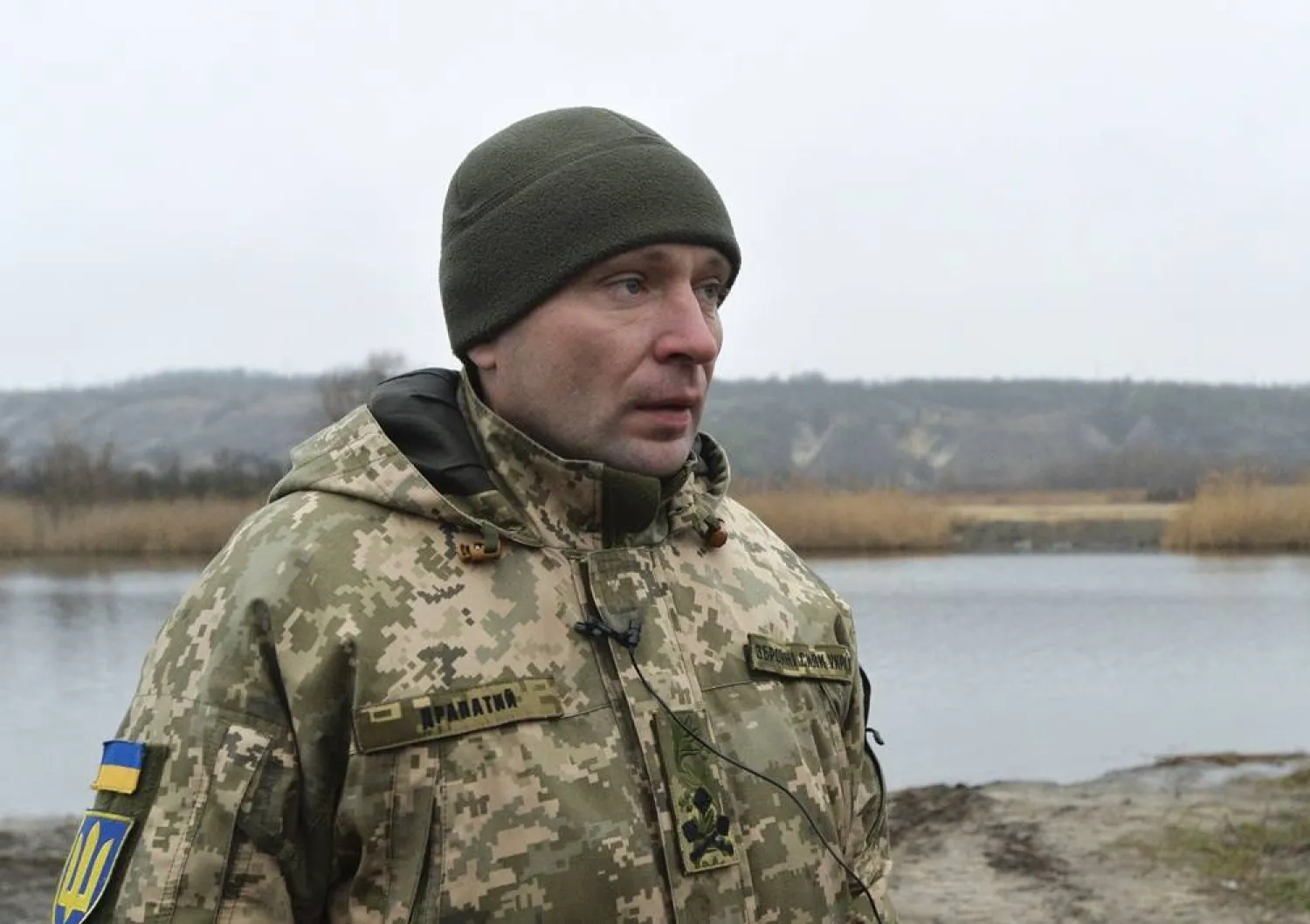

Ukraine Overhauls Its Military Top Brass for the Fight Against Russia

Deputy Commander of the Joint Forces, Brigadier General Mykhailo Drapatyi, attends a military training in the Luhansk area, Ukraine, 14 December 2021. (EPA)
TT

Ukraine Overhauls Its Military Top Brass for the Fight Against Russia

Deputy Commander of the Joint Forces, Brigadier General Mykhailo Drapatyi, attends a military training in the Luhansk area, Ukraine, 14 December 2021. (EPA)

Ukraine pushed on with its fight against Russia’s invasion under new military leadership Wednesday, after President Volodymyr Zelenskyy bowed to public pressure and fired his commander-in-chief.

Ukraine has made significant progress in the war this year, and a rift between the country’s outgoing army chief and its defense minister threatened to derail its efforts. Both men lost their jobs following Zelenskyy’s major government reshuffle last week.

The top-level changes late Tuesday were intended to draw a line under an unwelcome spasm of political turmoil that lasted almost a week and prompted rejoicing in Russia.

The new army chief, 43-year-old Maj. Gen. Mykhailo Drapatyi, belongs to a new generation of Ukrainian generals who have come up through the ranks during the battle against Russian aggression. He became known for his daring and courage in 2014, the year that Russia seized and illegally annexed Ukraine's Crimean Peninsula — eight years before Moscow's all-out invasion.

Zelenskyy said Drapatyi and other commanders must present an updated defense strategy, including continued reform of the corps system, faster weapon and drone deliveries, stronger air defense against Russian strikes, and a clearer mobilization plan.

Zelenskyy met separately Tuesday with outgoing defense minister Mykhailo Fedorov, a 35-year-old tech-savvy entrepreneur credited with swiftly developing Ukraine’s drone technology that has given it a battlefield edge.

Fedorov locked horns with outgoing commander-in-chief Gen. Oleksandr Syrskyi, a 60-year-old veteran trained in the Soviet Union before Ukraine’s independence.

Street protests in Kyiv and other cities demanded Fedorov’s return, viewing him as a key military modernizer, and urged Zelenskyy to fire Syrskyi, regarded as part of the old guard.

Zelenskyy offered Fedorov what he called a respected position in the government that would unify the country’s technology sector. It wasn’t clear if Fedorov accepted the offer -- or whether the latest moves would satisfy protesters and calm the streets.

Fedorov supported Drapatyi's appointment, calling it a “new hope in the fight of free people for freedom and justice” and “a voice for change that could not go unheard.”

Fedorov had criticized Syrskyi publicly before his dismissal, saying the general was blocking his reform efforts and needed to be replaced for Ukraine not to fail in its resistance against Russia.

But Syrskyi defended his wartime record in a statement Wednesday.

Among other things, he claimed Ukrainian forces had clawed back 743 square kilometers (287 square miles) of Russian-occupied Ukrainian territory this year and said he was handing his successor an army that was not only defending but also conducting offensive operations.

It was not possible to independently verify his claim.

Fedorov called Syrskyi to thank him for his military triumphs, including defending the Kyiv region at the time of Russia's February 2022 full-scale invasion, the Kharkiv counteroffensive operation later that year and other battles, calling them “already an important part of Ukraine’s history.” But he added that the country must “move even faster and write new chapters, correcting all previous mistakes.”

The political crisis began last Thursday, when Zelenskyy overhauled his wartime government, replacing his prime minister and firing Fedorov after just six months in the post.

The reshuffle immediately drew thousands of protesters into the streets of Kyiv and other cities, framing Fedorov’s removal as Zelenskyy siding with an entrenched military old guard over a reformer.

Meanwhile, Ukrainian drones overnight struck two more sprawling warehouses of Russia’s major online retailer, Wildberries, in Russia’s southern regions of Krasnodar and Stavropol, Wildberries founder Tatyana Kim and Russian officials said Wednesday.

The strikes came four days after Ukraine’s long-range drones hit massive Wildberries warehouses in the Moscow region and in the Tambov region, killing eight people and wounding dozens, according to officials.

Zelenskyy said Saturday said that the facilities were used by Russia to supply sanctioned components for the production of drones and navigation equipment.



Death Toll from Russian Bus Strike in Eastern Ukraine Jumps to 30

Police officers look at the damages following a Russian drone strike on the Northern Bridge in Kyiv on October 4, 2026, amid the Russian invasion of Ukraine. (Photo by Mykola TYMCHENKO / AFP)
TT

Death Toll from Russian Bus Strike in Eastern Ukraine Jumps to 30

Police officers look at the damages following a Russian drone strike on the Northern Bridge in Kyiv on October 4, 2026, amid the Russian invasion of Ukraine. (Photo by Mykola TYMCHENKO / AFP)

Thirty people were killed on Thursday when Russia struck two passenger buses in Kramatorsk, near the frontline in eastern Ukraine, local authorities said.

"As of now, the death toll from this morning's attack on buses has risen to 30. Eighteen people were wounded," the Donetsk regional prosecutor's office said. The governor's office gave the same toll and said public transport had been suspended.

Ukraine's national police said Russia had hit the buses with a glide bomb.

Kramatorsk is one of the key cities that Russia has not yet captured in the eastern Donetsk region, which Moscow claims as its own.

It has been a logistics and supply hub for the Ukrainian military for much of the war and is part of the so-called "fortress belt" which troops are fighting to keep hold of.

Russian forces have edged close to the city's eastern edge, which has prompted calls for civilians who remain to relocate to safer regions of Ukraine.

Thursday's strike, which happened at 10:00 am (0700 GMT), came a day after a Russian missile hit an apartment block in the northern region of Chernigiv, killing 22, including five children.

Kramatorsk City Council said it was "yet another horrific crime committed by the Russian army against the civilian population".

"Once again, the Russians have struck a location where there are absolutely no military targets," it added.


Police Fire Tear Gas at a Barricaded High School in Paris as School Protests Show No Sign of Ending

Protesters shout slogans and hold placards in a street during a blockade of Sciences Po university in Paris as part of nationwide student protests demanding better school conditions, France, October 7, 2026.  REUTERS/Sarah Meyssonnier
Protesters shout slogans and hold placards in a street during a blockade of Sciences Po university in Paris as part of nationwide student protests demanding better school conditions, France, October 7, 2026. REUTERS/Sarah Meyssonnier
TT

Police Fire Tear Gas at a Barricaded High School in Paris as School Protests Show No Sign of Ending

Protesters shout slogans and hold placards in a street during a blockade of Sciences Po university in Paris as part of nationwide student protests demanding better school conditions, France, October 7, 2026.  REUTERS/Sarah Meyssonnier
Protesters shout slogans and hold placards in a street during a blockade of Sciences Po university in Paris as part of nationwide student protests demanding better school conditions, France, October 7, 2026. REUTERS/Sarah Meyssonnier

Dozens of students dragged rubbish bins into position outside a high school in northeastern Paris early on Thursday, erecting fresh barricades before police moved in with tear gas as France’s nationwide protests show few signs of ending.

The Helene Boucher Lycee has been a flashpoint for clashes in the French capital, and is one of hundreds of schools disrupted by protesters Thursday.

At least a dozen demonstrations in support of the high school students' movement are planned around France later in the day.

Riot police gathered in side streets as students converged on the school. Many protesters wore surgical masks or hoodies, apparently afraid to be recognized.

Police have made more than 6,600 arrests since late September, when students, most of them under 18, started protesting to demand more education funding, according to the Interior Ministry. The Education Ministry said that 375 schools were either fully or partially closed on Thursday.

Pressure mounts on an embattled administration

While the number of school closures was down compared to Tuesday, pressure is mounting on the government of outgoing President Emmanuel Macron.

The protests against the under-funding of schools — many of them struggling with dilapidated facilities and insufficient staff — have drawn troublemakers not concerned about the aims of the protest movement as well as unions and political groups.

In a TV address, Prime Minister Sebastien Lecornu lamented the “violence, students and staff being attacked, police officers and gendarmes injured, schools set on fire or vandalized, thousands of hours of classes lost, not to mention threats and insults.”

He took aim at “political leaders who use this anger to conduct their electoral battles." France goes to the polls for a presidential election in April. “We cannot play with the safety of France’s youth,” Lecornu said.

At the Lycee, 18-year-old university student Emma Khelil came to offer support to those at the barricades at her former high school. She told The Associated Press that she’s really concerned about police violence.

“We’re here to defend our rights, not to lose an eye or a hand,” Khelil said. She also said that she had noticed insulation problems and water leaks in the school building and had even seen rats on occasion. Other students confirmed that they’d seen rats too.

She was not convinced by Lecornu’s efforts to calm the situation.

“I don’t think the movement is going to lose momentum. As long as things don’t change, we’re going to see the movement grow stronger, and potentially a convergence of struggles, especially with the next presidential election coming up,” she said.

Not long after she spoke, police surrounded a nearby square. The crowd surged, and tear gas was fired.

The protest movement crosses borders

The impact of France's protests is also being felt north of the border, in Belgium.

Liege Mayor Willy Demeyer issued a ban on public gatherings until midnight on Oct. 16, given what he described as the “real, serious and imminent risk” of repeated clashes and vandalism that authorities expected in coming days.

City police said they used water cannon and tear gas on Wednesday to keep several hundred protesters at bay. Authorities sent emergency mobile text messages warning shopkeepers to close their premises due to rioting.

Almost 90 people were arrested and several police were injured. Police reinforcements were sent from the capital Brussels and from Antwerp, and more are coming. Smaller protests have been held in Mons and Charleroi.

In a post on social media, Belgium’s Interior Minister Bernard Quintin said the “perpetrators will have to answer for their actions before the courts.”

The Belgian protests, organized through social media chat groups, include demands for more teachers and smaller classes as well as complaints about education reform in Belgium, but are also likely inspired by events in France.


A Partial Building Collapse in Istanbul Kills 2 and Traps at Least 2 More

Firefighters and rescue team members work next to a partially collapsed seven story building in Istanbul, Thursday, Oct. 8, 2026. (Abdullah Tepeli/DIA Photo via AP)
TT

A Partial Building Collapse in Istanbul Kills 2 and Traps at Least 2 More

Firefighters and rescue team members work next to a partially collapsed seven story building in Istanbul, Thursday, Oct. 8, 2026. (Abdullah Tepeli/DIA Photo via AP)

A seven-story building in Istanbul partially collapsed on Thursday, killing two people, officials said. Emergency crews were trying to reach at least two people that remained trapped inside.

The reason for the collapse was not immediately known and an investigation was underway. Rescue teams were working to reach those trapped even as there were warnings of a further collapse of the building, The Associated Press said.

The building’s three lower floors, including a ground-floor shop, caved in before dawn in the district of Maltepe, on the Asian side of Istanbul, a city that is bisected by the Bosporus Strait.

Residents from the upper floors were safely evacuated while search teams rescued eight more people from the rubble. The rescuers recovered two bodies and were trying to reach two people still believed to be inside, according to the Istanbul governor's office.

Earlier, Davut Gul, the governor of Istanbul, said rescuers had made contact with a 6-year-old trapped in the rubble. It was not immediately clear if the child was among those rescued.

He warned that the building was at risk of further collapse, hampering the rescue efforts. Nearby buildings were also evacuated for safety, the governor said.

Istanbul and other parts of Türkiye are undergoing an urban transformation program that aims to replace old and earthquake-risky buildings with safer housing.