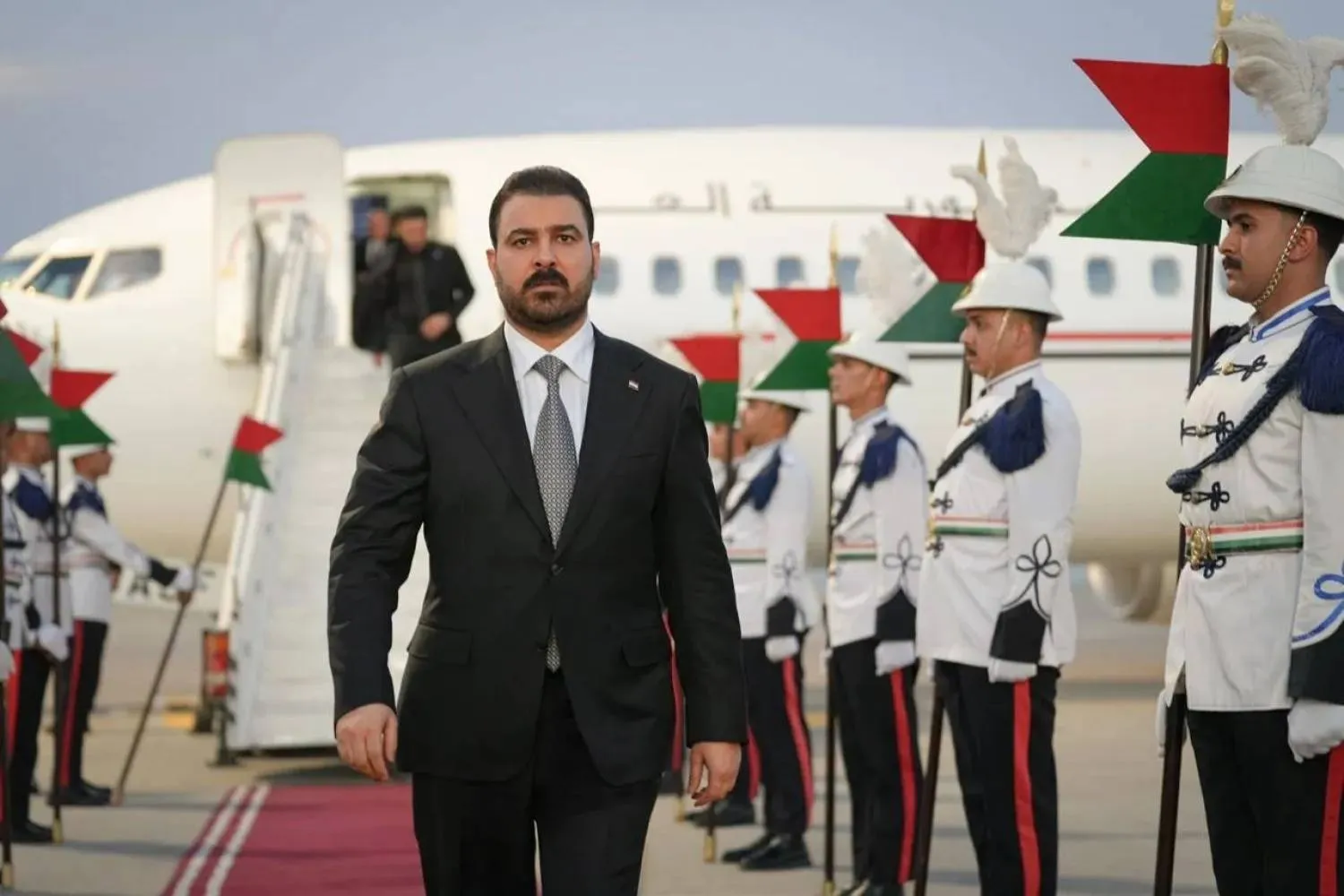
Iraq Rejects Discussing State Control of Weapons in 'Other Capitals'

 Iraqi Prime Minister Ali al-Zaidi (Prime Minister’s Media Office)
Iraqi Prime Minister Ali al-Zaidi (Prime Minister’s Media Office)
TT

Iraq Rejects Discussing State Control of Weapons in 'Other Capitals'

 Iraqi Prime Minister Ali al-Zaidi (Prime Minister’s Media Office)
Iraqi Prime Minister Ali al-Zaidi (Prime Minister’s Media Office)

Iraqi Prime Minister Ali al-Zaidi will travel to Tehran on Thursday at the head of a senior government delegation for talks with top Iranian officials on energy, trade, transportation and agriculture.

The Iraqi government said the issue of bringing all weapons under state control would not be on the agenda, calling it “an Iraqi sovereign matter.”

The visit comes less than a week after al-Zaidi traveled to the United States, as Baghdad steps up diplomacy with regional and international partners while trying to balance its ties with Washington and Tehran amid mounting regional tensions.

Government spokesperson Haider al-Aboudi said on Wednesday that the visit followed an official invitation from the Iranian president and that al-Zaidi would be accompanied by a senior delegation.

Talks will cover energy, trade, transportation and agriculture, he said, adding that gas would also be discussed “in line with Iraq’s interests.”

Al-Aboudi did not mention any security or military issues on the agenda. Instead, he said, “bringing weapons under state control is an Iraqi sovereign matter that is not discussed in other capitals.”

He described the issue as “a national decision” and a priority in al-Zaidi’s government program.

Local reports had cited informed sources as saying al-Zaidi might ask Iran to pressure armed factions to hand over missiles and drones and close what the government calls the file of “uncontrolled weapons” before a Baghdad deadline at the end of September.

But the government’s comments on Wednesday ruled out discussing the issue with Iranian officials.

Al-Aboudi said bringing weapons under state control remained an internal Iraqi matter and would not be discussed with any country.

The issue has been one of al-Zaidi’s main pledges since his government took office. Baghdad says all weapons must come under the authority of the state and its official institutions, while the matter should be handled through legal channels and dialogue to preserve domestic stability.

Experts voice doubts

Observers remain skeptical that the government can bring the factions’ weapons under its control.

Researcher Saif al-Saadi told Asharq Al-Awsat that some factions had agreed to the move as “a temporary tactic to avoid confrontation with the US administration.”

“Bringing weapons under state control cannot be achieved through an announcement by one faction or another,” he said.

“It requires taking control of the weapons, cataloging them and then restructuring the brigades and regiments so they do not remain a single unified body.”

Academic Abbas Abboud told Asharq Al-Awsat that it was difficult to foresee armed clashes between the state and the factions over the dismantling of their weapons networks.

He said the government would continue to rely on “dialogue as a possible means of bringing weapons under state control.”

In a related development, al-Aboudi said Iraq was carrying a diplomatic initiative in its foreign engagements to address rapidly unfolding regional developments as the war between the United States and Iran widens again.

Al-Zaidi said in an interview with The Atlantic that he had proposed to US President Donald Trump that he delay retaliation against Iran over the killing of US soldiers in Iraq and Jordan.

Baghdad has sought in recent months to keep Iraq out of regional conflicts by drawing on its ties with rival powers.

The government says Iraq’s stability depends on easing regional tensions, preventing the country from becoming an arena for settling scores and pursuing negotiations as “the most appropriate way to address the dangerous consequences for the region and the world.”


Sudan’s Currency Tumbles to New Low as War Hammers Economy

People stand at a market in Omdurman, Sudan, September, 19, 2026. (Reuters)
TT

Sudan’s Currency Tumbles to New Low as War Hammers Economy

People stand at a market in Omdurman, Sudan, September, 19, 2026. (Reuters)

Sudan's currency ‌hit a new low of 10,000 Sudanese pounds to the dollar on Wednesday in parallel market trading, continuing a dramatic fall over recent months as wartime conditions take their toll on the economy.

The rapid 60% depreciation has heaped hardship on Sudanese still trying to regain their footing after devastating conflict and ‌forced displacement caused ‌by the war between ‌Sudanese ⁠armed forces and the ⁠paramilitary Rapid Support Forces, putting basic food items out of reach.

Sudan's official exchange rate remains stuck at 4,200 SDG to the dollar, a rate last seen on the parallel market ⁠in army-controlled areas in May.

A large ‌portion of ‌that fall has happened over the past month, ‌as the pound fell from a ‌previous low of 8,000, depreciating 20%. Prior to the start of the war in April 2023, the rate was about 600 ‌pounds to the dollar.

Currency traders cited import demands as a ⁠chief ⁠factor as the government increased the tightly controlled customs dollar, used to calculate duties, to more than 5,600 this week.

As the war continues Sudan has decreased production of key dollar earners while its chief export, gold, has increasingly been smuggled abroad. Meanwhile, the army-controlled government has said the war and reconstruction efforts require dollar-draining imports.


France Says to Hold Conference for Lebanese Forces after Israeli Elections

French President Emmanuel Macron gestures as he speaks to members of the media on the day of the 9th Annual One Planet Sovereign Wealth Funds (OPSWF) Summit, in Lusail, Qatar, 21 October 2026.  EPA/BENOIT TESSIER
French President Emmanuel Macron gestures as he speaks to members of the media on the day of the 9th Annual One Planet Sovereign Wealth Funds (OPSWF) Summit, in Lusail, Qatar, 21 October 2026. EPA/BENOIT TESSIER
TT

France Says to Hold Conference for Lebanese Forces after Israeli Elections

French President Emmanuel Macron gestures as he speaks to members of the media on the day of the 9th Annual One Planet Sovereign Wealth Funds (OPSWF) Summit, in Lusail, Qatar, 21 October 2026.  EPA/BENOIT TESSIER
French President Emmanuel Macron gestures as he speaks to members of the media on the day of the 9th Annual One Planet Sovereign Wealth Funds (OPSWF) Summit, in Lusail, Qatar, 21 October 2026. EPA/BENOIT TESSIER

French President Emmanuel Macron said on Wednesday that this country will organise a conference to support the Lebanese armed forces after the Israeli elections this month, as truce talks between the two sides stall.

"We will also coordinate to carry out this work of support for the Lebanese armed forces and a conference will be set up in the coming weeks by France... I think it is useless to do it before the Israeli elections, but we will organise such a conference because it is unavoidable," he told reporters in Qatar.

Israel goes to the polls on October 27.

Lebanese authorities last year committed to disarming Hezbollah after months of cross-border hostilities culminated in a 2024 war between the group and Israel.

But Hezbollah drew Lebanon into the Middle East war this year by attacking Israel, which responded with heavy strikes and a ground invasion.

In June, Lebanese and Israeli authorities signed a framework agreement which involves the disarmament of Hezbollah, a gradual Israeli withdrawal from territories it occupies, and the deployment of the Lebanese army to the area.

Hezbollah has rejected surrendering its weapons and the direct negotiations with Israel.


Syria: Israeli Forces Shell Quneitra Countryside

An Israeli military vehicle is seen near the border between the Israeli-occupied Golan Heights and Syria, May 4, 2025. REUTERS/Shir Torem/File Photo
TT

Syria: Israeli Forces Shell Quneitra Countryside

An Israeli military vehicle is seen near the border between the Israeli-occupied Golan Heights and Syria, May 4, 2025. REUTERS/Shir Torem/File Photo

Israeli forces fired several artillery shells on Wednesday at the area around eastern Tell al-Ahmar in the southern Quneitra countryside in southern Syria.

The Syrian Arab News Agency (SANA) said that “occupation forces fired two projectiles that landed on agricultural land around eastern Tell al-Ahmar, causing no injuries".

Israel continues to violate the 1974 Disengagement Agreement through repeated incursions into southern Syria, raids on and arrests of civilians, land bulldozing and shelling, among other attacks, the agency said.

Syria has repeatedly called for Israeli forces to withdraw from its territory, stressing that all measures taken by Israel are null and void and have no legal effect under international law. Damascus has also urged the international community to fulfil its responsibilities and compel Israel to withdraw fully from southern Syria.