

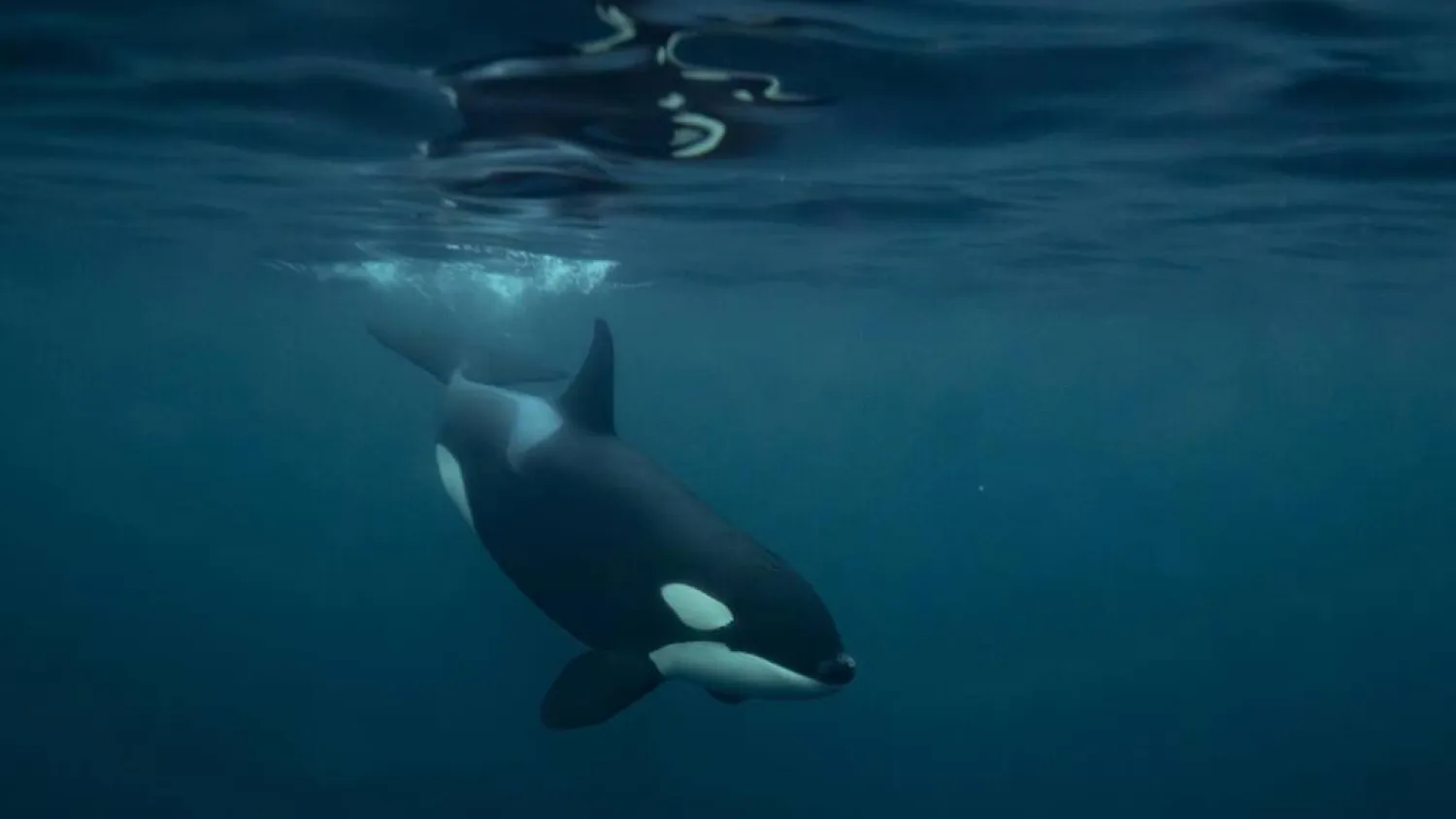

Killer Whales: Orcas Blow Fish to Bits 'for Fun', Study Finds

Killer whales are highly intelligent apex predators and have been known to play with their prey and deploy sophisticated tactics to ensnare them. Olivier MORIN / AFP/File
TT

Killer Whales: Orcas Blow Fish to Bits 'for Fun', Study Finds

Killer whales are highly intelligent apex predators and have been known to play with their prey and deploy sophisticated tactics to ensnare them. Olivier MORIN / AFP/File

A group of killer whales have been documented blowing a sunfish to bits in an unusual underwater escapade offering never-before-seen insights into orca behavior, according to research released Thursday.

Video released by the US-based NGO Beneath

The Waves shows one orca holding the tail of a sunfish, with its fellow whale then charging with full force into the rotund mola, which explodes into pieces.

The sunfish is already dead -- this isn't an elaborate murder ritual.

Instead, it might be an attempt to turn the fish into smaller bite-sized chunks, researcher Kathryn Ayres said.

"Or it could also just be for fun. Orcas are known for playing with their food," she explained.

"Orcas often tear apart prey and share it with other members of the group, including calves and juveniles."

The antics were documented on two occasions in 2024 and 2025 off the Gulf of California, according to the research published in the peer-reviewed Frontiers in Ethology.

Mark Peter Simmonds, director of science at OceanCare, likened it to "human formal meals where socializing as well as nutrition are in play".

"Perhaps it is similar to the time when the lead human at a formal meal would carve up the roast," he told AFP.

Killer whales are highly intelligent apex predators and have been known to play with their prey and deploy sophisticated tactics to ensnare them.

They have been documented engaging in "wave washing" -- cooperating to create choppy waters that knock seals off sheets of ice so they can be more easily captured and eaten.

They have also been seen wearing dead salmon as hats for reasons that remain a mystery.

And they use tools -- research last year showed a critically endangered population of orcas in the Salish Sea breaking off pieces of seaweed to rub and groom each other.

"It just really shows us how intelligent orca are," Rebecca Wellard, a scientist at Western Australia's Curtin University who was not involved in the research, told AFP.

"I think I hope that gives people more respect for complex creatures that are great predators in their environment."

The hapless sunfish can weigh up to 2,000 kilograms and is distinct for both its size and peculiar shape featuring a flattened body and fins.

They don't commonly explode, the research points out.

"They're a heavy, bony fish, so it must be some severe ramming," Wellard said.


Avalanche Hits Glacier on China's Muztagh Ata in Xinjiang

People walk through a flood-affected area in Devighat, Nuwakot district, Nepal, 05 September 2026. EPA/NARENDRA SHRSTHA
TT

Avalanche Hits Glacier on China's Muztagh Ata in Xinjiang

People walk through a flood-affected area in Devighat, Nuwakot district, Nepal, 05 September 2026. EPA/NARENDRA SHRSTHA

An avalanche struck Glacier No. 2 on Muztagh Ata, near China's border with Tajikistan in the northwestern Xinjiang region, with several tourists capturing footage on their phones, state broadcaster CCTV reported on Sunday.

Video showed a massive wall of snow and ice ⁠cascading down the mountainside, ⁠forming a snow cloud more than 100 meters (328 feet) wide, the broadcaster said.

There were no casualties or property damage ⁠because the avalanche took place in an unpopulated area far from major roads, CCTV reported, according to Reuters.

The main peak of Muztagh Ata, covered by ice and glaciers, is 7,546 meters high. Glacier No. 2 is closed to the public because ⁠of ⁠heightened risks of glacial activity.

The local culture and tourism bureau on Saturday warned tourists not to enter unauthorized high-risk restricted zones on Muztagh Ata, citing complex terrain, volatile weather, weak communication signals and extremely poor rescue conditions.


Indonesia Cancels Flights at Jakarta Airport, Others as Anak Krakatau Volcano Erupts

In this drone photo released by the Geological Agency (Badan Geologi) of Indonesia's Ministry of Energy and Mineral Resources, Mount Anak Krakatau spews volcanic smoke in Sunda Strait, Indonesia, Saturday, Sept. 5, 2026. (Badan Geologi via AP)
TT

Indonesia Cancels Flights at Jakarta Airport, Others as Anak Krakatau Volcano Erupts

In this drone photo released by the Geological Agency (Badan Geologi) of Indonesia's Ministry of Energy and Mineral Resources, Mount Anak Krakatau spews volcanic smoke in Sunda Strait, Indonesia, Saturday, Sept. 5, 2026. (Badan Geologi via AP)

Indonesia’s Anak Krakatau volcano erupted early Sunday, prompting the cancellation of all flights at Jakarta’s Soekarno-Hatta International Airport and disrupting other domestic airports as volcanic ash drifted across parts of western Indonesia.

Indonesia’s Geological Agency said the volcanic island located in Indonesia’s Sunda Strait between the main Java and Sumatra islands had showed signs of activity since Friday before erupting for 30 seconds at 3:53 a.m. Sunday. Closed-circuit camera footage showed lava flares from the volcano.

No casualties were reported and no evacuation order was issued, The Associated Press reported. The nearest settlement is more than 16 kilometers (10 miles) away, but authorities warned residents and visitors to stay at least 3 kilometers (2 miles) from the active crater.

Volcanic ash spread across parts of Jakarta and Lampung province on Sumatra’s southern tip, Indonesia’s Center for Volcanology and Geological Hazard Mitigation said.

AirNav Indonesia closed airspace around Soekarno-Hatta and Halim Perdanakusuma airports in Jakarta, as well as four other airports, including Radin Inten II Airport in Lampung, because of volcanic ash.

Thousands of passengers affected By mid-afternoon, the closure had affected 516 flight movements, with 202 in Jakarta’s Soekarno-Hatta airport alone that affected about 22,800 passengers, on Sunday. The airport was ordered closed until at least 5:30 p.m.

Indonesia’s Directorate General of Civil Aviation said it was closely monitoring the eruption's impact on air travel and coordinating with airlines, airport operators, air navigation services and the meteorology agency.

“Safety remains our top priority in every operational decision,” Lukman F. Laisa, Ministry of Transportation director general of civil aviation, said in a statement.

He warned flight schedules could face cascading disruptions affecting aircraft rotations, fleet availability and terminal capacity as airlines work to restore operations.

The eruption also disrupted services at Bali’s I Gusti Ngurah Rai International Airport and at Medan.

Volcano remains active Indonesia’s volcanology agency and the Darwin Volcanic Ash Advisory Centre identified two ash clouds using satellite imagery. One plume rose to 20,000 feet (6,100 meters) and drifted northeast over Jakarta, Banten, West Java and nearby waters. A second cloud reached 50,000 feet (15,200 meters) and spread over parts of Banten, Lampung and Bengkulu provinces, the southern Sunda Strait and sections of the Indian Ocean west of Sumatra.

Lana Saria, head of Indonesia’s Geological Agency, said activity at Anak Krakatau has intensified since July, with Sunday’s eruption the strongest during the current period of unrest.

The repeated eruptions indicate a continued supply of magma and volcanic gases beneath the volcano, she said, though officials cannot predict whether a larger eruption will occur.

“We continue to evaluate the volcano’s development based on all monitoring data, not solely on the number of eruptions or the height of the ash column,” Saria said in a video briefing.

She said the main hazards include volcanic ash, high concentrations of gas and the ejection of hot rocks and other material around the crater area.


Prince Hisahito Turns 20 as Japan's Government Reinforces Male-only Succession Rules

In this handout photo taken by the Imperial Household Agency of Japan on August 13, 2026 and released on September 6, 2026, Japan's Prince Hisahito (R) visits the Science Museum of Map and Survey in Tsukuba, Ibaraki Prefecture, northeast of Tokyo, ahead of his 20th birthday. (Photo by Handout / Imperial Household Agency of Japan / AFP)
TT

Prince Hisahito Turns 20 as Japan's Government Reinforces Male-only Succession Rules

In this handout photo taken by the Imperial Household Agency of Japan on August 13, 2026 and released on September 6, 2026, Japan's Prince Hisahito (R) visits the Science Museum of Map and Survey in Tsukuba, Ibaraki Prefecture, northeast of Tokyo, ahead of his 20th birthday. (Photo by Handout / Imperial Household Agency of Japan / AFP)

Prince Hisahito turned 20 on Sunday as he faces growing attention as a future monarch in Japan following the government's unpopular revision to the Imperial House Law that reinforces male-only succession rules.

Hisahito, the nephew of Emperor Naruhito, is second in line to Japan's 1,500-year-old Chrysanthemum Throne and the youngest of 16 members of the rapidly shrinking and aging imperial family.

The child who loved animals and bugs, especially dragonflies, is now a sophomore majoring in biology at the University of Tsukuba near Tokyo. He has been often spotted on campus with friends, sometimes carrying a bug-catching net or on his bicycle.

While he mostly concentrates on his studies, Hisahito started taking on some official duties. He attended a palace banquet for Philippine President Ferdinand Marcos Jr. in May, prayed for the atomic bombing victims in Hiroshima and joined a teenagers' camp in the southwestern Japanese city in August.

Hisahito is often compared to his hugely popular cousin, 24-year-old Princess Aiko, who has impressed everyone with her ability to interact with people and make them smile. She is the emperor's daughter and most Japanese want her to be his successor, even though as a woman she is ineligible.

The revised succession law enacted by Japan's Parliament in July lifts a ban on the adoption of male offspring from extremely distant former royal families. It lets female royals keep their status after marrying a commoner, so they can continue to undertake official duties, but their future partners and offspring won't be royals.

The revisions to the 19th-century law have been criticized as anachronistic and sexist and led to protests from Japanese who see the changes, which were backed by conservative Prime Minister Sanae Takaichi, as an attempt to eliminate Aiko from ruling while justifying discrimination against women and a patriarchal system.

According to The Associated Press, experts say the measures will put Hisahito and his eventual wife under enormous pressure to bear a male child as they determine the future of the imperial family.

Asked about his future and marriage plans at his debut news conference last year, Hisahito said his main focus was to study and expressed hopes to spend some time overseas to gain new perspectives and meet people from different backgrounds and cultures.

“About marriage, I haven't thought about an ideal timing or a partner yet,” he said.
